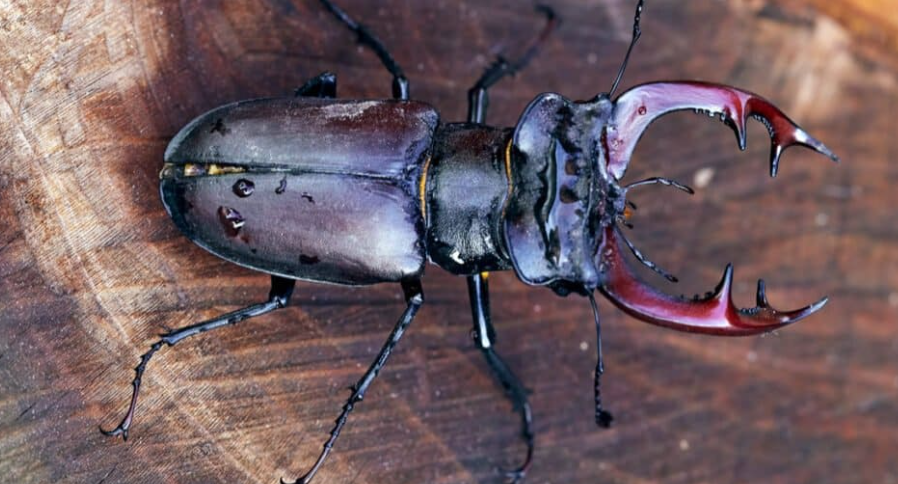
Among the most visually dramatic insects on Earth are the pincer-bearing beetles — species whose mandibles have evolved far beyond their original function of chewing food into elaborate weapons, signals, and tools used in combat, courtship, and defense. Pincer-like mandibles are found across several beetle families, most notably the stag beetles of the family Lucanidae, the ground beetles of Carabidae, the longhorn beetles of Cerambycidae, and the earwig-like rove beetles of Staphylinidae. Worldwide, the family Lucanidae alone contains over 1,200 described species, the majority of which display some degree of mandible enlargement in males — making it one of the richest families for sexually selected weaponry in the entire insect world.
The evolution of enlarged mandibles in beetles is one of the most studied examples of sexual selection in the animal kingdom. In most pincer-bearing species, the enlarged mandibles are found exclusively or predominantly in males and have been shaped by generations of male-on-male combat for access to females or prime breeding sites — a process Darwin identified as sexual selection over 150 years ago. The relationship between body size and mandible size is often non-linear and exaggerated — meaning that as males grow larger, their mandibles grow disproportionately faster than the rest of the body, a phenomenon called positive allometry that produces the most extravagant pincers in the largest individuals. In some species, this scaling relationship is so steep that the mandibles of the largest males can exceed the length of the entire body.
Despite their spectacular appearance, beetles with pincers face significant conservation pressures worldwide. Many of the largest and most impressive pincer-bearing species — particularly the great stag beetles of Europe, North America, and East Asia — depend on dead and decaying wood for their larval development, a habitat that has become increasingly scarce as forests are managed, tidied, and cleared of fallen timber. The stag beetle Lucanus cervus is legally protected across much of Europe, and several Southeast Asian and South American species face pressure from the international collector trade, where large males with exceptional mandibles can command prices of hundreds of dollars. Habitat loss, deforestation, and the collection trade together make pincer beetles among the most conservation-sensitive groups within the order Coleoptera.
Also Read: Different Types of Beetles
Notable Pincer-Bearing Beetles
1. Stag Beetle (Lucanus cervus)
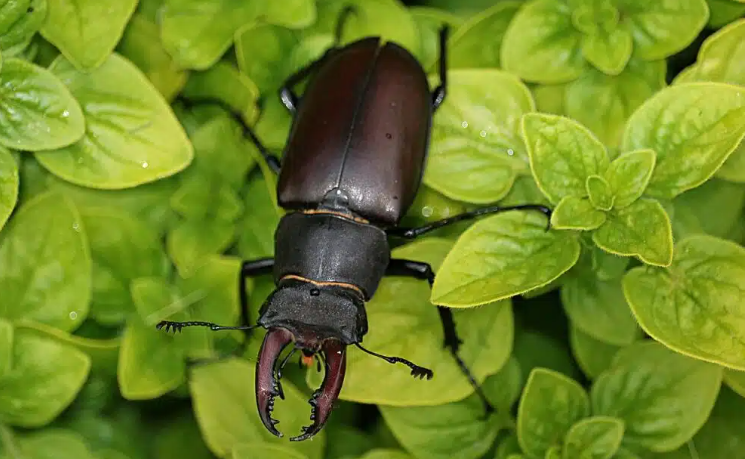
The stag beetle is the most celebrated pincer-bearing beetle in the world, with males sporting enormous, reddish-brown mandibles that can reach up to half the total body length and bear irregular tooth-like projections resembling the antlers of a stag deer. Found across Europe and parts of western Asia, males use these spectacular pincers in ritualized wrestling contests on tree trunks and branches — attempting to grip a rival, lift him bodily, and throw him to the ground to win access to females and prime sap-feeding sites. The larvae spend three to seven years developing within decaying oak stumps and logs, and the removal of dead wood from gardens and managed woodland has caused dramatic population declines across northern and western Europe, where the species is now legally protected.
2. Giant Stag Beetle (Lucanus elaphus)
The giant stag beetle of the southeastern United States is the largest stag beetle in North America, with males bearing branched, elk-antler-like mandibles that can extend nearly as long as the body itself — structures of extraordinary complexity for a beetle mandible. Males engage in extended grappling matches on oak and hickory trunks on warm summer nights, using their pincers to attempt to lever rivals off the bark and send them tumbling to the ground. The larvae develop for two to four years within the decaying roots and stumps of hardwood trees, particularly oaks, making the retention of old stumps and dead root systems in woodland management critical to the species’ survival.
3. Dorcus Stag Beetle (Dorcus titanus)
Dorcus titanus, the giant Dorcus or great toothed stag beetle, is the largest stag beetle in Asia and one of the most sought-after beetles among collectors worldwide, with males from certain island populations in Indonesia and the Philippines displaying massively developed, toothed mandibles that can span nearly the entire body length. Unlike many stag beetles whose pincers are smooth and curved, the mandibles of Dorcus titanus are heavily toothed along their inner edges, giving them both a more fearsome appearance and greater gripping power during male combat. The species is extraordinarily variable across its wide range — spanning from northern India through Southeast Asia to Japan — with dozens of subspecies described, each adapted to the forest conditions of its particular island or region.
4. Rainbow Stag Beetle (Phalacrognathus muelleri)
The rainbow stag beetle of Queensland, Australia and Papua New Guinea is widely regarded as one of the most beautiful beetles in the world, combining spectacular pincer development in males with an iridescent, multi-colored sheen across the elytra and pronotum that shifts between green, gold, purple, and red depending on the angle of light. Males use their moderately developed but sharply toothed mandibles in combat for feeding sites on rainforest trees, where sap flows attract both sexes on warm tropical nights. The species has become highly popular in the exotic pet and beetle-keeping hobby — particularly in Japan — where captive breeding has produced individuals of exceptional size whose mandibles are considerably longer than those typically found in wild populations.
5. Cyclommatus Stag Beetle (Cyclommatus metallifer)
Cyclommatus metallifer is a stunning Southeast Asian stag beetle whose large males bear extraordinarily long, slender, sickle-shaped mandibles that can exceed the entire body length — producing a total length that makes them among the longest beetles in the world relative to body size. The mandibles are smooth, deeply curved, and armed with small inward-pointing teeth near the tips, and are used in both gripping contests with rival males and in holding females during mating. Native to the islands of Sulawesi and surrounding Indonesian archipelago, the species inhabits primary tropical rainforest and is highly vulnerable to the logging and forest conversion that has dramatically reduced forest cover across Sulawesi in recent decades.
Also Read: Beetles That Glow At Night
6. Reddish-brown Stag Beetle (Pseudolucanus capreolus)
The reddish-brown stag beetle is the most widespread stag beetle in North America, found in deciduous forests from the eastern United States west to the Great Plains, where males display moderately enlarged, smooth reddish-brown mandibles used in competition for females at sap flows and decaying wood sites. While its mandibles are less dramatically developed than those of its giant relative Lucanus elaphus, the reddish-brown stag beetle is a far more commonly encountered species and is the stag beetle most likely to be found in suburban gardens and parks with old trees. Adults are nocturnal and are strongly attracted to lights on warm summer nights, making them one of the beetle species most frequently encountered by North Americans without specifically looking for insects.
7. Firefly Stag Beetle (Nigidius spp.)
Stag beetles of the genus Nigidius are a group of small, shiny black pincer-bearing beetles found across tropical Africa, Asia, and the Pacific islands, whose compact, powerful mandibles are proportionally shorter and more robust than those of the large display-fighting stag beetles but are used with considerable force in both male combat and defensive pinching. Unlike the large, tree-trunk-wrestling species, Nigidius beetles are primarily associated with rotting bamboo and small-diameter woody debris on the forest floor. Several species have been introduced accidentally to new regions through the international trade in bamboo products and are considered minor invasive pests of bamboo plantations in parts of Southeast Asia.
8. Pinching Bug (Lucanus placidus)
The smooth or placid stag beetle — colloquially known as the pinching bug across much of the eastern United States — is a medium-sized stag beetle whose males bear moderately enlarged, smooth mandibles capable of delivering a surprisingly firm and memorable pinch if the beetle is handled carelessly. Found in deciduous forest across the eastern half of North America, it is closely related to the giant stag beetle but is considerably smaller and more compact in build. Adults fly on warm summer nights and are attracted to porch lights and illuminated windows, where they are sometimes collected by curious homeowners unaware of the beetle’s identity or pinching capability.
9. Ox Beetle (Strategus aloeus)
The ox beetle is a large, robust rhinoceros beetle of the southern United States, Central America, and northern South America whose males bear three prominent horns on the pronotum — but whose powerful, curved mandibles also function as secondary grasping and prying tools during underground burrow disputes with rival males. Males use both their horns and their mandibles in subterranean combat over burrow systems containing females, wrestling and pushing rivals in confined underground spaces where flight and visual displays are impossible. The larvae develop in decaying wood and root matter in sandy soils, and adults are most active on warm summer nights, frequently appearing at lights across the Gulf Coast states.
10. Dobsonfly Larva Mimic Beetle (Cychrus caraboides)
The snail hunter ground beetle is a specialized predatory carabid of European woodlands whose head and mandibles are uniquely elongated and narrowed — forming a pincer-like beak perfectly shaped for reaching deep into the coiled shells of land snails and extracting the soft body within. While not a pincer in the fighting sense of stag beetles, the long, crossed mandibles of Cychrus are among the most functionally specialized beetle mouthparts on Earth, representing a remarkable evolutionary adaptation to a single, highly specific prey type. The beetle hunts by night in damp woodland, probing leaf litter and moss for hibernating snails, and its narrowed body profile allows it to pursue prey into crevices and under bark that wider-bodied predators cannot access.
11. Dung Beetle Pincer (Coprophanaeus lancifer)
Coprophanaeus lancifer is a large, spectacular South American dung beetle and carrion beetle whose males bear a prominent curved horn on the head and powerful, toothed mandibles used in combat with rivals over carcass and dung resources — a combination of horn and mandible weaponry unusual among scarab beetles. It is one of the largest dung beetles in the world, with some individuals reaching over 4 cm in length and displaying a striking metallic blue-green sheen across the pronotum and elytra. The species is notable for breeding in carrion as well as dung — an uncommon habit among scarabs — and plays an important role in the rapid burial and decomposition of small vertebrate carcasses in Amazonian forest ecosystems.
12. Longhorn Beetle (Macrodontia cervicornis)
The sabertooth longhorn beetle of South American rainforests is one of the longest beetles in the world, with large males reaching up to 17 cm in total length including the enormous, serrated mandibles that project forward from the head like a pair of curved sabers. The mandibles of Macrodontia cervicornis are not used in male combat in the manner of stag beetles but instead serve in gripping and manipulating woody material and — it is suspected — in holding females during mating, though the species’ behavior in the wild remains poorly documented. It is a highly prized species in the beetle-collecting world, and large males with exceptional mandibles command significant prices in the international insect trade.
13. Ground Beetle (Carabus coriaceus)
The great leather-back ground beetle is the largest ground beetle in Europe, a powerful, flightless predator whose large, curved, sharply pointed mandibles are formidable weapons used to capture, grip, and dismember earthworms, slugs, snails, and other invertebrates on the soil surface. When threatened by a predator or handled by a human, it can deliver a surprisingly sharp pinch with its mandibles and simultaneously ejects an acrid chemical spray from its abdomen — combining mechanical and chemical defenses with considerable effect. It inhabits old deciduous forest and well-structured garden soils across Europe, where it is a valuable but declining ally in natural pest control.
14. Violin Beetle (Mormolyce phyllodes)
The violin beetle of Southeast Asian rainforests is a highly flattened, extraordinarily shaped ground beetle whose long, narrow head bears slender but sharply pointed mandibles that function as effective piercing weapons against the soft-bodied beetle larvae, millipedes, and other invertebrates it hunts beneath shelf fungi on fallen logs. The extreme flattening of the body — including the head and mandibles — is an adaptation to life in the narrow crevices between layers of bracket fungi, where the beetle both shelters and hunts. When threatened, it rears the front of its body and opens its mandibles in a defensive display, and can deliver a precise, painful pinch if cornered.
15. Stag-like Cerambycid (Psalidognathus friendii)
Psalidognathus friendii is a spectacular longhorn beetle of the Andean cloud forests of South America whose males bear greatly enlarged, toothed mandibles that have earned it the nickname “stag longhorn” — a reference to the stag beetle-like development of its pincer-like mouthparts in a family not normally associated with mandible elaboration. The mandibles are used in male combat for access to females on host tree trunks, representing an independent evolution of fighting mandibles in the longhorn beetle family that parallels the much more widespread phenomenon in Lucanidae. Its iridescent, metallic green and blue coloration combined with its dramatic mandibles make it one of the most visually striking beetles in South America and a prized specimen in natural history collections.
Also Read: Beetles That Eat Wood
16. Siamese Stag Beetle (Hexarthrius parryi)
Hexarthrius parryi is a large and spectacular Asian stag beetle found in the forests of Thailand, Myanmar, and the Malay Peninsula, whose males bear long, gently curved mandibles armed with prominent upward-pointing inner teeth — a distinctive pincer structure that gives the species an appearance quite different from the branched antler-like mandibles of Lucanus stag beetles. Males use these toothed pincers in combat on tree trunks and branches, and the inner teeth provide additional gripping leverage during wrestling contests that can last several minutes before one male concedes and drops from the branch. The species is popular in the Asian beetle-keeping hobby, where captive-reared males with well-developed mandibles are maintained as display animals and sometimes used in staged beetle-fighting contests — a traditional pastime in parts of Thailand and Japan.