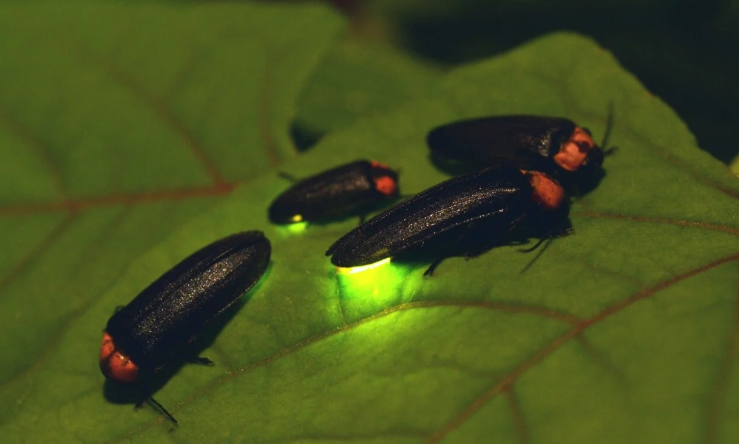
Bioluminescence — the ability to produce and emit living light — is one of the most captivating phenomena in the natural world, and among insects it is almost exclusively found within a single order: the beetles. The ability to generate cold light through a chemical reaction involving the enzyme luciferase acting on a substrate called luciferin has evolved independently at least three times within beetles alone. Globally, there are estimated to be over 2,000 species of light-producing beetles, the vast majority belonging to the firefly family Lampyridae, with additional glowing species found in the families Phengodidae and Elateridae.
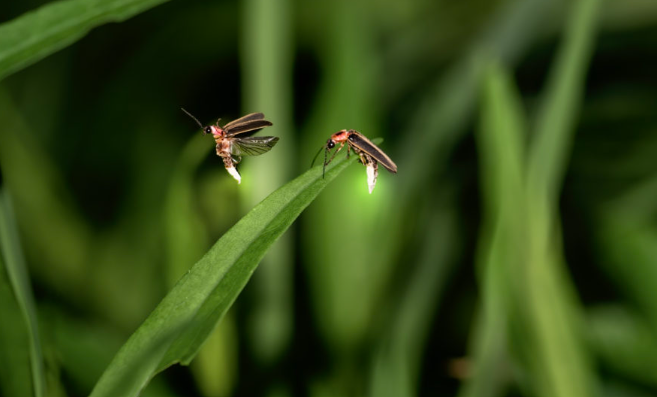
The light produced by glowing insects is extraordinarily efficient — nearly 100% of the energy released by the bioluminescent reaction is emitted as light, with virtually no heat produced, which is why it is described as cold light. By comparison, a standard incandescent light bulb converts only about 10% of its energy into visible light, losing the rest as heat. Each species of firefly produces a genetically encoded flash pattern — a specific combination of flash duration, interval, and flight path — that acts as a species-specific Morse code for mate recognition, with some tropical species producing flashes so precisely synchronized that thousands of individuals will light up entire riverbanks in perfect unison.
Glowing insects face growing threats worldwide, with firefly populations declining sharply across North America, Europe, and Asia due to light pollution, habitat loss, pesticide use, and climate change. A landmark global study published in 2020 identified light pollution as the single greatest threat to firefly populations, as artificial light at night disrupts the flash communication that fireflies depend on for finding mates. Some species, such as the synchronous firefly of the Great Smoky Mountains and the blue ghost firefly of the Appalachian forests, have become ecotourism attractions drawing tens of thousands of visitors annually — a growing recognition of their cultural and ecological value.
Also Read: Scorpions That Glow At Night
Insects that Glow in the Dark
1. Common Eastern Firefly (Photinus pyralis)
The common eastern firefly is the most abundant and widely recognized firefly in North America, familiar to generations of children across the eastern United States and Canada as the quintessential summer lightning bug. Males produce a distinctive J-shaped yellow-green flash lasting about half a second while flying at dusk, and females perched on vegetation respond with a timed answering flash to guide the male toward them. It is the species most commonly used in bioluminescence research, and the luciferase enzyme derived from its light organ has become one of the most widely used reporter tools in molecular biology and medical diagnostics worldwide.
2. Synchronous Firefly (Photinus carolinus)
The synchronous firefly of the Appalachian Mountains is one of the only firefly species in North America — and one of very few in the world — in which large populations of males synchronize their flashes with extraordinary precision, producing waves of simultaneous light that roll through dark forest understories in a breathtaking natural display. The synchronizing mechanism is not fully understood but is thought to involve a neural coupling response in which each male adjusts its flash timing in response to neighboring males. The annual synchronous firefly display in Great Smoky Mountains National Park has become one of the most sought-after wildlife spectacles in the United States, with a lottery system introduced to manage the tens of thousands of visitors who apply to witness it each year.
3. Blue Ghost Firefly (Phausis reticulata)
The blue ghost firefly of the southern Appalachian Mountains is a hauntingly beautiful species whose males produce a continuous, hovering glow of pale blue-white light rather than the discrete flashes typical of most fireflies — drifting low over the forest floor like floating blue embers in the darkness. Females are wingless and glow steadily from the leaf litter below, creating an eerie landscape of scattered blue lights on warm May and June nights in old-growth mountain forest. The species is highly sensitive to habitat disturbance and light pollution, and its populations are largely confined to old, undisturbed forest hollows in the southern Appalachians.
4. Japanese Firefly (Aquatica lateralis)
The Japanese firefly is the most celebrated of Japan’s several firefly species and holds deep cultural significance in Japanese poetry, art, and folklore, where it has been a symbol of summer, love, and the souls of the departed for over a thousand years. Its larvae are aquatic, living in clean, cool streams where they feed on freshwater snails — making the species an exquisitely sensitive indicator of water quality, and its disappearance from Japanese rivers through the 20th century a direct measure of water pollution and habitat degradation. Firefly festivals celebrating the emergence of this species draw large crowds across rural Japan each June, and restoration of clean waterways has allowed some local populations to recover.
5. Railroad Worm (Phrixothrix hirtus)
The railroad worm is not a worm at all but the wingless, larva-like female of a South American glowworm beetle in the family Phengodidae, whose body produces one of the most extraordinary bioluminescent displays of any insect — glowing green from paired spots along the sides of each body segment while simultaneously glowing red from a single light organ on the head. The effect, visible on warm nights on the forest floor, resembles a miniature illuminated train, which gives the species its evocative common name. The red head light is particularly unusual as red bioluminescence is extremely rare in nature, and the precise function of the dual-color display is still not fully understood.
6. Headlight Elater (Pyrophorus noctilucus)
The headlight elater is a large click beetle of Central and South American tropical forests that produces a continuous green bioluminescent glow from two oval light organs positioned on the pronotum — the plate behind the head — giving the beetle the appearance of a tiny vehicle with headlights when seen approaching in darkness. A third light organ on the underside of the abdomen glows only when the beetle is in flight, potentially aiding mate recognition in the air. In the colonial Caribbean, these beetles were reportedly collected in small cages and used as reading lights and to illuminate pathways at night — a remarkable natural lantern.
7. Glow-worm (Lampyris noctiluca)
The European glow-worm is a firefly beetle whose wingless, slug-like females produce a steady, bright green glow from the underside of the last three abdominal segments on warm summer nights, climbing to exposed positions on grass stems and low vegetation to maximize the visibility of their light signal to flying males. The glow is bright enough to read by in complete darkness and was reportedly used for exactly this purpose by soldiers in the trenches of the First World War. Populations have declined dramatically across the United Kingdom and much of Europe over the past 50 years, with surveys indicating losses of over 75% in some regions, driven by light pollution, the loss of rough grassland, and the decline of the snail populations on which larvae feed.
8. Cliff Firefly (Pteroptyx tener)
The cliff firefly is a Southeast Asian species famous as one of the most spectacular synchronizing fireflies in the world, with massive aggregations of males gathering in riverine mangrove and forest trees along rivers in Malaysia, Thailand, and Borneo to flash in near-perfect synchrony — illuminating entire trees in rhythmic pulses of green light visible from hundreds of meters away. These display trees, known locally as pokok kelip-kelip, are traditional ecotourism attractions, and boat tours along the Selangor River in Malaysia to observe them draw visitors from around the world. The synchronizing behavior of this species was one of the first studied scientifically and remains a subject of active research in the mathematics of coupled oscillators.
Also Read: Different Types of Beetles
9. Big Dipper Firefly (Photinus pyralis)
The big dipper firefly — a name sometimes applied specifically to the characteristic J-shaped flash pattern of Photinus pyralis males as they dip in flight — is the species most North Americans associate with childhood summer evenings. The name refers to the distinctive downward arc of the male’s flight path as it flashes, which traces a shape resembling the Big Dipper constellation in the night air. This species was the source of the luciferase gene that researchers first cloned and expressed in other organisms in 1986, opening an entire field of genetic reporter technology that has since transformed molecular biology research.
10. Trilobite Beetle Female (Duliticola hoiseni)
The female trilobite beetle of Southeast Asian rainforests is a remarkable insect that retains a larva-like appearance throughout its adult life — a phenomenon called neoteny — and produces a faint bioluminescent glow from its segmented, armored body on the rainforest floor. The glow is weak and diffuse compared to fireflies, and its precise function in this cryptic, slow-moving forest floor insect is not fully understood. The species is rarely encountered and has been the subject of scientific fascination since the 19th century, partly because females and males look so completely unlike each other that they were originally classified as different species.
11. Foxfire Fungus Gnats (Orfelia fultoni)
While not beetles, the larvae of certain fungus gnat species — particularly Orfelia fultoni of the Appalachian Mountains — produce bioluminescent light from their bodies in a phenomenon known as foxfire, creating glowing blue-green trails on the surface of moist, rotting logs and cave walls. The glow is thought to attract small flying insects toward the larva’s sticky mucous threads, functioning as a predatory lure similar to the more famous glowworm caves of New Zealand. Dense colonies of glowing larvae can illuminate the interiors of hollow logs with an eerie, sustained blue-green light visible to the naked eye on dark nights.
12. New Zealand Glowworm (Arachnocampa luminosa)
The New Zealand glowworm is not a beetle but the bioluminescent larva of a fungus gnat, yet it represents one of the most spectacular examples of insect bioluminescence on Earth, covering the ceilings of limestone caves and forest grottoes with thousands of individual blue-green lights that mimic a starlit sky. Each larva hangs a curtain of sticky silk threads from its tube on the cave ceiling and uses its glow to lure small flying insects toward the threads, where they become trapped and are consumed. Waitomo Caves on New Zealand’s North Island — densely colonized by this species — receives hundreds of thousands of tourists annually and is one of the country’s most iconic natural attractions.
13. Pennsylvania Firefly (Photuris pennsylvanica)
The Pennsylvania firefly is a large North American species and one of the most cunning predators among glowing insects — females mimic the flash responses of smaller firefly species in the genus Photinus to lure males toward them, then capture and eat them rather than mate. This predatory mimicry, studied extensively by entomologist James Lloyd, has earned these females the nickname “femmes fatales” of the firefly world. By consuming Photinus males, they also acquire the defensive chemicals known as lucibufagins that Photinus beetles produce, incorporating them into their own bodies as a chemical defense against spiders and other predators.
14. Tropical Firefly (Luciola cruciata)
Luciola cruciata, known in Japan as Genji-botaru, is a large and brilliantly luminescent stream-side firefly whose intense green flashes illuminate Japanese mountain valleys on early summer nights in displays celebrated in Japanese culture for centuries. Males produce slow, rhythmic flashes as they fly low over clean, fast-flowing mountain streams where the aquatic larvae feed on freshwater limpets. The species became a symbol of environmental recovery in Japan after water quality improvements in the late 20th century allowed populations that had vanished from many rivers to gradually return.
15. Cuban Firefly (Photinus cubensis)
The Cuban firefly is a Caribbean species of the large and diverse Photinus genus whose males produce a rapid, bright yellow-green flash sequence as they fly through warm tropical evenings in Cuba and neighboring Caribbean islands. Like most Photinus species, it produces lucibufagins — toxic steroid compounds sequestered from the diet and used as a chemical defense against predation by spiders, birds, and other invertebrates. The species is part of a diverse Caribbean firefly fauna that has been poorly studied compared to North American and Asian species and represents a significant gap in the global understanding of firefly ecology and diversity.
16. Dismalites (Orfelia fultoni)
Dismalites is the local name given to the bioluminescent larvae of the fungus gnat Orfelia fultoni that inhabit Dismals Canyon in Alabama — one of only a handful of locations in North America where these glowing larvae occur in sufficient density to create a visible nighttime display. The larvae glow a soft blue-green from the walls of the sandstone canyon and the undersides of moist rock overhangs, creating a delicate, otherworldly light show on warm, humid nights from spring through autumn. Dismals Canyon has become a dedicated ecotourism site offering guided night tours to observe the phenomenon, drawing comparisons to the more famous glowworm caves of New Zealand and Australia.
17. Firefly Squid (Watasenia scintillans)
While not an insect, the firefly squid of Japanese waters deserves mention as a remarkable parallel in marine bioluminescence — it produces brilliant blue light from thousands of photophores covering its body and congregates in such vast numbers in Toyama Bay each spring that the sea surface glows visibly at night. The spectacle draws thousands of visitors and has been designated a Special Natural Monument of Japan. Its mention here illustrates the remarkable convergent evolution of bioluminescence across the tree of life, arising independently over 40 times in different animal lineages, from insects to squid to deep-sea fish.
18. Titiwangsa Firefly (Pteroptyx bearni)
The Titiwangsa firefly is a Malaysian species closely related to the famous synchronizing cliff firefly, found along forested riverbanks in the mountain ranges of peninsular Malaysia where males gather in vegetation along the water’s edge to produce coordinated flash displays on warm nights. Like other synchronizing Pteroptyx species, males adjust their flash timing in response to neighbors until large clusters achieve near-perfect synchrony, producing a pulsing green glow that lights up sections of riverbank forest. Habitat loss from logging and agricultural conversion along Malaysian riverways has put pressure on populations of this and related synchronizing firefly species.
19. Winter Firefly (Ellychnia corrusca)
The winter firefly is a North American species remarkable for being active as an adult in the coldest months of the year — emerging in late autumn and remaining active through winter and early spring, sometimes seen crawling on snow or tree bark on mild winter days. Unlike most fireflies, adult winter fireflies do not flash — they are entirely non-luminescent as adults and communicate instead through chemical pheromones, though their larvae do glow faintly. Their presence in winter is a reminder that not all firefly species fit the familiar summer-evening, light-flashing profile and that the family Lampyridae encompasses a far wider range of life history strategies than the iconic glowing adults suggest.
20. Bioluminescent Click Beetle (Ignelater luminosus)
Ignelater luminosus is a Caribbean click beetle belonging to the tribe Pyrophorini — the light-bearing click beetles — that produces a constant greenish glow from paired pronotal light organs and a bright flash from an abdominal organ during flight. Found in Puerto Rico, Cuba, and neighboring islands, it inhabits humid tropical forest and is most visible on overcast, moonless nights when males fly slowly through the understory in search of females. Unlike fireflies, which use their light primarily for mate communication, click beetles of this group may also use bioluminescence for predator deterrence, though the full range of functions remains an active area of research.
21. Appalachian Firefly (Photuris versicolor)
The Appalachian firefly is a large, variable North American species in the predatory Photuris genus, whose females are capable of mimicking the flash patterns of multiple different Photinus firefly species — a rare example of a single predator employing multiple mimicry templates to lure different prey species. Males of this species produce their own legitimate flash pattern to attract females of their own kind, while females simultaneously use deceptive flashing to attract and consume males of smaller species. The extraordinary behavioral flexibility of Photuris fireflies has made them one of the most intensively studied groups in the evolutionary biology of mimicry, predation, and chemical ecology among insects.