Beetles represent the single largest order of animals on Earth, with over 400,000 described species accounting for approximately 25% of all known animal life. Within this extraordinary diversity, a striking number of species have evolved striped patterns on their elytra — the hardened wing covers that define the beetle body plan. These stripes range from bold, high-contrast bands of black and yellow to subtle lines of iridescent color etched into metallic wing covers, and they have evolved independently across dozens of unrelated beetle families.
Stripes on beetle elytra serve a range of biological functions that scientists have studied extensively. In many species, bold stripes function as aposematic coloration — warning signals that advertise toxicity, foul taste, or chemical defenses to potential predators. In others, longitudinal stripes break up the beetle’s outline against bark, leaf litter, or grass stems through disruptive camouflage, making them harder for visually hunting predators to detect. Some striped species are harmless mimics of genuinely dangerous striped insects, exploiting a predator’s learned avoidance without paying the biological cost of producing actual toxins.
The ecological diversity of striped beetles is remarkable — striped species are found among predators, herbivores, scavengers, pollinators, and wood borers, and they inhabit environments from tropical rainforest canopies and desert sand dunes to temperate meadows and freshwater margins. Some of the most economically significant beetle pests in the world, including the Colorado potato beetle and the striped cucumber beetle, owe their notoriety in part to the very stripes that make them instantly identifiable in the field. Across cultures, striped beetles have attracted human attention for centuries, featuring in art, folklore, and scientific illustration alike.
Also Read: Different Types of Beetles
Beetles With Stripes on Their Back
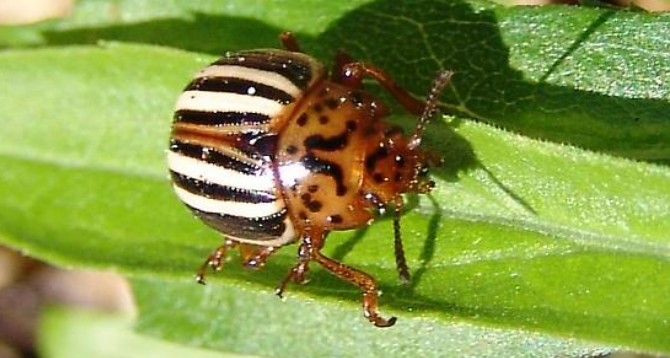
1. Colorado Potato Beetle (Leptinotarsa decemlineata)
The Colorado potato beetle is perhaps the most instantly recognizable striped beetle in the world, bearing ten alternating black and cream-yellow longitudinal stripes across its rounded orange elytra. Native to the Rocky Mountain region of North America, it has spread to become a devastating agricultural pest across Europe, Asia, and beyond, feeding on the foliage of potato, tomato, and eggplant plants at every life stage. It holds the dubious distinction of having developed resistance to more insecticides than any other pest insect — over 50 different chemical classes — making it one of the most challenging beetles to control in modern agriculture.
2. Striped Cucumber Beetle (Acalymma vittatum)
The striped cucumber beetle is a slender, yellow-and-black striped leaf beetle that is one of the most damaging pests of cucurbit crops — cucumbers, squash, melons, and pumpkins — across North America. Adults chew ragged holes in leaves, flowers, and fruit, but the greater damage is done by their role as vectors of bacterial wilt disease, which they transmit between plants as they feed and which can kill entire crops within weeks of infection. A single heavily infested field can harbor thousands of beetles per plant during peak emergence in early summer.
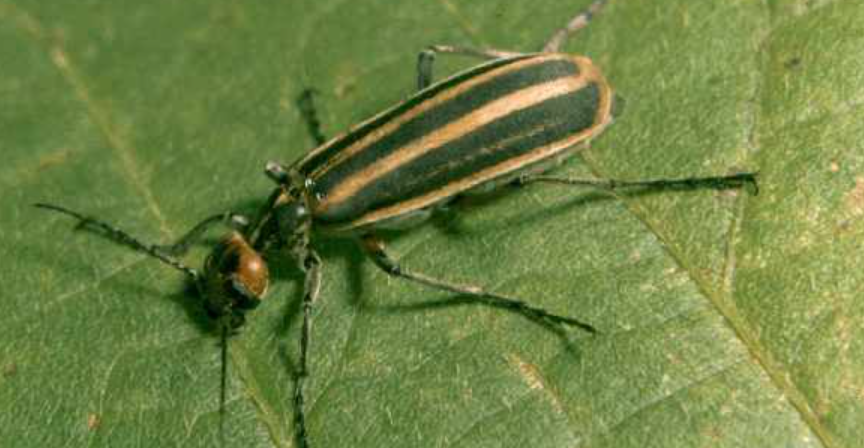
3. Striped Blister Beetle (Epicauta vittata)
The striped blister beetle is a long, narrow beetle marked with bold black and yellow longitudinal stripes that serves as a clear warning of its potent chemical defense — the toxin cantharidin, which causes severe blistering of skin and mucous membranes on contact. Found across North America in grasslands and agricultural fields, it feeds on the foliage of potato, tomato, alfalfa, and various wildflowers, and can appear in sudden, destructive swarms that strip plants bare. Dead beetles accidentally baled into hay pose a serious and potentially fatal risk to horses, as even small quantities of cantharidin consumed in feed can cause irreversible kidney and gastrointestinal damage.
4. Tiger Beetle (Cicindelinae)
Many tiger beetle species display bold pale stripes, spots, and markings on their iridescent elytra that serve both as disruptive camouflage against sandy or rocky substrates and as species-recognition signals for finding mates. The white or cream markings are highly variable between species and have been used as a primary taxonomic character for identifying the approximately 2,600 species in this subfamily. Tiger beetles are among the fastest running insects on Earth and use their acute vision and speed to run down prey across open ground.
5. Striped Flea Beetle (Phyllotreta striolata)
The striped flea beetle is a tiny but highly damaging pest of brassica crops — cabbage, broccoli, kale, canola, and mustard — recognized by the two wavy yellow stripes running the length of its shiny black elytra. It causes characteristic shothole damage to young seedlings by chewing small round pits through leaf surfaces, and severe infestations can destroy entire seedling stands within days of crop emergence. The species overwinters as adults in soil and leaf litter and emerges in large numbers in early spring precisely when young brassica transplants are most vulnerable.
6. Seven-spotted Ladybird (Coccinella septempunctata)
The seven-spotted ladybird is one of the most familiar beetles in Europe and North America, with its bright red elytra bearing exactly seven black spots — three on each wing cover and one shared spot at the junction. While its spots rather than stripes define its pattern, the bold red-and-black contrast functions identically to aposematic stripes, warning predators of its unpalatable alkaloid secretions. It is one of the most widely used biological control agents in the world, with adults and larvae each capable of consuming hundreds of aphids per day.
7. Striped Bark Beetle (Plagionotus arcuatus)
The striped bark beetle is a striking longhorn beetle of European oak forests, whose jet-black elytra are decorated with bold, arched bands of yellow — a pattern that mimics the warning coloration of wasps with remarkable accuracy. This Batesian mimicry is reinforced by the beetle’s behavior, as it moves in a jerky, wasp-like manner on sun-warmed bark surfaces. Larvae bore beneath the bark of recently felled or dying oak trees, and adults are most active in warm weather when wasps are also at their most visible and the mimicry is most effective.
8. Striped Longhorn Beetle (Strangalia maculata)
The spotted or striped longhorn beetle is a slender, wasp-mimicking cerambycid of European woodlands whose yellow elytra are boldly marked with irregular black stripes and spots — a highly convincing visual imitation of a stinging wasp. Adults are frequently seen visiting flowers to feed on pollen and nectar, where the mimicry of dangerous stinging insects provides protection while foraging in exposed situations. The larvae develop within the rotting wood of deciduous trees including oak, beech, and birch.
Also Read: Beetles That Eat Wood
9. Banded Longhorn Beetle (Typocerus velutinus)
The banded longhorn beetle is a North American cerambycid whose rich brown or tawny elytra are crossed by neat, pale yellow transverse bands — a pattern that mimics the banding of yellowjacket wasps and paper wasps visiting the same flowers. Adults are common and conspicuous flower visitors, feeding on pollen from goldenrod, Queen Anne’s lace, and milkweed during summer months. Their larvae develop in the decaying roots and lower wood of hardwood trees, particularly oaks and beeches.
10. Striped Ground Beetle (Graphipterus serrator)
Striped ground beetles of the genus Graphipterus are fast-running, flightless predatory beetles of African and Middle Eastern deserts, decorated with distinctive black and white longitudinal stripes on their elytra. The striped pattern is thought to provide disruptive camouflage against the strongly light-and-shadow-dappled surface of sandy desert ground, helping the beetle remain inconspicuous while pursuing prey. They are active nocturnal hunters of other insects, moving rapidly across open sand in search of invertebrate prey.
11. Striped Oil Beetle (Berberomeloe majalis)
The striped oil beetle of the Iberian Peninsula is a large, flightless blister beetle with a dramatically swollen, soft abdomen striped in black and orange-red — one of the most striking and easily recognized beetles of the Mediterranean region. Like all blister beetles, it produces cantharidin as a defensive toxin and is considered one of the most poisonous insects in Europe. Its complex life cycle depends entirely on specific solitary bee species as hosts for the parasitic first larval stage, and its populations have declined sharply due to the loss of bee-rich wildflower habitats.
12. Striped Sunflower Beetle (Zygogramma exclamationis)
The striped sunflower beetle is a leaf beetle native to North America whose cream-colored elytra are marked with bold brown longitudinal stripes — a pattern that provides surprisingly effective camouflage against the fibrous texture of sunflower stems and leaves. Both adults and larvae feed on sunflower foliage, and in outbreak years large populations can cause serious defoliation of both wild and cultivated sunflowers across the Great Plains. The species has attracted interest as a potential biological control agent for invasive sunflower relatives in other parts of the world.
13. Striped Ambrosia Beetle (Trypodendron lineatum)
The striped ambrosia beetle is a small, cylindrical bark beetle of conifer forests in North America and Europe whose elytra carry subtle but distinctive pale and dark longitudinal striping. It bores small, perfectly round entry holes into the sapwood of recently felled or stressed conifers, creating a ladder-like gallery system in which it cultivates the ambrosia fungus on which it and its larvae feed. Its entry holes, stained blue-black by the accompanying fungal growth, cause significant downgrade of timber value in sawlogs and are an important economic concern for the forestry industry.
14. Striped Chafer (Hoplia philanthus)
The striped chafer is a small scarab beetle of European grasslands and meadows whose brown elytra carry faint but characteristic pale longitudinal striping, giving it a subtly patterned appearance against dry grass stems and soil. Adults emerge in early summer and feed on the pollen and petals of grasses and low-growing flowers, while the larvae develop underground feeding on plant roots. It is a minor turf pest in parts of central and northern Europe, where larval root feeding can cause patchy yellowing of lawns and sports turf.
15. Striped Diving Beetle (Graphoderus zonatus)
The striped diving beetle is a medium-sized aquatic predator of European and Asian ponds and slow rivers, recognized by the pale yellowish elytra crossed by irregular dark transverse banding that provides effective camouflage among aquatic vegetation. Like all diving beetles, it carries a bubble of air beneath its elytra for underwater breathing and hunts aquatic invertebrates, tadpoles, and small fish with speed and precision. It is a species of conservation concern in several European countries due to the loss of clean, well-vegetated freshwater habitats.
16. Striped Click Beetle (Agriotes lineatus)
The striped click beetle is a slender, dull brown beetle whose elytra carry fine but distinct pale longitudinal striping — an understated pattern that provides effective camouflage against dry soil and plant litter in the grassland and arable farmland habitats it favors. Adults are harmless and rarely noticed, but the larvae — known as wireworms — are among the most damaging soil pests in temperate agriculture, feeding on the roots, seeds, and underground stems of wheat, potato, carrot, and other crops for up to five years before pupating. Wireworm damage is particularly severe in fields recently converted from permanent pasture to arable crops.
17. Striped Potato Flea Beetle (Epitrix cucumeris)
The striped potato flea beetle is a minute, jumping leaf beetle of North America and Europe that attacks potato, tomato, eggplant, and related solanaceous crops, leaving characteristic pinhole feeding damage on the leaves and transmitting plant diseases in the process. Its common name reflects both its striped appearance and its powerful hind legs, which allow it to leap explosively when disturbed in a manner similar to a flea. Infestations are most damaging to young transplants and seedlings, where heavy foliar feeding can cause complete leaf collapse in vulnerable plants.
18. Striped Soldier Beetle (Cantharis rustica)
The striped soldier beetle is a common European soft-winged flower beetle whose elytra display a distinctive dark central stripe running the full length of otherwise pale or red-tinged wing covers. Adults are abundant in summer meadows, where they visit umbelliferous flowers to feed on pollen and nectar while also preying on small insects such as aphids. The combination of flower visiting and predatory behavior makes soldier beetles valuable generalist beneficial insects in garden and agricultural landscapes.
19. Striped Dung Beetle (Onitis belial)
Striped dung beetles of the genus Onitis are medium to large scarabs found across Africa and the Mediterranean, some species bearing faint longitudinal striping or ridging on their elytra that provides subtle patterning against dry soil substrates. They are strong, fast fliers that locate fresh dung by scent over considerable distances and rapidly bury large quantities of animal feces in underground brood chambers. Their tunneling activity aerates compacted soils and dramatically accelerates nutrient cycling in the savanna, grassland, and arid scrub environments they inhabit.
20. Striped Bark Longhorn (Chlorophorus varius)
The striped bark longhorn is a small, attractive cerambycid beetle of southern European and Mediterranean woodlands whose pale elytra are decorated with a bold mosaic of black and yellow patches and stripes that create a convincing wasp-mimicking pattern. Adults are active in hot summer sunshine on flowering umbellifers and the cut surfaces of freshly felled timber, where the wasp mimicry is particularly effective. Larvae develop beneath the bark of a wide variety of deciduous and Mediterranean shrub species.
21. Three-lined Potato Beetle (Lema daturaphila)
The three-lined potato beetle is a slender leaf beetle of North America whose bright orange-red elytra each bear a bold black longitudinal stripe, giving the beetle three dark lines in total — the two outer stripes on each elytron and one along the central suture. Both adults and larvae feed on the foliage of plants in the nightshade family, including potato, tomato, and the wild weed horsenettle. It is frequently confused with the striped cucumber beetle but differs in its rounder body shape and preference for solanaceous rather than cucurbit host plants.
22. Striped Carabid Beetle (Carabus cancellatus)
The striped carabid is a large, flightless ground beetle of European farmland and grassland whose elytra carry deeply impressed rows of pits and ridges that create a distinctly striped or reticulated surface texture, ranging in color from metallic bronze to dark greenish-black. It is a voracious nocturnal predator of earthworms, slugs, caterpillars, and insect larvae, and is considered one of the most beneficial predatory beetles in arable agriculture. Population declines have been recorded across intensively farmed regions of Europe due to tillage, pesticide use, and the loss of field margin habitats.
23. Striped Chafer Beetle (Anomala dubia)
The striped chafer is a small scarab of European and Asian grasslands whose elytra display variable but often clearly striped patterns of brown, tan, and pale yellow across the wing covers. Adults feed on the leaves and flowers of low-growing plants in summer, while the C-shaped white larvae develop underground over one to two years, feeding on the roots of grasses and cereals. Like many scarab chafers, it is attracted to light at night and is commonly seen around outdoor lamps and illuminated windows in rural areas.
24. Striped Blister Beetle (Mylabris variabilis)
Mylabris blister beetles are a diverse genus of African and Eurasian beetles, many species of which display vivid black and orange or yellow striped elytra as a warning of their potent cantharidin defense. They are commonly seen feeding on the pollen and petals of flowers in open grassland and semi-arid habitats, where their bright stripes advertise their toxicity to visually hunting birds and lizards. In parts of Africa and Asia, Mylabris beetles have been used in traditional medicine for centuries, though their cantharidin content makes handling without protection extremely dangerous.
25. Striped Longhorn Flower Beetle (Leptura quadrifasciata)
The four-banded longhorn is a slender cerambycid of European woodlands whose jet-black elytra are crossed by four distinct pale yellow transverse bands — a striking pattern that creates a convincing imitation of a stinging wasp or bee. Adults are active in summer sunshine on the flowers of hogweed, elder, and wild parsnip, where the mimicry of dangerous hymenopterans provides protection while foraging in exposed, open situations. Larvae develop within the rotting wood of deciduous trees, particularly birch, alder, and willow.
26. Striped Cucumber Beetle, Western (Acalymma trivittatum)
The western striped cucumber beetle is closely related to its eastern counterpart but is found primarily in the western United States and Mexico, where it similarly attacks cucurbit crops with black and yellow stripes along its elytra. It is a significant pest of melons, squash, and cucumbers in irrigated desert agriculture, where it can vector bacterial wilt and cause substantial economic losses. Its ability to overwinter as adults in soil and debris and to disperse widely as a strong flier makes it a persistent and difficult pest to manage.
27. Striped Leaf Beetle (Donacia marginata)
Donacia leaf beetles are slender, metallic aquatic leaf beetles whose elytra often display fine longitudinal striping in iridescent metallic green, bronze, or copper tones. They live and feed on the leaves, stems, and flowers of emergent and floating aquatic plants such as reeds, water lilies, and bur-reed, spending their larval stage underwater attached to plant roots, breathing oxygen extracted directly from root tissue. Found across Europe, Asia, and North America, they are among the most visually striking beetles associated with freshwater wetland habitats.
28. Striped Ground Beetle (Calosoma alternans)
Calosoma ground beetles are large, fast-running predatory carabids found across the Americas, Europe, and Asia, several species of which display boldly ridged, striated, or striped elytra in metallic green, copper, and black. Known as caterpillar hunters, they are specialist predators of moth and butterfly caterpillars and are among the most beneficial beetles in forestry, having been deliberately introduced into North America from Europe to control gypsy moth outbreaks. Some species are strong fliers, ascending trees at night to hunt caterpillars in the canopy.
29. Striped Mealworm Beetle (Alphitobius diaperinus)
The lesser mealworm beetle is a small, dark stored-product beetle whose elytra carry finely striated, almost striped surface texturing in dark reddish-brown to black coloration. It is a serious pest of poultry houses worldwide, infesting litter, feed, and the fabric of farm buildings where it can vector poultry diseases and harbor Salmonella. Despite being a pest in the poultry industry, its larvae — like those of related mealworm beetles — have attracted significant interest as a sustainable source of protein for human food and animal feed.
30. Striped Tortoise Beetle (Stolas coalita)
Striped tortoise beetles of South America are spectacular leaf beetles whose rounded, shield-like elytra display complex patterns of black stripes and markings against vivid red, orange, or gold backgrounds. Like other tortoise beetles, their expanded elytral margins allow them to clamp tightly to leaf surfaces when threatened, presenting a smooth, impenetrable shell to predators. They feed on the leaves of plants in the morning glory and sweet potato families in tropical and subtropical forests and gardens.
31. Striped Swamp Beetle (Helochares lividus)
Striped swamp beetles are small water scavenger beetles of European and Asian wetlands whose pale, yellowish elytra carry rows of fine dark streaks and stripes running the length of the wing covers. They inhabit the margins of ponds, marshes, and slow rivers, feeding on algae and decaying plant matter in shallow water among emergent vegetation. Their finely striped patterning provides effective camouflage against the variegated background of reed stems and aquatic plant debris in their preferred marginal habitats.
32. Striped Frog Beetle (Sagra buqueti)
Frog beetles of the genus Sagra are spectacular leaf beetles of tropical Asia and Africa whose elytra can display brilliant metallic iridescence — often with subtle longitudinal striping in contrasting metallic tones of green, blue, purple, and gold. Males of many species have grossly enlarged hind legs used in combat with rivals for mating positions on host plants, giving them an unusual and dramatic silhouette. Larvae are stem borers of tropical woody plants, living within galls or tunneled stems.
33. Striped Seed Beetle (Bruchidius fasciatus)
Striped seed beetles of the family Chrysomelidae are small, mottled beetles whose elytra display irregular pale and dark striped or banded patterns that provide effective camouflage against dried plant stems and seed pods. Larvae develop entirely within the seeds of leguminous plants, consuming the seed interior while leaving the outer coat intact — a feeding strategy that makes early detection of infestation in stored legume crops extremely difficult. Several species are invasive stored-product pests of beans, lentils, and chickpeas in tropical and subtropical agriculture.
34. Striped Bark Chafer (Polyphylla fullo)
The pine chafer or striped chafer is a large European scarab whose elytra are dramatically streaked with broad white stripes against a dark brown background — one of the most boldly patterned of all European scarab beetles. Males possess spectacular fan-like antennae used to detect the pheromones of females from considerable distances on warm summer evenings. Larvae spend three to four years in sandy soils feeding on the roots of pines and other conifers, and the adults are strong, buzzing fliers most active on warm evenings near sandy-soiled pine forests.
35. Striped Darkling Beetle (Pimelia bipunctata)
Striped darkling beetles of the genus Pimelia are flightless desert beetles of North Africa and the Mediterranean whose elytra carry raised ridges or subtle longitudinal striping that contributes to both camouflage and structural reinforcement of the elytra against desiccation. Like many desert darkling beetles, they are important fog collectors in arid coastal environments, tilting their bodies into fog-bearing winds and channeling condensed water droplets toward their mouths. They are among the dominant invertebrate decomposers of arid and semi-arid Mediterranean habitats.
36. Striped Burying Beetle (Nicrophorus investigator)
The striped burying beetle is a large, robust carrion beetle of Europe and North America whose elytra are marked with bold orange-red transverse bands against a black background — warning coloration that signals its unpalatability and association with toxic carrion. Adults locate the carcasses of small birds and mammals by scent, bury them as brood provisions, and engage in biparental care of larvae — an unusually sophisticated level of parental investment for a beetle. The bright banding is also a mimic of the coloration of various stinging wasp and bee species, providing a second layer of predator deterrence.
37. Striped June Beetle (Polyphylla decemlineata)
The ten-lined June beetle is a large North American scarab found in the western United States and Canada whose elytra are boldly decorated with broad white longitudinal stripes against a rich brown background — one of the most strikingly patterned of all North American chafers. When disturbed, adults produce a loud hissing or squeaking sound by forcing air through their spiracles — a startling defense mechanism that has earned them the alternative name “watermelon beetle” in some regions. The larvae spend three to four years underground feeding on the roots of conifers, fruit trees, and turf grasses, causing significant damage in orchards and managed turf.
38. Striped Rove Beetle (Staphylinus erythropterus)
The red-winged rove beetle is a large European rove beetle whose red elytra — unusually long for rove beetles — are marked with black spotting and marginal dark striping that creates a bold patterned appearance. Like most rove beetles, it is a fast-running, aggressive predator found in woodland, meadows, and along riverbanks, where it hunts flies, small beetles, and other invertebrates in leaf litter and dung. Its relatively long elytra — which still leave most of the flexible abdomen exposed — make it distinctive among European rove beetles.
39. Striped Stem Borer Beetle (Oberea linearis)
The striped stem borer is a slender longhorn beetle of European and Asian woodlands whose pale, yellowish elytra carry a pair of bold black longitudinal stripes running their full length. Larvae bore into the young shoots and stems of hazel, birch, and alder, causing the shoot tips to wilt and die back — a symptom known as “shepherd’s crook” that is easily spotted from a distance. Despite causing locally visible damage to hazel coppice and woodland shrubs, the species is rarely numerous enough to cause serious economic harm.
40. Striped Flower Beetle (Trichius fasciatus)
The bee beetle is a distinctive European scarab whose hairy, stocky body and yellow-and-black striped elytra create an extremely convincing imitation of a bumblebee — a classic example of Batesian mimicry that protects this harmless pollen-feeder from insectivorous predators. Adults are most active in summer on the flowers of thistles, bramble, and hogweed in woodland clearings and hedgerows, where the mimicry of bumblebees visiting the same flowers is particularly effective. Like true bumblebees, their larvae develop in rotting wood, completing the lifecycle within decaying stumps and fallen logs in old woodland.