Beetles are the most species-rich order of insects on Earth, with over 400,000 known species belonging to the order Coleoptera. Among this vast group, a significant number are wood-feeders — insects whose larvae, adults, or both depend on timber, bark, and woody plant tissue for nutrition and shelter. Wood-feeding beetles are found across every forested continent, and their activities touch nearly every type of tree species known to science.
Wood-boring beetles collectively cause billions of dollars in economic damage each year, threatening timber industries, urban forestry, and heritage buildings worldwide. In the United States alone, invasive wood-boring beetles such as the emerald ash borer and the Asian longhorn beetle have caused losses estimated at over $4 billion annually in tree removal, treatment, and lost timber value. The global trade in wood products and live plants continues to facilitate the spread of non-native wood-boring species into new regions, where they often find no natural predators to limit their populations.
Despite their reputation as destructive pests, wood-eating beetles perform irreplaceable ecological functions in forest ecosystems. By tunneling through dead and dying trees, they accelerate decomposition, return nutrients to the soil, and create habitat for hundreds of other species including birds, fungi, and other invertebrates. Ecologists estimate that dead wood — much of it processed by wood-boring beetles — supports around 25% of all forest biodiversity, making these beetles foundational engineers of healthy forest systems.
Also Read: Different Types of Beetles
Beetles That Eat Wood
1. Asian Longhorn Beetle (Anoplophora glabripennis)
The Asian longhorn beetle is one of the most destructive invasive wood-boring pests in the world, native to China and Korea but now established in parts of North America and Europe following accidental introduction through wooden packing materials. Its larvae bore deep, winding galleries through the heartwood of healthy hardwood trees including maple, birch, willow, and elm, girdling the vascular system and killing the tree within a few years. There is no approved chemical treatment for established infestations, and eradication relies almost entirely on felling and destroying all host trees in the affected area.
2. Emerald Ash Borer (Agrilus planipennis)
The emerald ash borer is a slender, metallic green jewel beetle whose larvae feed in S-shaped galleries between the bark and wood of ash trees, cutting off the tree’s supply of water and nutrients. Since its discovery in North America around 2002, it has killed hundreds of millions of ash trees across the United States and Canada and continues to spread westward and into new regions. All North American ash species are considered highly susceptible, and the loss of ash trees has had cascading effects on forest biodiversity, urban canopy cover, and the cultures of Indigenous peoples for whom ash wood holds deep traditional significance.
3. Mountain Pine Beetle (Dendroctonus ponderosae)
The mountain pine beetle is a small bark beetle native to the forests of western North America that has caused the largest recorded insect outbreak in the history of North American forests, killing over 18 million hectares of pine forest in British Columbia alone between the late 1990s and 2015. Adult beetles bore through the outer bark of pine trees to lay eggs, and larvae feed on the nutrient-rich phloem layer just beneath the bark, effectively starving the tree. Warmer winters driven by climate change have dramatically reduced beetle mortality and allowed populations to explode far beyond their historical range.
4. Deathwatch Beetle (Xestobium rufovillosum)
The deathwatch beetle is a wood-boring anobiid whose larvae spend up to twelve years tunneling through old, partially fungus-decayed oak and other hardwoods used in the timbers of historic buildings, churches, and ancient furniture across Europe. Adults emerge in spring through the characteristic small round exit holes that give infested timber its riddled appearance, and males attract females by rhythmically banging their heads against the wood to produce a ticking sound. Infestations can persist undetected for decades, causing serious structural weakening of irreplaceable heritage timber before damage becomes apparent.
5. Furniture Beetle (Anobium punctatum)
The furniture beetle — whose larvae are universally known as woodworm — is responsible for the small, neat circular holes seen in antique furniture, wooden floorboards, roof timbers, and structural beams across Europe and North America. Larvae bore through both softwood and hardwood for three to five years, reducing the interior of the wood to a fine powdery dust called frass before pupating and emerging as adults. The species prefers timber with a moisture content above 14% and is most active in older, unheated buildings, making historic country houses and rural churches particularly vulnerable.
6. Old House Borer (Hylotrupes bajulus)
The old house borer is a longhorn beetle whose larvae are capable of infesting the seasoned softwood timbers of buildings for up to ten years, making it one of the most economically significant structural timber pests in Europe, North America, and Australia. Despite its name, it frequently attacks relatively new buildings — particularly those with untreated pine structural timber — and re-infestation of the same timber over multiple generations can eventually reduce beams to hollow shells. Infestations are often detected only by the rasping or ticking sounds made by larvae feeding within the wood.
7. Bark Beetle (Scolytinae)
Bark beetles are a vast and ecologically powerful subfamily of weevils comprising over 6,000 species, many of which feed in the thin but nutrient-rich layer of phloem tissue between the bark and wood of trees. Each species creates a characteristic pattern of galleries — a unique engraved signature on the wood surface — that can be used to identify the species responsible for an infestation. In natural forest settings, bark beetles are important drivers of forest turnover, targeting stressed and weakened trees, but under outbreak conditions triggered by drought, storm damage, and climate warming, they can overwhelm and kill even healthy trees across vast areas.
8. Horntail Wasp Mimic Beetle (Tremex)
While technically a wasp, the horntail’s relationship with wood-boring beetles is so intertwined that several beetle species mimic them closely in behavior and ecology. More relevantly, the genus Agrilus and related jewel beetles fill the same ecological niche, boring into living hardwood trees including oak, beech, and birch in ways that parallel the horntail’s habits. These beetles are challenging to detect and control because their larvae remain concealed deep within the wood for one to three years before adult emergence reveals the infestation.
9. Pine Sawyer Beetle (Monochamus)
Pine sawyer beetles are large longhorn beetles whose larvae are among the most destructive wood borers of conifer forests across the Northern Hemisphere, boring extensive galleries through the sapwood and heartwood of pines, firs, and spruces for one to three years. They are critically important as vectors of the pine wood nematode (Bursaphelenchus xylophilus), a microscopic roundworm that causes pine wilt disease and has devastated pine forests across Japan, China, Korea, and Portugal. A single infected adult beetle emerging from a diseased tree can carry hundreds of thousands of nematodes and spread them to healthy trees across a wide area.
10. Bess Beetle (Passalidae)
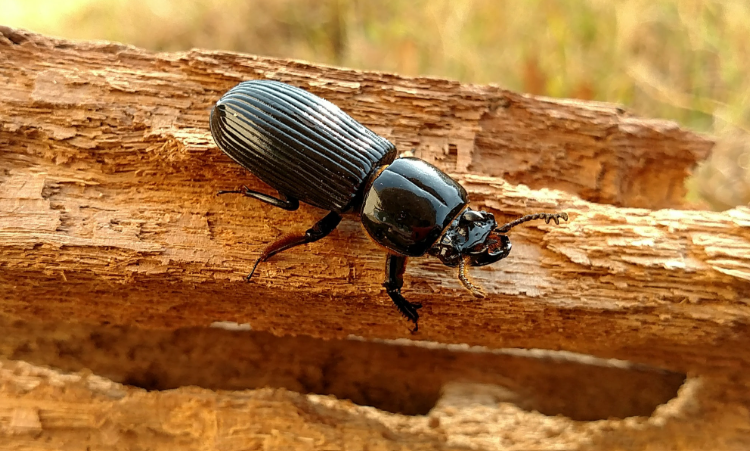
Bess beetles are large, shiny black tropical beetles that live as family groups within rotting hardwood logs, where both adults and larvae actively feed on and process decaying wood. Unlike most wood-boring beetles that tunnel for years in solitude, bess beetles are subsocial, with parents chewing wood into a soft pulp to feed their larvae and maintaining acoustic communication with offspring through stridulation. Their wood-processing activity is a significant contributor to decomposition rates in tropical and subtropical forest ecosystems across the Americas, Africa, and Southeast Asia.
11. Longhorn Beetle (Cerambycidae)
Longhorn beetles are one of the largest and most diverse wood-boring beetle families, with over 35,000 species whose larvae bore into the wood of a remarkably wide range of trees and shrubs across every forested continent. The larval stage — often lasting one to three years within the wood — does the greatest damage, while adults typically feed on pollen, bark, or plant sap and live only briefly. Many species are highly host-specific, targeting just one or a few tree genera, making the accidental introduction of exotic longhorn beetles into new regions particularly devastating to tree species with no evolved resistance.
12. Black Turpentine Beetle (Dendroctonus terebrans)
The black turpentine beetle is a large bark beetle native to the southeastern United States that attacks the base of living pine trees, boring through the outer bark to feed and breed in the phloem layer just beneath. Unlike most bark beetles that colonize the upper trunk and crown, it focuses on the lower trunk, creating large pitch tubes — masses of resin mixed with frass — that are a visible sign of infestation. Stressed trees recovering from lightning strikes, root disturbance, or fire are most vulnerable, and heavy infestations can kill trees by girdling the base.
13. Two-lined Chestnut Borer (Agrilus bilineatus)
The two-lined chestnut borer is a jewel beetle that attacks oak and chestnut trees in North America, particularly those already weakened by drought, defoliation, or disease. Its larvae feed in winding, meandering galleries just beneath the bark in the phloem and outer sapwood, and in heavy infestations these galleries overlap and coalesce to fully girdle the tree, causing branch dieback and death within two to three years. The species has become more problematic in recent decades as climate-driven drought events increase stress on oak trees across eastern North America.
14. Powderpost Beetle (Lyctus)
Powderpost beetles are small wood-boring beetles whose larvae reduce the interior of seasoned hardwood to a fine, flour-like powder — the source of their evocative name — while leaving the outer surface of the wood apparently intact until it is lightly touched and collapses. They infest the large-pored hardwoods such as oak, ash, hickory, and walnut that are commonly used in fine furniture, flooring, tool handles, and wooden antiques, preferring recently cut timber with high starch content. A female can detect starch in wood from a distance and will preferentially select high-starch timber for egg-laying, making newly milled hardwood particularly susceptible.
15. Common Bark Beetle (Scolytus scolytus)
The large elm bark beetle Scolytus scolytus is the primary vector of Dutch elm disease, a devastating fungal pathogen (Ophiostoma novo-ulmi) that has killed the vast majority of elm trees across Europe and North America since its introduction in the early 20th century. Adult beetles carry fungal spores on their bodies as they emerge from infected elms and bore feeding galleries into the bark of healthy trees nearby, inoculating them with the disease. The combination of beetle boring damage and fungal infection blocks water conduction in the tree’s vascular system, causing rapid wilting and death.
16. Spruce Beetle (Dendroctonus rufipennis)
The spruce beetle is a bark beetle native to the boreal and subalpine forests of North America that periodically erupts into massive outbreaks capable of killing spruce trees across millions of hectares. Larvae feed in the phloem beneath the bark of Engelmann and white spruce, and mass attacks overwhelm tree defenses through sheer numbers — a phenomenon called “mass attack” in which beetles release aggregation pheromones to recruit thousands of individuals to a single tree simultaneously. Climate warming has extended the beetle’s active season and reduced winter mortality, contributing to increasingly severe and frequent outbreaks across Alaska, Canada, and the Rocky Mountains.
17. Red Turpentine Beetle (Dendroctonus valens)
The red turpentine beetle is native to North America but has become an invasive pest of catastrophic proportions in China, where it was accidentally introduced in the 1980s and has since killed tens of millions of pine trees across 18 provinces. In its native range, it is generally a secondary pest attacking stressed or recently felled pines, but in China’s pine forests — where trees have no evolutionary history with the beetle — it attacks and kills even healthy, vigorous trees with alarming efficiency. Large, conspicuous pitch tubes at the base of infested trees are the most reliable field sign of infestation.
18. Ambrosia Beetle (Xyleborini)
Ambrosia beetles are wood-boring weevils that do not feed directly on wood but instead cultivate symbiotic fungal gardens within their galleries to nourish themselves and their larvae — a sophisticated form of fungal farming that evolved independently multiple times across beetle lineages. They bore small, perfectly circular entry holes into the sapwood of weakened or recently felled trees, and the blue-staining or white-rotting fungi they introduce can spread through the surrounding wood tissue and rapidly kill the host tree. Invasive species such as the redbay ambrosia beetle (Xyleborus glabratus) have caused massive mortality in avocado, redbay, and sassafras trees across the southeastern United States by introducing the lethal laurel wilt fungus.
19. Flatheaded Borer (Chrysobothris femorata)
The flatheaded apple tree borer is a jewel beetle whose larvae attack a wide range of hardwood trees and shrubs across North America, including apple, oak, maple, cottonwood, and many ornamental species. Newly planted or recently transplanted trees are especially vulnerable, as the stress of transplanting reduces their ability to defend against larval tunneling in the cambium and sapwood layer. Infestations often go undetected until the bark above a larval gallery sinks and cracks, by which point significant internal damage has already been done.
20. Shot Hole Borer (Euwallacea fornicatus)
The shot hole borer is a tiny ambrosia beetle native to Southeast Asia that has emerged as a significant invasive pest in California, South Africa, Israel, and Australia, attacking hundreds of tree species including oak, willow, avocado, and box elder. It bores into tree stems and branches to create galleries, simultaneously introducing the Fusarium fungus on which it farms, and in susceptible tree species this fungal infection causes rapid dieback of branches and eventually the death of the whole tree. Its tiny entry holes — barely 1 mm across — give the pest its name and make early detection extremely difficult without careful inspection.
21. Horned Passalus (Odontotaenius disjunctus)
The horned passalus, or bess beetle, is a large, glossy black beetle of eastern North American hardwood forests that spends its entire life cycle within a single rotting log, where a breeding pair establishes a tunnel system and raises successive broods of larvae cooperatively. Adults chew decayed wood into a soft paste to feed their larvae and communicate with them through a repertoire of at least 17 distinct stridulatory sounds — one of the most complex acoustic communication systems known in beetles. By processing large quantities of rotting hardwood over their lifetimes, bess beetle families make a substantial contribution to wood decomposition and soil formation in deciduous forest ecosystems.
Also Read: Lawn Bugs