Walls provide one of the most challenging yet potentially rewarding planting environments in any garden, combining thin, fast-draining substrate, exposure to drying winds, and often intense reflected heat with the unique structural support that allows a wide range of climbing, trailing, and crevice-dwelling plants to perform in ways that would be impossible in conventional garden beds. Plants that grow on walls have evolved or been selected for their ability to colonize difficult, nutrient-poor environments, often developing specialized structures such as adhesive pads, twining tendrils, aerial roots, or simply compact, drought-tolerant growth habits that allow them to thrive where other plants would struggle. Wall-growing plants can transform bare, sterile masonry into living tapestries of color and texture that improve insulation, support wildlife, and dramatically enhance the visual appeal of buildings and garden structures.
The global market for climbing and wall plants represents a significant sector of the ornamental horticulture industry, with ivy, clematis, wisteria, and climbing roses consistently ranking among the best-selling garden plants in temperate markets worldwide. Research conducted on buildings with established plant coverage has found that climbing plants and wall shrubs can reduce heat loss through walls by up to 30% during winter by providing an insulating layer of trapped air, while during summer they can reduce surface temperatures on sun-exposed walls by as much as 10 degrees Celsius through shading and transpirational cooling. These energy efficiency benefits, combined with the significant biodiversity value that wall-covering vegetation provides for birds and insects, have led to growing recognition of the ecological services that wall plants provide beyond their purely aesthetic contribution.
The diversity of plants capable of growing on or against walls is remarkable, spanning everything from true self-clinging climbers that can scale vertical surfaces without any support to shrubs trained flat against walls in a technique known as espalier, trailing plants that cascade down from wall tops, and specialized wall crevice plants that colonize the narrow gaps between individual stones in dry stone walls. Each of these different groups of wall plants has distinct requirements, characteristics, and appropriate applications, and understanding these differences is essential for selecting the right plant for any particular wall-growing situation. The orientation of the wall, its surface material, the climate of the region, and the specific position within the garden all influence which plants will perform best in any given situation.
Successful wall planting requires careful attention to the specific needs of different plant groups and an understanding of how walls modify the local microclimate experienced by plants growing against them. South and west-facing walls in the Northern Hemisphere accumulate heat during the day and release it slowly at night, creating conditions that allow gardeners to grow plants that might not survive in the open garden at the same latitude, effectively extending the climatic zone available for plant cultivation. North and east-facing walls, while cooler and shadier, also support a distinct range of plants adapted to these more challenging conditions. The following overview explores 40 plants suited to growing on walls in various conditions and climates.
Also Read: Climbing Plants With Yellow Flowers
Plants that Crawl Up Walls
English Ivy
English ivy is one of the most widely grown self-clinging climbers in the world, attaching itself to walls by means of tiny adhesive rootlets that allow it to scale vertical surfaces without any additional support. USDA Zones 4-9.
Ivy’s dense, evergreen foliage creates excellent wildlife habitat, with the berries providing important winter food for birds and the dense growth offering nesting sites and shelter. While ivy on walls is often blamed for structural damage, research suggests that healthy, well-maintained walls are generally not damaged by ivy, which may actually protect masonry from weathering.
Boston Ivy
Boston ivy produces spectacular autumn foliage in vivid shades of red and orange, clinging to walls by means of adhesive pads at the ends of its tendrils that grip masonry surfaces without penetrating them. USDA Zones 4-8.
This deciduous climber covers walls rapidly once established, creating a dense green summer canopy that turns to brilliant autumn color before the leaves fall to reveal the attractive bare stem structure through winter. Boston ivy is the plant famously covering the walls of many Ivy League university buildings.
Virginia Creeper
Virginia creeper is closely related to Boston ivy and similarly produces brilliant autumn color and uses adhesive tendrils to cling to walls, but its leaves are divided into five leaflets rather than the three-lobed single leaf of Boston ivy, giving it a slightly different texture. USDA Zones 3-9.
This vigorous deciduous climber is extremely hardy and tolerates a wide range of wall aspects including north-facing positions, making it valuable for covering large areas of wall in challenging locations. Its dark berries provide important food for birds during the autumn migration period.
Clematis
Clematis is one of the largest and most diverse groups of climbing plants grown in temperate gardens, encompassing hundreds of species and thousands of named cultivars ranging from early spring-flowering species with small nodding flowers to large-flowered summer hybrids in an extraordinary range of colors. USDA Zones 3-9 depending on variety.
Clematis climbs by twining its leaf stalks around supporting wires or trellis fixed to the wall surface, requiring some form of support rather than being self-clinging. The extraordinary diversity of flower size, color, and season within this genus means that walls can be clothed in clematis flower over an extended period by selecting varieties with different flowering times.
Wisteria
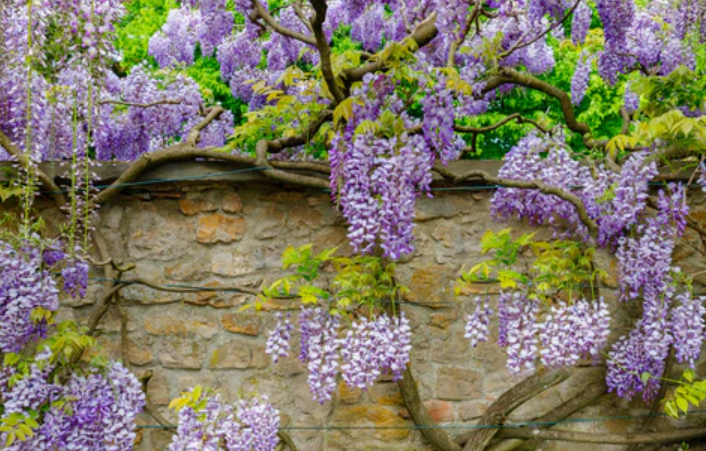
Wisteria produces spectacular cascades of fragrant flowers in lavender, purple, pink, or white in late spring, twining its woody stems around supporting wires or frameworks fixed to walls to create one of the most dramatic displays available in temperate horticulture. USDA Zones 5-9.
A well-established wisteria can live for a century or more, with some historic specimens covering enormous areas of wall and producing thousands of flower clusters in a single season. Wisteria requires regular pruning twice a year to manage its vigorous growth and encourage the production of flowering spurs.
Also Read: Climbing Plants With Red Flowers
Climbing Rose
Climbing roses are among the most beloved of all wall plants, producing repeat or once-flowering displays of fragrant blooms in virtually every color from pure white through every shade of pink, yellow, orange, and red to the darkest purples. USDA Zones 4-9 depending on variety.
Unlike true climbing plants, roses do not have any mechanism for attaching themselves to a support and must be tied to wires or trellis fixed against the wall surface. The range of climbing rose varieties available encompasses everything from compact, repeat-flowering modern climbers suitable for small garden walls to vigorous ramblers capable of covering an entire house facade.
Honeysuckle
Honeysuckle is a fragrant, twining climber that produces clusters of tubular flowers in combinations of cream, yellow, pink, and red that are among the most intensely perfumed of any climbing plant, particularly noticeable on warm summer evenings. USDA Zones 4-9 depending on species.
Several honeysuckle species are vigorous enough to cover substantial areas of wall relatively quickly while remaining manageable enough for smaller garden situations, making this one of the most versatile of all climbing plants for wall coverage. The flowers attract hummingbirds in North America and are important for moths and other pollinators in European gardens.
Also Read: Climbing Plants
Passion Flower
Passion flower produces extraordinarily exotic-looking blooms with intricate, finely detailed floral structures in combinations of white, blue, purple, and pink, climbing vigorously by means of tendrils and producing its spectacular flowers from summer into autumn. USDA Zones 6-10 depending on species.
On sheltered, sunny walls in mild climates, passion flower can reach impressive sizes and flower with exceptional generosity, while in cooler climates the shelter and reflected heat of a south or west-facing wall is often essential for reliable flowering. Some species also produce edible passion fruit, adding a productive dimension to this ornamental climber.
Pyracantha
Pyracantha, commonly known as firethorn, is an evergreen shrub that can be trained flat against a wall in the manner of an espalier, producing masses of white flowers in spring followed by spectacular displays of red, orange, or yellow berries that persist through winter and provide important food for birds. USDA Zones 6-9.
When trained against a wall, pyracantha develops an attractive, flat framework of branches covered in dense, spiny growth that creates effective security as well as ornamental value, making it a popular choice for walls where both beauty and deterrence to intruders are desired. Its tolerance for north and east-facing walls makes it valuable for shaded positions.
Cotoneaster horizontalis
Cotoneaster horizontalis is a semi-evergreen shrub that presses itself naturally flat against a wall without any training, its distinctive herringbone branching pattern creating an attractive geometric display that bears small white flowers in spring and abundant red berries in autumn and winter. USDA Zones 5-7.
This shrub is one of the few plants that will grow well against a north-facing wall, tolerating the shade and cold associated with this most challenging wall aspect while still producing a reliable display of autumn berries that attract birds. Its self-flattening habit makes it one of the easiest wall shrubs to manage.
Euonymus fortunei
Euonymus fortunei and its many cultivars, particularly the variegated forms with gold or silver-edged leaves, can be grown as self-clinging wall plants when trained against a surface, eventually developing adhesive rootlets that allow them to climb without additional support in a manner similar to ivy. USDA Zones 5-9.
The variegated forms of euonymus fortunei brighten shaded wall positions with their gold or silver-margined foliage throughout the year, providing year-round interest on north and east-facing walls where flowering climbers might struggle to perform at their best. This plant is slow to establish but long-lived once settled.
Garrya elliptica
Garrya elliptica is an evergreen shrub valued for its long, silvery-gray catkins that hang from the branches in late winter and early spring, providing ornamental interest during the bleakest period of the gardening year when trained against a wall. USDA Zones 8-10.
This shrub performs particularly well against sheltered walls in mild climates, where the protection offered by the wall helps it survive cold spells that might damage it in the open garden and allows the male plants to develop their longest and most impressive catkin displays. Male plants produce superior catkin displays to female plants.
Also Read: Climbing Plants With Purple Flowers
Fremontodendron
Fremontodendron is a large, fast-growing shrub native to California that produces a profusion of large, saucer-shaped golden-yellow flowers over an extended period from late spring into autumn when trained against a warm, sunny wall. USDA Zones 8-10.
The combination of spectacular yellow flowers and fast growth makes fremontodendron one of the most rewarding wall shrubs for suitable climates, capable of covering a substantial area of south or west-facing wall and flowering generously within a relatively short time of planting. The hairs covering the stems and leaves can cause skin irritation, so gloves should be worn when pruning.
Ceanothus
Ceanothus, the California lilac, produces masses of tiny flowers in various shades of blue, lilac, and white in spring or summer depending on the variety, performing most reliably in cooler climates when grown against a warm, sheltered wall that provides additional protection from winter cold. USDA Zones 8-10.
The intensely blue flower color of many ceanothus varieties provides a color that is relatively rare among flowering shrubs, making it a valuable addition to the wall garden palette. Evergreen varieties maintain their attractive, dark green foliage year-round, providing interest beyond the flowering period.
Trachelospermum
Trachelospermum jasminoides, commonly known as star jasmine, is an evergreen twining climber that produces intensely fragrant, small white flowers in summer and attractive glossy foliage year-round, making it one of the most desirable of all climbers for warm, sheltered walls. USDA Zones 8-11.
The exceptional fragrance of star jasmine flowers combined with their attractive, star-shaped form and the plant’s evergreen habit make this one of the most coveted of all climbers for warm climate gardens. In cooler climates, a warm, sheltered south-facing wall is essential for successful cultivation.
Campsis
Campsis, the trumpet vine, is a vigorous, deciduous climber that produces spectacular, large, trumpet-shaped flowers in vivid shades of orange, red, and yellow in late summer, attaching itself to walls by means of aerial rootlets similar to those of ivy. USDA Zones 5-9.
This climber’s exceptional heat tolerance and attraction for hummingbirds make it particularly valuable in hot, sunny garden positions where many other climbers might struggle. Campsis requires a warm, sheltered wall to flower reliably in cooler regions at the edge of its hardiness range, where a south-facing aspect is essential.
Eccremocarpus
Eccremocarpus scaber, the Chilean glory vine, is a fast-growing, semi-evergreen tendril climber that produces masses of small, tubular flowers in vivid orange, red, yellow, or pink from summer into autumn, often treated as an annual in cooler climates. USDA Zones 9-11.
This climber’s rapid growth and long flowering season make it valuable for quickly covering wall areas with color, even in a single season when grown as an annual in climates too cold for it to survive winter. In mild climates it becomes a true perennial, developing woody stems over time.
Lonicera japonica
Lonicera japonica, the Japanese honeysuckle, is a vigorous, semi-evergreen to evergreen twining climber producing small, intensely fragrant white and yellow flowers over an extended season, valued for its fragrance but requiring management to prevent it from becoming invasive in mild climates. USDA Zones 4-9.
In some regions outside its native range, this honeysuckle species has become invasive, spreading beyond cultivated gardens into natural areas where it can smother native vegetation. Gardeners in regions where it may spread invasively should consider native honeysuckle alternatives that provide similar ornamental value without environmental risk.
Solanum crispum
Solanum crispum, the Chilean potato tree, produces clusters of purple-blue flowers with yellow stamens over an extended summer season when trained against a warm, sheltered wall, its scrambling stems requiring the support of wires or trellis to achieve their best effect. USDA Zones 8-11.
The long flowering season and attractive flower color of solanum crispum make it a valuable choice for large, warm walls where a substantial, semi-evergreen climber is desired. The variety Glasnevin is particularly highly regarded for its profuse flowering and relative hardiness within the species.
Actinidia kolomikta
Actinidia kolomikta is a deciduous twining climber grown primarily for its extraordinary foliage, with the leaves of male plants developing distinctive pink and white splashes that give the plant an appearance of having been decorated with paint. USDA Zones 4-8.
The unusual, multi-colored foliage of actinidia kolomikta is most vivid on male plants grown against a warm, sunny wall, with the pink and white coloring developing most intensely during the main growing season. Female plants produce small, edible kiwi-like fruits but display less dramatic foliage coloring than male plants.
Akebia quinata
Akebia quinata, the chocolate vine, is a vigorous, semi-evergreen twining climber producing unusual, small, chocolate-purple flowers with a subtle chocolate fragrance in spring, followed by sausage-shaped purple fruits in warm summers. USDA Zones 4-9.
This attractive climber provides year-round interest through its attractive divided foliage, unusual spring flowers, and occasional autumn fruit display, making it a versatile choice for walls in suitable climates. Akebia is tolerant of shaded wall aspects, performing adequately even on north-facing walls.
Hydrangea petiolaris
Hydrangea petiolaris, the climbing hydrangea, is a magnificent self-clinging deciduous climber that attaches to walls by means of aerial rootlets, producing large, flat-topped clusters of white flowers in early summer and attractive autumn foliage and peeling bark for winter interest. USDA Zones 4-8.
This climber is exceptionally valuable for shaded and north-facing walls where its tolerance for lower light levels makes it one of the few large-flowered climbers that will perform well in these challenging positions. Climbing hydrangea is slow to establish but ultimately develops into an impressive, long-lived wall plant.
Schizophragma
Schizophragma is closely related to climbing hydrangea and similarly self-clinging, producing flat-topped flower clusters in summer but with distinctive large, single white or pink bracts rather than the ray florets of climbing hydrangea, creating a subtly different but equally beautiful effect. USDA Zones 5-9.
This climber similarly tolerates shaded walls reasonably well, making it a valuable alternative or companion to climbing hydrangea for north or east-facing aspects. The pink-bracted form Schizophragma hydrangeoides Roseum is particularly attractive and increasingly popular in cultivation.
Pileostegia viburnoides
Pileostegia viburnoides is a self-clinging, evergreen climber related to climbing hydrangea that produces frothy clusters of small, creamy-white flowers in late summer and autumn, maintaining its attractive glossy foliage year-round. USDA Zones 8-10.
This climber’s self-clinging habit and evergreen foliage make it particularly valuable for walls in mild climates where year-round coverage is desired without the need for tying in stems. Its tolerance for shaded wall aspects adds to its versatility in garden situations where light is limited.
Escallonia
Escallonia is an evergreen shrub that can be trained effectively against walls in coastal and mild-climate gardens, producing masses of small pink, red, or white flowers over an extended season from summer into autumn. USDA Zones 8-10.
This shrub’s exceptional salt tolerance makes it particularly valuable for walls in coastal gardens where salt spray exposure would damage many other plants. Trained flat against a wall, escallonia develops an attractive formal silhouette while providing dense, evergreen coverage and prolific flowering.
Magnolia grandiflora
Magnolia grandiflora is an impressive evergreen tree that can be trained against a large, warm wall to spectacular effect, producing enormous, fragrant white flowers in summer above large, glossy, rust-backed leaves that create year-round architectural interest. USDA Zones 6-10.
Training magnolia grandiflora flat against a warm wall in cooler climates allows this magnificent tree to be grown successfully in regions where it might not reliably survive in the open garden, with the wall’s stored heat helping the plant through winter cold spells. A large, south-facing wall is required to accommodate this potentially enormous plant.
Morello Cherry
The Morello cherry is a productive fruiting tree that is traditionally trained as a fan against north-facing walls in kitchen gardens, being one of the few fruit trees that produces a reliable crop on a shaded, cool wall aspect. USDA Zones 4-9.
Fan-trained Morello cherries produce their dark, sour fruits in summer, which are ideal for cooking, preserving, and making cherry brandy, and the trained form creates an attractive ornamental display of spring blossom and summer fruit. Training fruit trees against walls is a centuries-old horticultural tradition that maximizes wall space while producing valuable harvests.
Pear
Pears train exceptionally well as espaliers or fan-trained trees against sunny walls, producing reliable crops of fruit that benefit from the stored warmth of the wall surface, which helps ripen both the wood and the fruit in regions where outdoor temperatures alone might be insufficient. USDA Zones 4-9.
Wall-trained pears can achieve impressively large sizes while maintaining a flat, formal silhouette that makes them both ornamental and productive elements of the kitchen garden. The traditional walled kitchen garden made extensive use of fruit trained against walls to maximize the range of crops that could be grown in cooler climates.
Fig
Figs produce their best crops of edible fruit in cooler climates when trained against warm, south or west-facing walls, where the reflected and stored heat of the wall surface helps ripen both the wood and the developing fruit. USDA Zones 8-11.
Restricting fig root growth by planting in a contained bed or against a wall where root spread is naturally limited encourages the plant to put its energy into fruit production rather than vegetative growth, a traditional technique used in kitchen gardens for centuries. Wall-trained figs can develop into impressive, architecturally attractive espaliers over many years.
Wallflower
Wallflowers are naturally adapted to growing in the crevices of old stone and brick walls, where their deep tap roots can access the moisture and nutrients held within the mortar and their compact rosettes can maintain a foothold in minimal substrate. USDA Zones 5-9.
The intensely fragrant spring flowers of wallflowers in shades of orange, yellow, red, and burgundy create colorful, scented displays in wall crevices and dry stone wall tops where other plants cannot gain a foothold. While typically grown as biennials in garden beds, wallflowers growing in wall crevices can live for many years.
Aubrieta
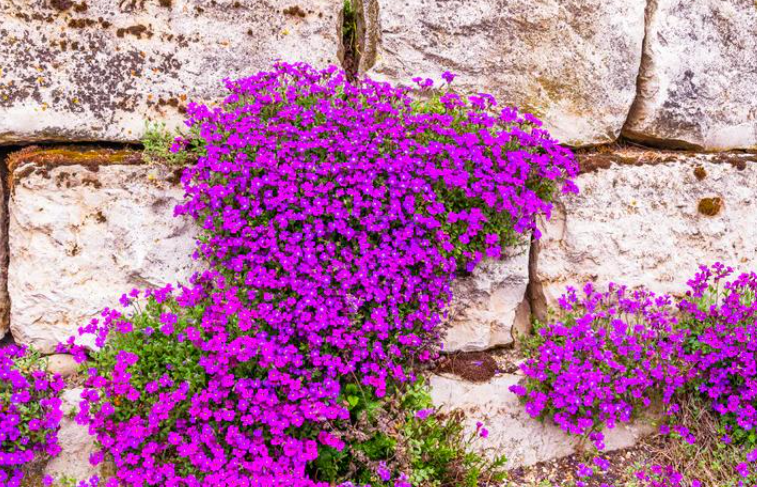
Aubrieta is a low-growing, mat-forming perennial that cascades attractively over walls and tumbles down their faces in spring, covering itself in small, four-petaled flowers in shades of purple, lilac, pink, and red. USDA Zones 4-8.
This plant’s natural habit of trailing down and over walls makes it ideal for wall tops, raised beds with stone facing, and dry stone walls where it can root into crevices between the stones. Cutting aubrieta back hard immediately after flowering keeps the plants compact and encourages fresh growth and better flowering the following season.
Alyssum saxatile
Alyssum saxatile, commonly known as gold dust or basket of gold, produces masses of tiny, bright yellow flowers in spring above gray-green cushions of foliage, particularly effective cascading over walls and the faces of raised beds. USDA Zones 3-7.
The silvery-gray foliage of alyssum saxatile provides attractive year-round interest beyond the spring flowering period, creating a soft, textured appearance on wall faces and crevices. Like aubrieta, it benefits from being cut back after flowering to maintain compact growth and prolong the plant’s productive life.
Sempervivum
Sempervivum, commonly known as houseleeks or hen and chicks, are naturally adapted to growing in the crevices of walls and rocky outcrops, their succulent rosettes requiring minimal soil and tolerating drought, heat, and cold with remarkable equanimity. USDA Zones 3-8.
These plants have been grown on roofs and walls in Europe for centuries, with traditional beliefs holding that they protect buildings from lightning strikes, and their practical adaptation to wall-top and crevice growing has made them one of the most traditional of all wall plants in temperate gardens. The extraordinary diversity of rosette sizes, colors, and textures within this genus allows interesting collections to be assembled on a single dry stone wall.
Erigeron karvinskianus
Erigeron karvinskianus, the Mexican fleabane, self-seeds prolifically into the smallest wall crevices and produces an almost continuous display of tiny daisy-like flowers that open white and age through pink to deep rose, creating a charming, naturalistic effect on old walls. USDA Zones 5-7.
Once established in a wall, this plant self-perpetuates by seeding into crevices, gradually colonizing available spaces and creating a natural, cottage garden atmosphere that suits old brick and stone walls particularly well. Its long flowering season from late spring to autumn makes it one of the most valuable of all wall crevice plants.
Cymbalaria muralis
Cymbalaria muralis, the ivy-leaved toadflax, is a delicate trailing plant that colonizes wall crevices through an extraordinary mechanism — after pollination, the flower stalks bend toward the wall and seek out crevices in which to deposit the seeds, actively placing them in suitable growing positions. USDA Zones 3-9.
This charming little plant produces tiny, snapdragon-like flowers in lilac and yellow over a long season, creating a delicate, fine-textured effect on the faces of old walls. Its self-seeding, wall-seeking behavior means it spreads naturally through appropriate wall habitats without requiring any deliberate planting.
Antirrhinum
Antirrhinums, commonly known as snapdragons, frequently establish themselves as short-lived perennials in the mortar of old walls, where their tap roots can penetrate between the stones and their rosettes can maintain a foothold in crevices containing minimal organic matter. USDA Zones 7-10 as perennials.
Wild snapdragons growing in wall crevices can develop into surprisingly long-lived plants, with well-established specimens persisting in favorable wall positions for many years as they self-seed into adjacent crevices. The cheerful, bicolor flowers in shades of red, pink, yellow, and white create colorful displays on old walls where they have naturalized.
Kenilworth Ivy
Kenilworth ivy, Cymbalaria muralis, produces small, ivy-shaped leaves and tiny lilac and white flowers on trailing stems that colonize wall crevices and cascade attractively over wall faces, creating a delicate, fine-textured covering on old stone and brick surfaces. USDA Zones 3-9.
This plant’s preference for growing downward into shaded crevices rather than upward into light means it naturally seeks out the cool, moist conditions within wall gaps, making it a reliable colonizer of north-facing and shaded wall surfaces where other plants might struggle to establish.
Erinus alpinus
Erinus alpinus, the fairy foxglove, is a tiny but charming plant that roots into the smallest wall crevices, producing neat rosettes of slightly sticky leaves topped by small spikes of pink, red, or white flowers in spring and early summer. USDA Zones 5-8.
This plant’s diminutive size makes it ideal for the smallest wall crevices where larger plants could not gain a foothold, and its cheerful flowers create a charming effect on old stone walls and rock garden features. Erinus is relatively short-lived but self-seeds readily into adjacent wall crevices.
Valerian
Red valerian, Centranthus ruber, is a robust, drought-tolerant perennial that colonizes old walls, cliffs, and chalky banks with equal ease, producing dense clusters of small, fragrant flowers in vivid shades of red, pink, or white from late spring through summer. USDA Zones 5-8.
This plant thrives in the alkaline conditions provided by old mortar and limestone walls, often establishing itself in wall faces through natural seeding where it can persist for many years as a long-lived, self-sustaining colony. Its tolerance for the drought and heat of wall-face conditions makes it one of the most reliable of all wall colonizing plants.