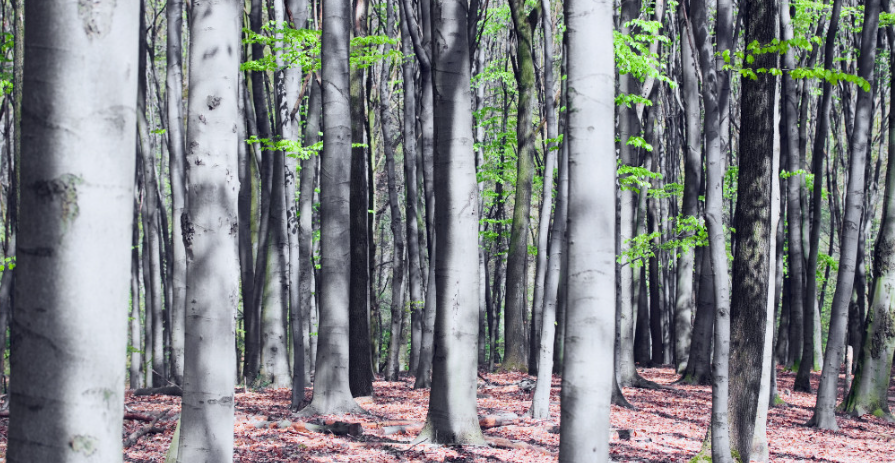
Trees with smooth gray bark stand out immediately in a forest full of furrowed, plated, and shaggy trunks, and according to Virginia Tech’s Cooperative Extension, American and European beech both carry a smooth, sensuous dark gray bark considered exceptionally attractive, though that same smoothness unfortunately makes both species a favorite target for people carving initials into the trunk. According to Purdue University Extension’s ID That Tree program, American beech can be reliably identified by that smooth gray bark combined with simple leaves showing parallel veins running out to small teeth along the edge.
That smoothness isn’t universal among large hardwoods, and researchers have proposed that beech’s unusually persistent smooth bark may trace back to a tropical evolutionary origin, where a slick trunk surface would have offered fewer footholds for climbing vines competing for the same sunlight. By contrast, the thick, furrowed bark typical of trees like black cherry or sugar maple is thought to be more of a cold-climate adaptation, which may help explain why beech bark stays vulnerable to splitting during a sudden hard frost.
Not every tree on this list keeps its smooth gray surface for a full lifetime, and several entries here are only reliably smooth and gray while young, developing the more typical furrowed or scaly bark of a mature hardwood as the trunk continues to thicken with age. What follows covers 21 trees with smooth gray bark, along with where each one grows and the data behind its trunk.
American Beech
American beech produces smooth, steel-gray bark that remains unbroken and unfurrowed even on the oldest, largest specimens, a trait genuinely unusual among large native hardwoods. According to Purdue University Extension, the species can be identified by that bark alongside its simple, parallel-veined leaves and long, pointed, cigar-shaped winter buds.
It grows throughout the eastern United States, favoring rich, well-drained forest soil in the later successional stages of a mature woodland. Its bark’s smoothness, appealing as it is, leaves the tree unusually vulnerable to lasting damage from carved graffiti, since scars persist and enlarge for decades rather than healing over the way they would on a rougher-barked species.
European Beech
European beech closely resembles its American relative in smooth, dark gray bark, distinguished by generally darker foliage and, according to Virginia Tech Cooperative Extension, better heat tolerance in warmer climate zones than American beech can manage. Its numerous ornamental cultivars, including striking purple-leaved forms, have made it a popular specimen tree well beyond its native range.
It grows as a landscape tree throughout much of the temperate United States, native to Europe and widely planted in parks and large estates. Its smooth bark carries the same vulnerability to graffiti damage found in its American counterpart.
American Hornbeam
American hornbeam, also called musclewood, produces smooth, gray bark that ripples and flexes over the trunk’s underlying wood in a pattern that genuinely resembles flexed muscle tissue. That distinctive sinewy texture is one of the most reliable identification features of any tree in the eastern forest.
It grows throughout the eastern United States as a shade-tolerant understory tree, favoring the rich, moist soil found along streams and in bottomland forests. Its extremely hard, dense wood has historically been used for tool handles and other applications requiring genuine durability.
European Hornbeam
European hornbeam closely resembles its American relative in smooth gray bark, though it typically grows into a larger, more upright tree without the same pronounced muscular fluting. Its dense, twiggy growth habit has made it a popular choice for clipped formal hedges throughout Europe.
It grows as a landscape tree throughout much of the temperate United States, tolerating heavy pruning considerably better than most other trees with genuinely smooth bark. Its tolerance for shearing has made it a common choice for pleached allées in formal garden design.
Serviceberry
Serviceberry produces smooth, light gray bark often marked with subtle vertical striping, providing attractive winter interest well beyond the tree’s brief but showy spring flower display. Its early white blossoms are among the first to appear each spring, often before most other native trees have broken dormancy.
It grows throughout woodland edges and understories across much of North America. Its sweet, edible summer berries are a favorite of both birds and human foragers, ripening just as many other spring-flowering trees are only beginning to set fruit.
Striped Maple
Striped maple produces smooth, greenish bark marked with distinctive vertical white stripes, a pattern unlike almost any other native tree and the source of both its common name and its alternate name, moosewood. Its unusual bark coloring provides genuine winter interest in an otherwise bare forest understory.
It grows throughout the northeastern United States and Canada as a shade-tolerant understory tree. Its large, 3-lobed leaves and unusual bark pattern make it one of the easier native understory trees to identify at any time of year.
Franklin Tree
Franklin tree produces smooth, grayish-brown bark marked with fine vertical striping, a subtle textural detail that adds interest even outside the tree’s fall flowering season. The species has been extinct in the wild since the early 1800s, with every cultivated specimen today descended from seed collected along Georgia’s Altamaha River by the Bartram family.
It grows as a rare landscape specimen tree throughout temperate regions of the United States. Its striking white fall flowers, sometimes blooming alongside colorful autumn foliage, make it one of the more unusual ornamental trees still available from specialty nurseries.
Southern Magnolia
Southern magnolia produces smooth to lightly textured gray bark, particularly noticeable on younger specimens before the trunk develops more pronounced surface texture with age. Its evergreen, glossy leaves and enormous, fragrant white flowers are typically what draw attention long before anyone examines the bark closely.
It grows throughout the southeastern United States as both a native forest tree and a widely planted ornamental. Its dense, low-branching habit often obscures much of the trunk from view, making the bark a somewhat overlooked feature of an otherwise iconic Southern tree.
Bigleaf Magnolia
Bigleaf magnolia produces smooth, pale gray bark supporting the largest simple leaves and largest flowers of any tree native to North America. Its enormous foliage, reaching up to 3 feet long, tends to draw far more attention than the comparatively understated bark beneath it.
It grows as a rare native understory tree throughout parts of the southeastern United States, typically found in rich, moist woodland valleys. Its smooth bark provides a clean, uncluttered backdrop for the tree’s genuinely oversized leaves and flowers.
Sweetbay Magnolia
Sweetbay magnolia produces smooth, light gray bark on a smaller, more slender tree than its Southern magnolia relative, often growing as a multi-stemmed large shrub in wetter conditions. Its fragrant white summer flowers, while smaller than those of Southern magnolia, bloom over a considerably longer season.
It grows throughout wetland margins and swamps across the eastern United States, tolerating consistently wet soil better than most other magnolia species. Its semi-evergreen to deciduous foliage, depending on the region, shows a silvery underside that flashes attractively in the wind.
Umbrella Magnolia
Umbrella magnolia produces smooth, gray bark supporting large, oblong leaves clustered at the branch tips in a whorled, umbrella-like arrangement that gives the tree its common name. Its large, somewhat unpleasant-smelling white flowers bloom later in spring than most other native magnolia species.
It grows throughout the eastern United States as a native understory tree, favoring rich, moist woodland soil similar to its bigleaf magnolia relative. Its distinctive foliage arrangement makes it easy to identify even without examining the bark directly.
Cucumber Tree Magnolia
Cucumber tree magnolia produces smooth, gray bark on the tallest and most timber-like of the native magnolia species, capable of reaching heights that rival many oaks and other traditional forest hardwoods. Its greenish-yellow flowers are considerably less showy than those of most other magnolias, easily overlooked high in the canopy.
It grows throughout the eastern United States, favoring rich, well-drained mountain forest soil. Its unusual, cucumber-shaped immature seed pods, which give the tree its common name, turn bright red before splitting open in fall.
Common Fig
Common fig produces smooth, pale gray bark on a small, often multi-trunked tree valued far more for its sweet, edible fruit than for its bark, though the trunk’s smoothness is a genuinely distinctive feature. Its large, deeply lobed leaves provide dense shade over the developing fruit each summer.
It grows as a garden fruit tree throughout much of the temperate and warm United States, tolerating a range of soil conditions once established. Its smooth bark and often sculptural, twisting trunk shape make it an attractive landscape feature even outside of fruiting season.
Camellia
Camellia, when trained as a small single-trunked tree rather than a multi-stemmed shrub, produces smooth, grayish bark providing a clean backdrop for its glossy evergreen foliage and showy winter flowers. Its tree-form training has become increasingly popular in modern Southern garden design.
It grows as a landscape ornamental throughout the southeastern United States and other mild-winter regions. Its smooth bark remains largely obscured by dense foliage unless the lower branches are deliberately pruned away to reveal the trunk.
Chinese Fringe Tree
Chinese fringe tree produces smooth, grayish bark supporting clusters of delicate, fringe-like white spring flowers that give the tree its common name. Its clean, understated trunk provides a simple backdrop for the plant’s showy, cloud-like flower display each spring.
It grows as a landscape tree throughout much of the temperate United States, native to China and Korea. Its smaller size and generally tidier growth habit have made it an increasingly popular alternative to the native fringe tree in residential landscaping.
American Holly
American holly produces smooth, light gray bark that remains notably unbroken and consistent even as the tree ages, a trait shared with the true beeches on this list despite the 2 species being entirely unrelated. That smooth, pale trunk provides valuable winter interest alongside the tree’s better-known red berries and spiny evergreen leaves.
It grows throughout the eastern United States as both a native forest understory tree and a widely planted ornamental. Its dense, spiny foliage often obscures much of the lower trunk, making the smooth bark most visible on older, more open-grown specimens.
Paw Paw
Paw paw produces smooth, thin, gray-brown bark on a small understory tree that also produces the largest edible fruit native to North America. Its oversized, tropical-looking leaves give the tree a distinctly lush appearance despite growing wild as far north as the Great Lakes region.
It grows throughout the eastern United States, typically found in rich, moist bottomland forests alongside larger canopy trees. Its smooth bark and drooping, maroon spring flowers, pollinated primarily by flies and beetles rather than bees, add to the tree’s overall unusual character.
Sugar Maple
Sugar maple produces smooth, light gray bark while young, gradually developing the deeply furrowed, plated texture typical of a mature specimen as the trunk continues to thicken over decades. That early smoothness is a genuinely useful way to distinguish a young sugar maple from other maple seedlings before leaf shape becomes the more reliable identifier.
It grows throughout the northeastern United States and Canada, prized both for its brilliant fall foliage color and as the primary source of maple syrup. Its bark texture change with age is a normal part of the tree’s development rather than any sign of disease or stress.
American Basswood
American basswood produces smooth, light gray bark while young, developing shallow furrows and a rougher texture only as the tree matures over many years. Its large, heart-shaped leaves and fragrant summer flowers typically draw more attention than the bark at any stage of the tree’s life.
It grows throughout the eastern and central United States, valued for its soft, easily carved wood and its importance as a nectar source for honeybees. Its young smooth bark offers a helpful early clue when trying to identify a basswood seedling before it produces recognizable leaves.
Redbud
Redbud produces smooth, grayish-brown bark while young, developing scaly, slightly exfoliating texture with darker inner bark showing through as the tree matures over a couple of decades. Its early spring flowers, appearing directly on the bark before leaves emerge, are typically what draws attention long before anyone examines the trunk closely.
It grows throughout the eastern and central United States as a popular small ornamental and native understory tree. Its bark’s gradual transition from smooth to scaly is a normal part of aging rather than any indication of disease.
Persian Ironwood
Persian ironwood produces smooth, grayish bark while young, developing the strikingly mottled, exfoliating, multicolored bark the species becomes famous for only as the tree matures over many years. That transformation from an unremarkable smooth gray trunk into a genuinely spectacular patchwork surface makes the tree’s age immediately apparent to an experienced observer.
It grows as a landscape specimen tree throughout much of the temperate United States, native to Iran and the Caucasus region. Its brilliant, long-lasting fall foliage color and eventual ornamental bark make it a favorite specimen tree despite the patience required to see its full mature character develop.
Things to Remember
Trees with smooth gray bark can look very similar from a distance, but the bark often has subtle differences in color, texture, and pattern. Some trees keep smooth bark as they mature, while others gradually develop cracks, ridges, or rough patches. Looking closely at the trunk and branches can provide useful clues.
It is also important to examine more than the bark. Leaves, twigs, flowers, fruits, branching patterns, and the overall shape of the tree can help distinguish species with similar gray trunks. For example, blue beech is known for its smooth bluish-gray bark and distinctive fluted trunk.
When identifying a tree with smooth gray bark, compare several characteristics rather than relying on bark color alone. Clear photographs of the trunk, leaves, and entire tree can make identification easier, especially when the tree is compared with a reliable regional identification guide.