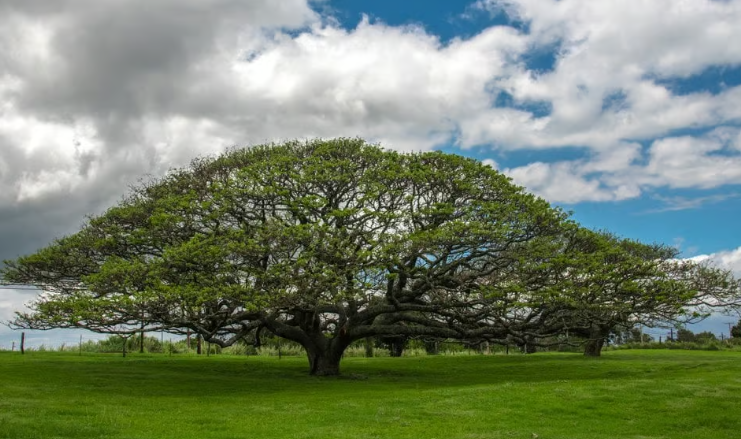
Trees with large canopies can dwarf almost anything else in a landscape, and according to the National Wildlife Federation, the crowns of the largest southern live oaks reach diameters of up to 150 feet, nearly large enough to encompass half a football field, even though the average specimen spreads a still-impressive 80 feet. According to University of Florida IFAS Extension, a live oak’s height of 60 to 80 feet is often matched or exceeded by a canopy spread reaching 60 to 120 feet, meaning the tree can genuinely grow wider than it is tall.
That relationship between height and spread varies enormously across large-canopy species, and according to the North Carolina Extension Gardener Plant Toolbox, live oak’s broad crown rarely exceeds 50 feet in height while its gnarled branches can reach out 40 to 100 feet wide, a ratio unlike almost any other common shade tree. Several named live oak cultivars have been specifically bred to manage that trait, and according to Clemson Cooperative Extension’s Home and Garden Information Center, the cultivar Cathedral Oak is expected to reach a mature spread of 60 to 120 feet, underscoring just how much canopy space a single tree can eventually demand.
A canopy that size doesn’t come without consequences for what grows underneath it, and a tree wide enough to cast that much shade fundamentally changes the light, moisture, and temperature conditions for everything in its footprint. What follows covers 28 trees with large canopy, along with where each one grows and the data behind its spread.
Southern Live Oak
Southern live oak produces one of the widest canopies of any tree in North America, and according to the North Carolina Extension Gardener Plant Toolbox, its broad crown reaches out 40 to 100 feet wide while the tree itself rarely exceeds 50 feet in height. Its low, sweeping, sinuously curved branches often touch the ground before arching back upward, a growth habit that requires early structural pruning to manage safely.
It grows throughout the southeastern United States, thriving in the warm, humid conditions of its native range. Its nearly evergreen foliage, replaced gradually over several weeks each spring rather than dropping all at once, keeps the tree’s enormous canopy filled with leaves nearly year-round.
White Oak
White oak produces a broad, rounded canopy on an exceptionally slow-growing but long-lived tree that ranks among the most durable native shade trees in North America. According to Utah State University Extension, the species won’t produce acorns until it reaches maturity, sometimes not until it’s 50 to 100 years old.
It grows throughout the eastern United States, favoring rich, well-drained upland soil. Its slow growth rate means a truly massive, wide-spreading specimen often represents a century or more of accumulated growth.
Bur Oak
Bur oak produces a wide, conical crown when young that flattens and rounds out considerably as the tree matures, and according to Utah State University Extension, it can reach 60 to 70 feet tall with a similarly wide crown spread. Its thick, fire-resistant bark and deep, spreading root system help it survive drought and disturbance that would kill most other large shade trees.
It grows throughout the eastern United States and as far west as Montana and Wyoming, often forming the natural boundary between eastern hardwood forest and open prairie. Its tolerance for pollution, compacted soil, and extremely dry conditions has made it a popular choice for difficult urban planting sites.
English Oak
English oak produces a broad, rounded canopy on a long-lived tree capable of reaching a spread comparable to or exceeding its own height at full maturity. Its lobed leaves and acorns held on distinctly long stalks distinguish it from many similar-looking native American oak species.
It grows as a landscape shade tree throughout much of the temperate United States, native to Europe and long associated with grand estate and parkland plantings. Its slow, steady growth rate rewards patience with a genuinely massive mature canopy after several decades.
Also Read: Trees with White Bark
American Sycamore
American sycamore produces one of the widest canopies of any native eastern hardwood, with mature trees capable of spreading 70 feet or more while reaching heights of 100 feet along favorable riverbank sites. Its enormous, maple-like leaves combine with a distinctive mottled bark to make it easy to identify even from a considerable distance.
It grows throughout the eastern United States, favoring the rich, consistently moist soil found along rivers and streams. Its massive branch structure and rapid early growth rate have made it a popular choice for parks and large open spaces where its full spread can develop unobstructed.
American Elm
American elm produces a distinctive vase-shaped canopy, narrow at the base and dramatically widening overhead, historically responsible for the cathedral-like, arching tunnel effect once common along American residential streets. Its graceful form made it the single most widely planted street tree in the country before Dutch elm disease devastated the species throughout the 20th century.
It grows throughout the eastern and central United States, and disease-resistant cultivars developed in recent decades have allowed a cautious return of the species to urban planting programs. Its historically massive canopy spread, often exceeding 100 feet on an open-grown specimen, remains one of the most dramatic examples of American shade tree architecture.
Sugar Maple
Sugar maple produces a dense, broadly rounded canopy capable of spreading 40 to 50 feet or more on a mature, open-grown specimen, providing some of the deepest shade of any common shade tree. Its canopy is prized for its spectacular fall color display in addition to its practical cooling effect.
It grows throughout the northeastern United States and Canada, also serving as the primary source of maple syrup. Its dense canopy can make growing grass or other sun-loving plants directly beneath a mature specimen genuinely difficult.
Norway Maple
Norway maple produces one of the densest canopies of any commonly planted shade tree, casting a shade so complete that it noticeably suppresses the growth of grass and other plants beneath it. Its rapid growth rate allows a young tree to develop a substantial canopy within just a couple of decades.
It grows throughout much of the eastern and midwestern United States, originally planted extensively as a street and shade tree before its invasive tendencies in natural forest settings became fully understood. Its shallow, aggressive root system frequently competes with turfgrass for both water and nutrients.
Silver Maple
Silver maple produces a wide, spreading canopy on one of the fastest-growing large shade trees available, capable of reaching a substantial spread within just 20 to 30 years. Its rapid growth comes at the cost of notably weak, brittle wood prone to storm damage as the tree matures.
It grows throughout the eastern and central United States, commonly found along rivers and floodplains. Its fast growth and wide canopy made it an enormously popular shade tree choice in the mid-20th century, though its brittle branches have since made it a less recommended option for modern residential planting.
Horse Chestnut
Horse chestnut produces a dense, broadly rounded canopy capable of spreading 40 feet or more, supported by large, palmately compound leaves that provide exceptionally deep summer shade. Its canopy is topped each spring with showy, upright clusters of white or pink flowers visible from a considerable distance.
It grows as a landscape shade tree throughout much of the northern United States. Its substantial canopy and dense shade have made it a traditional choice for large European parks and boulevards, a tradition carried over into American landscape design.
Monkey Pod Tree
Monkey pod tree, also called rain tree, produces an umbrella-like canopy that’s often wider than the tree itself is tall, among the most dramatically spreading crowns of any commonly planted tropical shade tree. Its leaflets fold closed before rainfall, an unusual weather-sensitive adaptation that gives the tree its common name.
It grows as a landscape shade tree in South Florida, Hawaii, and other frost-free tropical regions of the United States. Its enormous, flattened canopy makes it a favorite for providing shade over large gathering spaces in tropical landscape design.
Banyan Tree
Banyan tree produces one of the most extensive canopies of any tree in the world, spreading outward indefinitely as aerial roots descend from the branches, take root in the soil, and thicken into additional supporting trunks. A single banyan can eventually cover several acres, functioning almost like an entire small forest grown from one original seed.
It grows as a specialty landscape tree in South Florida and other frost-free tropical regions of the United States. Its ever-expanding canopy structure means a truly old specimen may no longer have any clearly identifiable single original trunk at its center.
Baobab
Baobab produces a canopy that appears strikingly undersized relative to its massive, swollen trunk for much of the year, since the tree drops its leaves entirely during the dry season in its native African range. Once fully leafed out, its rounded crown provides welcome shade across the otherwise sparse landscapes where the tree typically grows.
It grows as a specialty landscape tree in the warmest, most frost-free parts of the United States, including South Florida and parts of Southern California. Its massive trunk, capable of storing thousands of gallons of water, is at least as remarkable as the canopy it eventually supports.
Camphor Tree
Camphor tree produces a dense, broadly rounded, evergreen canopy capable of spreading 50 feet or more on a mature specimen, providing substantial year-round shade unlike most other large deciduous shade trees. Its aromatic leaves release a distinctive camphor scent when crushed.
It grows as a landscape shade tree throughout the southeastern United States and other warm regions. Its dense evergreen canopy and vigorous growth have also made it a documented invasive concern in parts of the Southeast, where it readily spreads via bird-dispersed seed into surrounding natural areas.
Ombu Tree
Ombu tree produces an enormous, dome-shaped canopy supported by a massive, swollen, water-storing trunk rather than true wood, giving the tree a genuinely unusual structure among large-canopied species. Its rapid growth and broad shade have made it a traditional gathering point on the open South American grasslands where it naturally grows.
It grows as a specialty landscape tree in the mildest, most frost-free parts of the United States, including coastal California. Its soft, pulpy wood is unsuitable for lumber, which is part of why the tree has traditionally been left standing rather than harvested even in otherwise treeless grassland regions.
Kapok Tree
Kapok tree produces a massive, tiered, umbrella-like canopy atop one of the tallest trees in its native tropical rainforest range, often emerging well above the surrounding forest canopy entirely. Its enormous buttressed roots help support the tree’s substantial height and canopy weight in the shallow tropical soil it typically grows in.
It grows as a specialty landscape tree in South Florida and other frost-free tropical regions of the United States. Its seed pods contain a fluffy, water-resistant fiber historically used to stuff life jackets and pillows before synthetic materials became widely available.
Also Read: Trees With Smooth Gray Bark
Weeping Willow
Weeping willow produces a wide, cascading canopy of pendulous branches that can spread as wide as the tree is tall, creating a distinctly graceful, drooping silhouette unlike almost any other large shade tree. Its rapid growth allows a young tree to develop a substantial canopy within just a decade or so.
It grows throughout much of the United States, particularly near ponds and low-lying areas where its cascading form is especially prized. Its shallow, aggressive root system is notorious for seeking out and infiltrating nearby sewer lines and septic systems.
Camperdown Elm
Camperdown elm, a distinctive weeping cultivar grafted onto a standard elm trunk, produces a wide, umbrella-shaped canopy of contorted, drooping branches that can spread considerably wider than the tree’s own modest height. Its unusual, sculptural form makes it a popular specimen tree despite requiring careful staking and structural support while young.
It grows as a landscape specimen tree throughout much of the temperate United States, valued for the dramatic shaded canopy it creates directly at ground level. Its dense, tangled branch structure creates a genuinely enclosed, room-like space beneath a single mature specimen.
Cedar of Lebanon
Cedar of Lebanon produces a wide, flat-tiered canopy on a stately evergreen conifer capable of spreading as wide as the tree is tall at full maturity. Its horizontal, plate-like branching pattern becomes more pronounced and distinctive as the tree ages over many decades.
It grows as a landscape specimen tree throughout much of the temperate United States, native to the mountains of Lebanon and the broader eastern Mediterranean region. Its slow growth rate and imposing eventual size have made it a traditional centerpiece for large estate and parkland plantings.
Deodar Cedar
Deodar cedar produces a wide, gracefully drooping canopy on a large evergreen conifer, distinguished from cedar of Lebanon by its more pendulous branch tips and softer overall silhouette. Its substantial mature spread makes it best suited to large open landscapes rather than smaller residential yards.
It grows as a landscape specimen tree throughout much of the temperate and warmer United States, native to the western Himalayas. Its graceful, weeping branch tips give the tree a softer appearance than most other large evergreen conifers despite its considerable eventual size.
Lacebark Elm
Lacebark elm produces a broad, rounded canopy capable of spreading 40 to 50 feet on a mature specimen, supported by a notably strong branch structure resistant to storm damage compared to many other fast-growing shade trees. Its distinctively mottled, exfoliating bark provides additional ornamental interest beyond the tree’s substantial shade.
It grows as a landscape tree throughout much of the temperate United States, valued for its strong resistance to Dutch elm disease compared to native elm species. Its combination of a wide canopy and genuine storm resistance has made it an increasingly popular replacement for more storm-prone large shade trees.
Ginkgo
Ginkgo produces a narrow, upright canopy while young that gradually widens and rounds out considerably as the tree matures over many decades, eventually developing a substantial spread on the oldest specimens. Its distinctive fan-shaped leaves turn a brilliant, uniform gold each fall before dropping in a dramatic, concentrated shower.
It grows as a landscape and street tree throughout much of the temperate United States, tolerating urban pollution and compacted soil exceptionally well. Its status as one of the oldest living tree species on Earth, essentially unchanged for millions of years, adds a genuine sense of history to its eventual wide, mature canopy.
American Basswood
American basswood produces a dense, broadly rounded canopy capable of spreading 40 to 60 feet on a mature specimen, supported by large, heart-shaped leaves that provide substantial summer shade. Its fragrant summer flowers draw an especially heavy concentration of foraging honeybees.
It grows throughout the eastern and central United States, valued for its soft, easily worked wood in addition to its substantial shade value. Its dense canopy can make growing turfgrass or other sun-loving plants directly beneath a mature specimen genuinely difficult.
Southern Magnolia
Southern magnolia produces a dense, broadly pyramidal to rounded evergreen canopy capable of spreading 40 feet or more, providing substantial year-round shade unlike most other large flowering trees. Its glossy, dark green leaves and enormous, fragrant white flowers make its canopy a genuine multi-season landscape feature.
It grows throughout the southeastern United States as both a native forest tree and a widely planted ornamental. Its dense, low-branching canopy habit often extends nearly to the ground unless deliberately pruned to reveal the trunk.
Royal Poinciana
Royal poinciana produces one of the most dramatically wide, flat-topped canopies of any flowering tree, often spreading considerably wider than the tree itself is tall at full maturity. Its brilliant clusters of red-orange summer flowers cover the entire flattened crown in a display visible from a considerable distance.
It grows as a landscape tree throughout South Florida and other tropical and subtropical regions of the United States. Its wide, umbrella-like canopy shape has made it one of the most photographed flowering trees in tropical landscape design.
Moreton Bay Fig
Moreton Bay fig produces an enormous, dense, spreading canopy supported by massive buttressed roots that can extend well beyond the tree’s own trunk diameter, creating a support structure genuinely unlike any temperate shade tree. Its canopy alone can eventually shade an area covering nearly an acre on the oldest specimens.
It grows as a specialty landscape tree in South Florida, Southern California, and other frost-free regions of the United States. Its aggressive, wide-spreading root system makes it entirely unsuitable for planting anywhere near sidewalks, foundations, or underground utilities.
Strangler Fig
Strangler fig produces an expansive, irregular canopy that begins life as an epiphyte high in a host tree’s branches before eventually sending roots to the ground and enveloping the original host entirely. Once established independently, its canopy can rival or exceed the size of the tree it originally grew upon.
It grows as a specialty landscape tree in South Florida and other frost-free tropical regions of the United States. Its unusual growth strategy means a mature specimen’s canopy may be considerably older and more established than its own visible trunk would suggest.
Umbrella Thorn Acacia
Umbrella thorn acacia produces a distinctively flat-topped, wide canopy that gives the African savanna its iconic silhouette, an adaptation thought to help the tree maximize shade coverage relative to its trunk investment in a landscape with intense sun and limited water. Its thorny branches and flattened crown shape make it instantly recognizable even to people who have never visited its native range.
It grows as a specialty landscape tree in the warmest, driest parts of the United States, including parts of Arizona and Southern California. Its wide, flat canopy provides some of the only significant shade available across the open grassland habitats it naturally colonizes.
Also Read: Trees With Heart Shaped Leaves
Things to Remember
Trees with large canopies can provide wide areas of shade, but their size and shape can vary considerably. Some develop broad, rounded crowns, while others have spreading or irregular branches. When identifying or choosing a large-canopy tree, consider its mature height, canopy spread, trunk structure, and overall growth habit.
A tree’s canopy also affects the space around it. Large trees may have extensive root systems, and the area beneath the canopy can extend well beyond the trunk. Their mature size should therefore be considered when selecting a planting location, particularly near buildings, driveways, sidewalks, and other trees.
When identifying a tree with a large canopy, look at more than its crown shape. Leaves, bark, flowers, fruits, branching pattern, and the tree’s growing environment can provide additional clues. Clear photographs of the entire tree, leaves, and trunk can make it easier to compare the tree with a reliable identification guide.