Trees with large leaves actually achieve that size through 2 genuinely different botanical strategies, and the distinction matters more than it might seem. According to Colorado State University Extension’s Master Gardener program, Kentucky coffeetree produces a single compound leaf that can reach 36 inches long and 24 inches wide, a scale that rivals the biggest simple leaves in North America, even though the leaf is actually built from dozens of small individual leaflets rather than one continuous blade.
That compound-versus-simple distinction separates this list into 2 clear camps. A tree like bigleaf magnolia carries the largest true simple leaf blade of any tree native to North America, while a tree like Kentucky coffeetree, black walnut, or tree of heaven achieves an equally enormous overall leaf structure by packing many smaller leaflets onto one shared central stem. Both approaches produce a dramatically oversized leaf from a distance, but only one of them involves a single uninterrupted piece of leaf tissue.
Climate also plays a considerable role in which strategy a given tree relies on, and the largest simple-leaved trees on this list tend to be shade-tolerant understory species evolved to maximize light capture beneath a taller canopy, while several of the largest compound-leaved trees are instead fast-growing, sun-loving pioneers that colonize open, disturbed ground. What follows covers 21 trees with large leaves, along with where each one grows and the data behind its foliage.
Bigleaf Magnolia
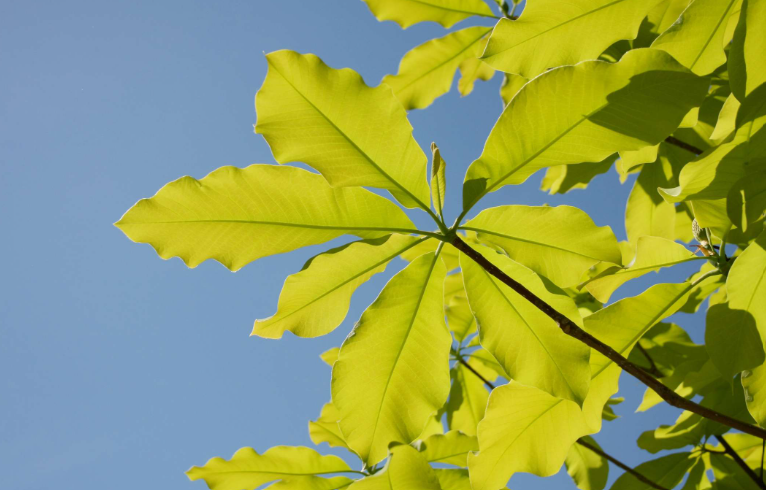
Bigleaf magnolia produces the largest simple leaves and largest flowers of any tree native to North America, with individual leaves reaching up to 3 feet long and a foot wide on a single, uninterrupted blade. Its considerable size makes it vulnerable to wind damage, and strong gusts can tear the enormous leaves and make the tree noticeably less attractive as a result.
It grows as a rare native understory tree throughout parts of the southeastern United States, typically found in rich, moist woodland valleys. Its oversized foliage gives it a strikingly tropical appearance despite its temperate native range.
Umbrella Magnolia
Umbrella magnolia produces large, oblong simple leaves reaching up to 2 feet long, clustered at the branch tips in a distinctive whorled, umbrella-like arrangement that gives the tree its common name. Its leaves taper more sharply at the base than those of its larger-leaved relative bigleaf magnolia, a useful way to distinguish the 2 species.
It grows throughout the eastern United States as a native understory tree, favoring rich, moist woodland soil. Its foliage arrangement makes the tree easy to identify at a glance, even from a considerable distance.
Also Read: Trees With White Bark
Cucumber Tree Magnolia
Cucumber tree magnolia produces large simple leaves on the tallest and most timber-like of the native magnolia species, capable of reaching heights that rival many oaks and other traditional forest hardwoods. Its leaves, while sizable, are considerably smaller than those of its bigleaf and umbrella magnolia relatives.
It grows throughout the eastern United States, favoring rich, well-drained mountain forest soil. Its unusual, cucumber-shaped immature seed pods turn bright red before splitting open each fall.
Southern Magnolia
Southern magnolia produces large, glossy, leathery evergreen leaves reaching up to 8 inches long, considerably smaller than its deciduous bigleaf relative but substantial enough to provide dense, year-round shade. Its enormous, fragrant white flowers typically draw more attention than the foliage itself.
It grows throughout the southeastern United States as both a native forest tree and a widely planted ornamental. Its dense, low-branching habit often keeps much of its substantial foliage close to eye level.
Paulownia
Paulownia, also called princess tree, produces enormous, velvety, heart-shaped simple leaves that can rival or exceed magnolia in size, particularly on the vigorous young growth of a recently cut or coppiced tree. Its fast growth rate, among the fastest of any tree in temperate climates, allows a seedling to reach 15 feet or more in its very first year.
It grows throughout much of the eastern United States, commonly found colonizing recently cleared or disturbed ground where its enormous leaves quickly shade out competing vegetation. Its oversized foliage is most dramatic on young, rapidly growing shoots rather than a mature, established tree.
Catalpa
Catalpa produces enormous heart-shaped simple leaves that can reach 12 inches long, often arranged in distinctive whorls of 3 around the stem rather than in simple opposite pairs. Its coarse, almost tropical-looking foliage gives the tree an outsized presence even in a modest suburban yard.
It grows throughout the eastern and central United States, native to a small region near the confluence of the Mississippi and Ohio Rivers before spreading widely as a landscape tree. Its long, cigar-shaped seed pods add to the tree’s overall dramatic scale.
Also Read: Trees With Large or Long Seedpods
American Sycamore
American sycamore produces large, maple-like simple leaves that can reach up to 10 inches across, among the largest leaves of any common native shade tree found along rivers and floodplains. Its distinctive mottled, flaking bark is often just as recognizable as its substantial foliage.
It grows throughout the eastern United States, favoring the rich, consistently moist soil found along rivers and streams. Its considerable leaf size contributes to the dense summer shade the tree is widely planted to provide.
Devil’s Walking Stick
Devil’s walking stick produces some of the largest compound leaves of any plant native to North America, with a single doubly divided leaf capable of spanning several feet across despite being built from dozens of small individual leaflets. Its enormous foliage is clustered entirely at the top of an otherwise bare, spiny stem.
It grows throughout the eastern and central United States, favoring moist, partially shaded woodland edges. That combination of a spiny, unbranched trunk topped with an oversized crown of compound foliage gives the tree an unmistakably tropical appearance despite its temperate range.
Horse Chestnut
Horse chestnut produces large, palmately compound leaves made up of 5 to 7 individual leaflets that together can span nearly 2 feet across on a mature tree. Its substantial foliage provides exceptionally deep summer shade beneath the tree’s broad, rounded canopy.
It grows as a landscape shade tree throughout much of the northern United States. Its dramatic, hand-shaped compound leaf structure makes it easy to identify even from a considerable distance.
Paw Paw
Paw paw produces large, drooping, tropical-looking simple leaves that can reach a foot long on a small understory tree that also produces the largest edible fruit native to North America. Its oversized foliage gives the tree a distinctly lush appearance despite growing wild as far north as the Great Lakes region.
It grows throughout the eastern United States, typically found in rich, moist bottomland forests alongside larger canopy trees. Its considerable leaf size helps it compete for the limited light available in a shaded forest understory.
Kentucky Coffeetree
Kentucky coffeetree produces one of the largest overall leaf structures of any tree in North America, a single doubly compound leaf reaching up to 36 inches long and 24 inches wide, built from more than 40 individual leaflets. Despite that enormous overall size, each individual leaflet is comparatively modest, only 2 to 3 inches long on its own.
It grows throughout the eastern and central United States, adaptable to a wide range of soil conditions from moist bottomland to dry, compacted urban sites. Its massive compound leaves emerge notably late in spring and drop early in fall, leaving the tree with a stark, bare winter silhouette for much of the year.
Black Walnut
Black walnut produces large compound leaves that can reach up to 2 feet long, made up of 15 to 23 individual leaflets with fuzzy undersides. Its roots release allelopathic chemicals that actively suppress the growth of many other nearby plants, a trait entirely separate from its considerable leaf size.
It grows throughout the eastern United States, reaching up to 120 feet tall in rich forest soil. Its substantial compound leaves turn a uniform yellow each fall before dropping relatively early compared to many other native hardwoods.
Tree of Heaven
Tree of heaven produces large compound leaves that can exceed 3 feet long on vigorous young growth, among the largest of any commonly encountered tree in North America, made up of dozens of individual leaflets along a shared central stem. Its rapid growth rate, notable even among fast-growing invasive trees, allows root sprouts to reach several feet in their very first year alone.
It grows throughout much of the United States, particularly along roadsides, rail corridors, and disturbed urban lots. Its oversized compound foliage and rapid spread have made it one of the most difficult invasive trees to eliminate once established.
Staghorn Sumac
Staghorn sumac produces large, fern-like compound leaves that can reach 2 feet long, made up of numerous narrow, toothed leaflets arranged along a fuzzy, antler-like central stem. Its foliage turns a brilliant orange-red each fall, among the most vivid displays of any native shrub or small tree.
It grows throughout most of North America, thriving in poor, dry, rocky soil where many other trees struggle. Its dense, fern-like compound leaves give even a young sucker sprout a surprisingly substantial, mature appearance.
American Basswood
American basswood produces large, heart-shaped simple leaves reaching 4 to 10 inches long, among the largest simple leaves of any common eastern shade tree. Its fragrant summer flowers hang from a distinctive strap-like bract unique to the linden genus.
It grows throughout the eastern and central United States, valued for its soft, easily carved wood in addition to its substantial shade value. Its considerable leaf size contributes to the dense, cooling shade the tree is prized for in parks and large yards.
Chinese Parasol Tree
Chinese parasol tree produces enormous, deeply lobed simple leaves that can span nearly a foot across, supported on a smooth, distinctively green-barked trunk unlike almost any other tree on this list. Its bold, tropical-looking foliage provides dense summer shade before dropping to reveal the tree’s uniquely colored bark each winter.
It grows as a landscape tree throughout the southern United States, tolerating urban pollution and heat notably well. Its oversized leaves make the tree instantly recognizable even without examining the bark.
Elephant Ear Fig
Elephant ear fig produces some of the largest leaves of any commonly cultivated fig species, reaching up to 2 feet long with a distinctly heart-shaped, felted, sandpaper-like texture. Its dramatic foliage has made it an increasingly popular houseplant and tropical landscape specimen in recent years.
It grows as a landscape tree in South Florida and other frost-free tropical regions of the United States and as a container plant elsewhere. Its considerable leaf size requires a substantial container or planting space to accommodate properly.
Traveler’s Palm
Traveler’s palm produces enormous, paddle-shaped leaves arranged in a single flat, fan-like plane that can eventually span 15 feet or more across on a mature specimen. Despite its palm-like appearance and common name, it’s more closely related to the bird of paradise than to any true palm tree.
It grows as a landscape specimen throughout South Florida and other tropical regions of the United States. Its dramatic, oversized foliage arrangement makes it one of the most recognizable tropical trees in any landscape.
Banana Plant
Banana plant produces enormous, thick-ribbed leaves that can reach several feet long, unfurling from a central growing point in a distinctly tropical, paddle-like shape. Despite their substantial size, the leaves are notably prone to tearing in strong wind, limiting the plant’s usefulness as a windbreak.
It grows as a warm-season ornamental and fruit-bearing plant throughout the southernmost United States and as a container plant elsewhere. A single mature plant can produce a canopy of leaves large enough to create dense shade within just one growing season.
Fiddle Leaf Fig
Fiddle leaf fig produces large, glossy, violin-shaped leaves that can reach over a foot long on a mature specimen, with prominent, deeply etched veining running through each leaf. Its dramatic, sculptural foliage has made it one of the most popular statement trees of the past decade.
It grows as an outdoor tree in frost-free tropical climates and as a houseplant throughout the rest of the United States. Its considerable leaf size and upright growth habit make it a striking indoor specimen even in a modest-sized room.
Rubber Plant
Rubber plant produces large, glossy, thick leaves that can reach nearly a foot long on a mature indoor specimen, with a milky latex sap that gives the plant its common name. In its native tropical forest habitat, a mature tree can grow well over 100 feet tall with correspondingly larger foliage than any indoor specimen typically develops.
It grows as an outdoor landscape tree in frost-free tropical regions and as a houseplant throughout the rest of the United States. Its substantial, leathery leaves make it a durable, low-maintenance choice for a large indoor space.
Also Read: Trees With Large Canopy
Things to Remember
Trees with large leaves can be easy to notice, but leaf size alone is not enough for accurate identification. Look at the shape, edges, texture, veins, and arrangement of the leaves, as well as whether they are simple or divided into leaflets. Leaf size can also vary within the same tree depending on growing conditions.
It is also helpful to examine the entire tree rather than focusing only on its foliage. Bark, twigs, flowers, fruits, branching pattern, and overall tree shape can provide additional clues. The location and habitat where the tree is growing may also help narrow down the possibilities.
When identifying a tree with large leaves, compare several characteristics instead of relying on leaf size alone. Clear photographs of the leaves, bark, and whole tree can make identification easier, especially when comparing the tree with a reliable regional identification guide.