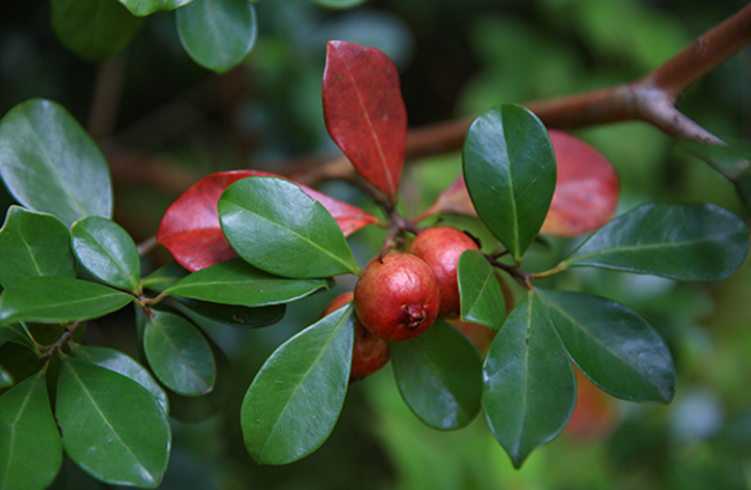
Strawberry guava (Psidium cattleyanum) is a small evergreen tree or shrub grown for its attractive foliage and flavorful fruit. It belongs to the myrtle family, Myrtaceae, and is related to the common guava (Psidium guajava). Unlike common guava, strawberry guava usually produces smaller, round fruits with a thin skin and a distinctive sweet-tart flavor.
The plant is sometimes called Cattley guava, cherry guava, or Chinese guava. Its compact growth makes it interesting for home gardens, while its dense evergreen foliage can also provide screening and wildlife habitat. The fruits are usually red when ripe, although yellow-fruited forms are also grown.
One of the appealing things about strawberry guava is that it can be both ornamental and productive. In suitable climates, it produces fragrant white flowers followed by edible fruit. The plant is also tolerant of a range of soil conditions and can cope with periods of dry weather once established. However, its vigorous growth and ability to spread have made it invasive in some regions, so gardeners should check local regulations and recommendations before planting it.
What Is Strawberry Guava?
Strawberry guava is an evergreen shrub or small tree native to parts of South America. It is generally smaller than common guava and often develops multiple stems, giving it a dense, bushy appearance.
The scientific name is Psidium cattleyanum. The species name honors William Cattley, an English horticulturist associated with the plant’s introduction into cultivation.
Depending on growing conditions, strawberry guava can reach roughly 10–20 feet tall, although plants are often kept much smaller through pruning. Its leaves are thick, glossy and dark green, providing year-round foliage in frost-free climates.
The fruit is the feature that attracts most gardeners. It is typically around 1–1.5 inches across, although size varies between plants. The skin may be red, dark red or yellow depending on the form. Inside is soft, juicy flesh surrounding numerous small seeds.
Strawberry Guava Identification
Strawberry guava is relatively easy to recognize when several characteristics are considered together.
The plant has smooth, reddish-brown to gray bark, glossy oval leaves and small white flowers. Young branches may have a reddish appearance before becoming more mature and woody.
The leaves are usually about 2–4 inches long. They are oval to elliptical, with a relatively leathery texture. When crushed, the leaves have a characteristic aromatic smell.
The flowers are white and have prominent yellowish stamens. They are usually about 1 inch across and appear individually or in small groups in the leaf axils.
The fruit is round and generally turns red or yellow as it matures. The red-fruited form is the one most commonly associated with the name strawberry guava.
Strawberry Guava Fruit
The fruit is one of the main reasons people grow Psidium cattleyanum.
Ripe strawberry guavas have thin skin and juicy flesh. The flavor is often described as sweet, aromatic and slightly acidic, with a flavor that can remind some people of strawberries. The exact taste varies considerably between individual trees and growing conditions.
The fruit can be eaten fresh after washing. It can also be used to make:
- Jams
- Jellies
- Sauces
- Juices
- Syrups
- Desserts
- Fruit preserves
- Smoothies
Because the fruit contains many small seeds, some people prefer to strain it when preparing sauces or preserves.
The fruit should generally be allowed to ripen on the plant until it develops its characteristic color and becomes slightly soft. Ripe fruit is delicate and does not always store well for long periods, so harvesting and using it promptly is often preferable.
What Does Strawberry Guava Taste Like?
Strawberry guava has a distinctive flavor that is difficult to compare with only one fruit.
Many people describe ripe red strawberry guava as sweet, aromatic and mildly tart. The flavor can have a berry-like quality, which explains the common name “strawberry guava.”
Yellow-fruited forms can have a somewhat different flavor and may be sweeter or more tropical tasting. Fruit quality is affected by the variety, climate, soil, maturity and amount of sunlight the tree receives.
For the best flavor, fruit should be fully ripe rather than harvested while still hard and green.
Strawberry Guava Flowers
Strawberry guava produces attractive white flowers with numerous stamens.
The flowers are relatively simple but striking against the plant’s dark green leaves. Flowering is important because it marks the beginning of fruit development.
Like other members of the genus Psidium, the flowers can attract insects that visit for pollen and nectar. In a garden setting, flowering strawberry guava can therefore contribute to insect activity while also producing fruit.
Flowering time depends on climate. In warm regions, flowering and fruit production may occur over an extended period rather than being limited to one short season.
How Big Does Strawberry Guava Get?
A mature strawberry guava can become a substantial shrub or small tree.
In favorable conditions, it may reach approximately 10–20 feet tall, with a similar or somewhat narrower spread. However, its ultimate size depends heavily on climate, soil, moisture and pruning.
Its naturally dense growth can make it useful as a screen or informal hedge. Gardeners who want a smaller fruit tree can prune it regularly.
Pruning is particularly useful in smaller gardens because it makes harvesting easier and helps prevent the plant from becoming excessively dense.
Where Does Strawberry Guava Grow?
Strawberry guava originated in South America, particularly areas of southern Brazil and nearby regions. It has subsequently been introduced to many tropical and subtropical parts of the world.
It grows best where winters are mild and frost is limited. Warm, humid climates can support vigorous growth, but established plants can tolerate some periods of dry weather.
The species has naturalized in several regions outside its native range. In some locations, particularly on islands and in tropical environments, it has become invasive and can form dense stands.
This is an important consideration for gardeners. Before planting strawberry guava, check whether Psidium cattleyanum is considered invasive in your area.
Strawberry Guava Growing Conditions
Strawberry guava is relatively adaptable, but it performs best when several basic requirements are met.
Sunlight
Full sun is generally ideal for strawberry guava.
A location receiving at least 6 hours of direct sunlight per day encourages strong growth, flowering and fruit production.
Plants can tolerate some partial shade, particularly in very hot climates, but heavy shade can reduce flowering and fruit production.
Soil
Strawberry guava can grow in several soil types as long as drainage is reasonable.
A fertile, well-drained soil containing organic matter is ideal. The plant can tolerate somewhat poor soils once established, but adding compost before planting can help young plants establish more quickly.
Avoid sites that remain waterlogged for long periods. Continuously saturated soil can restrict root health and encourage problems with the root system.
Water
Young strawberry guava plants need regular watering while their root systems are developing.
Once established, plants can tolerate periods of reduced rainfall. However, consistent moisture during flowering and fruit development can improve growth and fruit production.
A layer of organic mulch around the root zone can help conserve soil moisture. Keep mulch a few inches away from the trunk to reduce the risk of excessive moisture around the bark.
How to Plant Strawberry Guava
Choose a sunny location with adequate room for the mature plant.
Dig a hole approximately twice as wide as the root ball but no deeper than the root system. Position the plant so that the top of the root ball is level with the surrounding soil.
Backfill with the excavated soil and water thoroughly.
For the first several months, monitor soil moisture carefully. Young plants benefit from regular irrigation while their roots become established.
If planting multiple strawberry guavas as a hedge or screen, allow sufficient spacing for mature growth and airflow.
How to Grow Strawberry Guava From Seed
Strawberry guava can be propagated from seed, although seed-grown plants may not always be identical to the parent plant.
Remove seeds from fully ripe fruit and clean away as much fruit pulp as possible. Sow them in a clean, well-drained growing medium and keep the medium consistently moist.
Warm conditions generally encourage germination.
Seedlings can initially be grown in containers and transplanted after they have developed into sturdy young plants.
For gardeners who want predictable fruit characteristics, nursery-grown plants or vegetatively propagated plants can be preferable.
Pruning Strawberry Guava
Pruning is not always necessary, but it can be useful for maintaining an attractive and manageable plant.
Remove dead, damaged or crossing branches first. You can then selectively shorten overly long branches to encourage a compact shape.
Strawberry guava can also be trained into a small tree by removing lower branches and selecting a central trunk.
Regular pruning has an additional benefit: it can make harvesting easier by keeping fruit within reach.
Avoid removing excessive amounts of healthy foliage at one time. Heavy pruning can temporarily reduce flowering and fruit production.
Fertilizing Strawberry Guava
A healthy strawberry guava growing in reasonably fertile soil may not require heavy fertilization.
A balanced fruit-tree fertilizer can be used when the plant is actively growing, following the manufacturer’s instructions. Compost or other well-decomposed organic matter can also be incorporated around established plants.
Avoid excessive nitrogen. Too much nitrogen can encourage leafy growth at the expense of flowering and fruit production.
If the plant shows poor growth, yellow leaves or weak fruiting, consider testing the soil before applying large amounts of fertilizer.
Strawberry Guava Pests and Problems
Strawberry guava is generally considered a relatively hardy plant, but it is not completely free from pests.
Possible problems include:
- Scale insects
- Aphids
- Fruit flies
- Caterpillars
- Mealybugs
- Fungal diseases
- Root problems caused by poorly drained soil
Fruit can also attract birds and other wildlife once it begins to ripen.
Good growing conditions are one of the simplest ways to reduce plant problems. Give the tree sufficient sunlight, avoid excessive watering and maintain good airflow through the canopy.
Regularly inspecting leaves, stems and developing fruit can help you detect problems before they become severe.
Is Strawberry Guava Invasive?
This is one of the most important questions to consider before planting Psidium cattleyanum.
Although strawberry guava is a useful fruit plant in gardens, it has become invasive in some tropical and subtropical regions. It can spread beyond cultivated areas and form dense thickets that compete with native vegetation.
Its ability to produce abundant fruit contributes to its spread because animals can consume the fruit and disperse the seeds.
For this reason, check local invasive-species guidance before planting strawberry guava, especially if you live in Hawaii, parts of the Pacific, tropical islands or other areas where the species has naturalized.
A plant that behaves well in one region may become problematic in another.
Strawberry Guava vs. Common Guava
Strawberry guava and common guava are closely related, but there are noticeable differences.
| Feature | Strawberry guava | Common guava |
|---|---|---|
| Scientific name | Psidium cattleyanum | Psidium guajava |
| Typical growth | Shrub/small tree | Small to medium tree |
| Fruit | Usually smaller | Usually larger |
| Fruit color | Red or yellow forms | Green/yellow skin |
| Flavor | Sweet, aromatic, berry-like | Sweet, tropical and fragrant |
| Leaves | Smaller, glossy | Larger |
| Cold tolerance | Somewhat more tolerant | More sensitive |
| Main uses | Fresh fruit, preserves, landscaping | Fresh fruit, juice, cooking |
The two species can look similar, particularly when they are young. Fruit size, leaf characteristics and growth habit are useful clues for identification.
Is Strawberry Guava Good for a Home Garden?
Strawberry guava can be an attractive and productive addition to a suitable garden.
Its advantages include edible fruit, evergreen foliage, attractive flowers, relatively compact growth and adaptability to a range of growing conditions.
However, the invasive potential is a significant consideration. It should not automatically be recommended for every warm-climate garden.
For gardeners in regions where it is not invasive, a well-pruned strawberry guava can provide both ornamental value and a useful harvest. In regions where it is listed as invasive, gardeners should consider native fruiting plants or other non-invasive alternatives.
Frequently Asked Questions
How fast does strawberry guava grow?
Strawberry guava can grow relatively quickly in warm, favorable conditions. Growth is usually slower when temperatures are low, sunlight is limited or moisture is inadequate.
Can you eat strawberry guava?
Yes. Fully ripe strawberry guava fruit is edible. It can be eaten fresh or used in jams, jellies, sauces and other preparations.
Does strawberry guava need full sun?
Full sun is best for strong growth and fruit production. It can tolerate some partial shade, but heavy shade may reduce flowering and fruiting.
Is strawberry guava cold hardy?
It is more tolerant of cool conditions than some tropical fruit trees, but prolonged freezing temperatures can damage the plant. Its exact cold tolerance depends on the plant, age and growing conditions.
How long does strawberry guava take to fruit?
The time to fruit depends on how the plant was propagated and its growing conditions. Plants grown from seed generally take longer to produce fruit than mature nursery plants.
Can strawberry guava grow in pots?
Yes. Its relatively compact growth makes it possible to grow in a large container. Container-grown plants need good drainage, regular watering and occasional pruning to keep their size manageable.
Final Thoughts
Strawberry guava (Psidium cattleyanum) is an unusual fruiting plant that combines ornamental value with edible fruit. Its glossy evergreen leaves, white flowers and colorful berries make it attractive throughout much of the year in suitable climates.
For gardeners, the biggest advantages are its relatively compact size, flavorful fruit and adaptability. Full sun, well-drained soil and adequate moisture during establishment will give the plant a good foundation.
The most important caution is its invasive potential. Before adding strawberry guava to your landscape, check local invasive-plant regulations and recommendations. Where the species is considered appropriate, careful pruning and responsible fruit management can help keep it productive and manageable.