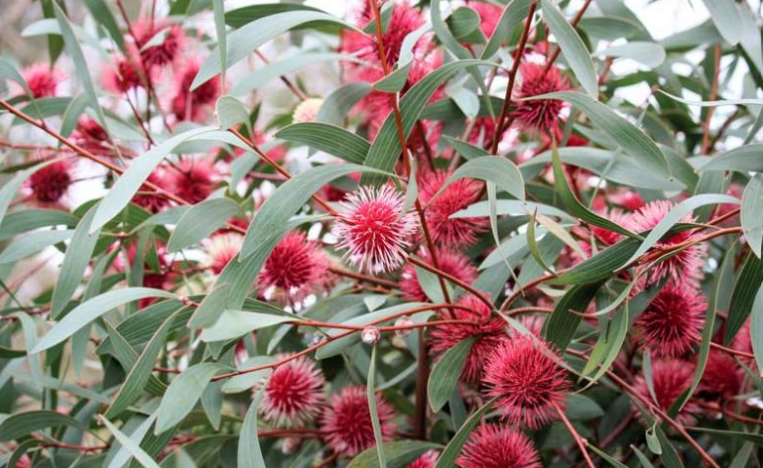
Hakea (Hakea spp.): Australia’s Overlooked Proteaceae Giant
Hakea is a genuinely large Australian native genus that lives somewhat in the shadow of its more famous Proteaceae relatives, banksia and grevillea, despite containing well over 150 species and displaying some of the most visually striking flowers and fruit found anywhere in the family. From delicate, spidery blooms to dense, globular pincushion-shaped flower clusters, the genus offers a remarkable range of form packed into a group most casual gardeners have never specifically sought out by name.
What truly sets Hakea apart, though, is its relationship with fire. The majority of species produce hard, woody seed pods that stay sealed shut for years, waiting specifically for the heat of a bushfire or the death of the plant itself before finally releasing their seeds, a genuinely elegant survival strategy built around exactly the kind of disturbance that would destroy most other plants outright.
This guide covers the genus’s classification and naming history, how to identify it, its remarkable fire-adapted seed release strategy, its considerable species diversity across Australia, a closer look at one of its most recognizable species, a genuine invasive species concern tied to the genus, and what it takes to grow one successfully.
Botanical Classification
Hakea belongs to the family Proteaceae, placing it alongside banksia, grevillea, isopogon, and waratah as close relatives within that considerable Australian plant family. Species counts for the genus vary somewhat depending on the source, with most references citing around 150 species, though broader counts that include recognized subspecies push the total past 180.
The genus was formally described in 1797 by the botanists Heinrich Adolph Schrader and Johann Christoph Wendland, though the first scientific collections of Hakea material were actually made considerably earlier, in 1770, by Joseph Banks and Daniel Solander during Captain Cook’s famous Endeavour voyage along the Australian coast. Hakea is closely related to grevillea, and the clearest botanical distinction between the 2 genera comes down to fruit: Hakea produces persistent, genuinely woody fruit capsules, while grevillea’s fruit is considerably less substantial and long-lasting.
Brief History and Naming
The genus honors Baron Christian Ludwig von Hake, a German patron of botany who lived from 1745 to 1818, though surprisingly little biographical detail about him survives in botanical records today, a genuine gap in the historical record for a man whose name is now permanently attached to an entire Australian plant genus. That pattern of honoring a European patron with a genus name, despite that patron having no direct connection to Australia or its flora, is a recurring theme across several native Australian plant genera named during this same general era of European botanical exploration.
Taxonomic refinement within the genus has continued well into modern times, and the work isn’t finished even today. Populations once classified as Hakea gibbosa growing in Queensland, for example, were more recently determined to be sufficiently distinct to warrant their own separate species designation, Hakea actites, a genuine reminder that species boundaries within such a large, diverse genus continue to be actively studied and refined. Given how many Hakea species exist across such a wide geographic range, this kind of ongoing reclassification is likely to continue as researchers examine more closely related regional populations in greater genetic detail.
Identifying Characteristics
Hakea flowers follow the broader Proteaceae pattern of lacking true petals or sepals, instead displaying 4 fused structures called tepals in a single whorl, but the overall flower arrangement varies considerably across the genus in ways that give rise to many of its common names. Botanists generally recognize 3 main flower arrangement types within Hakea: a spider arrangement, where flower styles radiate outward from a rounded cluster much like a spider’s legs, a pincushion arrangement, where flowers form a dense, globular cluster, and a brush arrangement, where flowers gather into elongated, cylindrical clusters typically positioned conspicuously at the branch tips.
Following flowering, Hakea produces hard, woody seed pods, each containing exactly 2 seeds, and the plant’s common names often reflect the pods’ distinctive shapes just as much as the flowers do, giving rise to names like cricket ball hakea, sea urchin hakea, frog hakea, and cauliflower hakea depending on the specific species involved. Bark texture also varies meaningfully across the genus, with most species showing relatively smooth bark while certain northern species develop thick, deeply grooved, cork-like bark instead. Leaf shape adds yet another layer of variation, ranging from broad, flat leaves in some species to the genuinely needle-like, sharply pointed foliage that gives several species their common names, including needlewood and needlebush.
Fire Adaptation and Seed Release
Hakea’s relationship with fire is genuinely one of the more remarkable survival strategies found in the Australian bush. In the majority of species, those hard, woody seed pods remain tightly sealed on the plant, sometimes for years, refusing to open under ordinary conditions and instead waiting for a specific environmental trigger, most commonly the intense heat of a passing bushfire, though the death of the plant itself can also prompt the pods to finally release their seeds.
That fire dependency extends to how individual plants themselves survive a burn. Many fire-adapted Hakea species develop a lignotuber, a woody, swollen structure at or just below ground level that stores energy and allows the plant to resprout even if a fire destroys everything visible above ground. Not every species shares this trait, though, and 2 well-known species, Hakea laurina and Hakea corymbosa, notably lack a lignotuber entirely, relying instead on other survival strategies.
Some northern species take yet another approach, developing thick, corky, heat-insulating bark that protects the living tissue beneath it and allows the plant to resprout directly from buds embedded within the trunk itself rather than from an underground lignotuber. A smaller number of species have evolved an entirely different seed-release trigger altogether, responding to sporadic heavy flooding rains rather than fire to establish successfully.
Species Diversity and Range
Hakea is found across nearly every ecological habitat in Australia, occurring in every state and territory, though species diversity is concentrated overwhelmingly in the southwest of Western Australia, home to roughly 128 of the genus’s species, with a second considerable concentration found along Australia’s eastern coast. That range spans an enormous climatic gradient, from Hakea chordophylla in the tropical Kimberley region of northern Australia down to species like Hakea ruscifolia in the temperate southwest.
Kings Park and the Western Australian Botanic Garden maintain approximately 100 different Hakea species within their living collections alone, a genuine testament to just how much diversity exists within a genus that remains considerably less familiar to casual gardeners than its banksia and grevillea relatives. Some Western Australian species can also prove genuinely difficult to maintain outside their native climate, particularly in the more humid conditions found along Australia’s eastern coastal strip, a real consideration for anyone trying to grow a WA native species in a less compatible climate elsewhere in the country.
A Closer Look: Pincushion Hakea
Hakea laurina, commonly called pincushion hakea, offers a genuinely striking example of the genus’s visual appeal and makes for a useful close-up look at one specific, well-documented species. It grows as a tall shrub reaching up to 6 meters, spreading several meters wide, without the lignotuber many of its fire-adapted relatives rely on, and it’s endemic to a specific coastal stretch of southwestern Western Australia running roughly from Perth southeast toward Albany and east to Cape Arid National Park.
Its flowers create a genuinely dramatic visual effect: red tepals only about 8 millimeters long are paired with considerably longer white carpels protruding roughly 20 millimeters outward, and the combination gives the entire flower cluster its distinctive pincushion appearance. The species tolerates a range of soil types and frost, and it’s commonly used for ornamental planting, shading in public streets, wildlife habitat, windbreaks, and erosion control. Despite that considerable horticultural value, remaining wild populations face genuine threats, including clearance along road verges for routine maintenance, weed invasion, pollution from phosphate fertilizers used in nearby farming, and fire regimes that have become less frequent than the species evolved to depend on.
An Invasive Species Concern
The same hardiness and prolific seeding that make Hakea so successful within Australia’s challenging native conditions have made certain species a genuine problem once introduced elsewhere. Several Hakea species have become invasive outside Australia, particularly in South Africa, New Zealand, and parts of the Mediterranean region, where they lack the natural checks, including the specific fire regimes and competing native vegetation, that help keep populations balanced within their home range.
That invasive potential is worth real consideration before planting any Hakea species outside Australia, and checking local invasive species guidance specific to your region is a genuinely worthwhile step given the documented history of certain species escaping cultivation and establishing problematic wild populations on other continents. Within Australia itself, this concern doesn’t apply in the same way, since the genus is native there and forms a genuine part of the ecosystems it occurs in rather than displacing them.
Growing Considerations
Hakea generally thrives in full sun and well-drained, often poor or sandy soil, reflecting genuine adaptation to the nutrient-poor conditions found across much of its native Australian range. Most species show considerable drought tolerance once established, and many also tolerate frost reasonably well, though specific cold hardiness varies depending on the particular species and its native climate of origin.
Given the genus’s considerable fire adaptation, many Hakea species also respond well to occasional hard pruning, which can help maintain a denser, more compact shape in cultivation even without an actual bushfire to prompt that kind of renewal growth. Propagation is generally straightforward from seed, particularly once a gardener understands that many species’ seed pods may need artificial heat treatment to open and release viable seed, directly mimicking the fire trigger the plant would naturally encounter in the wild. Some growers simply place collected pods in a warm oven for a short period, a practical, low-tech way to replicate the heat a wild pod would eventually experience during a natural bushfire.
The Bottom Line
Hakea deserves considerably more attention than it typically gets, a genuinely large and diverse Australian native genus offering striking pincushion, spider, and brush-shaped flowers alongside one of the more remarkable fire-adapted survival strategies found anywhere in the plant world. Its considerable species diversity means there’s very likely a Hakea suited to almost any Australian garden willing to look past the more famous banksia and grevillea names and give this underappreciated Proteaceae relative a genuine chance.