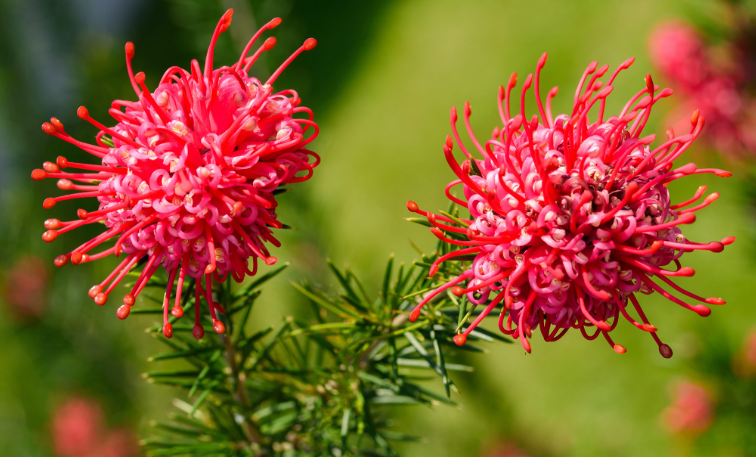
Grevillea is a genuinely staggering genus by any measure, spanning around 360 species that range from low, ground-hugging shrubs under half a meter tall to towering trees reaching 35 meters, all unified by the distinctive spidery, nectar-rich flowers that give the genus its common name, spider flower. It’s the third-largest genus of Australian flowering plants, and its considerable diversity has made it one of the most widely planted native genera in gardens across Australia and increasingly around the world.
That popularity comes with a genuinely important caveat most casual gardeners never hear about. Several Grevillea species and hybrids, including some of the most commonly planted ornamental cultivars, produce chemical compounds capable of causing a real, sometimes severe allergic skin reaction, one so similar to poison ivy exposure that doctors have specifically documented cases of it being misdiagnosed as Toxicodendron dermatitis.
This guide covers the genus’s classification and naming history, how to identify it, its remarkable size range, its relationship with pollinators, the genuine contact dermatitis risk tied to several popular varieties, a look at conservation concerns within the genus, and what it takes to grow one successfully.
Botanical Classification
Grevillea belongs to the family Proteaceae, subfamily Grevilleoideae, and was formally described in 1809 by the botanist Robert Brown. The genus was named in honor of Charles Francis Greville, an 18th-century British patron of botany and a co-founder of the Royal Horticultural Society, a naming convention common across several Australian native plant genera from this same era of European botanical exploration.
The genus is overwhelmingly Australian, with the vast majority of its roughly 360 species endemic to the continent, concentrated especially heavily in Western Australia and New South Wales. A smaller number of species occur naturally outside Australia, including a few in New Guinea, New Caledonia, and Sulawesi, making Grevillea predominantly but not exclusively an Australian genus.
Brief History and Naming
Grevillea’s common names reflect the genus’s remarkable internal diversity about as directly as a plant group’s names can. Beyond the widely used spider flower, individual species and forms go by names including silky oak, toothbrush, and simply grevillea, each pointing to a genuinely different aspect of the plant’s appearance depending on which of the roughly 360 species is being described.
Taxonomic work on the genus has continued for well over 2 centuries since Robert Brown’s original description, with researchers periodically reclassifying individual species, merging some that were once considered separate, and splitting others as genetic and morphological research has clarified true species boundaries. That ongoing refinement is typical of a genus this large and diverse, where the sheer number of species involved makes complete taxonomic certainty a genuinely moving target. Western Australia alone is home to well over 200 of the genus’s species, a concentration of diversity that reflects the same ancient, isolated landscape responsible for so much of the state’s broader Proteaceae richness.
Identifying Characteristics
Grevillea flowers follow the broader spider-like structure that gives the genus its common name, with long, curling styles extending outward from a central flower cluster in a shape that genuinely resembles spider legs radiating from a body. Flower color spans red, pink, orange, yellow, and cream depending on the species, and individual flowers are typically gathered into dense clusters or elongated, brush-like spikes positioned prominently at the branch tips.
What makes identification genuinely challenging across the genus as a whole is its staggering range in overall plant size and form. Some Grevillea species stay as low, sprawling groundcovers reaching less than half a meter tall, while others develop into substantial trees up to 35 meters in height, a size range considerably wider than almost any other single plant genus a home gardener is likely to encounter.
Leaf shape varies just as dramatically, from finely divided, fern-like foliage to broad, holly-like leaves with spiny margins, depending entirely on which species you’re looking at. That combination of variable leaf texture and considerable size range is exactly why a novice gardener can genuinely struggle to recognize 2 unrelated-looking Grevillea species as belonging to the same genus at all without checking the flowers specifically.
Pollination
Most Grevillea species show clear adaptation to pollination by nectar-feeding birds, a pattern consistent with several other Australian Proteaceae genera and reflected in the genus’s typically tubular, nectar-rich flower structure. Species that instead rely primarily on insect pollination tend to produce noticeably smaller, more fragrant flowers than their bird-pollinated relatives, a genuinely logical evolutionary distinction given that insects respond far more strongly to scent as a pollination cue than birds typically do.
Beyond birds, certain Grevillea species also draw considerable attention from native bees and introduced European honey bees, broadening the genus’s overall pollinator value well beyond birds alone. That combination of bird and insect pollination across different species has made Grevillea plantings a genuinely valuable addition to a garden specifically designed to support local wildlife.
The Contact Dermatitis Problem
Here’s the detail most Grevillea buyers never hear before planting one: several species and hybrids within the genus, particularly those in the taxonomic section Eugrevillea, contain long-chain alkyl resorcinols, phenolic compounds structurally similar to urushiol, the compound responsible for poison ivy’s notorious allergic reaction. Medical literature has documented genuine allergic contact dermatitis from Grevillea exposure closely mimicking a Toxicodendron, or poison ivy, reaction, complete with the same characteristic linear, streaky rash pattern and even measurable cross-reactivity in patients sensitive to one plant group developing reactions to the other.
The most significant culprits are Grevillea robusta, commonly called silky oak or silver oak, and the widely planted hybrid cultivar Grevillea ‘Robyn Gordon,’ a cross between Grevillea banksii and Grevillea bipinnatifida. Grevillea robusta has specifically been documented as a cause of occupational dermatitis among arborists in Australia, and reactions have also been traced to the plant’s sawdust and even objects crafted from its wood, including wooden bracelets. This isn’t purely a modern cultivar problem either: the explorer Ludwig Leichhardt documented a case in 1847 when a member of his expedition developed a blistering skin reaction after carrying Grevillea seed pods against his skin, showing the underlying chemistry has been causing real problems for a very long time, well before modern breeding programs ever existed.
‘Robyn Gordon’ itself carries a genuinely poignant naming history. It was selected and registered in 1973 by David Gordon at Myall Park in Glenmorgan, Queensland, named in memory of his daughter Robyn, who had died in 1969 at just 16 years old. The cultivar went on to become one of the most widely planted Grevillea hybrids both within Australia and internationally, which is precisely why its documented dermatitis risk matters to such a considerable number of gardeners. Despite its growing popularity as an ornamental shrub in the United States specifically, Grevillea remains poorly recognized there as a cause of phytodermatitis, meaning an American gardener or dermatologist encountering a mysterious, poison-ivy-like rash might not immediately consider a Grevillea planting as the actual source. Anyone known to be sensitive to poison ivy or poison oak is generally advised to approach Grevillea plantings, particularly ‘Robyn Gordon’ and its close relatives, with real caution.
Conservation and Fire Ecology
Several Grevillea species face genuine conservation pressure, and Australia’s severe 2019 to 2020 bushfire season highlighted the problem directly. Grevillea johnsonii, also called Johnson’s grevillea, was specifically flagged as a high conservation priority requiring urgent management intervention in the aftermath of those fires, alongside numerous other native plant species whose populations were pushed to genuinely concerning levels.
Fire ecology plays out differently across different Grevillea species. Grevillea longifolia, the fern-leaf spider flower found in the Sydney Basin, is killed outright by fire but regenerates reliably from seed afterward, with its seeds also serving as a genuine food source for insects and native mammals like the bush rat.
Grevillea buxifolia, the grey spider flower, faces a more complicated fire relationship, since its main conservation threat comes specifically from inappropriate fire regimes involving too frequent burning, a reminder that fire-adapted doesn’t mean fire-proof under any and all conditions. Grevillea thelemanniana, the spider net grevillea, represents one of the more extreme conservation cases in the genus, critically endangered and restricted to just a handful of specific suburbs around Perth, Western Australia.
Popular Species and Cultivars
Grevillea robusta stands out as one of the genus’s most commercially significant species beyond ornamental use, valued historically for its timber and widely planted as a shade and street tree well outside its native range in eastern Queensland and far northern New South Wales.
‘Robyn Gordon’ remains perhaps the most widely recognized Grevillea cultivar specifically because of its considerable ornamental success, despite the dermatitis concerns covered above, and related hybrids bred from similar parentage, including ‘Sandra Gordon,’ ‘Merinda Gordon,’ and ‘Dorothy Gordon,’ have followed a similar breeding pattern.
Grevillea sericea, the pink spider flower, remains popular in cultivation specifically for its wide natural distribution across New South Wales and its genuine appeal to both native and introduced bee species. Grevillea alpina, commonly called alpine grevillea despite occurring across a genuinely wide range of habitats beyond strictly alpine conditions, offers another popular garden option valued for its compact size and reliable flowering.
Growing Considerations
Grevillea generally thrives in full sun and well-drained soil, and the genus is notably sensitive to high phosphorus levels, a trait shared across much of the Proteaceae family and tied to the nutrient-poor soils so many Australian natives evolved in. A low-phosphorus fertilizer formulated specifically for Australian natives, used sparingly if at all, is the safer choice over any standard all-purpose garden fertilizer.
Given the genus’s documented dermatitis risk, wearing gloves and long sleeves when pruning or handling Grevillea, particularly ‘Robyn Gordon’ and other Eugrevillea section hybrids, is a genuinely sensible precaution regardless of whether you’ve reacted to the plant before, since sensitization can develop with repeated exposure over time even in someone who initially shows no reaction at all.
Most species are otherwise low maintenance once established, tolerating considerable drought and requiring only occasional shaping to maintain a tidy form. Given how dramatically mature size varies across the genus, checking a specific species or cultivar’s expected height and spread before planting matters considerably more with Grevillea than with most other garden shrubs.
The Bottom Line
Grevillea is a genus of genuine extremes, encompassing an extraordinary range of size, form, and flower color across roughly 360 species, while also carrying a real, well-documented allergic contact dermatitis risk that too few gardeners know about before planting one of its most popular hybrids. Enjoy the spectacular flowers and considerable wildlife value this genus offers, but handle pruning and maintenance with real care, especially if you or anyone in your household has ever reacted to poison ivy.