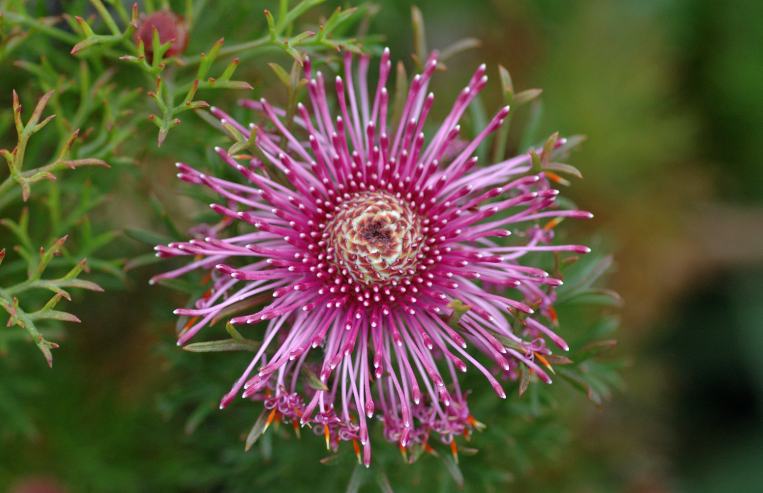
Isopogon is a genus of roughly 35 to 40 Australian shrubs best known by the common name drumsticks, a direct reference to the distinctive round, woody, cone-like fruit that persists on the plant for months or even indefinitely after flowering. Closely related to grevillea and banksia within the broader protea family, Isopogon brings its own genuinely distinctive silhouette to that considerable family tree, with rigid, often deeply divided foliage topped by compact, globular flower heads.
The genus also carries a genuinely unusual story behind its own name, one involving a race between competing botanists to publish first, a hastily completed naming job, and a formal scientific description that technically beat its own author into print. That kind of behind-the-scenes botanical drama is a reminder that even a genus name taken for granted today often has a far more complicated history than it first appears.
This guide covers the genus’s classification and the naming dispute tied to its discovery, how to identify it, its relationship with fire, its native range and distribution, several notable individual species, a genuine conservation case study tied to one particularly vulnerable species, and what it takes to grow one successfully.
Botanical Classification
Isopogon belongs to the family Proteaceae, with Isopogon anemonifolius serving as the genus’s formally designated type species. Species counts for the genus vary somewhat by source, typically cited as around 35 species in older references and closer to 39 or 40 in more recent treatments as taxonomic work has continued, with the genus endemic entirely to Australia and occurring in every state and territory except the Northern Territory.
The genus name comes from the Greek words isos, meaning equal, and pogon, meaning beard, a reference to the equal-length hairs found covering the fruit, or nuts, of several species within the genus. Common names for the genus include drumsticks, conesticks, and conebushes, though coneflower, sometimes also applied to Isopogon, is more properly associated with the closely related genus Petrophile, a naming overlap worth keeping in mind if you’re trying to confirm exactly which plant a given common name refers to.
A Naming Priority Dispute
Isopogon’s formal scientific naming involved a genuinely unusual race between competing botanists. The genus was first formally published in 1809 by Joseph Knight, in a work titled On the Cultivation of the Plants Belonging to the Natural Order of Proteeae, a publication that managed to appear in print before Robert Brown’s own, separately prepared description of the same genus, even though Brown had already written his account first.
Brown’s formal description eventually appeared in 1810, published as part of his broader work on the Proteaceae family in the Transactions of the Linnean Society, by which point Knight’s name had already claimed formal priority simply by reaching publication first. Adding another layer to the story, the botanist Richard Anthony Salisbury had earlier, in 1807, established a different genus name, Atylus, specifically intending to separate this and related species out of the genus Protea, but never completed the proper naming combinations needed to make that genus name valid, leaving the field open for Knight’s rushed publication to ultimately claim the name Isopogon still in use today.
That tangle of near-simultaneous publications is a genuinely vivid illustration of just how competitive, and occasionally messy, early 19th-century botanical description could get, particularly for a continent as rich in newly encountered plant diversity as Australia was proving to be.
Identifying Characteristics
Isopogon species grow as erect or prostrate shrubs with rigid, often deeply divided compound leaves, though a small number of species have simple, undivided leaves instead. Flowers are gathered into compact, rounded heads at the ends of the branches, typically in yellow or pink depending on the species, and those flower heads give way to the genus’s signature feature: a hard, woody, globular to barrel-shaped seed cone, usually around 2 centimeters in diameter, that often remains attached to the plant for an extended period, sometimes indefinitely, well after the flowers themselves have faded.
Size varies considerably across the genus, from genuinely prostrate, ground-hugging forms spreading barely 20 centimeters tall to more substantial upright shrubs reaching 1.5 to 2 meters. Foliage color can also shift seasonally in certain species, with some developing a purple tinge through autumn and winter that contrasts attractively against the grey, cone-like seed heads persisting from the previous flowering season.
Fire Adaptation and an Important Exception
Many Isopogon species develop a lignotuber, a woody, swollen structure at or below ground level that allows the plant to resprout even after a bushfire destroys everything visible above ground, with new seedlings commonly appearing in the growing season immediately following a fire. That fire-adapted regeneration strategy is shared broadly across much of the Proteaceae family and reflects the genus’s long evolutionary history within Australia’s fire-prone landscapes.
Not every species shares this trait, though, and the distinction matters a great deal for anyone actually growing one. Isopogon formosus, the rose coneflower, specifically lacks a lignotuber, which means it genuinely cannot regenerate from its rootstock if pruned too severely, unlike many of its lignotuberous relatives that handle hard pruning without issue. Knowing which specific species you’re growing, rather than assuming every Isopogon shares the same fire and pruning tolerance, is a genuinely important distinction before reaching for the pruning shears.
Native Range and Distribution
Isopogon occurs across every Australian state and territory except the Northern Territory, with the greatest concentration of species found in Western Australia, home to 27 of the genus’s species by one count. New South Wales, by contrast, currently has just 7 recognized species, reflecting the same broader pattern seen across several other Proteaceae genera where Western Australia’s ancient, nutrient-poor soils have driven a disproportionate share of the family’s total diversification.
Individual species occupy their own specific niches within that broader range, from sandy coastal heath to dry sclerophyll forest and woodland, often on exposed sites with notably poor, well-drained soil. That considerable habitat specificity across different species is part of why some Isopogon species thrive readily in cultivation while others prove genuinely difficult to grow successfully outside their precise native conditions. A species adapted to a narrow, specific pocket of sandy coastal heath, for instance, may simply fail to establish reliably in a garden with heavier clay soil, regardless of how carefully it’s otherwise cared for.
Notable Species
Isopogon anemonifolius, broad-leaved drumsticks, holds genuine historical significance as one of the very first Australian plants brought into cultivation in Europe, dating back to the late 1700s, and several named cultivars have since been developed from this long-cultivated species. Native to eastern New South Wales, it produces yellow flowers in late spring and early summer, and its leaves develop an attractive purple tinge through the cooler months that contrasts nicely with its persistent, cone-like seed heads.
Isopogon ceratophyllus, commonly called horny cone bush, takes its species name from the Greek words for little horn and leaf, a direct reference to its distinctive, deeply divided, antler-like foliage. Found in sandy heathland across western Victoria and eastern South Australia, it’s a hardy species in temperate climates, though not widely cultivated despite that genuine toughness.
Isopogon prostratus, the prostrate cone-bush, represents the genus at its most diminutive, growing just 0.2 meters tall while spreading to about a meter wide, restricted to a genuinely narrow, disjunct range across specific tablelands regions of New South Wales and just 2 isolated areas in Victoria.
A Conservation Case Study
Isopogon fletcheri, commonly called Fletcher’s drumsticks, offers a genuinely instructive example of how several separate vulnerabilities can compound into a real conservation concern for a single species. Named after the biologist Joseph James Fletcher, who discovered the plant in the late 1800s, this species is restricted to sandstone and gravel soils along Australia’s east coast and is distinguished from its eastern relatives by having an entire, undivided leaf margin rather than the divided or textured leaves typical of other east coast Isopogon species.
The species faces a combination of genuine limiting factors: its seeds are dispersed by gravity alone, with no wind or animal-assisted mechanism to help the species colonize new ground, severely restricting its natural capacity to spread. That limitation is compounded by its occurrence within a genuinely fire-prone ecosystem and its additional sensitivity to Phytophthora, a soil-borne fungal pathogen that affects numerous other Australian native plants as well. Together, those factors have resulted in Isopogon fletcheri being formally listed as Vulnerable under both state and Commonwealth conservation legislation, a genuine illustration of how multiple, individually modest vulnerabilities can combine into a serious overall conservation concern.
Growing Considerations
Isopogon species generally prefer full sun to light shade and moist, well-drained, sandy to sandy loam soil, and most are reasonably hardy once properly established in conditions that suit them. Like most Proteaceae, the genus shows real sensitivity to phosphorus, and only a low-phosphorus fertilizer, or one specifically formulated for Australian native plants, should ever be used.
Phytophthora cinnamomi, the same root rot fungus implicated in Isopogon fletcheri’s conservation listing, poses a genuine risk across the wider genus, making sharp drainage a priority for any Isopogon planting regardless of species. Western Australian species in particular can prove genuinely difficult to grow successfully in the more humid eastern states, since many simply don’t tolerate that higher humidity well and are considerably less hardy there than species native to the eastern states themselves.
When propagating from cuttings, using older plant material rather than soft new growth tends to produce more reliable results, and light, regular pruning generally improves shape and density in species that can tolerate it. Confirming whether a specific species or cultivar actually possesses a lignotuber before attempting any hard, rejuvenating prune remains a genuinely important step, given how differently Isopogon formosus and its lignotuberous relatives respond to exactly that kind of treatment.
The Bottom Line
Isopogon brings a genuinely distinctive drumstick-shaped seed cone and a considerable range of foliage texture and flower color to the already crowded field of Australian native Proteaceae, backed by a formal naming history involving a real race to publication between competing 19th-century botanists. Choose a species suited to your specific climate and soil, respect the genuine differences in fire tolerance and pruning resilience between species, and this often-overlooked relative of grevillea and banksia will reward you with a genuinely distinctive addition to a native garden.