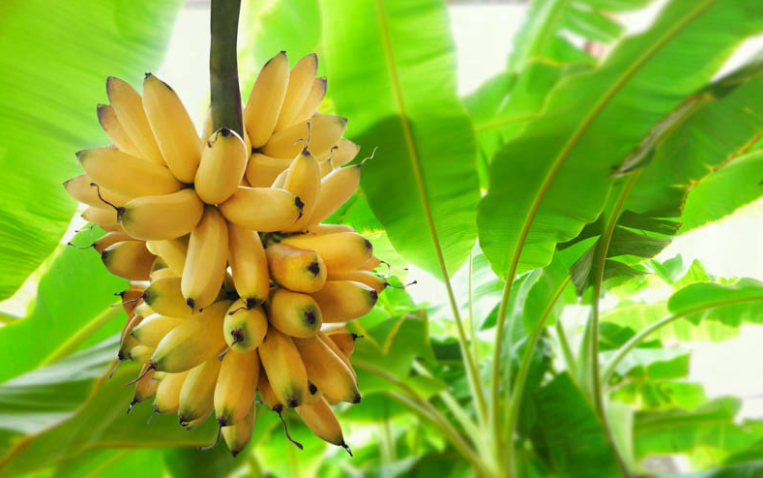
The Robusta banana is one of the most commercially significant Cavendish subgroup cultivars in Asia, holding a position of particular importance in India — the world’s largest banana-producing nation — where it dominates both domestic fresh markets and the country’s growing export trade. Belonging to the AAA genomic group with three complete chromosome sets derived entirely from Musa acuminata, Robusta shares its genomic classification with Williams, Grand Nain, and Dwarf Cavendish, yet stands apart as a cultivar specifically selected and refined for performance under South and Southeast Asian growing conditions. Its name is not merely descriptive branding — it genuinely reflects the plant’s characteristically vigorous constitution, strong pseudostem, and reliable productivity across a wide range of tropical agricultural environments.
Physically, Robusta is a tall, imposing banana plant, typically reaching 4 to 6 metres at full maturity with a thick, robust pseudostem — often green with black blotches — and large, spreading, deep green leaves that create a substantial canopy footprint. It is generally taller than Williams and significantly taller than Dwarf Cavendish, positioning it at the upper end of the Cavendish subgroup’s height range, which demands careful site selection and wind protection in exposed growing areas. The pseudostem is notably sturdy relative to its height, giving the plant better lodging resistance than some other tall Cavendish clones, and the root system is vigorous and deep-anchoring, exploring a wide soil volume to support the plant’s high growth rate and heavy bunch production. Under optimal conditions in India’s major banana-growing states, Robusta plants can develop impressive bunch weights of 35 to 55 kg, making it one of the highest-yielding Cavendish cultivars grown at scale.
The fruit of the Robusta banana conforms closely to the global Cavendish standard — long, uniformly curved fingers of 18 to 24 cm with smooth, green skin that ripens to bright, consistent yellow, and familiar mild, creamy-sweet flesh with a soft, appealing texture. Among Cavendish types, Robusta fruits are recognized for their notably uniform finger length and shape across the bunch, a characteristic that appeals to both domestic market buyers and export packers who prioritize cosmetic consistency. The skin is slightly thicker than that of some other Cavendish clones — a practical advantage in reducing bruising during the handling and transport chains common in India’s extensive banana distribution network — and the flesh maintains good eating quality across a reasonable post-ripening window of 3 to 5 days. While the flavor does not deviate dramatically from the Cavendish template, many Indian consumers and growers note a slightly fuller sweetness in naturally ripened Robusta compared to ethylene-treated commercial fruit.
India’s relationship with Robusta banana production is one of sheer agricultural scale. India produces over 31 million tonnes of bananas annually — more than any other country on earth — accounting for approximately 26% of global production, and Robusta is the single most important variety underpinning that output. It is grown across the key banana-producing states of Maharashtra, Karnataka, Andhra Pradesh, Gujarat, Madhya Pradesh, and Tamil Nadu, with the Jalgaon district of Maharashtra being particularly celebrated as India’s “Banana Capital,” producing some of the finest Robusta fruit in the country from the rich, black cotton soils of the Tapti River basin. The variety’s adaptability to the range of soil types, temperature regimes, and irrigation systems found across these diverse states has been central to its dominance — no other single variety has proven as consistently productive across India’s varied banana-growing environments.
Beyond India, Robusta has established meaningful commercial presence across Southeast Asia, East Africa, and parts of the Middle East, where it is valued by exporters for its good shelf life, attractive appearance, and compatibility with the ethylene ripening protocols used by modern supermarket supply chains. In Kenya and Tanzania, Robusta is grown alongside local cultivars in the coastal and mid-altitude zones for both domestic consumption and export to regional markets in the Middle East and Europe. The variety has also attracted interest in parts of Central America and the Caribbean as an alternative to Grand Nain in niche markets seeking Cavendish-type fruit with slightly different bunch architecture and sizing characteristics. Its global footprint, while not as widespread as Grand Nain in the export trade, reflects its genuine versatility as a commercial cultivar across a broad tropical geography.
Like every member of the Cavendish subgroup, Robusta carries no resistance to Fusarium wilt Tropical Race 4 (TR4), the catastrophic soil-borne fungal pathogen that has devastated Cavendish plantations across Southeast Asia, the Middle East, and increasingly Africa. India has so far maintained relatively limited TR4 incursion compared to Southeast Asian nations, but the disease has been detected in parts of the country and represents a potentially industry-transforming threat to Robusta’s dominance in Indian banana agriculture. The Indian Council of Agricultural Research (ICAR) and state agricultural universities have been actively engaged in developing TR4-resistant banana varieties through both conventional breeding and genetic improvement programs, with Robusta’s yield and fruit quality benchmarks serving as the performance standard that any replacement variety must meet to gain farmer acceptance across India’s enormous and diverse banana-growing sector.
How to Grow and Care for Robusta Banana
Climate and Site Selection
Robusta thrives in hot, humid tropical conditions with temperatures between 20°C and 38°C, performing particularly well in the warm river valleys and coastal plains of South and Southeast Asia where temperatures remain consistently high year-round. It is sensitive to cold and should not be planted in sites that experience temperatures below 14°C for extended periods, as chilling injury slows growth significantly, delays flowering, and reduces bunch weights. Select a full-sun position with reliable wind protection — Robusta’s considerable height makes it one of the more wind-vulnerable Cavendish cultivars, and bunch-laden plants require either natural shelter from tree windbreaks or artificial protection from shade cloth or windbreak netting.
Soil Preparation
Robusta performs best in deep, well-draining, fertile loam or black cotton soils with a pH between 6.0 and 7.5 — the black cotton soils of Maharashtra’s Jalgaon district being the benchmark for what Robusta can achieve in ideal soil conditions. Incorporate generous quantities of farmyard manure — at least 10 kg per planting pit — along with a balanced pre-plant fertilizer of nitrogen, phosphorus, and potassium before planting, working amendments into a pit of at least 60 cm depth and 60 cm width. Avoid waterlogged or compacted sites entirely, as Robusta’s vigorous root system demands well-aerated soil to reach its productive potential and is highly susceptible to the root rot organisms that proliferate in poorly drained conditions.
Planting
Robusta is propagated from sword suckers, corm bits, or — increasingly in commercial Indian production — tissue culture plantlets produced by agricultural research stations and private nurseries, which offer the advantage of genetic uniformity, disease-free status, and faster early establishment. Plant suckers or tissue culture plants at 30 to 40 cm depth in prepared pits, spacing plants 1.8 to 2.5 metres apart in paired rows with 1.8 metres between plants and 2 metres between row pairs — a high-density system widely used in Maharashtra that maximizes land productivity while maintaining adequate airflow. Water immediately after planting and apply mulch across the entire planting area to conserve moisture and moderate soil temperature during the critical establishment phase.
Watering
Robusta has a substantial water requirement reflecting its rapid growth rate and large evapotranspiring leaf area, typically needing 35 to 50 mm of water equivalent per week during the active growing season in the absence of rainfall. Drip irrigation is the preferred method in commercial Indian Robusta production, with lateral lines delivering water directly to the root zone at intervals calculated to maintain field capacity without waterlogging. Deficit irrigation during the fruit-filling stage — maintaining soil moisture at 70 to 80% of field capacity rather than 100% — has been shown in Indian research trials to improve sugar accumulation and flavor concentration in Robusta fruit without significantly reducing bunch weight.
Fertilizing
Robusta is a high-demand feeder that responds dramatically to well-managed fertilizer programs, with Indian commercial growers typically applying total seasonal doses of 200 to 250 g nitrogen, 60 to 75 g phosphorus, and 300 to 400 g potassium per plant across 6 to 8 split applications timed to key growth stages. Begin with a phosphorus-heavy establishment feed in the first two months, shift to a nitrogen-dominant program through the vegetative growth phase, and transition to high-potassium feeding from flower initiation through bunch fill to maximize fruit size and sweetness. Farmyard manure applications of 10 kg per plant at planting and again at the midpoint of the crop cycle provide essential organic matter and micronutrients that enhance the efficiency of inorganic fertilizer inputs.
Mulching
Apply a generous 10 to 15 cm mulch layer of sugarcane trash, straw, or dry banana leaves across the entire mat area immediately after planting and maintain it continuously throughout the crop cycle. In the hot, dry conditions of Maharashtra and Gujarat where Robusta is extensively grown, mulching reduces soil moisture evaporation by up to 50%, moderates soil temperature fluctuations that stress the root system, and suppresses the vigorous weed growth that competes intensely for nutrients and water in fertile, irrigated banana soils. Spent pseudostem material from harvested plants is an excellent mulch source, returning potassium-rich organic matter to the root zone with each successive harvest cycle.
Desuckering
Robusta produces vigorous suckers prolifically and requires regular, disciplined desuckering to maintain the productive three-generation mat structure — mother, primary follower, secondary follower — that drives efficient, continuous fruiting. Inspect the mat every 4 to 6 weeks during the growing season and remove all unwanted suckers at ground level, destroying the growing point with a sharp knife or chisel to prevent regrowth. In high-density commercial plantings, precise follower selection and positioning is critical to maintaining the regular inter-plant spacing that ensures adequate light penetration and airflow across the crop canopy as successive generations develop.
Propping
Given Robusta’s considerable height and typically heavy bunch weights, propping is an essential and non-negotiable management practice in commercial production rather than an optional precaution. Install two or three bamboo props or timber stakes angled at 45 degrees from the bunch side of the pseudostem, tied firmly to the stem above the bunch peduncle, as soon as the bunch begins developing significant weight — typically 4 to 6 weeks after flower emergence. In areas prone to strong seasonal winds or cyclones, additional cable or rope support systems anchored to ground stakes around the plant perimeter provide an extra layer of protection for high-value, near-harvest bunches.
Flowering and Bunch Management
Robusta typically flowers 10 to 14 months after planting under Indian tropical conditions, with higher altitudes and cooler seasons extending this timeline. Once all hands have emerged from the flower bract and the bell is producing only sterile bracts, remove it cleanly 15 cm below the last hand to concentrate photosynthate into fruit fill and accelerate bunch development. Bag developing bunches with blue perforated polyethylene bags — standard commercial practice across Indian Robusta plantations — which protect fruit from thrips damage, sunburn, and dust contamination while creating a warmer microclimate that advances harvest timing by 1 to 2 weeks and improves the cosmetic quality of the finished fruit.
Pest and Disease Management
Panama disease TR4 is the paramount biosecurity concern for Robusta growers, requiring strict protocols around planting material certification, soil movement, tool sterilization, and farm visitor management to prevent introduction onto clean properties. Corm weevil (Cosmopolites sordidus) is a serious and widespread pest in Indian Robusta production, damaging the corm and root system in ways that significantly reduce plant vigour and bunch weight — managed through pheromone traps, clean planting material, and approved insecticide treatments applied to the corm at planting. Sigatoka leaf disease, nematodes, and Banana Bunchy Top Virus — the latter spread by the banana aphid and causing catastrophic stunting and yield loss — round out the key integrated pest management priorities for Indian Robusta growers.
Harvesting
Harvest Robusta when fingers are three-quarter full — well-rounded in cross-section with clear angularity disappearing — and skin color has progressed from deep green to medium green or pale green, typically 13 to 16 weeks after flower emergence under Indian conditions. Given the plant’s height, harvesting safely requires two operators — one to make the clean upward cut through the bunch peduncle and one to support and cushion the falling bunch — to prevent the impact bruising that degrades cosmetic quality and shelf life. Harvested bunches should be immediately transferred to padded harvest crates or banana mats, moved to a cool packing shed without delay, and handled as gently as possible throughout the post-harvest chain to maintain the cosmetic quality that premium markets demand.
Post-Harvest Plant Care
Immediately after bunch removal, cut the spent pseudostem to approximately 1 metre in height to allow stored carbohydrates to transfer downward into the corm and developing follower sucker, then reduce to ground level 2 to 3 weeks later. Distribute the chopped pseudostem sections across the mat as moisture-retaining, potassium-rich mulch, add a fresh application of farmyard manure and balanced fertilizer around the base of the primary follower, and replenish the mulch layer to set the successor plant on the strongest possible trajectory toward its own productive cycle. Sterilize all cutting tools thoroughly between plants and maintain meticulous farm records of plant growth stages, input applications, and pest observations to continuously refine management decisions across successive crop generations.