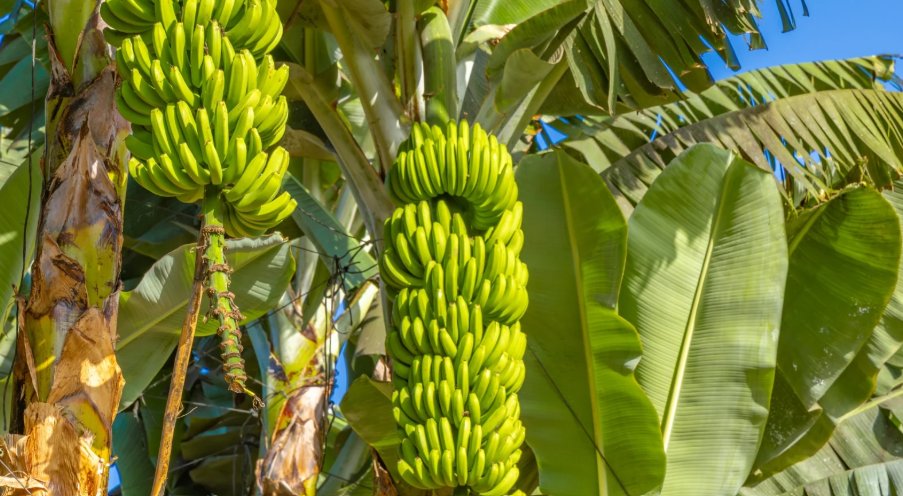
The Williams banana is a premier Cavendish subgroup cultivar that has earned its place as one of the most commercially important banana varieties in the Southern Hemisphere, dominating domestic markets and export programs across Australia, South Africa, and New Zealand. Like all members of the Cavendish subgroup, it belongs to the AAA genomic group, carrying three complete chromosome sets derived entirely from Musa acuminata, the sweet banana ancestor native to Southeast Asia and the Pacific. While it shares its genomic identity with Dwarf Cavendish, Grand Nain, and other Cavendish clones, Williams is a distinct cultivar selected and refined specifically for its exceptional vigor, large bunch size, and outstanding post-harvest performance under commercial handling conditions.
Physically, the Williams is a tall, robust banana plant, typically reaching 3.5 to 5 metres at maturity with a thick, sturdy pseudostem and large, broad, deep green leaves that give it an imposing, architectural presence in the landscape. It sits in the mid-to-tall range of the Cavendish subgroup — taller than Dwarf Cavendish but generally not as extreme in height as some Grand Nain selections — and its strong pseudostem provides good resistance to lodging in moderate wind conditions. The plant is vigorous and fast-growing, producing leaves rapidly during warm, well-fed growing conditions, and it develops a large, productive mat of suckers that sustains continuous fruiting cycles when properly managed. Bunch weights under commercial conditions typically range from 30 to 50 kg, with well-managed plants in optimal conditions occasionally exceeding this range.
The fruit of the Williams banana is the quintessential Cavendish banana in every commercial respect — long, gently curved, smooth-skinned fingers of 18 to 22 cm that ripen from green through bright yellow to spotted yellow-brown, with the familiar mild, creamy sweetness and soft white flesh that has made Cavendish bananas the global standard. Williams fruits are noted among Cavendish types for their particularly uniform sizing and consistent shape across the bunch, qualities that make them highly attractive to supermarket buyers and export packers who demand tight cosmetic specifications. The flavor, while not dramatically different from other Cavendish clones, is considered by many Australian and South African growers to be slightly fuller and more aromatic than some other commercial Cavendish selections when fruit is allowed to ripen naturally on the plant rather than being ethylene-treated.
In Australia, Williams is the dominant commercial banana variety, grown extensively across the key banana-producing regions of Far North Queensland — particularly around Tully, Innisfail, Cardwell, and the Atherton Tablelands — which together produce approximately 94% of Australia’s total banana output. Australia’s banana industry is worth around AUD $700 million annually, and Williams underpins the majority of that value, thriving in the hot, humid, high-rainfall conditions of tropical Queensland that closely mirror the banana’s preferred growing environment. The variety’s performance in Australian conditions — combining high yields, large bunch weights, and good disease management compatibility — has made it the benchmark commercial cultivar against which other varieties are assessed by Australian growers and industry bodies.
Beyond Australia, Williams has established strong commercial footholds in South Africa — where it is grown in the Limpopo and Mpumalanga provinces and the KwaZulu-Natal coastal region — as well as in New Zealand’s Northland and parts of Central America and the Canary Islands. South Africa’s banana industry, centered on the subtropical river valleys of Limpopo, produces around 200,000 tonnes annually, with Williams accounting for a significant share of output destined for domestic supermarkets and regional African markets. In each of these growing regions, Williams has been selected and retained not merely because it produces good fruit, but because it integrates well into the full post-harvest chain — packing, transport, cool storage, and retail ripening — without compromising on the consistent eating quality that consumers expect from a Cavendish banana.
Like all Cavendish varieties, Williams faces the existential threat of Fusarium wilt Tropical Race 4 (TR4), the soil-borne fungal pathogen that has already devastated commercial Cavendish plantations across Southeast Asia, the Middle East, and parts of Africa, and for which no commercially viable chemical control or fully resistant replacement variety yet exists at scale.
The Australian banana industry — with Williams at its core — has invested heavily in biosecurity protocols, farm hygiene programs, and research into TR4-resistant banana varieties to protect the industry from the catastrophic losses that TR4 has caused elsewhere. Several research programs, including work at the Queensland University of Technology and by Bioversity International, are actively developing genetically improved or conventionally bred Cavendish-type bananas with TR4 resistance, with Williams itself being used as a benchmark target for flavor and yield in these breeding programs.
How to Grow and Care for Williams Banana
Climate and Site Selection
Williams performs best in hot, humid tropical and subtropical climates with temperatures consistently between 20°C and 35°C and annual rainfall of 1,500 to 2,500 mm, conditions that mirror its stronghold in Far North Queensland. It is less cold-tolerant than Dwarf Cavendish and should not be planted in sites that experience regular frost or prolonged temperatures below 12°C, which will stunt growth and delay or prevent flowering. Choose a full-sun, wind-sheltered position — Williams’ tall stature makes it more vulnerable to wind damage than compact varieties, and bunch-laden plants can topple in strong gusts without adequate shelter or support.
Soil Preparation
Prepare a deep, well-draining planting site enriched with generous amounts of aged compost, well-rotted manure, and a balanced pre-plant fertilizer worked into the top 50 cm of soil. Williams demands excellent drainage — its vigorous root system explores a wide soil volume but is highly sensitive to waterlogging, which causes rapid anaerobic root death and opens the plant to fungal pathogens. In naturally heavy or compacted soils, raise the planting bed and incorporate coarse organic matter and sand to create the free-draining, moisture-retentive loam that drives Williams’ characteristically vigorous growth.
Planting
Source Williams planting material from certified, disease-free nurseries or tissue culture laboratories, as the variety’s commercial importance has made high-quality, TR4-tested tissue culture plantlets widely available through banana industry suppliers. Plant sword suckers or tissue culture plantlets at a depth of 30 to 40 cm, spacing plants 3 to 4 metres apart in rows 3.5 to 4.5 metres wide to accommodate the plant’s tall canopy and wide leaf spread at maturity. Water thoroughly at planting and apply mulch immediately, and in exposed sites, install temporary windbreak netting around young plants until they establish a firm root anchor.
Watering
Williams has a high water demand commensurate with its vigorous growth and large leaf area, requiring the equivalent of 30 to 50 mm of water per week during the active growing season. Drip irrigation is the commercial standard for Williams production, delivering precise volumes directly to the root zone while keeping foliage and pseudostems dry to minimize fungal disease pressure. Monitor soil moisture regularly at root depth — 20 to 30 cm — and adjust irrigation frequency to maintain consistent moisture without saturation, particularly during dry seasons when rainfall deficits can significantly reduce bunch weights and finger length.
Fertilizing
Williams is among the heaviest-feeding of the Cavendish cultivars, reflecting its rapid growth rate and high bunch weight potential. Apply a high-nitrogen fertilizer every 6 to 8 weeks during vegetative development, transitioning to a balanced then high-potassium formula from flower emergence through bunch fill to maximize fruit size, weight, and flavor development. Commercial Williams growers in Queensland typically apply 200 to 300 g of nitrogen, 30 to 50 g of phosphorus, and 500 to 700 g of potassium per plant per year across multiple split applications, with supplementary magnesium and micronutrient programs to maintain leaf health and photosynthetic efficiency.
Mulching
Maintain a permanent, deep mulch layer of 10 to 15 cm across the entire mat area, using sugarcane trash, straw, or wood chips to conserve soil moisture, moderate soil temperature, and suppress weed competition. Mulch is particularly important for Williams because its high water and nutrient demands are most efficiently met when soil moisture is stable and weed competition for nutrients is minimized. Chopped spent pseudostem material from harvested plants makes excellent mulch, returning significant quantities of potassium and organic matter to the soil surface with each crop cycle.
Desuckering
Manage the Williams mat on a strict three-generation rotation — mother plant, primary follower, secondary follower — removing all additional suckers promptly to prevent overcrowding and resource competition that reduces bunch size and delays successive crops. Given Williams’ vigorous suckering tendency, desuckering may be needed every 4 to 6 weeks during peak growing season to stay ahead of unwanted sucker development. Select followers positioned to create a balanced, well-spaced mat rather than a lopsided cluster, which improves airflow, light penetration, and overall plant health across successive generations.
Propping and Wind Protection
Williams’ tall stature and heavy bunch weights create a real risk of plant toppling in wind or under the weight of a large bunch approaching harvest. Prop plants with sturdy bamboo or timber stakes tied loosely to the pseudostem once the bunch begins to develop and weigh down the plant, and in exposed sites install permanent windbreak hedges or shade cloth barriers along the prevailing wind direction. In commercial Queensland plantations, propping is standard practice for every flowering Williams plant, as a single toppled plant can damage neighbors and represents a complete loss of that plant’s entire productive cycle.
Flowering and Bunch Management
Williams flowers 9 to 12 months after planting in optimal tropical conditions, producing a large, pendulous bunch with typically 9 to 14 hands of well-filled fingers. Remove the male bud cleanly once all hands have formed and the bell is producing only empty bracts, cutting the stalk 15 cm below the last hand to redirect energy into fruit fill. Bag bunches immediately after the last hand opens using perforated blue polyethylene bags, which protect fruit from insect damage, wind scarring, and sunburn while creating a warm microclimate that can advance harvest by 2 to 3 weeks.
Pest and Disease Management
TR4 biosecurity is the paramount disease management concern for Williams growers, requiring strict farm hygiene protocols — boot washes, equipment sterilization, controlled visitor access, and soil movement restrictions — to prevent introduction of the pathogen onto clean properties. Sigatoka leaf disease is managed through regular removal and destruction of infected lower leaves, good plant spacing, and where necessary, approved fungicide spray programs calibrated to leaf infection scoring systems used by the Queensland banana industry. Banana weevil borer, nematodes, and Banana Bunchy Top Virus — spread by the banana aphid Pentalonia nigronervosa — round out the key pest management priorities, requiring integrated monitoring and targeted intervention to maintain plant health and productivity.
Harvesting
Harvest Williams bunches at the three-quarter full stage — when fingers are well-rounded in cross-section but still firmly green — typically 12 to 16 weeks after flowering, depending on temperature and season. The tall plant height means harvesting Williams generally requires two people — one to support and lower the bunch and one to make the cut — or the use of a harvest pole with a cutting attachment for single-operator efficiency. Handle harvested bunches with exceptional care, cushioning them on padded harvest trailers or banana mats to prevent the bruising and latex staining that degrades cosmetic quality and reduces market value.
Post-Harvest Plant Care
After the bunch is removed, cut the spent pseudostem to 1 metre immediately, then to ground level 2 to 3 weeks later, allowing carbohydrate reserves to transfer into the primary follower sucker. Chop the spent pseudostem into manageable sections and distribute them as mulch around the mat, where their high water and potassium content benefits the developing successor plant. Sterilize all cutting equipment between plants, apply fresh compost and a balanced fertilizer around the base of the follower, and maintain the mulch layer to set the next generation of the mat up for equally vigorous and productive growth.