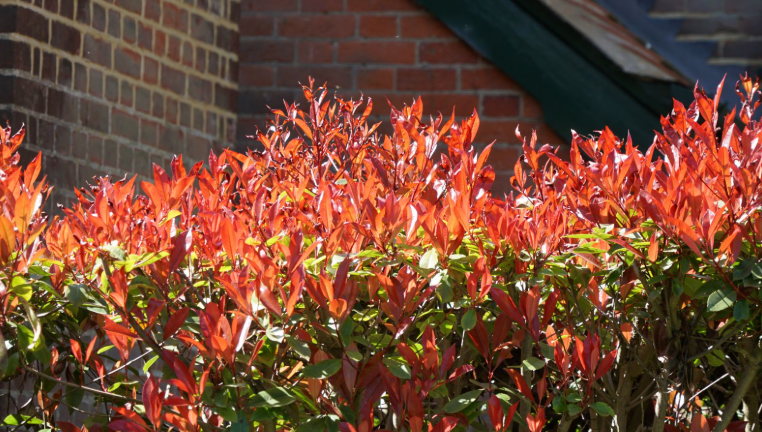
Photinia × fraseri became one of the most widely planted hedge shrubs across the American South almost entirely because of a single, specific visual trait: brilliant red new growth that flushes across the entire plant several times a year before fading to a deep, glossy green. For decades, that dramatic seasonal color made it the default choice for a fast, dense privacy screen in warmer climates.
The plant’s story is also a genuine cautionary tale about what happens when a single ornamental variety gets planted at enormous scale with too little genetic diversity behind it. A fungal disease that thrives in exactly the humid, crowded conditions so many hedges create has forced landscapers and homeowners across large parts of the country to reconsider a shrub that once seemed like an unbeatable low-maintenance choice.
This guide covers the plant’s classification and origin, how to identify it, what it takes to grow one, the disease problem that’s reshaped its reputation, popular cultivars, and how it’s best used in the landscape today.
Botanical Classification
Photinia × fraseri belongs to the rose family, Rosaceae, and is a hybrid cross between Photinia serratifolia, a species native to China, and Photinia glabra, native to Japan. The cross sign in its scientific name indicates its hybrid origin, a genetic combination of 2 distinct parent species rather than a single wild species in its own right.
The plant is commonly known as red tip photinia, red top, Fraser photinia, or Fraser’s photinia, with the species epithet fraseri honoring the nursery where the hybrid was first identified rather than describing any specific botanical trait. Its full scientific name, Photinia × fraseri Dress, credits the botanist who formally described and named the hybrid after its discovery.
Brief History
The hybrid originated as a chance seedling discovered in a seed lot at Fraser Nursery in Birmingham, Alabama, around 1940. According to the Missouri Botanical Garden, it was subsequently introduced into commerce in 1955 under the name Photinia × fraseri ‘Birmingham,’ though the cultivar designation ‘Birmingham’ was later dropped from common use, leaving the plant simply known by its hybrid species name.
That accidental origin, a naturally occurring cross discovered rather than deliberately bred, is a genuinely common pattern in the history of popular ornamental plants, and Fraser’s name has remained permanently attached to the hybrid ever since, even though the nursery itself didn’t set out to create it. The parent species themselves come from considerably different parts of East Asia, China for Photinia serratifolia and Japan for Photinia glabra, and the resulting hybrid shows traits from both, including a size and vigor that exceeds what either individual parent species typically produces on its own. The plant’s considerable visual appeal and fast growth rate drove rapid, widespread adoption across the American South in the decades following its introduction.
Identifying Characteristics
The plant’s most recognizable feature by far is its new growth, which emerges bronze-red to bright coppery-red at the tips of the branches before gradually fading to a glossy, deep green over roughly 2 to 4 weeks. That red flush repeats multiple times during the growing season, particularly after pruning, giving the shrub a genuinely eye-catching, ever-changing appearance that mature green foliage alone could never provide.
Leaves are simple, alternate, elliptic to oval in shape, finely serrated along the edges, and typically run about 3 to 5.5 inches long and 1.5 to 2 inches wide. In mid-spring, the plant produces small white flowers gathered into flat-topped clusters roughly 4 to 5 inches across, though the species usually produces few or no red fruit afterward, a genuine difference from its 2 parent species, both of which fruit more reliably. Left unpruned, Photinia × fraseri can reach a substantial size, commonly 10 to 20 feet tall and nearly as wide, though regular hedging keeps most cultivated specimens considerably more compact. Its considerable size potential is also part of why the species works as either a tall privacy screen or, with careful training, something closer to a small specimen tree in a landscape with enough room to let it reach that fuller natural form.
Growing Considerations
Photinia × fraseri prefers full sun to light shade, and while it tolerates full shade, expect noticeably reduced flowering and considerably greater susceptibility to disease in a shadier spot. It’s hardy across USDA zones 6 or 7 through 9 depending on the specific source consulted, and it shows reasonable drought tolerance once properly established.
The plant is notably intolerant of consistently wet soil, and getting water directly on the leaves, whether through overhead irrigation or poor drainage splashing moisture upward, should be avoided wherever possible, since damp foliage creates exactly the conditions its major disease problem needs to take hold. Nitrogen deficiency can also show up as off-color, yellowish foliage, a sign worth watching for in an otherwise healthy-looking planting. Propagation is typically done from cuttings rather than seed, since the hybrid origin means seed-grown plants won’t reliably come true to the parent.
The Entomosporium Leaf Spot Problem
No discussion of this plant is complete without addressing the fungal disease that has fundamentally reshaped its reputation and use. Entomosporium leaf spot, caused by the fungus Entomosporium maculatum, is by a considerable margin the most serious problem Photinia × fraseri faces, producing small dark spots on the leaves that can progress to severe defoliation and, in bad cases, the death of the entire plant.
The disease thrives specifically in humid, poorly ventilated conditions, which makes a densely planted hedge, exactly the application this plant became famous for, genuinely one of the worst possible environments for keeping it disease-free. According to Oregon State University’s Landscape Plants database, this disease has significantly reduced the use of Photinia × fraseri in parts of the United States, and heavy historical planting throughout the deep South specifically is now declining as a direct result. Preventing the disease matters far more than treating it once established, and that prevention comes down to providing genuinely good air circulation between plants, avoiding overcrowded spacing, and keeping the foliage as dry as realistically possible.
Pruning and the Flowering Tradeoff
Pruning this plant involves a genuine tradeoff worth understanding before you reach for the shears. Cutting the plant back in spring, after the current red growth flush has faded to green, encourages another flush of that prized red new growth, which is exactly why so many hedges get sheared repeatedly throughout the growing season.
That repeated shearing, though, comes at the direct expense of flowering, since pruning removes the growth that would otherwise produce the plant’s white spring flower clusters. Gardeners who want to see the plant flower, and potentially set the modest fruit crop that sometimes follows, need to let it grow naturally for at least part of the season rather than maintaining a constantly sheared formal hedge shape. Regular tip-pruning for shape is still worthwhile even then, just timed and limited with that flowering tradeoff in mind.
Popular Cultivars
Several named cultivars have been developed from the original hybrid, each offering some variation on size, foliage color, or growth habit. ‘Red Robin’ is probably the most widely planted Photinia × fraseri cultivar of all, recognized by the Royal Horticultural Society for its reliable performance, and ‘Little Red Robin’ offers the same general appearance in a genuinely dwarf form, reaching just 2 to 3 feet tall and wide, a practical option for a smaller garden space.
‘Pink Marble,’ also sold as ‘Cassini,’ is a variegated selection offering cream and pink tones mixed into the foliage rather than the plain green and red of the straight species, and it too carries RHS recognition. ‘Robusta,’ ‘Camilvy,’ ‘Curly Fantasy,’ and the more recently introduced ‘Super Hedger,’ bred specifically for strong, upright growth suited to formal hedging, round out the more commonly available named selections.
Landscape Uses
Photinia × fraseri has been used overwhelmingly as a hedge and privacy screen, a role its fast growth rate and naturally dense, upright habit suit particularly well. When left to grow into its natural form rather than being sheared constantly, it can also serve as an attractive specimen plant or landscape feature in its own right, developing a fuller, more varied shape than a tightly clipped hedge ever shows.
Its considerable tolerance for alkaline soils has broadened its usefulness beyond gardens with ideal, naturally acidic conditions, and its toughness has made it a historically popular choice for a children’s garden or playground border, where a resilient, fast-growing screen matters more than delicate ornamental refinement. That said, the ongoing disease pressure covered above has genuinely shifted professional landscaping opinion in many regions, and plenty of landscape designers now recommend considering alternative hedging species, particularly in humid climates where Entomosporium leaf spot is most severe.
Pests and Other Problems
Beyond its major fungal disease issue, Photinia × fraseri can also attract scale insects, spider mites, and aphids, and regular inspection of the foliage makes it considerably easier to catch and manage any of these infestations early before they become severe. None of these insect pests typically rival Entomosporium leaf spot in overall destructive potential, but they’re worth checking for during routine garden maintenance regardless, since catching a smaller infestation early is always more manageable than dealing with an established one later in the season.
With proper care and, critically, the disease avoided or well managed, the plant can live for decades, with some sources citing a potential lifespan approaching 50 years or more under favorable conditions. A shrub that suddenly loses all its foliage, though, is very likely a victim of leaf spot rather than any other single cause, and that kind of sudden, severe defoliation is usually a sign the plant is in serious trouble rather than simply experiencing ordinary seasonal leaf drop.
The Bottom Line
Photinia × fraseri earned its decades of popularity through genuinely striking red new growth and a fast, dense growth habit that made quick work of a privacy hedge, but its considerable vulnerability to Entomosporium leaf spot has reshaped how it’s used and recommended today, especially in humid climates where that disease thrives. Give it full sun, good airflow, and dry foliage, and it remains a genuinely attractive, fast-growing shrub, but it’s worth going in with realistic expectations about the disease risk that comes attached to its famous red tips.