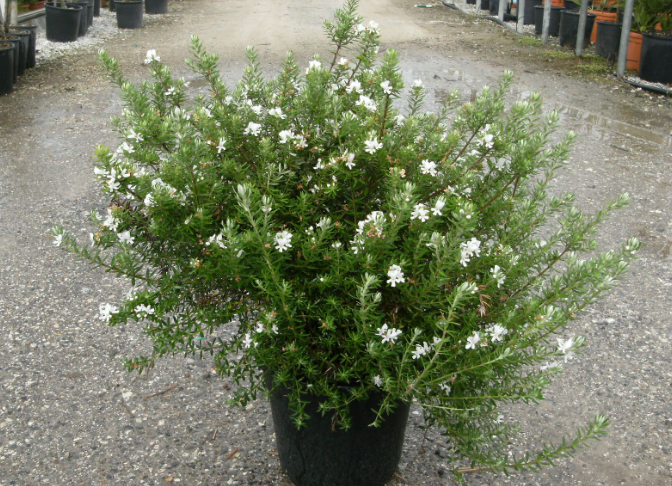
Westringia fruticosa is one of the toughest, most reliably low-maintenance shrubs an Australian or Mediterranean-climate gardener can plant, a dense, silvery-green evergreen that shrugs off salt spray, relentless coastal wind, and drought with equal indifference. Its common name, coast rosemary, points directly at the reason for its popularity: a passing resemblance to true rosemary that’s fooled plenty of gardeners into assuming it belongs in the kitchen rather than the garden bed.
That resemblance is entirely superficial. Westringia fruticosa isn’t related to culinary rosemary in any meaningful botanical sense, and it has no place in cooking, despite narrow, needle-like foliage that genuinely does look a lot like the herb at a casual glance. What it does have is a remarkable tolerance for exactly the harsh coastal conditions that make so many other garden shrubs struggle or fail outright.
This guide covers the plant’s classification and naming, how to identify it, where it grows naturally, how it earned a name it doesn’t quite deserve, its flowering habit, popular cultivars, landscape uses, and what it takes to grow one successfully.
Botanical Classification
Westringia fruticosa belongs to the genus Westringia within Lamiaceae, the mint family, placing it in the same broader plant family as true rosemary, basil, and sage despite sitting in a completely different genus from any of them. Its full scientific name is Westringia fruticosa (Willd.) Druce, and the species epithet fruticosa comes from Latin, simply meaning “shrubby,” a fitting if unglamorous description of the plant’s dense, bushy growth habit.
The genus Westringia itself commemorates Johan Peter Westring, an 18th-century Swedish physician and naturalist, a naming convention common in botany where a genus honors a historical figure connected to the broader scientific tradition rather than describing any specific trait of the plant itself. Membership in Lamiaceae is visible in the plant’s flower structure, where the upper petal splits into 2 distinct lobes, a characteristic shared across countless other mint family plants worldwide. That family connection also explains why Westringia and true rosemary share a loose family resemblance at all, despite belonging to entirely separate genera within that much larger, genuinely diverse plant family.
Identifying Characteristics
Westringia fruticosa forms a dense, rounded, evergreen shrub with narrow, grey-green to silvery leaves arranged in neat whorls along the stem, a tidy, orderly foliage pattern that holds its shape well whether the plant is clipped into a formal hedge or left to grow naturally. Left unpruned, the species can eventually reach around 4 meters, or roughly 13 feet, in height, though most cultivated specimens are kept considerably more compact through regular trimming.
Its small flowers are genuinely distinctive once you look closely: white, sometimes blushed with pale lilac or mauve, covered in fine hairs, and marked with small orange-to-purple spots on the lower petal lobes. Those spots function as a visual nectar guide for pollinating insects, a detail easy to miss without a close look but a reliable identifying feature once you know to check for it. The plant blooms intermittently throughout much of the year rather than in one concentrated seasonal flush, giving it a genuinely long period of ornamental interest compared to many shrubs that bloom briefly and then go quiet for the rest of the year.
Native Range and Habitat
Westringia fruticosa is native specifically to the coastal regions of New South Wales, Australia, where it grows naturally on sea cliffs, exposed headlands, sandy dunes, and harbor foreshores, including well-known wild populations found growing directly on exposed cliffs at Coogee, near Sydney. It has since naturalized more broadly across eastern and southern Australia beyond that original native range.
That native habitat, exposed, salt-laden, nutrient-poor, and frequently windswept, explains essentially everything about the plant’s considerable toughness in cultivation. A shrub that evolved to survive directly on an ocean-facing cliff face has little trouble handling the comparatively gentler conditions of an ordinary coastal garden. That same hardiness has allowed the species to naturalize well beyond its original New South Wales range, establishing itself along considerable stretches of coastline in other Australian states where conditions are similarly exposed and sandy.
Not a True Rosemary
The common name coast rosemary, along with alternate names like Australian rosemary and native rosemary, creates a genuine and persistent point of confusion. True culinary rosemary belongs to an entirely different genus, now classified as Salvia rosmarinus, and the 2 plants share no close botanical relationship beyond both occupying the same broad mint family and favoring similar dry, sunny, well-drained growing conditions.
The resemblance that earned Westringia its common name comes down to simple convergent appearance: both plants have narrow, needle-like leaves and a similar wiry, upright growth habit, and both thrive in comparable Mediterranean-style climates. Despite that visual similarity, Westringia fruticosa has no culinary use whatsoever and isn’t a flavoring substitute for true rosemary in any recipe. Anyone drawn to the plant specifically for cooking purposes should look elsewhere, since this is purely an ornamental and landscaping shrub.
Flowering and Wildlife Value
Westringia fruticosa’s small white flowers, produced more or less continuously across much of the year rather than in a single tight bloom window, make it a genuinely valuable nectar source for birds and other garden wildlife over an extended season. That near-constant flowering is part of why the plant has become such a reliable choice for a wildlife-friendly native garden in Australia specifically.
The flower’s structural details, the 2-lobed upper petal and the orange-to-purple spotted lower lobe, reflect its mint family membership and serve a genuine pollination function, guiding visiting insects toward the nectar reward at the flower’s center. Birds are also drawn to the shrub, both for the nectar its flowers provide and for the shelter its dense, tangled branching offers smaller species looking to nest or rest away from predators. That combination of extended bloom time and functional flower design has made the species popular well beyond its native range, including recognition from the Royal Horticultural Society’s Award of Garden Merit, a distinction given to plants judged to perform reliably well under real garden conditions.
Popular Cultivars
Decades of selection have produced a considerable range of named Westringia fruticosa cultivars, each bred for a specific size, form, or foliage characteristic beyond what the straight species offers. ‘Jervis Gem,’ ‘Smoky,’ ‘Naringa,’ and ‘Wynyabbie Gem’ are among the better-known cultivars widely used specifically as hedging plants, each offering slightly different growth habits and foliage tones suited to different garden applications.
‘Mundi’ takes the opposite approach entirely, offering a genuine groundcover form with darker green foliage, a dense, low, spreading habit, and attractive texture, making it a practical choice for covering ground rather than forming an upright hedge or screen. Choosing between these cultivars generally comes down to the specific job a gardener needs the plant to do, whether that’s a tall, clipped privacy hedge, a low border, or a sprawling bank cover on a difficult, exposed slope. A variegated form of the species also exists, offering cream-and-green foliage as a point of visual interest distinct from the plain grey-green coloring of the standard species and most other cultivars.
Landscape Uses
Westringia fruticosa is used extensively for formal hedging and informal screening, its fast growth and dense, tidy foliage making it a practical, low-maintenance alternative to slower-growing or more finicky hedge plants in a coastal or Mediterranean-climate garden. A planting spacing of around 150 centimeters between individual shrubs is commonly recommended to establish a dense, continuous hedge within a reasonable timeframe.
Beyond formal hedging, the plant works well as a foundation planting, a border shrub, a windbreak for a genuinely exposed coastal frontline site, and, in its groundcover cultivar form, as a low-maintenance spreading ground cover. Mixing several cultivars within the same garden, pairing an upright hedging form with the low, spreading ‘Mundi’ as underplanting, is a practical way to get varied texture and height from what is genetically still the same adaptable species. It also performs reliably in a container, provided the pot doesn’t dry out completely during the hottest part of summer, making it a flexible choice for a patio or balcony garden in a suitable climate.
Growing Considerations
Westringia fruticosa wants full sun and well-drained soil, tolerating sandy, loamy, and even heavier soil types provided drainage is adequate, with a preference for slightly acidic to neutral soil conditions. It’s considerably drought tolerant once established, typically taking around 12 weeks of regular watering to develop the root system needed to handle drier conditions on its own afterward.
The plant tolerates coastal wind, salt spray, and light to moderate frost reasonably well, though prolonged, severe frost should be avoided, and it’s generally hardy only up to about USDA zone 11b at the warmest end of the scale, reflecting its origin in a genuinely frost-free to only lightly frosty coastal climate. A low-phosphate fertilizer formulated specifically for Australian native plants, applied in early spring and again in autumn, provides adequate nutrition without encouraging the kind of soft, disease-prone growth that richer feeding can cause. Light pruning while the plant is young encourages dense, bushy growth, and established hedges benefit from regular trimming during the growing season to maintain a tidy, formal shape.
Pests and Diseases
Westringia fruticosa is a genuinely hardy plant when it comes to pests and disease, and healthy, well-sited specimens are typically free of serious problems. Its tough, aromatic foliage holds little appeal for deer and rabbits, making it a practical choice in a garden dealing with browsing wildlife pressure.
The main risk worth watching for is base rot, which can develop under excessive moisture or heavily shaded conditions where the soil stays wetter than the plant’s coastal, well-drained native habitat would ever allow. Ensuring genuinely good drainage and avoiding overly shaded planting sites addresses the great majority of problems this otherwise trouble-free shrub is likely to encounter. Overwatering an established plant, more than any pest or pathogen, remains the single most common way a Westringia fruticosa planting runs into trouble.
The Bottom Line
Westringia fruticosa earns its considerable popularity through sheer practicality: a dense, attractive, nearly indestructible evergreen shrub that tolerates salt spray, coastal wind, drought, and poor soil while still delivering months of flowers and genuine wildlife value. Its borrowed resemblance to true rosemary may be purely cosmetic, but its real-world performance as a hedge, screen, or low-maintenance garden anchor is entirely its own.