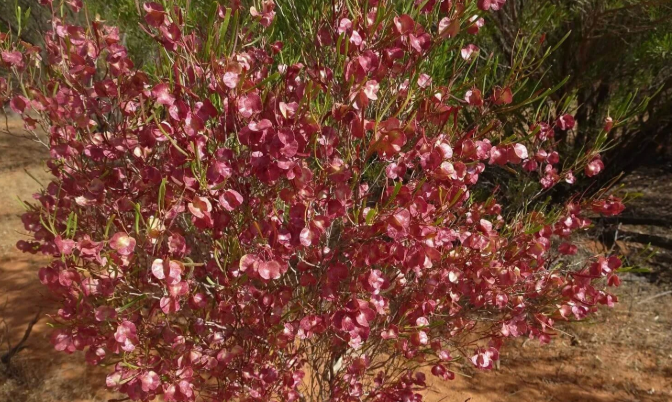
Hop bush is a tough, adaptable evergreen shrub with one of the most genuinely remarkable distribution stories of any plant in cultivation, a species that spread across 6 continents entirely on its own, without any help from human cultivation, over roughly the last 2 million years. Its colorful, papery seed capsules and willingness to thrive in poor, dry, exposed soil have made it a popular landscaping choice across the many warm regions it now calls home.
Despite its common name, hop bush has nothing to do with the hops used to flavor beer, beyond a genuine historical coincidence involving its fruit’s appearance and an early European Australian practice of using it as a substitute brewing ingredient. That naming mix-up, paired with the plant’s considerable ecological and botanical interest, makes it a genuinely rewarding shrub to understand beyond its reputation as a tough, low-maintenance landscaping plant.
This guide covers the plant’s classification and naming history, how to identify it, its extraordinary natural distribution, its considerable subspecies diversity, its traditional and practical uses, and what it takes to grow one successfully.
Botanical Classification
Hop bush, scientifically Dodonaea viscosa, belongs to the Sapindaceae family and is a dioecious species, meaning individual plants are either male or female rather than bearing both sexes of flower on the same shrub. The genus Dodonaea contains 69 recognized species, 60 of which are endemic to Australia, making the genus overwhelmingly, though not exclusively, an Australian one.
The genus name honors Rembert Dodoens, a 16th-century Flemish botanist who served as a professor of medicine at the University of Leyden in the Netherlands, a naming convention applied by the botanist Philip Miller in 1754. Records from that same period show Dodonaea viscosa was already being cultivated in Europe by 1754, a genuinely early introduction for a plant originally native to the opposite side of the world. That early cultivation date reflects just how far the plant’s natural range already extended by the time European botanists began formally documenting and naming it, long before the full scope of its transoceanic distribution had even been studied.
Brief History and Naming
The common name “hop bush” comes from a specific historical practice among early European settlers in Australia, who used the plant’s colorful, papery fruit capsules as a substitute for true hops and even yeast when brewing beer. Despite that shared common name and a genuine visual resemblance between the 2 plants’ fruit, hop bush is not related to true hops, Humulus lupulus, in any meaningful botanical sense, since the 2 species belong to entirely different plant families.
Beyond its accidental role in colonial brewing, hop bush held real traditional significance for Aboriginal Australians, who used the plant to treat toothache, cuts, and stingray stings. In New Zealand, where a related form of the species is known as akeake, the wood holds a genuinely remarkable distinction: it’s the heaviest of any native New Zealand timber, a property that gave it real traditional value for specific woodworking and tool-making purposes among Māori communities.
Identifying Characteristics
Hop bush typically grows as a dense, evergreen shrub reaching 10 to 15 feet tall and wide, though it can be maintained considerably smaller with regular pruning, and some forms develop into single-stemmed small trees reaching up to 8 meters under favorable conditions. Its leaves are slender and spoon-shaped, growing densely along the branches, with a glossy, resin-coated surface that gives the plant a notably sticky feel, directly reflected in its species name viscosa, Latin for sticky.
The plant’s actual flowers are genuinely inconspicuous and easy to overlook entirely, but its fruit more than makes up for that with considerable visual interest. Clusters of papery, wine-red, flower-like seed capsules develop in place of true flowers as the standout ornamental feature, and these capsules display noticeably richer, more saturated color when the plant grows in brighter light conditions.
A Remarkable Transoceanic Range
Hop bush’s natural distribution is where the plant’s story becomes genuinely extraordinary. Research has documented the species spreading across 6 continents entirely through natural oceanic dispersal, without any human assistance, achieving that reach in roughly the last 2 million years starting from its original point of origin in Australia. One study describing this phenomenon characterized hop bush as having achieved “a distribution equal to some of the world’s greatest transoceanic dispersers,” a genuinely impressive distinction for a shrub most people have never heard of.
That natural range now spans from roughly 33 degrees north latitude, reaching into California, all the way to 44 degrees south latitude in New Zealand’s South Island, encompassing parts of Africa, the Americas, southern Asia, Australia, New Zealand, and a considerable number of Pacific islands along the way. Few other woody plants can claim a naturally occurring range that wide without any direct human involvement in spreading it.
Subspecies Diversity
Given how widely hop bush has spread and how many different environments it’s adapted to along the way, the species shows considerable internal diversity, currently organized into 7 recognized subspecies. Four of those subspecies, angustissima, cuneata, mucronata, and spatulata, are found exclusively within Australia, while the remaining subspecies occur more broadly across the plant’s wider international range.
Each subspecies has adapted to its own specific habitat and shows varying degrees of drought tolerance as a result. Subspecies mucronata, for example, is found mainly in central Australia along with scattered populations in Western Australia, Queensland, and New South Wales, favoring rocky or sandy soil in genuinely arid regions. That considerable internal variation also means hop bush readily hybridizes where different subspecies or populations grow near each other, which is part of why growers specifically interested in a true-to-type specimen are generally advised to source seed from a single known wild population rather than from mixed garden stock. Researchers studying the species’ genetic diversity have specifically examined subspecies angustissima and spatulata as they occur along an environmental gradient in South Australia, work that’s helped build a clearer picture of how the plant’s considerable phenotypic variation tracks with the different conditions each population has adapted to.
Traditional and Practical Uses
Beyond its accidental role as a hops substitute in early Australian brewing, hop bush has held genuine practical value across several of the cultures within its vast natural range. Its bitter seed capsules have also seen limited use as a food condiment in certain traditional contexts, and its considerable wood density, particularly in the New Zealand akeake form, made it valuable for specific traditional purposes requiring a genuinely hard, heavy timber.
Modern practical applications lean more toward landscaping and land management than food or brewing. The plant’s dense root system and tolerance for poor, disturbed soil have made it a genuinely valuable choice for erosion control, dune stabilization, and as a pioneer species in revegetation projects following land disturbance, roles that take direct advantage of the same toughness that allowed it to spread across oceans in the first place.
Landscape Uses
Hop bush’s dense growth habit has made it a popular hedging and screening plant, valued for forming a genuinely solid, continuous barrier with minimal maintenance once established. Its tolerance for salt spray, wind, and pollution has made it a particularly practical choice for a coastal garden or an exposed urban planting site where more delicate ornamental shrubs would struggle.
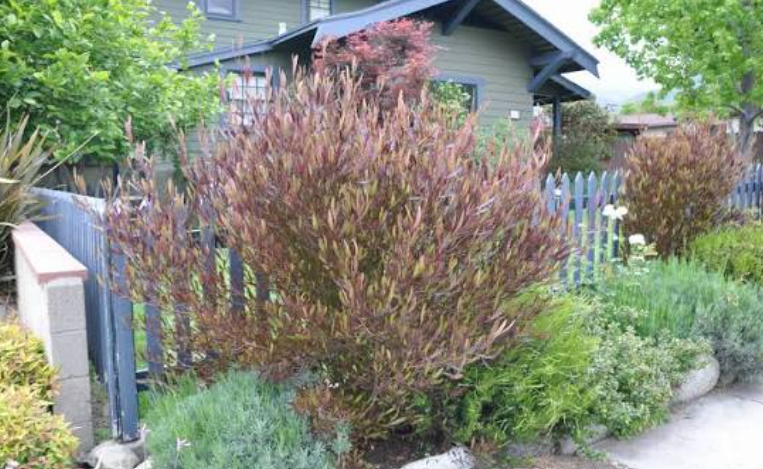
A popular cultivated selection called ‘Purpurea’ offers deep purple foliage instead of the species’ typical green, adding a genuine ornamental color option for gardeners wanting more visual drama than the straight species provides. Beyond hedging, hop bush also works well as a windbreak, a border planting, or a specimen shrub, and its considerable resin content has occasionally drawn comparisons to candlewood for its flammability, reflected in one of its less common alternate names. That same dense, resinous wood that earned it the candlewood nickname also contributes to the plant’s overall toughness and resistance to the kind of wind and salt damage that would quickly degrade a softer, less resinous shrub.
Growing Considerations
Hop bush thrives in full sun to light shade and isn’t particular about soil type, tolerating dry, sandy, or rocky conditions with genuine ease once established, though it also takes regular watering reasonably well if that’s what a particular garden setting provides. It’s hardy to around USDA zone 8 according to Oregon State University’s Landscape Plants database, though actual cold tolerance can vary depending on which subspecies or geographic seed source a particular plant traces back to.
The plant tolerates considerable heat, drought, ocean wind, and even desert conditions, reflecting the genuine ecological range it occupies across its naturally wide distribution. It can be propagated readily from both cuttings and seed, though as noted above, seed collected from a single known wild population is generally preferred over mixed garden seed specifically to avoid the unpredictable results that come from this species’ considerable tendency to hybridize.
Habitat Range and Ecological Notes
Within Australia specifically, hop bush occupies a genuinely wide range of habitat types, including rocky ridges, open forest, riverine plant communities, mallee scrubland, and general woodland and shrubland. It’s notably absent, though, from alpine environments and from genuinely dense vegetation communities like heathland and rainforest, suggesting the plant’s considerable toughness has real limits when it comes to extreme cold or heavy competition from denser surrounding vegetation.
That combination of broad habitat tolerance paired with specific environments it avoids altogether offers a useful window into exactly what conditions this species has evolved to handle well, open, sunny, often disturbed ground, rather than genuinely extreme cold or deep shade competition. Gardeners choosing a planting site for hop bush are well served by matching that same general preference, favoring an open, well-lit spot over a crowded bed or deeply shaded corner.
The Bottom Line
Hop bush earns its considerable reputation as a tough, adaptable landscaping shrub through genuine ecological credentials few other garden plants can match, a species that conquered 6 continents through nothing but ocean currents and sheer resilience, long before any gardener ever planted one on purpose. Give it full sun, decent drainage, and realistic expectations about its hybridizing tendency, and this unassuming shrub with the misleading common name will reward you with a genuinely low-maintenance hedge, screen, or specimen plant backed by one of the more remarkable natural histories in the plant world.