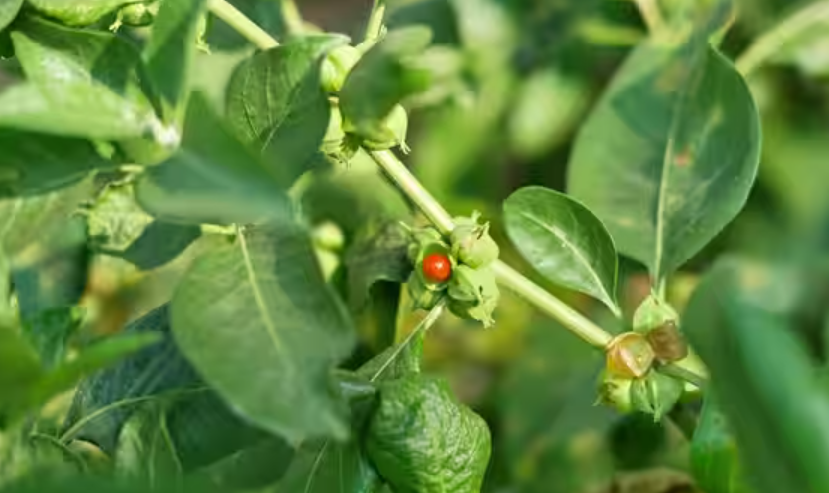
Ashwagandha is a small, woody shrub in the nightshade family, and identifying it correctly comes down to checking a handful of specific features together, since no single trait alone is enough to confirm the plant. Its scientific name, Withania somnifera, is also sold as Indian ginseng or winter cherry, and several close relatives within the same genus look similar enough that a careful look at the whole plant, not just one leaf or flower, is the safest way to be sure.
Overall Growth Habit
Start with the plant’s general shape and size. Ashwagandha grows as an erect, woody, evergreen perennial shrub, typically reaching somewhere between 1 and 5 feet tall depending on growing conditions and age, with most mature plants settling in the 3 to 4 foot range. Multiple grey-green, downy branches radiate outward from a central stem, giving the whole plant a somewhat sprawling, bushy silhouette rather than a single clean trunk.
The stems and young growth have a distinctly fuzzy, felt-like texture, a result of fine hairs covering the surface, which gives the plant an overall soft grey-green cast rather than a glossy green one. This downy texture is one of the easier features to check early, since it’s present across the whole plant and doesn’t require waiting for flowers or fruit to appear. A young seedling can look unremarkable at first, more like a small, soft-leaved weed than anything distinctive, which is exactly why relying on just one quick glance at a juvenile plant is a common source of misidentification.
Leaves
Ashwagandha leaves are simple, oval to elliptic in shape, and typically run anywhere from 2 to 6 inches long, occasionally reaching closer to 10 to 12 centimeters on vigorous growth. Their color is a dull, somewhat muted green rather than a bright or glossy one, and like the stems, the leaves often carry a light, soft fuzziness to the touch.
Leaves are arranged alternately along the stem, and their generally unremarkable, plain oval shape is part of why correct identification depends on looking at more than foliage alone. A nightshade-family leaf shape like this is shared by a considerable number of unrelated plants, so leaves are a useful supporting clue rather than a definitive one.
Flowers
The flowers are small, bell-shaped, and greenish-yellow, typically only about half an inch across. They’re genuinely easy to miss at a glance, since their color so closely matches the surrounding foliage that the plant can be in bloom without an untrained eye noticing right away.
Flowers emerge in small clusters from the base of the leaf bracts, though usually only a single flower within each cluster is open at any given time, with small yellow stamens visible at the center of each bloom. If you’re trying to confirm an identification and the plant isn’t yet fruiting, checking closely at these leaf junctions for small, bell-shaped, yellow-green flowers is worth the extra attention it takes.
Fruit and Berries
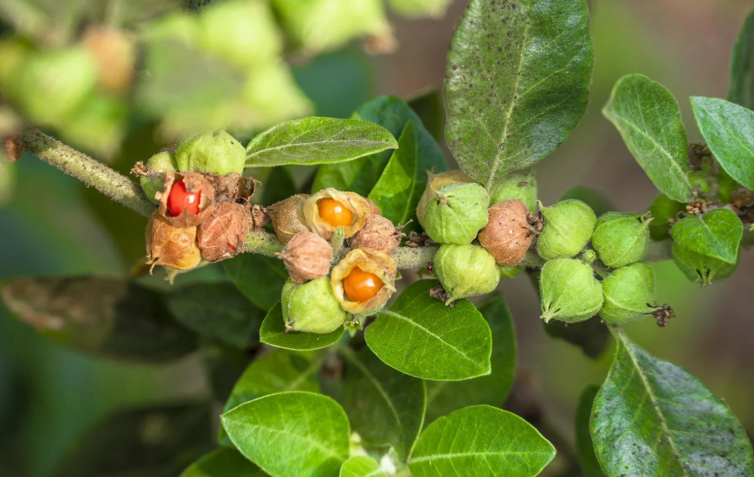
The fruit is one of the most visually distinctive and genuinely useful identifying features of ashwagandha. Each berry starts out green and ripens to a bright orange-red, and it’s enclosed in a thin, papery, bladder-like husk that often splits open or sloughs away as the fruit matures, revealing the vivid berry inside, a structure similar in concept to the papery husk on a ground cherry or Chinese lantern plant, both of which are also nightshade relatives.
Individual berries are small, round, and roughly half an inch across, and they contain numerous small, yellow, kidney-shaped seeds inside. This papery-husk-around-a-bright-berry combination is a genuinely strong identifying clue once fruiting begins, since it’s considerably more distinctive than the plant’s leaves or flowers alone. It’s worth noting directly that these berries are considered poisonous and should never be eaten, a serious safety point worth remembering regardless of how visually appealing the ripe red fruit looks.
The Root and Its Smell
If you have access to the root, and especially if other identifying features leave you uncertain, checking for smell is one of the most distinctive tests available. Ashwagandha’s name itself comes directly from this feature: it’s a combination of the Sanskrit words “ashva,” meaning horse, and “gandha,” meaning smell, a direct reference to the root’s strong, musky, horse-like odor.
The root itself is long, tuberous, and fibrous, typically pale brown to whitish in color. That genuinely distinctive smell is one of the most reliable single confirmations available if you’re trying to verify an identification with real confidence, since few other plants in casual cultivation share quite that particular odor.
Native Range and Habitat
Ashwagandha is native to India, the Middle East, and parts of North Africa, and it’s also found growing in Nepal, Sri Lanka, China, and Yemen. It favors dry, stony, often disturbed or waste ground, and it tolerates full sun to partial shade, reflecting genuine adaptation to the arid and semi-arid regions that make up much of its native and naturalized range.
If you’re trying to identify a plant you’ve encountered growing wild, finding it on poor, well-drained, sun-baked soil rather than a rich, consistently moist garden bed is itself a small supporting clue, consistent with the dry conditions the plant naturally favors. It’s also increasingly grown as a cultivated crop outside its native range, including in parts of the United States and Europe, so a plant matching this description in a garden bed or farm plot doesn’t necessarily mean it’s growing wild.
A Caution on Look-Alikes and Safety
The genus Withania contains several other species that are morphologically similar to true ashwagandha, meaning a confident identification really does benefit from checking multiple features together rather than relying on any single trait. Because the plant belongs to the nightshade family, anyone with a known nightshade sensitivity or allergy should also approach it, and especially its berries, with real caution.
If your goal in identifying the plant is to harvest or use it, rather than simply confirm what you’re looking at, it’s worth getting a second confirmation from an experienced forager, a regional field guide, or a knowledgeable local source before relying on self-identification alone, particularly given the toxicity of the berries and the existence of similar-looking relatives within the same genus.