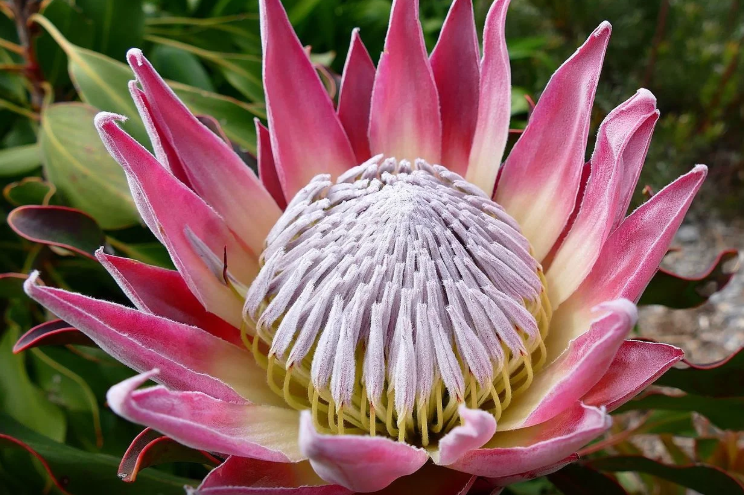
Protea is one of the most ancient, extraordinary, and visually arresting flowering plants on earth, belonging to the family Proteaceae — a lineage so old that it predates the breaking apart of the supercontinent Gondwana over 300 million years ago. The genus Protea comprises over 100 recognized species, the overwhelming majority of which are native to the Cape Floristic Region of South Africa, one of the world’s six recognized floral kingdoms and one of its most biodiverse. The genus takes its name from Proteus, the shape-shifting sea god of Greek mythology, a reference to the astonishing variety of forms, sizes, and colors found across the species. The King Protea, Protea cynaroides, is the national flower of South Africa, a source of immense national pride and a globally recognized symbol of the country’s extraordinary natural heritage.
The flower heads of Proteas are among the most dramatic and architecturally spectacular in the entire plant kingdom. What appears to be a single large flower is in fact a composite structure — a dense central dome or cone packed with dozens of tiny individual flowers, surrounded by multiple layers of large, stiff, petal-like bracts that range in color from creamy white and soft pink to deep crimson, burgundy, and rich coral. These bracts are often fringed with silky hairs, giving the blooms a luxuriously textured appearance. Flower heads range in size from a few inches across in smaller species to an extraordinary twelve inches in diameter in the King Protea, making them among the largest individual flower structures of any plant in the world.
Also Read: How To Grow Wisteria From Seed
Proteas are quintessential plants of the South African fynbos biome — a unique Mediterranean-climate shrubland characterized by thin, highly acidic, nutrient-depleted soils, hot dry summers, cool wet winters, and frequent natural fires. It is precisely these challenging conditions to which Proteas have perfectly adapted over millions of years of evolution. Many species have developed a remarkable survival strategy involving specialized woody structures at their base called lignotubers, from which the plant resprouts vigorously after fire. Some species hold their seeds in tightly sealed cones that only open after the heat of a fire passes over them — a reproductive strategy called serotiny that is perfectly attuned to their fire-dependent ecosystem.
As cut flowers and in the floral industry, Proteas have achieved remarkable global popularity and commercial importance. Their extraordinary visual impact, exceptionally long vase life of two to three weeks, and ability to dry beautifully while retaining their color and structure have made them hugely sought after by florists, wedding designers, and floral artists worldwide. South Africa, Australia, New Zealand, Hawaii, Chile, and Kenya are among the major commercial producers of cut Proteas, and the flowers appear regularly in high-end floral arrangements, bridal bouquets, and luxury hotel displays around the globe. Their bold, sculptural quality makes them as suited to dramatic contemporary arrangements as to rustic, naturalistic displays.
In the garden, Proteas are grown successfully in regions with a Mediterranean-type climate — warm, dry summers and cool, moist winters — including coastal California, the Mediterranean basin, parts of Australia and New Zealand, and the highlands of East Africa including Kenya. They are evergreen shrubs ranging from compact ground-hugging species of one foot in height to large, tree-like specimens reaching fifteen feet or more. Once established, they are remarkably tough, drought-tolerant, and long-lived plants, but they are famously intolerant of several common gardening practices including overwatering, phosphorus-rich fertilizers, and heavy clay soils, all of which can kill them with surprising speed.
Also Read: How to Grow Roses from Seed
Beyond their aesthetic and commercial appeal, Proteas play an irreplaceable ecological role in their native fynbos habitat. Their large, nectar-rich flower heads are a vital food source for a remarkable array of specialized wildlife, most notably the Cape sugarbird and various species of sunbird that have co-evolved alongside them as their primary pollinators. Rodents, beetles, and other insects also feed on Protea nectar and contribute to pollination. The loss of fynbos habitat to urban expansion, agriculture, and invasive plant species represents a serious conservation concern for many Protea species, and numerous conservation programs in South Africa are actively working to preserve both the plants and the unique ecosystem upon which they and countless other species depend.
How to Grow Protea from Seed
- Source fresh, high-quality seeds. The viability of Protea seeds declines relatively quickly after harvest, so always source seeds from a reputable specialist supplier and ensure they are as fresh as possible — ideally harvested within the current season. Fresh seeds have dramatically higher germination rates than older stored seeds, and starting with quality material is the single most important factor in success.
- Treat seeds to remove germination inhibitors. Protea seeds are coated with a chemical germination inhibitor that must be removed before sowing. Soak seeds in a solution of warm water and a small amount of liquid smoke — available from barbecue supply stores — for 24 hours, or alternatively soak in plain warm water for 24 hours, changing the water twice. Some growers also have success with a brief treatment using diluted hydrogen peroxide solution to further stimulate germination.
- Consider smoke treatment to mimic natural fire cues. In their natural fynbos habitat, Protea seeds are triggered to germinate by the chemical compounds in smoke following a wildfire. Commercially prepared smoke-water or smoke-impregnated germination discs are available from specialist horticultural suppliers and can be used to treat seeds or drench seed trays, closely replicating these natural fire-cue compounds and often producing a marked improvement in germination rates.
- Prepare a specialized, nutrient-free growing medium. This is critically important — Proteas are adapted to extremely nutrient-poor soils and are fatally sensitive to phosphorus in particular. Never use standard potting mix or any medium containing added fertilizer, compost, or peat. Instead, prepare a mix of equal parts coarse river sand and perlite, or use a dedicated fynbos or Proteaceae seed-starting mix available from specialist nurseries.
- Use deep individual pots or tubes from the start. Proteas develop a deep, extensive root system very early in their development and resent root disturbance intensely. Sow seeds in deep individual tubes, root trainers, or tall narrow pots rather than shallow seed trays, giving the taproot room to develop freely from the very beginning without the need for early transplanting.
- Sow seeds at the correct depth. Press seeds onto the surface of the moistened growing medium and cover them with a layer of coarse sand or fine grit to a depth of approximately ¼ to ½ inch (6–12 mm). The grit covering helps maintain moisture around the seed while keeping the neck of the emerging seedling dry, reducing the risk of damping-off, which can be a problem in the early stages of germination. Also Read: How to Grow Coreopsis from Seed
- Sow at the right time of year. The ideal time to sow Protea seeds is in late summer to early autumn in the Southern Hemisphere, or late summer in the Northern Hemisphere — timing that aligns with the beginning of the natural cool, moist season in their native habitat. Autumn-sown seeds experience the cooler, more humid conditions that naturally trigger germination and establish the strongest root systems before the following growing season.
- Maintain cool, consistent temperatures for germination. Unlike most ornamental plants that prefer warmth for germination, Proteas germinate best in relatively cool conditions, with soil temperatures between 50–65°F (10–18°C). Place seed pots in a cool, well-ventilated greenhouse, cold frame, or sheltered outdoor location. Excessive warmth inhibits germination and encourages fungal problems in the nutrient-free growing medium.
- Water with care using clean, low-pH water. Proteas are highly sensitive to water quality. Use rainwater or filtered water wherever possible, as tap water in many areas contains fluoride, chlorine, and dissolved minerals that can accumulate in the growing medium and harm developing seedlings. Water sparingly — keeping the medium just barely moist rather than wet — as Protea seeds and young roots are very susceptible to rotting in overly moist conditions.
- Be exceptionally patient with germination. Protea germination is notoriously slow and unpredictable. Some seeds may sprout within 4–6 weeks of sowing, while others from the same batch may take 3–6 months or longer. Do not discard seed pots after a few weeks of apparent inactivity — maintain them in appropriate conditions for at least six months before concluding that germination has failed.
- Protect emerging seedlings from fungal disease. Damping-off is the most common cause of seedling loss in Proteas. To minimize the risk, ensure excellent air circulation around seed pots at all times, avoid overhead watering, keep the surface of the growing medium on the drier side between waterings, and consider a preventative drench with a copper-based fungicide or a biological fungicide at the time of sowing.
- Provide bright light but avoid harsh direct sun initially. Once seedlings emerge, move them to a bright, well-lit location with good air circulation. Provide bright indirect light or gentle morning sun for the first several weeks, gradually introducing more direct sunlight as seedlings strengthen and develop their characteristic stiff, leathery foliage. Harsh, unfiltered midday summer sun can scorch young seedlings before they have developed sufficient protective leaf cuticle.
- Never fertilize young seedlings with standard fertilizers. The single most common cause of Protea seedling death after damping-off is fertilizer toxicity — particularly phosphorus toxicity. Standard potting fertilizers and slow-release granules contain phosphorus levels that are instantly lethal to Proteas. If any feeding is deemed necessary after several months of growth, use only a specifically formulated Proteaceae fertilizer that is explicitly labeled as phosphorus-free or very low in phosphorus.
- Pot up with great care and minimal root disturbance. When seedlings have been growing for several months and roots are visible at the base of the pot, it is time to move them to a larger container. Handle seedlings with extreme care, disturbing the root ball as little as possible. Use the same nutrient-free, free-draining growing medium as before, and water sparingly after repotting, allowing the plant to recover quietly without the additional stress of excess moisture.
- Harden off and transplant to the garden carefully. Before planting out into the garden, harden seedlings off gradually over two to three weeks by increasing their exposure to outdoor conditions progressively. Choose a planting site with full sun, excellent drainage, and naturally acidic, nutrient-poor soil. Improve drainage on heavier soils by incorporating generous quantities of coarse grit or river sand. Plant in late summer or early autumn when conditions are cooling, and water in gently after planting without over-saturating the surrounding soil.
- Accept that flowering from seed takes time — and is deeply rewarding. Proteas grown from seed are genuinely slow to reach flowering size, typically taking three to five years from sowing before producing their first magnificent blooms. This extended wait is simply the nature of these ancient, slow-growing plants, and no amount of feeding or coaxing will reliably accelerate the process without risking the plant’s health. Those gardeners who commit to the journey with patience, respect for the plant’s very specific needs, and a willingness to learn from early setbacks will ultimately be rewarded with one of the most breathtaking and conversation-stopping displays that any garden plant in the world is capable of producing.
Also Read: How To Grow Azalea From Seed