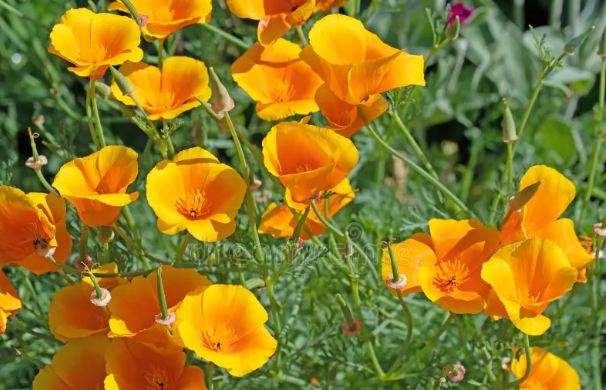
The California Poppy, known botanically as Eschscholzia californica, is one of the most iconic and immediately recognizable wildflowers in the world. It is the official state flower of California, a distinction it has held since 1903, and it grows wild in breathtaking abundance across the hillsides, roadsides, and grasslands of the western United States and northern Mexico. Named in honor of Johann Friedrich von Eschscholtz, a Baltic German naturalist who encountered the plant during an 1815 expedition to the California coast, it belongs to the poppy family, Papaveraceae, though it is a distinct genus from the true poppies of Papaver. Its blazing orange blooms carpeting sun-drenched Californian hillsides in spring are one of nature’s most spectacular floral displays.
The flowers of the California Poppy are silky, luminous, and gloriously simple in their beauty. The classic wild form produces vivid, cup-shaped flowers in a brilliant flame-orange, four petals wide and up to three inches across, that seem almost to glow with an inner light in direct sunshine. Modern cultivated varieties have expanded the color palette dramatically to include rich gold, lemon yellow, ivory white, soft pink, deep rose, brick red, and even bicolored forms with picotee edges. The flowers open wide in full sunshine and close at night and on overcast days — a behaviour known as nyctinasty — protecting the delicate pollen from rain and dew. The blooms are held on slender, upright stems above finely cut, blue-green, ferny foliage that is itself ornamental and attractive.
Also Read: How to Grow Nasturtium from Seed
Beyond its dazzling visual appeal, the California Poppy is deeply woven into the cultural and ecological fabric of its native region. For many California Native American peoples, the plant held both practical and spiritual significance — it was used medicinally as a mild sedative and painkiller, and its oily seeds were used to condition hair. Unlike its cousin the opium poppy, the California Poppy contains entirely different alkaloids — primarily californidine and eschscholtzine — and has no narcotic properties, though it has been used in herbal medicine as a gentle relaxant and sleep aid. Ecologically, its flowers are an important nectar and pollen source for native bees, beetles, and other pollinators in its native habitat.
As a garden plant, the California Poppy is celebrated above all else for its extraordinary ease of cultivation and its remarkable tolerance for poor, dry conditions. It thrives in lean, well-drained, even rocky or sandy soils where many other flowering plants would struggle, and it requires virtually no supplemental watering once established, making it one of the most genuinely drought-tolerant flowering annuals available to gardeners. It is grown as a cool-season annual in most climates, germinating and blooming in the cooler months of spring and early summer before setting seed and dying back as summer heat intensifies. In mild, frost-free climates it can behave as a short-lived perennial, persisting and reseeding year after year.
One of the California Poppy’s most endearing qualities is its enthusiastic and reliable self-seeding habit. Once established in a suitable garden spot, it will return year after year by scattering its own seeds prolifically at the end of the season, creating an ever-expanding naturalistic colony that requires no intervention from the gardener. Ripe seed capsules split open with a subtle but audible snap, flinging tiny seeds considerable distances. This generosity with seed, combined with the plant’s exceptional ease of germination, means that a single packet of seeds can provide years of ongoing floral abundance. Deadheading spent flowers prolongs the blooming period, while allowing some flowers to go to seed ensures the next generation is sown.
In the contemporary garden, the California Poppy earns its place in an extraordinarily wide range of settings and design styles. It is equally at home scattered through a wildflower meadow, massed in a cottage garden border, planted in drifts along a sunny pathway, grown in containers on a sun-drenched balcony, or used as a cheerful groundcover on a dry, sunny bank where little else will grow. Its vibrant color, feathery foliage, long blooming season, drought tolerance, and complete absence of serious pest or disease problems make it one of the most rewarding and versatile flowering plants a gardener can choose. Quite simply, for sheer bang-for-your-buck garden impact with minimal effort, few flowers on earth can rival the glorious, sun-loving California Poppy.
Also Read: How to Grow Zinnia From Seed
How to Grow California Poppy from Seed
- Direct sow rather than starting indoors. California Poppies are best sown directly in the ground where they are to grow and bloom. They develop a long, delicate taproot very early in their development and respond extremely poorly to transplanting, often dying or failing to thrive when their roots are disturbed. Starting them in pots indoors for later transplanting is strongly discouraged and almost always results in failure.
- Sow at the right time of year. In most climates, sow seeds in early spring as soon as the soil can be worked, even while light frosts are still possible — California Poppies are remarkably frost-tolerant as seedlings and actually prefer to germinate in cool soil. In mild, frost-free climates, seeds can also be sown in autumn for winter and spring blooming, which more closely mimics their natural growing cycle.
- Choose the sunniest spot available. California Poppies are sun worshippers and demand a location that receives full, direct sunlight for at least 6–8 hours daily. They will not perform well in shaded or even partially shaded conditions, producing sparse, weak, leggy growth and very few flowers. The sunnier and more open the site, the more spectacular the display will be.
- Prepare the soil minimally — less is more. One of the most important things to understand about California Poppies is that they actively prefer poor, lean, well-draining soil. Do not enrich the planting area with compost, manure, or fertilizer before sowing. Rich, fertile soil produces lush, floppy foliage at the expense of flowers, and overly moist or heavy soils cause the taproot to rot. Simply loosen the surface of the soil lightly with a rake and remove any large stones or debris.
- Prepare a fine, raked seed bed. After loosening the soil, rake the surface to a fine, even tilth. California Poppy seeds are tiny, and they need good contact with the soil surface to germinate reliably. A smooth, finely textured seed bed gives the best results and makes it easier to scatter seeds evenly across the planting area.
- Scatter seeds thinly and evenly. Mix the tiny seeds with a small amount of dry sand to make them easier to distribute evenly, then broadcast them over the prepared seed bed by hand. Aim for a spacing of roughly one seed per square inch at this stage, knowing that you will thin seedlings later. Avoid sowing too thickly, as overcrowded seedlings compete for light and moisture and produce inferior plants.
- Cover seeds only very lightly. After scattering seeds, rake the area very lightly or simply press the seeds into contact with the soil using a flat board or the back of a rake. Cover with no more than ⅛ inch (3 mm) of fine soil or leave them essentially on the surface — California Poppy seeds need light to germinate and should never be buried deeply.
- Water gently immediately after sowing. Water the sown area carefully using a watering can fitted with a fine rose head or a gentle garden hose spray setting to avoid washing the tiny seeds into clumps or washing them away entirely. Keep the seed bed evenly moist until germination occurs, watering gently whenever the surface begins to dry out.
- Expect germination in 10–15 days. Under cool, moist conditions, California Poppy seeds typically germinate within 10–15 days of sowing. The first seedlings to appear are slender and grass-like, and the characteristic finely divided, blue-green ferny foliage develops as the seedling matures. The germination rate of fresh California Poppy seeds is generally excellent, often exceeding 80–90%.
- Thin seedlings to the correct spacing. When seedlings are about an inch tall, begin thinning them to a final spacing of 6 inches (15 cm) apart for dwarf varieties and 8–10 inches (20–25 cm) for standard varieties. Thin by snipping unwanted seedlings at the base with scissors rather than pulling them, to avoid disturbing the taproots of neighboring plants. Proper spacing is essential for sturdy, well-branched plants with abundant flowers.
- Reduce watering once seedlings are established. After seedlings are a few inches tall and clearly growing strongly, begin reducing the frequency of watering. California Poppies are extraordinarily drought tolerant once established and actively prefer drier conditions. Overwatering at this stage is one of the most common mistakes gardeners make and leads to root rot, yellowing foliage, and poor flowering performance.
- Do not fertilize at any stage. Resist any temptation to feed California Poppies with fertilizer at any point during their growth. As plants of naturally lean, nutrient-poor soils, they respond to fertilization by producing excessive leafy growth at the direct expense of flowers. The best California Poppy display comes from benign neglect in terms of feeding — simply let the plants grow in their naturally lean soil without any supplementation.
- Deadhead regularly to extend flowering. Once plants begin to bloom, remove spent flowers regularly by pinching or snipping off the faded blooms before the seed pods begin to swell. Deadheading prevents the plant from putting its energy into seed production and significantly extends the blooming period, often keeping plants in continuous flower for several additional weeks beyond what they would otherwise achieve.
- Allow some seed pods to mature for self-seeding. As the season progresses and blooming begins to slow, stop deadheading a portion of the plants and allow their seed pods to fully ripen and split open naturally. The ripe capsules will eject seeds across the surrounding soil, ensuring a free and effortless display the following year. Mark the area lightly so you remember not to disturb the soil during autumn or winter tidying.
- Manage self-seeded plants with a light hand. The following spring, self-sown seedlings will emerge in abundance across the planting area. Thin these seedlings as needed, leaving the strongest and best-spaced plants to develop. Over several seasons, California Poppies can spread quite widely by self-seeding, so simply thin or weed out any plants growing in unwanted locations while allowing the rest to flourish freely.
- Embrace the plant’s natural seasonal cycle. California Poppies are cool-season plants that naturally complete their life cycle and decline as summer heat intensifies. When plants begin to look tired, yellow, and ragged in the heat of summer, pull them up cleanly, compost the spent plants, and trust that the seeds already in the soil will germinate and begin the cycle afresh when cooler, moister autumn or spring conditions return. Working with rather than against this natural rhythm is the secret to effortless, year-after-year success with this magnificent and generous wildflower.
Also Read: How To Grow Jasmine From Seed