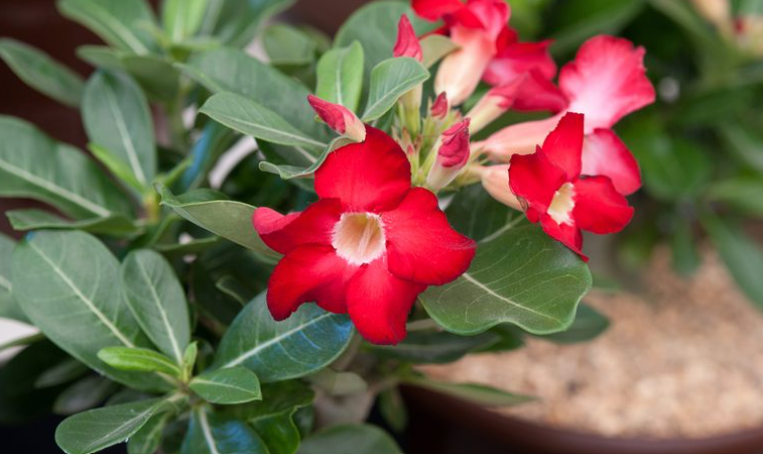
The Desert Rose, known botanically as Adenium obesum, is one of the most spectacular and exotic-looking flowering plants in the world, belonging to the dogbane family, Apocynaceae. Native to the arid and semi-arid regions of sub-Saharan Africa and the Arabian Peninsula — from Senegal and Mauritania in the west, across the Sahel, through East Africa, and into Yemen and Oman — it thrives in some of the harshest environments on earth, surviving prolonged drought, intense heat, and rocky, nutrient-depleted soils with remarkable resilience. Its genus name Adenium is derived from “Aden,” the Yemeni port city near which the plant was first scientifically documented, while obesum refers to the swollen, obese appearance of its extraordinary thickened trunk and base.
The most immediately striking feature of the Desert Rose is its magnificent caudex — a greatly swollen, bottle-shaped base and trunk that stores water to sustain the plant through extended dry periods. This dramatic, sculptural structure, which can grow to impressive sizes over many decades, gives the Desert Rose the appearance of a miniature ancient tree and makes it one of the most prized subjects in the art of bonsai. Above this swollen base, the plant produces fleshy branches clothed in glossy, dark green, spatula-shaped leaves and crowned with clusters of trumpet-shaped flowers in vivid shades of pink, red, white, bicolor, and striped combinations. The blooms are strikingly beautiful — bold, waxy, and long-lasting — appearing most prolifically during the warm months of the year.
Also Read: How to Grow And Care For Anemone
Despite its name, the Desert Rose is not related to true roses at all. It earned its common name simply from the combination of its rose-like flowers and its desert origins. In its native African habitat, it grows as a large shrub or small tree reaching up to ten feet in height, often found growing in rocky outcrops, dry riverbeds, and open woodland where it receives maximum sunlight and excellent drainage. Like many members of the Apocynaceae family, the Desert Rose contains potent toxic compounds — cardenolides and other cardiac glycosides — throughout all its parts, particularly in the milky white sap. In parts of Africa, this toxic sap has historically been used to tip hunting arrows and fishing spears, and the plant should always be handled with gloves and kept away from children and pets.
As a horticultural subject, the Desert Rose has achieved extraordinary worldwide popularity as both an outdoor garden plant in tropical and subtropical climates and as a prized indoor and patio container plant in temperate regions. In tropical countries including Kenya, Thailand, India, and across Southeast Asia, it is grown with immense enthusiasm and has inspired highly competitive horticultural communities dedicated to developing new hybrid varieties with increasingly extravagant flower forms, colors, and patterns. Thousands of named hybrid cultivars now exist, ranging from simple single-flowered forms to ruffled, double, picotee, and spider-petaled varieties of breathtaking complexity and beauty, with flower colors spanning virtually every shade of the warm spectrum.
In terms of cultural requirements, the Desert Rose is a plant of genuine extremes — extraordinarily tolerant of heat, drought, and neglect on one hand, yet surprisingly sensitive to cold, overwatering, and poor drainage on the other. It thrives in full, blazing sunlight and demands it for healthy growth and generous flowering. It requires very well-draining, gritty soil and a watering regime that allows the growing medium to dry out almost completely between waterings. The one condition that will kill a Desert Rose faster than almost anything else is cold, wet soil — temperatures below 50°F (10°C) combined with moist roots are a near-certain death sentence for this sun-loving tropical plant.
The Desert Rose occupies a uniquely cherished place in gardens and homes across the tropical world, and its popularity continues to grow globally as gardeners in temperate climates discover its rewards as a container plant that can be moved indoors during winter. In the language of ornamental horticulture, it represents the perfect marriage of sculptural beauty and floral generosity — a plant that looks magnificent even when not in bloom, and absolutely breathtaking when it is. Its long lifespan, with well-tended specimens living for many decades and developing increasingly impressive caudex structures with age, means that a Desert Rose is not merely a garden plant but a living investment, growing more beautiful, more valuable, and more extraordinary with every passing year.
Also Read: How to Grow Four O’Clock Flower from Seed
How to Grow Desert Rose from Seed
- Source fresh seeds from a reputable supplier. Desert Rose seeds lose viability relatively quickly, and germination rates drop sharply in seeds older than six months to a year. Always purchase seeds from a reliable specialist supplier who can confirm freshness, or collect seeds from a known parent plant immediately after the elongated seed pods split open naturally and release the feathery, plumed seeds into the air.
- Prepare to sow promptly after obtaining seeds. Unlike many other seeds that benefit from extended storage, Desert Rose seeds should be sown as soon as possible after harvesting or purchasing. The feathery tufts attached to each seed help with wind dispersal in the wild but can be left on during germination without causing any problems, though some growers prefer to remove them by simply snipping them off close to the seed body.
- Choose the right time to sow. Sow Desert Rose seeds during the warmest months of the year — late spring through midsummer — when ambient temperatures are consistently high. Warm soil temperatures are absolutely essential for fast, successful germination, and sowing during cooler periods produces slow, erratic results and dramatically increases the risk of seedling damping-off.
- Prepare a perfectly draining seed-starting medium. Desert Rose seeds must never sit in moist, heavy growing medium. Prepare a gritty, fast-draining mix consisting of approximately 50% coarse river sand or perlite combined with 50% cactus and succulent potting mix. This blend provides just enough moisture retention for germination while ensuring the rapid drainage that prevents seed and root rot from the very beginning.
- Use shallow trays or small individual pots. Sow seeds in shallow seed trays or small individual pots approximately 3 inches deep. The growing medium should be filled to within half an inch of the rim and firmed lightly but not compacted. Using individual pots from the start reduces the need for early transplanting, which can disturb the developing caudex and root system of young seedlings.
- Sow seeds at the correct depth and orientation. Place seeds horizontally on the surface of the pre-moistened growing medium and press them gently into the surface so they make good contact with the mix. Cover with just a very thin layer — approximately ¼ inch (6 mm) — of fine grit or coarse sand. Burying seeds too deeply slows germination and increases the risk of rotting before the seedling can emerge.
- Pre-soak seeds to accelerate germination. Soak seeds in warm — not hot — water for 1–2 hours immediately before sowing to soften the seed coat and encourage faster water uptake. Some experienced growers extend the soak to 12 hours, adding a small amount of liquid seaweed fertilizer to the soaking water as a gentle growth stimulant, though plain warm water produces perfectly adequate results for most gardeners.
- Maintain very high temperatures for germination. Desert Rose seeds germinate fastest and most reliably at soil temperatures between 80–95°F (27–35°C). Place seed trays on a horticultural heat mat set to the higher end of this range, or in the warmest location available — such as a sunny greenhouse, a warm windowsill above a radiator, or outdoors in full sun during the hottest summer months. The warmer the conditions, the faster and more uniform the germination will be.
- Cover trays loosely to retain warmth and humidity. Place a clear plastic dome, a sheet of glass, or a loose covering of clear plastic wrap over seed trays to trap warmth and maintain the high humidity that supports rapid germination. Ensure a small gap for some air circulation to prevent excessive condensation buildup, which can promote fungal growth on the seeds and emerging seedlings.
- Expect germination within 3–7 days under ideal conditions. Desert Rose seeds are among the fastest-germinating of any succulent or semi-succulent plant when temperatures are sufficiently high and seeds are fresh. Under ideal warm conditions, the first seedlings typically emerge within three to seven days of sowing, initially as two small, rounded seed leaves followed quickly by the first true leaves and the very beginnings of the characteristic swollen base.
- Remove the cover immediately after germination begins. As soon as seedlings begin to emerge, remove the plastic cover or dome promptly to improve air circulation and prevent damping-off. Desert Rose seedlings are vulnerable to fungal collapse in stagnant, overly humid air, and good airflow from the earliest stage of growth is essential for keeping them healthy and upright.
- Place seedlings in maximum direct sunlight. Move germinated seedlings into the brightest, sunniest position available — ideally outdoors in full, unfiltered direct sun or in a south-facing greenhouse — as soon as they have emerged. Desert Rose seedlings require intense light from their very earliest days to develop compact, sturdy growth and begin forming their characteristic swollen caudex. Insufficient light produces tall, spindly seedlings with thin stems that never develop the coveted fat base.
- Water sparingly using the soak-and-dry method. Once seedlings are established, adopt a disciplined watering routine of watering thoroughly, then waiting until the growing medium has dried out almost completely before watering again. This soak-and-dry cycle closely mimics the boom-and-bust rainfall patterns of the Desert Rose’s native habitat and encourages the development of a swollen, water-storing caudex from the very earliest stages of the plant’s life.
- Begin feeding carefully once seedlings are a month old. After approximately four weeks of growth, begin feeding seedlings every two to three weeks with a diluted liquid fertilizer formulated for flowering plants or succulents, applied at half the recommended strength. During the active growing season, a fertilizer slightly higher in phosphorus and potassium relative to nitrogen encourages robust caudex development and prepares the young plant for its first flowering, which can occur surprisingly quickly — sometimes within six to twelve months of germination under ideal conditions.
- Pot up progressively as the caudex develops. As seedlings grow and the swelling at the base of the stem becomes more pronounced, move them into progressively larger pots filled with the same gritty, free-draining cactus mix. Each time you repot, consider planting the seedling slightly higher in the new pot and exposing a little more of the swollen base above the soil line — a technique that encourages the caudex to thicken and flare at the surface, gradually developing the dramatic sculptural form that makes mature Desert Rose plants so visually extraordinary.
- Protect from cold and embrace the long-term journey. Desert Rose plants grown from seed are genuinely rewarding long-term projects. Always bring container-grown plants indoors or into a heated greenhouse when nighttime temperatures drop below 50°F (10°C), as cold is their most dangerous enemy. In tropical climates like Kenya’s, plants can be grown outdoors year-round and will develop into impressive shrubs of increasing beauty with each passing season. With patient, attentive care — maximum sun, disciplined watering, minimal cold, and occasional feeding — a Desert Rose grown from seed will reward its grower for many decades, developing a progressively more magnificent and sculptural caudex and producing its gorgeous trumpet blooms in ever-greater abundance with every year that passes.
Also Read: How to Grow Jacob’s Ladder Flower from Seed