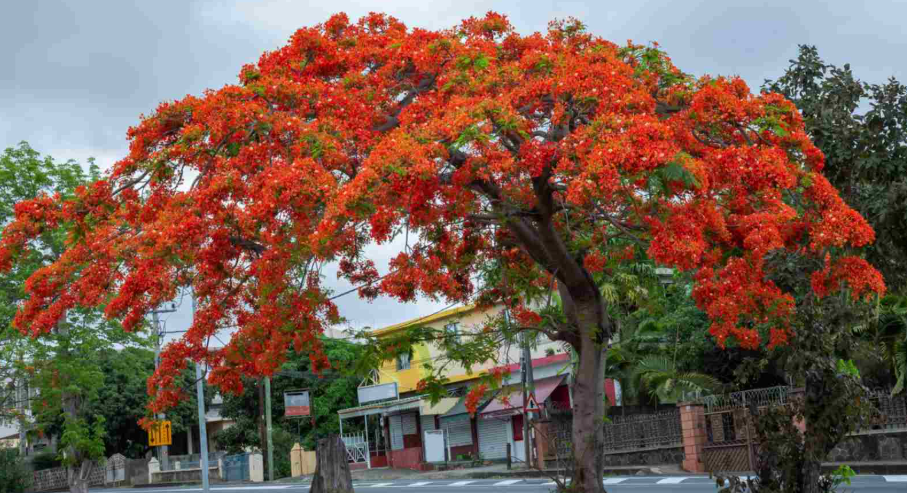
Quebec has an enormous range of growing conditions. A tree that grows rapidly around Montréal or Gatineau may perform very differently in the Laurentians, Saguenay–Lac-Saint-Jean, Abitibi-Témiscamingue or farther north. Winter temperatures, the length of the growing season, soil moisture and exposure all have a major influence on how quickly a tree develops.
For gardeners and landowners looking for faster results, several trees stand out. Hybrid poplars, willows, cottonwoods, silver maple and certain birches and maples can produce impressive annual growth when planted in suitable conditions. Research at the Université du Québec en Abitibi-Témiscamingue has specifically examined hybrid poplar productivity across Quebec’s boreal regions, highlighting both its high growth potential and the importance of site conditions, clone selection and management.
The trees below include native Quebec species, widely planted landscape trees and a few species better suited to the warmer southern part of the province. Growth figures are approximate and represent potential annual height growth for established, healthy trees under favorable conditions.
21 Fast Growing Trees in Quebec at a Glance
| Tree | Approx. growth rate | Typical mature height | Best suited to |
|---|---|---|---|
| Hybrid Poplar | 4–8 ft/year | 50–100+ ft | Southern and central Quebec |
| Eastern Cottonwood | 3–6 ft/year | 70–100+ ft | Southern Quebec, moist sites |
| Black Willow | 3–6 ft/year | 30–60 ft | Wet soils and waterways |
| White Willow | 3–6 ft/year | 50–80+ ft | Moist sites |
| Balsam Poplar | 2–4 ft/year | 50–80 ft | Central and northern Quebec |
| Trembling Aspen | 2–4 ft/year | 40–70 ft | Boreal and northern Quebec |
| Silver Maple | 3–5 ft/year | 60–80 ft | Southern Quebec |
| Freeman Maple | 2–4 ft/year | 40–70 ft | Southern and central Quebec |
| Red Maple | 2–3 ft/year | 40–70 ft | Southern Quebec |
| Manitoba Maple | 2–4 ft/year | 40–70 ft | Southern and central Quebec |
| Paper Birch | 1.5–3 ft/year | 40–70 ft | Much of Quebec |
| River Birch | 1.5–3 ft/year | 40–70 ft | Warmer, moist sites |
| American Elm | 2–4 ft/year | 60–90 ft | Southern Quebec |
| Black Locust | 2–4 ft/year | 40–70 ft | Warmer southern areas |
| Northern Red Oak | 1.5–2.5 ft/year | 60–80 ft | Southern Quebec |
| Eastern White Pine | 2–3 ft/year | 70–100+ ft | Much of southern/central Quebec |
| Red Pine | 1.5–2.5 ft/year | 50–80 ft | Sandy, well-drained soils |
| White Spruce | 1–2 ft/year | 40–80 ft | Across much of Quebec |
| Tamarack | 1.5–2.5 ft/year | 40–70 ft | Cold, wet areas |
| Norway Spruce | 1.5–2.5 ft/year | 60–100 ft | Southern and central Quebec |
| Tulip Tree | 2–3 ft/year | 70–100 ft | Sheltered southern Quebec |
Important: These growth rates are estimates, not guarantees. A tree growing on a fertile, moist site with full sun can grow substantially faster than the same species planted in compacted, dry or heavily shaded soil.
1. Hybrid Poplar
Approximate growth rate: 4–8 ft per year
Hybrid poplar is arguably the strongest candidate when the goal is maximum growth in Quebec. Different hybrids vary considerably, but selected clones can produce exceptional growth and have been used for short-rotation forestry, biomass production, shelterbelts and rapid landscape establishment.
Research at UQAT has examined hybrid poplar growth specifically under Quebec’s boreal conditions, including Abitibi-Témiscamingue and northern Quebec. Studies have shown that growth can be strongly affected by clone, soil conditions, competition, spacing and management.
Hybrid poplar is best planted where there is plenty of room. Its rapid growth, large eventual size and extensive root system make it a poor choice for cramped residential lots or locations immediately beside septic systems and foundations.
2. Eastern Cottonwood
Approximate growth rate: 3–6 ft per year
Eastern cottonwood (Populus deltoides) is one of the fastest-growing native hardwoods available for southern Quebec. It naturally favors moist soils, floodplains and areas near rivers, making it particularly well suited to landscapes where water is readily available.
Its rapid growth can produce substantial shade surprisingly quickly, but the mature tree is enormous. Cottonwood should therefore be considered primarily for large properties, restoration projects and naturalized areas rather than small suburban gardens.
3. Black Willow
Approximate growth rate: 3–6 ft per year
Black willow (Salix nigra) is a fast-growing tree for wet ground and waterways. Its ability to establish quickly makes it useful for stream-bank stabilization, erosion control and naturalized landscapes.
Willows have attracted considerable research interest in Quebec because of their rapid growth and ability to produce large amounts of biomass. Research at the Université de Montréal’s Institute for Research in Plant Biology specifically focuses on short-rotation willow cultivation, noting the group’s rapid growth, strong rooting ability and ease of vegetative propagation.
Black willow needs space and moisture. Its roots actively seek water, so it should be kept away from septic systems, underground pipes and foundations.
4. White Willow
Approximate growth rate: 3–6 ft per year
White willow (Salix alba) can develop very quickly when planted in fertile soil with abundant moisture. It is especially useful for large properties where the goal is to create shade or a windbreak relatively quickly.
The species can eventually become a large tree, and its branches can be vulnerable to storm damage. Plant it where falling branches will not create a hazard.
5. Balsam Poplar
Approximate growth rate: 2–4 ft per year
Balsam poplar (Populus balsamifera) is one of the most useful fast-growing native trees for central and northern Quebec. It is well adapted to cold conditions and naturally occurs in moist forests, river valleys and boreal environments.
Its combination of cold tolerance and rapid juvenile growth makes it a particularly useful choice when a southern species such as tulip tree or silver maple is not sufficiently hardy.
6. Trembling Aspen
Approximate growth rate: 2–4 ft per year
Trembling aspen (Populus tremuloides) is one of Quebec’s most familiar native trees. It is a classic pioneer species, quickly colonizing forest openings, disturbed ground and areas following fire or harvesting.
Aspen can establish rapidly, but it frequently produces suckers and may form extensive colonies. That makes it more suitable for acreage properties, woodland restoration and naturalized areas than formal gardens.
7. Silver Maple
Approximate growth rate: 3–5 ft per year
Silver maple (Acer saccharinum) is one of the fastest-growing maple trees suitable for southern Quebec. It has historically been planted extensively in Montréal and other urban areas because of its rapid development and tolerance of moist conditions.
McGill University’s Herbarium notes that silver maple is common around Montréal and naturally occurs on moist low-lying sites and near water. It also notes that the species grows quickly and can hybridize naturally with red maple to produce Freeman maple.
The major disadvantage is structural weakness. Silver maple can develop large, brittle branches and vigorous roots. It needs substantial space and is better suited to large properties than small yards.
8. Freeman Maple
Approximate growth rate: 2–4 ft per year
Freeman maple (Acer × freemanii) is a hybrid of silver maple and red maple. It combines some of the rapid growth of silver maple with attractive fall color and a more useful landscape form.
It is particularly attractive for southern Quebec homeowners who want a reasonably fast-growing shade tree without choosing a pure silver maple. Many cultivars are available, with differences in mature size, crown shape and fall color.
9. Red Maple
Approximate growth rate: 2–3 ft per year
Red maple (Acer rubrum) is a versatile native tree with excellent autumn color. It occurs naturally across a wide range of eastern North American habitats and is well established in southern Quebec.
McGill University’s Herbarium notes that red maple is common around Montréal and can grow across a surprisingly broad range of conditions, from floodplains to dry upland forests.
Its growth is generally more moderate than silver maple, but red maple is often a better long-term landscape choice when fall color, form and adaptability are more important than maximum speed.
10. Manitoba Maple
Approximate growth rate: 2–4 ft per year
Manitoba maple (Acer negundo) is an adaptable, relatively fast-growing maple that can tolerate a variety of urban and disturbed conditions. It is particularly useful where rapid establishment is more important than formal ornamental appearance.
The species can develop weak branches and an irregular crown, so it is not always ideal for a carefully maintained residential garden. It is better suited to larger landscapes, restoration areas and locations where toughness is the priority.
11. Paper Birch
Approximate growth rate: 1.5–3 ft per year
Paper birch (Betula papyrifera) is one of Quebec’s most recognizable native trees. Its white peeling bark provides year-round interest, while its relatively quick growth allows young trees to establish a visible presence within a few years.
The Université du Québec à Chicoutimi identifies paper birch as a native Quebec pioneer species that commonly establishes after wildfire, forest harvesting and windthrow. It prefers well-drained soil and can be useful for creating early shade in a naturalized landscape.
Paper birch is less successful on hot, dry urban sites. Keeping the root zone adequately moist during establishment is especially important.
12. River Birch
Approximate growth rate: 1.5–3 ft per year
River birch (Betula nigra) is a faster-growing birch with attractive peeling bark and good tolerance of wet soil. It is more appropriate for the warmer parts of Quebec than the far north.
It can be an excellent choice for a property with a pond, drainage swale or naturally moist soil. Its mature size is substantial, so it should not be treated as a small ornamental tree.
13. American Elm
Approximate growth rate: 2–4 ft per year
American elm (Ulmus americana) was once one of the most important large shade trees in Quebec towns and cities. Young trees can grow quickly and eventually form the tall, arching canopy historically associated with elm-lined streets.
Modern planting should focus on Dutch elm disease-resistant cultivars. Resistant selections provide a much better option for homeowners who want the traditional elm form without relying on highly susceptible trees.
14. Black Locust
Approximate growth rate: 2–4 ft per year
Black locust (Robinia pseudoacacia) can grow rapidly on favorable sites and produces attractive fragrant white flowers. Its wood is also exceptionally durable.
Its tendency to sucker and spread is the principal reason to be cautious. Black locust is better suited to larger rural properties than small formal gardens, where its aggressive growth can become difficult to manage.
15. Northern Red Oak
Approximate growth rate: 1.5–2.5 ft per year
Northern red oak (Quercus rubra) is one of the better choices if you want a tree that combines respectable growth with long-term durability. It is primarily a southern Quebec choice and prefers reasonably fertile, well-drained soil.
It will not compete with hybrid poplar or willow for annual growth, but it has a major advantage: the tree can remain a valuable landscape specimen for many decades.
Research from the Université de Montréal’s forest biology group has specifically examined how faster growth affects wood density in northern red oak and has studied the species in southeastern Canada.
16. Eastern White Pine
Approximate growth rate: 2–3 ft per year
Eastern white pine (Pinus strobus) is one of the most important native evergreen trees in Quebec. Young trees can grow relatively rapidly on good sites and eventually become enormous.
Its evergreen foliage makes it particularly useful for year-round screening and wind protection. Give it plenty of space, however, because mature trees can exceed 100 ft under favorable conditions.
17. Red Pine
Approximate growth rate: 1.5–2.5 ft per year
Red pine (Pinus resinosa) is well suited to sandy, acidic and well-drained soils. It is a useful choice for larger properties where a native evergreen is desired.
Although its growth rate is not as spectacular as hybrid poplar, red pine has a useful combination of cold hardiness, longevity and adaptability to relatively poor soils.
18. White Spruce
Approximate growth rate: 1–2 ft per year
White spruce (Picea glauca) is one of Quebec’s most dependable cold-hardy evergreen trees. It can be used for windbreaks, privacy screens, shelterbelts and naturalized plantings.
Its annual growth is more moderate than that of poplars and willows, but its excellent winter hardiness makes it much more dependable in northern Quebec.
The Université Laval’s forestry faculty continues to distribute and work with native tree species including white spruce, red spruce, sugar maple and yellow birch, reflecting their importance in Quebec’s forest and landscape systems.
19. Tamarack
Approximate growth rate: 1.5–2.5 ft per year
Tamarack (Larix laricina) is a deciduous conifer that loses its needles every autumn. It is exceptionally well adapted to Quebec’s cold climate and can grow on wet sites where many other trees struggle.
Its golden-yellow fall color makes it especially attractive in naturalized landscapes. Although it is not among the province’s fastest trees, its cold tolerance and adaptability make it a useful option for northern properties.
20. Norway Spruce
Approximate growth rate: 1.5–2.5 ft per year
Norway spruce (Picea abies) is not native to Quebec but is widely planted because it can develop relatively quickly and provides dense evergreen screening.
It is particularly useful for windbreaks and large properties. With good soil and adequate moisture, young trees can establish substantial annual growth, although performance declines on severely dry or compacted sites.
21. Tulip Tree
Approximate growth rate: 2–3 ft per year
Tulip tree (Liriodendron tulipifera) is one of the more ambitious choices for southern Quebec. It is mainly appropriate for protected locations in the warmer parts of the province and is not a good choice for the coldest northern regions.
Its large, distinctive leaves and tulip-shaped flowers make it an impressive specimen. Mature trees can become enormous, so give it plenty of room from the beginning.
The Fastest Growing Trees in Quebec
If maximum annual height growth is the main objective, these are the strongest candidates from the list:
- Hybrid poplar — 4–8 ft/year
- Eastern cottonwood — 3–6 ft/year
- Black willow — 3–6 ft/year
- White willow — 3–6 ft/year
- Silver maple — 3–5 ft/year
- Balsam poplar — 2–4 ft/year
- Trembling aspen — 2–4 ft/year
- Freeman maple — 2–4 ft/year
- Manitoba maple — 2–4 ft/year
- American elm — 2–4 ft/year
Hybrid poplar deserves particular attention in Quebec. Research from UQAT has examined its productivity along a south-to-north gradient in Abitibi-Témiscamingue, demonstrating why the species should be evaluated according to local climate, soil and clone rather than treated as having one universal growth rate.
Fast Growing Trees for Southern Quebec
Southern Quebec, including areas around Montréal, Laval, Longueuil, Gatineau and parts of the Eastern Townships, provides the broadest selection.
Good candidates include:
- Silver maple
- Freeman maple
- Red maple
- Eastern cottonwood
- Hybrid poplar
- American elm
- Northern red oak
- Black locust
- Eastern white pine
- Tulip tree
The warmer growing season makes it possible to grow species that would be unreliable farther north.
Fast Growing Trees for Northern Quebec
In northern Quebec, cold hardiness and growing-season length become more important than absolute growth rate.
Consider:
- Balsam poplar
- Trembling aspen
- Paper birch
- White spruce
- Tamarack
- Red pine
- Eastern white pine
- Black spruce
A species that grows 2 ft annually but survives consistently may be a much better choice than a species capable of 4 ft of growth that suffers winter injury every few years.
Best Fast Growing Trees for Wet Soil
Quebec has extensive wetlands, floodplains and poorly drained areas. If your property stays wet, consider:
- Black willow
- White willow
- Eastern cottonwood
- Balsam poplar
- River birch
- Tamarack
- Silver maple
Willows are especially interesting because of their rapid growth and rooting ability. Research at the Université de Montréal has investigated fast-growing willow cultivars in short-rotation systems, including their use for biomass and environmental applications.
Best Fast Growing Trees for Shade
If the main objective is to create shade quickly, the strongest choices include:
For maximum speed:
Hybrid poplar, eastern cottonwood, silver maple and willow.
For a more balanced landscape:
Freeman maple, red maple, American elm and northern red oak.
For evergreen shade and screening:
Eastern white pine and Norway spruce.
Remember that mature size matters. A tree that grows 4 ft per year but eventually reaches 80–100 ft may not be appropriate for a typical residential lot.
Best Fast Growing Trees for Privacy
For a fast privacy screen, evergreen trees have an important advantage because they maintain foliage through winter.
Consider:
- Eastern white pine
- White spruce
- Norway spruce
For deciduous screening where winter privacy is less important, hybrid poplar, balsam poplar and willow can establish height much more rapidly.
A mixed planting is often preferable to a single-species screen because it reduces the risk that one pest, disease or environmental problem will damage the entire planting.
How to Encourage Faster Growth
A tree’s potential growth rate is only part of the equation. Site preparation and maintenance can make an enormous difference.
Choose the right site
Match the tree to your soil moisture, drainage, sunlight and local winter temperatures.
Water during establishment
Young trees need consistent moisture while their root systems develop. Drought during the first few growing seasons can severely reduce growth.
Reduce competition
Grass, weeds and nearby trees compete for water and nutrients. Keeping competing vegetation away from the immediate root zone can improve establishment.
Improve poor soil
Compacted or nutrient-poor soil can prevent a fast-growing species from reaching its potential. Hybrid poplar research in Quebec has shown that site preparation and vegetation management can substantially influence early growth. One UQAT study found improvements in height growth following specific site-preparation and vegetation-management treatments.
Mulch correctly
Organic mulch helps retain soil moisture and moderate soil temperatures. Keep mulch away from the trunk to prevent moisture-related bark problems.
Do not overfertilize
Adding large amounts of fertilizer is not a substitute for appropriate soil, water and sunlight. Excessive nitrogen can produce weak, overly vigorous growth rather than a stronger tree.
Are Fast Growing Trees Good for Small Quebec Yards?
Some are, but the fastest species are often the least suitable.
Hybrid poplar, cottonwood, silver maple and large willows can eventually become enormous. Their roots and branches may also interfere with buildings, drainage systems, driveways and overhead utilities.
For a smaller yard, a more moderate tree such as Freeman maple, red maple or a carefully selected elm cultivar may provide a better balance between growth rate and mature size.
Fast Growth vs. Long-Term Value
The fastest tree is not necessarily the best tree.
Poplars and willows can create shade quickly, but their wood may be relatively soft and their mature roots and branches can require considerable management. Oaks and pines grow more slowly but can remain useful landscape trees for generations.
For this reason, many Quebec properties benefit from a mixture of species: a few fast-growing trees for early shade or screening combined with slower-growing, longer-lived trees for the future.
How Quickly Will a Newly Planted Tree Grow?
A common mistake is to assume that a tree advertised as growing 4 ft per year will immediately add 4 ft after planting.
Newly transplanted trees often spend considerable energy establishing roots. Growth can therefore be modest during the first few years, especially if the tree is planted during drought or in compacted soil.
Once established, a healthy tree on a suitable site may approach its expected growth rate. Even then, annual growth naturally changes with age, weather and environmental conditions.
Key Takeaways
Quebec offers an excellent selection of fast-growing trees, but the best choice depends heavily on where you live in the province. Southern Quebec provides opportunities for species such as silver maple, Freeman maple, northern red oak and tulip tree, while northern and boreal regions favor extremely hardy species such as balsam poplar, trembling aspen, paper birch, tamarack and white spruce.
If your main goal is maximum growth, hybrid poplar, eastern cottonwood, black willow, white willow and silver maple are among the strongest choices. For a more balanced residential landscape, Freeman maple, red maple, American elm or northern red oak may be better long-term options.
Most importantly, don’t judge a tree solely by its advertised growth rate. Climate, soil, moisture, competition and available space determine how much of that potential growth you actually see. A tree that is perfectly matched to your Quebec property can outperform a theoretically faster species planted in the wrong location.
Further References
- Université du Québec en Abitibi-Témiscamingue (UQAT) — Hybrid Poplar Growth Research.
UQAT — Hybrid Poplar Growth Study
Useful for discussing hybrid poplar establishment and early growth in western Quebec, including how soil fertility, nutrition, and management affect growth. - Université du Québec à Montréal (UQAM) — Shoot and Root Responses of Hybrid Poplars.
UQAM — Hybrid Poplar Growth Research
This research examines the environmental conditions that influence hybrid-poplar growth in boreal forest soils and is particularly relevant when explaining why growth rates vary between sites in Quebec. - Université du Québec à Montréal — Hybrid Poplar Growth and Productivity.
UQAM — Hybrid Poplar Research
Provides research on factors influencing height and diameter growth in fast-growing poplar species, including the importance of physiological and nutritional conditions. - Université Laval — Hybrid Poplar and Quebec Forestry Research.
Université Laval — Poplar Culture Research
This research material includes work by Université Laval researchers on hybrid poplar plantations in southern Quebec and examines how soil amendments and fertilization can affect tree growth. - Université du Québec à Abitibi-Témiscamingue — Hybrid Poplar Productivity and Growth.
UQAT — Hybrid Poplar Productivity Research
Useful for putting hybrid poplar’s growth into perspective: research associated with UQAT reports Quebec plantation yields of roughly 8–12 m³/ha/year, with considerably higher productivity possible on exceptional sites.