Manitoba may be known for its wide-open prairie landscapes, but much of the province is covered by forests, parkland, and mixedwood ecosystems. From the agricultural regions around Winnipeg and Brandon to the boreal forests farther north, Manitoba offers a surprisingly wide range of conditions for growing trees.
The challenge is that Manitoba has a short growing season, cold winters, periodic drought, strong winds, and large differences in soil and moisture from one location to another. A tree that grows rapidly beside a well-watered riverbank may perform very differently on an exposed prairie acreage. For that reason, the best fast-growing trees for Manitoba are species and cultivars that combine vigorous growth with cold hardiness and reasonable adaptation to prairie conditions.
Fast-growing trees are particularly useful for Manitoba shelterbelts, windbreaks, privacy screens, erosion control, wildlife habitat, shade, and rural properties. The University of Manitoba has documented the importance of shelterbelts in the province, while prairie research has shown that mixed plantings can provide benefits for soil conservation, biodiversity, water quality, and carbon storage.
The growth rates below are approximate annual height increases under favourable conditions. Soil, moisture, sunlight, genetics, competition from grass, winter injury, and establishment practices can all make actual growth considerably faster or slower.
Quick Comparison: Fast Growing Trees for Manitoba
| Tree | Approx. growth rate | Typical mature height | Best use |
|---|---|---|---|
| Hybrid Poplar | 4–8 ft/year | 50–80+ ft | Rapid shade and shelter |
| Northwest Poplar | 3–6 ft/year | 50–100 ft | Shelterbelts |
| Eastern Cottonwood | 3–6 ft/year | 60–100+ ft | Large properties |
| Black Willow | 3–6 ft/year | 40–70 ft | Wet areas |
| Golden Willow | 3–5 ft/year | 40–60 ft | Shelterbelts |
| Manitoba Maple | 2–4 ft/year | 40–60 ft | Quick shade |
| Trembling Aspen | 2–4 ft/year | 40–70 ft | Native woodland |
| Balsam Poplar | 2–4 ft/year | 50–80 ft | Moist sites |
| American Elm | 2–4 ft/year | 60–80 ft | Large shade tree |
| Siberian Elm | 2–4 ft/year | 40–70 ft | Dry, exposed sites |
| Freeman Maple | 2–3 ft/year | 40–60 ft | Urban landscapes |
| Green Ash | 2–3 ft/year | 40–60 ft | Shelterbelts |
| Paper Birch | 1.5–3 ft/year | 40–60 ft | Cool landscapes |
| River Birch | 1.5–3 ft/year | 40–70 ft | Moist landscapes |
| Basswood | 2–3 ft/year | 50–70 ft | Long-term shade |
| Bur Oak | 1.5–2.5 ft/year | 60–80 ft | Prairie landscapes |
| Hackberry | 1.5–2.5 ft/year | 40–60 ft | Dry sites |
| Tamarack | 1.5–2.5 ft/year | 40–70 ft | Wet, cold sites |
| Siberian Larch | 1.5–2.5 ft/year | 50–70 ft | Windbreaks |
| Scots Pine | 1.5–2.5 ft/year | 40–70 ft | Dry shelterbelts |
| Jack Pine | 1–2.5 ft/year | 30–60 ft | Sandy soils |
| White Spruce | 1–2 ft/year | 50–80 ft | Evergreen shelter |
| Norway Spruce | 1.5–2.5 ft/year | 60–100 ft | Windbreaks |
| Black Spruce | 1–2 ft/year | 30–60 ft | Boreal sites |
| Amur Maple | 1.5–3 ft/year | 15–25 ft | Smaller yards |
1. Hybrid Poplar
Approximate growth rate: 4–8 ft per year
Hybrid poplar is one of the best choices in Manitoba when the primary objective is rapid height growth. Selected poplar hybrids have long been used across the Canadian Prairies for shelterbelts, farmstead protection, biomass production, and reforestation. Prairie research has found hybrid poplar among the species capable of substantial biomass accumulation in shelterbelt systems.
The Okanese poplar, for example, is described in Manitoba’s current tree and shrub information as a fast-growing shelterbelt and reforestation tree capable of approximately 3–5 ft of annual growth under suitable conditions. Hybrid poplars need plenty of space, however. Their aggressive roots and relatively short lifespan make them poor choices immediately beside foundations, septic systems, or underground infrastructure.
2. Northwest Poplar
Approximate growth rate: 3–6 ft per year
Northwest poplar is a vigorous hybrid associated with prairie shelterbelts and large rural landscapes. It can develop an impressive canopy relatively quickly, making it particularly useful when the goal is to establish shade or wind protection within a few years.
University of Saskatchewan information describes the Populus × jackii group as vigorous hybrids with large leaves and strong growth, with ‘Northwest’ being a particularly noteworthy and tough form for farms and shelterbelts. These hybrids are generally more appropriate for acreages and agricultural landscapes than small urban yards.
3. Eastern Cottonwood
Approximate growth rate: 3–6 ft per year
Eastern cottonwood is one of the fastest-growing large native trees available to Manitoba landowners. It naturally favours moist soils and river valleys, where its rapid juvenile growth allows it to establish quickly after disturbance.
Cottonwood has also played an important role in prairie tree improvement. The University of Saskatchewan notes that cottonwood became an important parent in the development of numerous hybrid poplars used in Prairie shelterbelts. Because mature cottonwoods can become enormous, they should be planted only where there is sufficient space.
4. Black Willow
Approximate growth rate: 3–6 ft per year
Black willow is a strong candidate for wet Manitoba properties. Willows are naturally vigorous growers when their roots have reliable access to moisture, and black willow can provide shade and bank stabilization relatively quickly.
The main disadvantage is structural durability. Fast-growing willows can develop brittle branches and extensive root systems, so they should be kept well away from buildings, septic fields, water infrastructure, and heavily used areas.
5. Golden Willow
Approximate growth rate: 3–5 ft per year
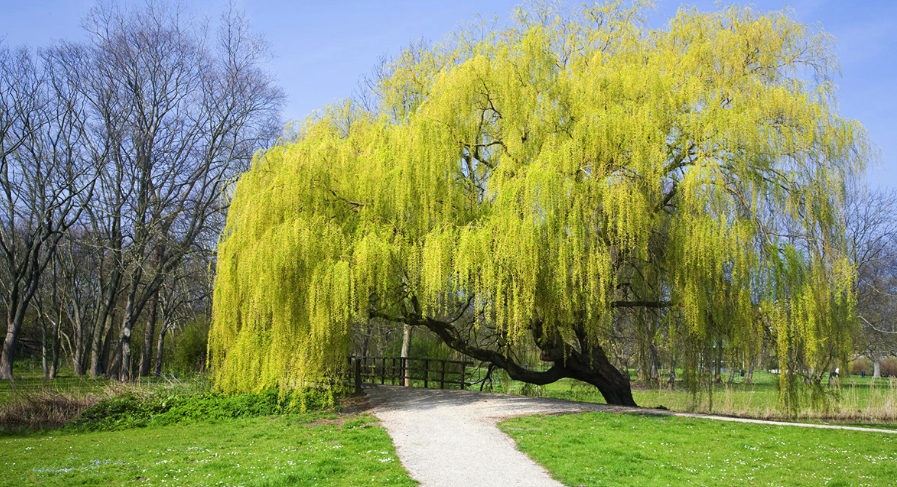
Golden willow is valued for both rapid growth and its distinctive yellow-golden young stems. It has been used on the Prairies as a shelterbelt and shade tree, particularly where soil moisture is adequate.
University of Saskatchewan describes golden willow as a fast-growing tree that can reach approximately 50–60 ft and become particularly attractive during winter because of its bright stems. It is a good option for a spacious rural property, although its water demand and tendency to shed branches should be considered.
6. Manitoba Maple
Approximate growth rate: 2–4 ft per year
Manitoba maple is one of Manitoba’s classic rapid-growing shade trees. It is remarkably adaptable and can establish on a range of soils, particularly where adequate moisture is available. It has historically been planted extensively in prairie shelterbelts and farmsteads.
University of Saskatchewan describes Manitoba maple as a rapid-growing tree that can reach approximately 60 ft. It also notes that the compact male cultivar ‘Sensation’ offers a more manageable form and does not produce the abundant seeds associated with the species.
7. Trembling Aspen
Approximate growth rate: 2–4 ft per year
Trembling aspen is one of Manitoba’s most important native pioneer trees. It can establish quickly after disturbance and is particularly effective at colonizing open areas where sunlight is abundant.
Aspen can also spread through root suckers, allowing a single tree or small group to develop into a larger grove. This makes it excellent for naturalized landscapes and wildlife habitat but less desirable for a tightly controlled residential planting. University of Alberta forest research includes trembling aspen among the principal species used in modelling Canada’s western boreal mixedwoods.
8. Balsam Poplar
Approximate growth rate: 2–4 ft per year
Balsam poplar is a fast-growing native tree particularly suited to moist and cool Manitoba locations. It is common in northern and boreal environments and can become a large tree when soil moisture and fertility are favourable.
It works especially well for naturalized plantings, streamside areas, wildlife habitat, and larger properties. Like other poplars, however, its mature roots and size make careful spacing essential.
9. American Elm
Approximate growth rate: 2–4 ft per year
American elm can be a relatively fast-growing shade tree, particularly while young. Its classic vase-shaped canopy makes it one of the most attractive large deciduous trees for lawns, boulevards, and spacious properties.
Modern disease-resistant selections are particularly valuable because Dutch elm disease has historically devastated American elm populations. Manitoba landowners should consider resistant cultivars rather than relying on unselected trees.
10. Siberian Elm
Approximate growth rate: 2–4 ft per year
Siberian elm is known for vigorous growth and considerable tolerance of dry, exposed conditions. It can establish where some other shade trees struggle, making it attractive for difficult prairie properties.
Its weaknesses include relatively brittle wood, poor branch structure, and the possibility of becoming weedy. It should therefore be selected primarily where toughness and rapid establishment matter more than ornamental perfection.
11. Freeman Maple
Approximate growth rate: 2–3 ft per year
Freeman maple is a hybrid between red maple and silver maple that combines useful characteristics from both parents. It can provide relatively quick shade while developing a more attractive landscape form than some extremely vigorous maples.
Freeman maple is particularly useful in urban and suburban Manitoba where homeowners want a medium-to-large shade tree without choosing a massive cottonwood or willow. Select cultivars that are proven hardy for your local Manitoba growing conditions.
12. Green Ash
Approximate growth rate: 2–3 ft per year
Green ash has historically been one of the most important shelterbelt trees on the Canadian Prairies. It combines reasonable growth, cold tolerance, and adaptability, and it has been widely planted around farms and rural properties.
Research on prairie shelterbelts has included green ash alongside hybrid poplar, Manitoba maple, and white spruce as important long-term tree species. Emerald ash borer is an important consideration, however, so species diversity is preferable to establishing a new planting dominated by ash.
13. Paper Birch
Approximate growth rate: 1.5–3 ft per year
Paper birch brings attractive white bark and respectable growth to Manitoba landscapes. It is particularly well suited to cooler environments and can provide strong visual interest through all four seasons.
Birch generally performs best where its roots have adequate moisture but are not permanently waterlogged. Drought stress can make birch more vulnerable to insects and decline, so irrigation may be important around homes during extended dry periods.
14. River Birch
Approximate growth rate: 1.5–3 ft per year
River birch is a useful choice for wetter Manitoba landscapes. Its peeling bark and multi-stemmed structure make it more ornamental than many traditional shelterbelt species.
It should be reserved for sites with dependable moisture. On dry prairie soil, it may require supplemental irrigation to maintain vigorous growth.
15. Basswood
Approximate growth rate: 2–3 ft per year
Basswood, or American linden, is a long-lived shade tree that can establish relatively quickly on fertile sites. It eventually develops a broad crown capable of providing excellent summer shade.
Its fragrant flowers also make it valuable to pollinators. Basswood is a better long-term landscape investment than many extremely rapid-growing trees because it combines respectable growth with substantial mature size and longevity.
16. Bur Oak
Approximate growth rate: 1.5–2.5 ft per year
Bur oak is one of the best large native trees for Manitoba’s prairie and parkland regions. It is not among the very fastest trees, but its combination of drought tolerance, cold hardiness, longevity, and strong structure makes it an excellent long-term choice.
For acreage owners who want a substantial shade tree without relying on a short-lived poplar, bur oak deserves serious consideration. Give it plenty of room because mature specimens can become exceptionally large.
17. Hackberry
Approximate growth rate: 1.5–2.5 ft per year
Hackberry is a tough prairie tree that can tolerate a range of difficult conditions. It is particularly useful where a homeowner wants a hardy shade tree capable of handling urban conditions and periods of dryness.
Its growth rate is moderate rather than spectacular, but its adaptability makes it valuable for Manitoba’s variable climate. Hackberry can also provide food and habitat for wildlife.
18. Tamarack
Approximate growth rate: 1.5–2.5 ft per year
Tamarack, also called eastern larch, is one of Manitoba’s most interesting native conifers. Unlike spruce and pine, it loses its needles in autumn, turning a striking golden yellow before winter.
Tamarack is especially useful on wet and cold sites. Regional tree information lists larch/tamarack as a fast-growing species in northern Manitoba landscapes, demonstrating that it can outperform many conifers under favourable conditions.
19. Siberian Larch
Approximate growth rate: 1.5–2.5 ft per year
Siberian larch is a hardy deciduous conifer that can be useful for shelterbelts and exposed rural properties. It combines relatively rapid growth with excellent winter hardiness.
Its deciduous nature is also useful in windbreak design because the tree provides substantial summer foliage while allowing considerably more winter sunlight through the landscape.
20. Scots Pine
Approximate growth rate: 1.5–2.5 ft per year
Scots pine is one of the better evergreen choices for dry Manitoba sites. It tolerates sandy soils and can establish reasonably quickly when planted in full sun.
University of Minnesota research describes jack pine as a fast-growing conifer capable of performing well on poor, sandy soils, illustrating the broader suitability of hardy pine species for northern prairie landscapes. Scots pine can similarly be useful where moisture is limited but a year-round evergreen screen is desired.
21. Jack Pine
Approximate growth rate: 1–2.5 ft per year
Jack pine is an excellent tree for sandy and nutrient-poor soils. It is naturally adapted to northern climates and can tolerate conditions that would challenge many broadleaf shade trees.
Its irregular form may not suit formal gardens, but on large rural properties it can provide useful evergreen structure and wildlife habitat. It is particularly appropriate for northern and sandy areas of Manitoba.
22. White Spruce
Approximate growth rate: 1–2 ft per year
White spruce is one of Manitoba’s most reliable evergreen trees. It is not as fast as hybrid poplar or willow, but its combination of cold hardiness, longevity, and dense evergreen foliage makes it invaluable for windbreaks and shelterbelts.
White spruce is also useful as the long-term component of a mixed shelterbelt. Fast-growing poplars can provide early shelter while spruce gradually develops into the durable backbone of the planting.
23. Norway Spruce
Approximate growth rate: 1.5–2.5 ft per year
Norway spruce can grow more rapidly than many other large evergreen trees and can eventually become a substantial windbreak tree. Its dense branches are particularly useful for reducing wind and creating sheltered microclimates.
It needs adequate drainage and plenty of room. A mixed planting of Norway spruce with deciduous shelterbelt trees can provide more structural diversity than a single-species row.
24. Black Spruce
Approximate growth rate: 1–2 ft per year
Black spruce is a classic boreal tree and a particularly good option for northern Manitoba. It is adapted to cold climates and can tolerate wetter and less productive conditions than many large landscape trees.
It should not be chosen when maximum growth is the only goal. Its value lies in its ability to survive and develop under northern conditions where faster-growing southern species may fail.
25. Amur Maple
Approximate growth rate: 1.5–3 ft per year
Amur maple is much smaller than most of the trees on this list, making it useful for homeowners who want relatively rapid growth without planting a giant shelterbelt tree.
It can reach roughly 15–25 ft and provides attractive autumn colour. Because it is considerably smaller than Manitoba maple, it can be easier to incorporate into residential landscapes, although local regulations and invasive-species guidance should always be checked before planting non-native species.
Which Trees Grow Fastest in Manitoba?
If your goal is maximum height growth, the strongest choices are generally:
- Hybrid poplar
- Northwest poplar
- Eastern cottonwood
- Black willow
- Golden willow
- Manitoba maple
- Trembling aspen
- Balsam poplar
Hybrid poplar is particularly useful when you need rapid shelter or shade. Okanese poplar, for example, is specifically described as capable of around 3–5 ft of annual growth under favourable conditions.
However, the fastest-growing tree is not necessarily the best tree for a Manitoba property. Poplars and willows can develop aggressive roots and large crowns, while some fast-growing trees are more susceptible to storm damage or have shorter useful lifespans.
Best Fast Growing Trees for Winnipeg and Southern Manitoba
Southern Manitoba generally offers some of the most favourable conditions for a broad selection of landscape trees, particularly where irrigation or naturally fertile soil is available.
Good choices include:
- Hybrid poplar
- Northwest poplar
- Manitoba maple
- American elm
- Freeman maple
- Basswood
- Bur oak
- Green ash
- Paper birch
- White spruce
- Norway spruce
In Winnipeg and other urban areas, mature size is particularly important. A tree that grows 4 ft per year can quickly become much larger than expected when planted beside a house or driveway.
Best Fast Growing Trees for Manitoba Acreages
Acreages provide more space for the large trees that are often excluded from urban landscapes.
For larger rural properties, consider:
- Hybrid poplar
- Northwest poplar
- Eastern cottonwood
- Trembling aspen
- Balsam poplar
- Manitoba maple
- American elm
- Green ash
- White spruce
- Norway spruce
- Scots pine
A mixed shelterbelt is generally more resilient than a single-species planting. University of Saskatchewan guidance describes modern shelterbelts as combinations of trees, shrubs, and understory plants designed to create diversity, protect soil, and modify local microclimates.
Best Fast Growing Trees for Northern Manitoba
Northern Manitoba has shorter growing seasons and much colder winter conditions, so hardiness becomes increasingly important.
Strong candidates include:
- Balsam poplar
- Trembling aspen
- Black spruce
- White spruce
- Tamarack
- Siberian larch
- Jack pine
- Paper birch
The University of Alberta’s Mixedwood Growth Model includes trembling aspen, balsam poplar, black spruce, white spruce, jack pine, and other boreal species in its growth modelling, reflecting the importance of these trees in Canada’s northern mixedwood forests.
Best Trees for Wet Manitoba Soil
Wet soil can dramatically change which trees are appropriate.
Consider:
- Black willow
- Golden willow
- Balsam poplar
- Eastern cottonwood
- River birch
- Tamarack
- Black spruce
Tamarack is particularly interesting because it combines cold hardiness with an ability to grow in wet environments. Willows are usually faster where water is abundant, but their root systems and branch structure require careful site planning.
Best Trees for Dry Manitoba Soil
Dry prairie conditions favour a different group of trees.
Consider:
- Bur oak
- Hackberry
- Scots pine
- Jack pine
- Siberian elm
- Manitoba maple
- Trembling aspen
No tree should be considered completely drought-proof during establishment. Even species that tolerate dry conditions later in life need adequate moisture during their first several growing seasons.
How to Make Fast Growing Trees Grow Faster
The species you choose is only one part of the equation.
Control grass around young trees
Grass can compete aggressively with newly planted trees for moisture and nutrients. Maintaining a weed- and grass-free zone around the root area can make establishment substantially easier.
Water deeply
Manitoba can experience periods of serious summer dryness. Young trees should receive deep, consistent watering rather than being allowed to cycle repeatedly between drought and saturation.
Use mulch correctly
A layer of organic mulch can conserve moisture and moderate soil temperatures. Keep mulch away from direct contact with the trunk to avoid creating a persistently damp environment around the bark.
Protect young trees
Rabbits, deer, rodents, and other wildlife can remove a surprising amount of annual growth from young trees. Protective guards may be essential on rural properties.
Choose the right genetics
This is particularly important for Manitoba. A tree from a warmer climate may grow quickly in ideal conditions but suffer winter injury or dieback during severe Manitoba winters. Regionally adapted cultivars are often a better choice than simply choosing the fastest-growing species on paper.
Fast Growing Trees vs. Long-Term Trees
There is an important difference between growing quickly and being a good long-term tree.
Hybrid poplar may provide several feet of growth every year but can have a relatively short useful lifespan. A bur oak may take longer to reach substantial size but can remain a valuable landscape tree for generations.
For a shelterbelt, this suggests an important strategy: combine fast-growing species with longer-lived trees. The poplars and willows provide early protection while spruce, oak, elm, or other durable species gradually become the permanent framework.
Manitoba research on eco-buffer design similarly recommends combining fast- and slow-growing species rather than relying exclusively on rapid growers.
How Quickly Will a Newly Planted Tree Grow?
Newly planted trees often grow much more slowly during their first year than their published growth rate suggests.
This is because the tree must first establish roots in its new environment. A nursery tree that adds only a few inches during its first growing season may still be developing perfectly normally.
Once established, a vigorous hybrid poplar or willow can potentially add several feet per year under favourable conditions. A spruce or pine may add considerably less but continue growing steadily for many more years.
For Manitoba, it is better to judge a tree’s performance over several growing seasons rather than expecting a newly planted tree to immediately achieve its maximum growth rate.
Why Fast Growth Isn’t Always Better
Fast-growing trees can be extremely useful, but they come with trade-offs.
Some rapid growers:
- Develop aggressive root systems
- Have brittle branches
- Become too large for residential properties
- Need more water
- Have shorter lifespans
- Produce abundant suckers
- Require more pruning
- Can become vulnerable to wind or storm damage
A mixed planting often provides a better long-term result. University of Manitoba research into alternative shelterbelt designs found that diversified plantings can combine trees and shrubs with different growth rates, heights, lifespans, and ecological functions.
Key Takeaways
Manitoba has an excellent selection of fast-growing trees, but the best choice depends on the site.
For maximum speed, hybrid poplar, Northwest poplar, eastern cottonwood, willow, Manitoba maple, and trembling aspen are among the strongest options. For long-term shade, American elm, basswood, bur oak, and Manitoba maple offer a better balance between growth and longevity. For evergreen shelter, white spruce, Norway spruce, Scots pine, jack pine, and black spruce are valuable choices.
Wet properties favour willow, balsam poplar, river birch, and tamarack, while dry prairie sites are better suited to bur oak, hackberry, pine, and other drought-tolerant species.
Above all, remember that a published growth rate is only an estimate. Manitoba’s short growing season, winter temperatures, drought, wind, soil conditions, and local genetics can dramatically affect actual performance. Choosing a tree that is adapted to your part of Manitoba and your particular soil and moisture conditions will usually produce better results than choosing the species with the biggest number in a growth-rate column.
For many Manitoba properties, the smartest approach is not to plant 1 exceptionally fast tree—it is to create a diverse planting that combines fast-growing trees for early results with slower, longer-lived trees for the future.
Further References
- Natural Resources Canada — How Much Forest Does Canada Have?
Natural Resources Canada — How Much Forest Does Canada Have?
Provides current national forest-area statistics and explains how Canada defines and measures forest area. It reports approximately 369 million hectares of forest in Canada and discusses changes in forest area over time. - Natural Resources Canada — The State of Canada’s Forests: Annual Report 2025.
The State of Canada’s Forests — Annual Report 2025
One of the best sources for a current article because it includes national, provincial, and territorial forest-related statistical data, along with information about forest area, forest inventory, disturbances, and sustainable forest management. - Statistics Canada — Forest Land by Province and Territory.
Statistics Canada — Forest Land by Province and Territory
Provides province-by-province and territory-by-territory forest-land figures, including data for British Columbia, Ontario, Quebec, Alberta, Saskatchewan, Manitoba, the Atlantic provinces, Yukon, Northwest Territories, and Nunavut. Note that this particular table uses older 2001 inventory data, so it is best used for historical comparison rather than current rankings. - Natural Resources Canada — Forest Classification.
Natural Resources Canada — Forest Classification
Useful for explaining the major forest regions found across Canada’s provinces and territories. It identifies regions such as the Boreal, Great Lakes–St. Lawrence, Acadian, Coast, Columbia, Montane, and Subalpine forests, along with their characteristic tree species. - Natural Resources Canada — Forest Regions, Atlas of Canada.
Natural Resources Canada — Forest Regions of Canada
This resource provides a map and historical data showing the extent of Canada’s major forest regions and includes information on the area of each forest region within individual provinces. It is particularly useful for discussing where Canada’s forests are concentrated geographically.