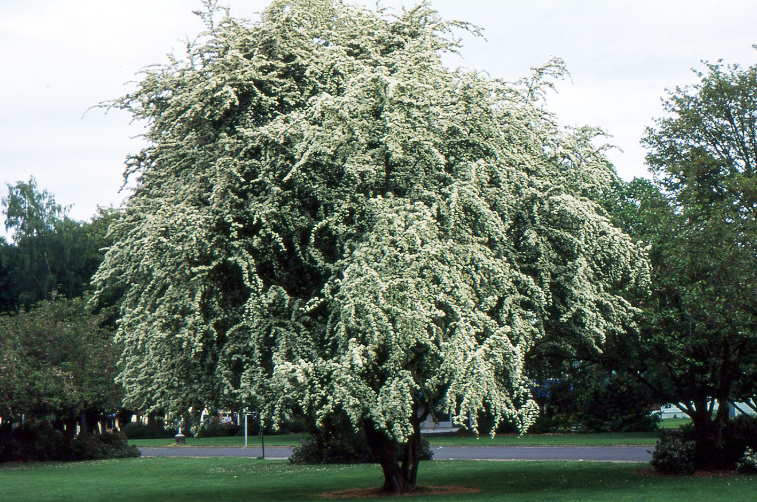
Common hawthorn (Crataegus monogyna) is one of the most familiar native trees of the British countryside. Often called hawthorn, May, or hedgerow thorn, it is particularly associated with traditional hedgerows, field boundaries, woodland edges, scrub, and open countryside. Its clouds of white, sometimes pink-tinged flowers in late spring are followed by clusters of deep red fruits known as haws.
This is a remarkably adaptable tree. It can grow as a small single-stemmed tree, a multistemmed shrub, or a dense hedging plant, and it tolerates exposed locations and a wide range of soil types. The RHS lists it as hardy to H7, making it suitable for essentially all UK conditions. A mature common hawthorn is typically around 4–8 metres tall and wide in cultivation, although larger specimens can reach approximately 10–15 metres.
Beyond its ornamental value, common hawthorn is an exceptionally useful wildlife plant. Its spring flowers provide nectar and pollen for insects, its red haws are eaten by birds and mammals, and its dense, thorny branches provide excellent nesting and shelter. Forest Research describes hawthorn as a major component of British hedgerows, estimating that it makes up around 70% of their structure.
Common Hawthorn at a Glance
| Feature | Details |
|---|---|
| Botanical name | Crataegus monogyna |
| Common names | Common hawthorn, hawthorn, May, hedgerow thorn |
| Plant family | Rosaceae |
| Type | Deciduous tree or shrub |
| Native range | Britain, Ireland, Europe, North Africa and southwestern Asia |
| Typical cultivated height | 4–8 m |
| Potential mature height | About 10–15 m |
| Typical spread | 4–8 m |
| Estimated growth rate | About 40–60 cm per year |
| Flowers | White or occasionally pink-tinged |
| Flowering period | Late spring, commonly May |
| Fruit | Dark red haws |
| Foliage | Deeply lobed, dark green |
| Hardiness | H7 |
| Light | Full sun or partial shade |
| Soil | Chalk, clay, loam or sand |
| Soil moisture | Moist but well-drained to well-drained |
| Uses | Hedging, wildlife gardens, specimen tree, countryside planting |
What Does Common Hawthorn Look Like?
Common hawthorn is usually a compact, densely branched tree with a rounded or irregular crown. The branches become increasingly woody and thorny as the tree matures, making established specimens particularly effective as hedges and wildlife shelter.
The leaves are small, glossy and deeply lobed, usually measuring around 6 cm long. The lobes are more deeply cut than those of the closely related Midland hawthorn (Crataegus laevigata). In autumn, the foliage can turn yellow before falling.
The bark is brown-grey and becomes more fissured and knobbly with age. Young twigs are slender and typically carry sharp thorns. In winter, the position of the thorns can help distinguish hawthorn from blackthorn: hawthorn spines emerge from the same points as the buds, whereas blackthorn has a different arrangement.
Common Hawthorn Flowers
The flowers are one of the tree’s most recognizable features. In late spring, usually around May, the branches become covered with flat-topped clusters of small white flowers, although a slight pink tinge can sometimes occur.
Each flower has 5 petals and contains both male and female reproductive parts. The flowers are strongly scented and attract a wide range of insects seeking nectar and pollen. The familiar timing of hawthorn blossom has also given the tree its traditional association with May and the transition from spring toward summer.
The flowers can make an established hawthorn look almost white from a distance, particularly when several trees are flowering together in a hedgerow.
Hawthorn Berries: The Haws
After pollination, common hawthorn produces small, deep red fruits called haws. They ripen in autumn and can remain on the branches into winter, providing a valuable food source for wildlife.
Birds including redwings, fieldfares and thrushes feed on the fruits, while small mammals can also make use of them. The persistent berries extend the tree’s wildlife value well beyond the spring flowering period.
The fruits can be processed into foods such as jellies, wines and sauces. However, the seeds contain potentially harmful compounds, and the RHS advises caution when considering the fruit for human consumption.
How Fast Does Common Hawthorn Grow?
Common hawthorn is a moderately fast-growing tree, although it is not in the same growth category as fast-growing willows or poplars.
A useful estimate is approximately 40–60 cm of height growth per year under favourable conditions. Growth is influenced by soil fertility, moisture, competition, exposure, age and whether the plant is being managed as a hedge or allowed to develop into a tree.
Young plants generally establish more slowly while their root systems develop. Once established, growth can become more vigorous, especially on fertile soils with adequate moisture. Mature trees naturally slow down as they devote more energy to maintaining their established crown and producing larger branches.
How Big Does Common Hawthorn Get?
In cultivation, the RHS gives a typical mature height and spread of approximately 4–8 metres. However, individual trees can become substantially larger if they are allowed to grow freely.
The Woodland Trust records mature common hawthorn reaching approximately 15 metres in height, although such large specimens are not representative of every garden-grown plant. The eventual size depends heavily on growing conditions, management and whether the tree is grown as a hedge, shrub or single-stemmed specimen.
For a small garden, regular pruning can keep hawthorn considerably smaller and denser.
Where Does Common Hawthorn Grow?
Common hawthorn is native to Britain and Ireland and has a very broad natural range extending across much of Europe, North Africa and southwestern Asia. In Britain it occurs widely in hedgerows, woodland edges, scrub, grassland and open countryside.
Government information describes its distribution as widespread and relatively continuous across Britain, apart from some upland areas where populations can become more fragmented. It has also been planted extensively as a hedging species for centuries.
It can occur at elevations of up to approximately 610 metres in Britain, demonstrating its considerable adaptability. It is particularly successful in open or lightly shaded conditions where competition is not excessive.
What Soil Does Common Hawthorn Prefer?
One of hawthorn’s greatest advantages is its tolerance of different soil types. It can grow in chalk, clay, loam and sand, provided the soil is reasonably well drained.
It tolerates both acidic and alkaline conditions and can cope with exposed sites. However, permanently waterlogged soil is unsuitable. For the best flowering and fruiting, plant it where the soil remains reasonably moist but does not stay saturated.
Hawthorn is particularly valuable for difficult rural sites because it can establish in conditions where some ornamental trees would struggle.
Does Hawthorn Grow in Shade?
Common hawthorn tolerates partial shade, although full sun generally produces better flowering and fruiting.
A tree planted in deep shade may survive but is unlikely to flower as heavily as one receiving several hours of direct light. If your main objective is a spectacular display of May blossom and abundant haws, choose an open position with good light.
For hedges, some shade is usually manageable, particularly when the hedge contains a mixture of native species.
Growing Common Hawthorn as a Hedge
Hawthorn is one of Britain’s traditional hedging plants and remains an excellent choice for wildlife-friendly boundaries. Its dense branching habit and thorns create an effective physical barrier while providing shelter for birds and small mammals.
An established hawthorn hedge can reach around 3 metres if left relatively tall, but regular trimming can maintain it at approximately 1.4–2.5 metres. Less frequent trimming generally allows more flowers and fruit to develop.
For a more naturalistic wildlife hedge, avoid cutting it excessively often. Allowing some flowering and fruiting wood to develop can increase its value to insects and birds while creating a more natural structure.
Common Hawthorn for Wildlife
Few native British trees provide such a combination of flowers, fruit and dense thorny cover.
The Woodland Trust reports that common hawthorn can support more than 300 species of insect. Its flowers provide nectar and pollen for bees and other pollinators, while its foliage supports caterpillars of numerous moth species.
The dense branches are particularly valuable for nesting birds. The structure offers protection from predators and can make a hawthorn hedge an important refuge in farmland and suburban landscapes.
The haws add another layer of wildlife value in autumn and winter, when food availability can become more limited.
Common Hawthorn as a Wildlife Hedge
If you are planting a native hedge, common hawthorn works especially well when combined with other native species rather than planted as a single-species boundary.
Good companions include:
- Hazel (Corylus avellana)
- Blackthorn (Prunus spinosa)
- Holly (Ilex aquifolium)
- Elder (Sambucus nigra)
- Field maple (Acer campestre)
- Dogwood (Cornus sanguinea)
A mixed hedge can provide a wider range of flowers, berries, foliage and structural habitats throughout the year. The RHS specifically recommends combining hawthorn with species such as hazel and elder when creating diverse wildlife habitat.
How to Plant Common Hawthorn
Choose a position in full sun or partial shade with reasonably well-drained soil. Hawthorn is tolerant of exposure, so it can work in locations where more delicate ornamental trees would suffer.
Dig a planting hole wider than the root system and plant the tree at approximately the same depth at which it was previously growing. Firm the soil around the roots and water thoroughly after planting.
A layer of organic mulch around the base can help conserve moisture and suppress competing vegetation. Keep the mulch away from direct contact with the trunk.
How to Prune Common Hawthorn
Common hawthorn requires relatively little pruning when grown as a natural tree. Remove dead, damaged or crossing branches and maintain a balanced structure as the tree develops.
Hedging plants require more regular trimming. The RHS recommends trimming hawthorn hedges after flowering or in autumn.
If wildlife value is important, avoid cutting the hedge during the main bird nesting season unless there is a genuine safety or legal reason to do so. Allowing some sections to flower and fruit can also significantly improve its ecological value.
Common Hawthorn Pests and Diseases
Hawthorn is generally a tough tree, but it can be affected by several pests and diseases.
Potential problems include:
- Aphids
- Caterpillars
- Gall mites
- Fireblight
- Powdery mildew
- Leaf spots
- Honey fungus
- Crown gall
- Silver leaf
The RHS lists fireblight among the diseases that can affect common hawthorn.
Good planting conditions and avoiding unnecessary damage to the tree can help reduce stress. If symptoms appear, identify the problem accurately before applying any treatment.
Common Hawthorn vs Midland Hawthorn
Common hawthorn is sometimes confused with Midland hawthorn (Crataegus laevigata), another native British species.
There are several useful differences. Common hawthorn usually has more deeply divided leaves, while Midland hawthorn tends to have less deeply lobed foliage. Common hawthorn flowers generally have 1 style, while Midland hawthorn typically has 2 or 3. The fruits also differ in seed number.
The 2 species can hybridise, which can make identification more difficult in some populations.
Common Hawthorn vs Blackthorn
Hawthorn and blackthorn are frequently confused because both are thorny native plants commonly found in hedgerows.
Blackthorn (Prunus spinosa) generally flowers before its leaves appear, producing white blossom in early spring. Hawthorn flowers later, around May, when its leaves are already present.
The fruits are also different. Blackthorn produces dark blue-black sloes, whereas hawthorn produces smaller red haws.
In winter, the position of the buds and thorns can provide another identification clue, with hawthorn thorns emerging from the same point as the buds.
Can You Grow Common Hawthorn in a Small Garden?
Yes. Common hawthorn can be maintained as a relatively compact tree or hedge through pruning, although it is important to remember that the species naturally has the potential to become much larger.
There are also more compact cultivars. For example, Crataegus monogyna ‘Compacta’ reaches only around 2.5 metres and is notably thornless, making it considerably easier to manage in a smaller garden.
For a small garden where the traditional thorny character is important, careful pruning of the standard species may be preferable. For a low-maintenance ornamental planting, a compact cultivar may be easier.
Is Common Hawthorn Evergreen?
No. Common hawthorn is deciduous, meaning it loses its leaves during autumn.
Its foliage emerges in spring, remains green through summer and usually turns yellow before falling. The tree’s winter silhouette is dominated by its branching structure and thorns, while the red haws may remain visible into the colder months.
If you need a year-round green hedge, an evergreen species such as holly or yew would be more appropriate.
Can Hawthorn Be Used as a Security Hedge?
Yes. The dense branching and sharp thorns make common hawthorn an effective defensive hedge.
It is particularly useful around rural properties, boundaries and wildlife gardens where a natural rather than formal barrier is preferred. However, its thorns make it unsuitable immediately beside heavily used paths, children’s play areas or locations where people regularly brush against the vegetation.
For maximum density, regular formative pruning encourages branching from lower down the plant.
Can You Eat Hawthorn Berries?
The red haws have a long history of culinary use and can be processed into jellies, wines and other products. The young leaves and flowers have also traditionally been used as food.
However, the seeds contain potentially harmful compounds, and the fruits can cause stomach upset in some people. The safest approach is to use only properly identified fruit and remove the seeds before culinary preparation. The RHS specifically advises that the seeds should be removed if the fruit is being eaten.
Why Is Common Hawthorn Important in Britain?
Hawthorn is much more than an attractive flowering tree. It is a fundamental part of the traditional British hedgerow landscape.
Hedgerows provide wildlife corridors between fragmented habitats, offer shelter and nesting sites, help reduce soil erosion and can contribute to carbon storage. Forest Research currently describes hawthorn as the backbone of UK hedgerows, estimating that it accounts for around 70% of their structure.
Its combination of rapid establishment, tolerance of different soils, thorny growth, flowers and fruit explains why it has been planted so extensively for centuries.
Fun Facts
- Scientific name: Crataegus monogynaIts name “monogyna” has a botanical meaning. The species name monogyna refers to the flower having a single style, which is the female reproductive structure of the flower. Its fruits also typically contain a single stone.
- It can be surprisingly thorny. Common hawthorn develops stout, woody thorns that can reach about 2.5 cm (1 inch) long. These sharp branches have helped make hawthorn a traditional hedging plant, where dense growth can form an effective natural barrier.
- Its red fruits are actually pomes. The small red fruits may look like berries, but botanically they are pome fruits, placing hawthorn in the rose family alongside apples and pears. Each fruit of common hawthorn typically contains one stone.
- Its flowers can have a surprisingly strong smell. Common hawthorn produces clusters of small white flowers in spring. Oregon State University notes that the pollen has a powerful smell, making the flowering period particularly distinctive.
- It can provide food and habitat for wildlife—but can also spread aggressively. Hawthorn fruits are eaten by birds, which can then disperse the seeds. While this makes the plant valuable to wildlife, common hawthorn has also become naturalized in parts of North America and can form dense thickets that crowd out other vegetation.
Key Takeaways
Common hawthorn is one of the UK’s most useful native trees because it combines beauty, toughness and exceptional wildlife value. Its white May blossom, deeply lobed leaves, red autumn haws and thorny branches make it easy to recognise, while its tolerance of different soils and exposed locations makes it remarkably versatile.
Whether grown as a single small tree, a traditional field hedge or part of a mixed wildlife boundary, Crataegus monogyna provides benefits throughout the year. Few native species offer such a strong combination of flowers for pollinators, fruit for birds, shelter for wildlife and dense growth for hedging.
For gardeners looking for a native tree that fits naturally into the British landscape, common hawthorn remains one of the strongest choices.
Further References
- Oregon State University — Crataegus monogyna (Common Hawthorn).
Oregon State University — Common Hawthorn
A very useful source covering botanical classification, mature size, thorns, leaves, flowers, fruit, USDA hardiness, native range, and its naturalization in North America. - University of Connecticut — Crataegus monogyna (Singleseed Hawthorn).
University of Connecticut — Singleseed Hawthorn
Provides detailed identification and horticultural information, including height, growth rate, leaves, flowers, red fruit, thorns, soil preferences, sun requirements, landscape uses, and common problems. - University of Florida IFAS — Crataegus monogyna Assessment.
University of Florida IFAS — Crataegus monogyna
Particularly useful for discussing the species’ origin, growth habit, and invasive potential in the United States. The assessment identifies common hawthorn as a species with high invasion risk in Florida. - University of Arkansas — Arkansas Tree Database: Common Hawthorn.
University of Arkansas — Common Hawthorn
A good species-identification reference covering size, leaves, flowers, fruit, fall color, growing conditions, diseases, landscape uses, and thorns. - Western Washington University — Common Hawthorn.
Western Washington University — Common Hawthorn
Useful for the history, identification, habitat, hedge use, thorns, fruit, and broader discussion of Crataegus diversity.