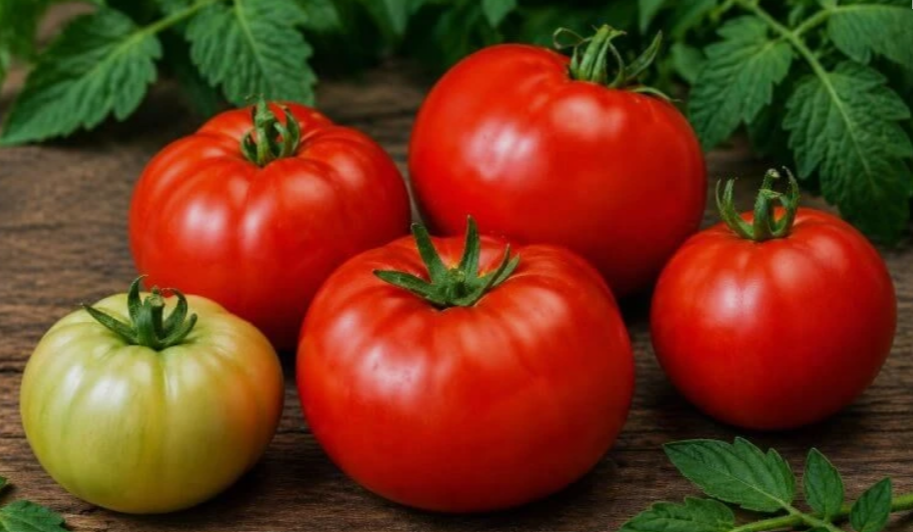
Brandywine Tomato: The Heirloom Everyone Grows for Flavor and Forgives for Everything Else
Brandywine is the heirloom tomato that taught a generation of gardeners to care about flavor, a large pink beefsteak with potato-leaf foliage and a reputation for tasting like what a tomato is supposed to taste like. It’s also one of the slowest, least productive, and most temperamental tomatoes you can plant. Gardeners grow it anyway, and extension trials help explain both halves of that bargain.
The plant’s story is as tangled as its fruit is lumpy. Its origin is debated, several different strains share the name, and many seeds sold as Brandywine aren’t the original. Knowing which version you’re getting, and what to expect from it, makes the difference between a harvest of sweet, juicy slicers and a season of green shoulders and split skins.
This guide covers Brandywine’s history and the debate over its origin, the main strains sold under the name, and how to identify the plant. It then looks at timing, yield, and disease and cracking problems. It closes with practical growing advice and newer hybrids that borrow its flavor.
A Disputed History
The version of Brandywine most gardeners grow today reached the public through the Seed Savers Exchange in 1982. Ben Quisenberry, an Ohio tomato enthusiast who lived from 1887 to 1986, listed it after reportedly receiving seeds from Dorris Sudduth Hill, who said the variety had been in her family for over 80 years. That’s why the original strain is often called Sudduth’s Strain or Pink Brandywine.
Earlier claims muddy the picture. Tomato Dirt reports that Burpee says it introduced a Brandywine to customers in 1886, nearly a century before the Seed Savers listing, and Specialty Produce notes that similar tomatoes appeared in American seed catalogs in the 1800s. Wikipedia says the plant is often described as Amish in origin but that there’s no evidence for it, and Specialty Produce suggests the idea arose because the Brandywine Creek area had Amish communities. The short summary is that the name is old, the modern strain is traceable to the early 1980s, and the exact lineage is unknown.
The Strains Sold as Brandywine
Brandywine isn’t one tomato but a family. Pink and red strains are the most common in home gardens, and Specialty Produce says the two are often mislabeled or sold interchangeably. Red Brandywine first appeared in 1984, but experts believe that was a mislabeled Pink Brandywine, and a true Red Brandywine was listed by Steve Miller in 1988.
A yellow strain called Platfoot also exists, and Rutgers trials have grown Brandywine strains named Power’s, Landis Valley Red, Yellow Platfoot, and Sudduth, among others. Because so many look-alikes circulate, the pink, potato-leaved original is sometimes labeled Brandywine (Sudduth’s). If you want the classic, check the label and ask the seller which strain you’re buying.
Identifying Brandywine
Brandywine has unusual potato-leaf foliage, with smooth, oval, pointed leaves instead of the jagged leaves of most tomatoes. The fruit is a large, pink, beefsteak-shaped tomato, usually flattened and often marked by green shoulders. Wikipedia lists a fruit weight of up to 24 ounces, Tomato Dirt gives 12 ounces to 2 pounds, and a Rutgers list gives 10 to 16 ounces for a late-season open-pollinated type.
The plant is indeterminate, a vigorous vine that keeps growing until frost. North Carolina State’s extension leaflet puts indeterminate tomatoes at 5 to 8 feet tall, so plan on a tall support. Louisiana State University’s 2012 heirloom trial described Pink Brandywine as an extra-large plant with excellent foliage and little disease until late in the season.
Days to Maturity
Brandywine is among the slowest tomatoes to ripen. Wikipedia says 80 to 100 days, Tomato Dirt gives 80 to 100, and the University of California Master Gardeners list 85 days, while Colorado State lists 80. Tatiana’s TomatoBase lists 90 days from transplant for the Sudduth strain, so plan for the long end of the range.
Colorado State sorts varieties as early at under 69 days, midseason at 70 to 80, and late beyond 81, which puts most Brandywine strains in the late category. That’s a real problem in short-season gardens, where fruit may never ripen before frost. Gardeners in cool regions should start seed early, use black plastic or row covers, and consider an earlier variety as backup.
Flavor and Yield
Flavor is the reason for Brandywine’s fame. Wikipedia quotes a description of great tomatoey flavor, and others describe a sweet tomato offset by a wonderful acidity. The pinkish flesh sets it apart from the deep-red slicers sold in most stores.
The trade-off is yield. Wikipedia notes the plant is heavily cultivated despite its relatively low yield, Tomato Dirt rates yield as moderate, and a Missouri State University presentation lists Brandywine as an example of a heirloom with lower yields than hybrids. Louisiana State University explains why many growers don’t plant heirlooms at all: they simply don’t produce the high yields that hybrids do.
Cracking, Disease, and Other Problems
Brandywine shares the typical weaknesses of large heirlooms. The Missouri State presentation describes it as very large, irregular fruit susceptible to cracking, with lower yields than hybrids and a lack of disease resistance. University of Florida extension says heirloom varieties are not generally disease resistant, have a shorter shelf life, and are highly susceptible to bruising, along with defects such as blossom-end scar, catfacing, and cracking.
Louisiana State University’s trial found that Red Brandywine was somewhat disease susceptible and that heirloom tomatoes are softer than hybrids and tend to crack. Cornell Cooperative Extension sums up the challenges of heirloom tomatoes as cracking, catfacing and other defects, and lack of disease resistance, yet notes that gardeners swear by the flavor. Whole ripe fruit also has a short shelf life, so eat it within a few days.
Growing Brandywine
Plant Brandywine in full sun, in rich, well-drained soil, with the longest possible season. Water evenly, since fruit cracking is associated with large variations in soil moisture, and mulch 2 to 3 inches deep to hold moisture steady, as University of Wisconsin Extension recommends. The same source says blossom-end rot results from uneven watering and advises avoiding large doses of nitrogen.
Heat matters for fruit set. The University of Maryland reports that pollination can be disrupted when daytime temperatures exceed 90 degrees Fahrenheit and nights stay above 70, and shade cloth blocking about 30 percent of sunlight can help in heat waves. Because the plants are big, give them sturdy cages or stakes; the University of Georgia notes that staking gives extra security against wind and heavy fruit loads.
Pruning and Support
Brandywine’s potato-leaf foliage is large and dense, so airflow matters. Cornell’s research describes pruning suckers as a season-long task for indeterminate tomatoes, and Arizona’s extension service notes that unchecked growth shades the fruit and reduces air circulation. The University of Georgia notes that light pruning in a dense canopy lets air and sun reach the plant.
Tie the vine to its support as it grows, and be generous with strength. A single fruit can weigh a pound or more, and a cluster of them can bend a flimsy cage. Sturdy stakes with soft ties, or a trellis with a top wire, will carry the weight.
What University Trials Show
Extension programs have tested heirlooms for years because of rising grower and gardener demand. Rutgers Cooperative Extension reported in 2004 that it was in its third year of evaluating heirloom tomatoes for New Jersey growers, and that the main culls in the trial were blossom-end rot, small fruit, and catfacing. Brandywine strains appeared alongside Mortgage Lifter, Cherokee Purple, and many others, which shows how routinely it serves as the benchmark heirloom.
Louisiana State University’s 2012 trial went further and asked about 175 people to rate heirloom tomatoes for taste, with Red Brandywine and Pink Brandywine among the entries. The trial notes also record plant size, disease, cracking, and yield for each, and they describe heirlooms as softer than hybrids with a tendency to crack. Results like these explain why Brandywine is praised at the table and worried over in the garden.
Brandywine vs. Other Big Heirlooms
Brandywine’s timing looks long next to its peers. The University of California lists Mortgage Lifter at 80 to 90 days and Cherokee Purple at 75 to 90, while Wikipedia gives 70 to 80 for Cherokee Purple and 80 to 100 for Brandywine. Fruit sizes overlap, with Cherokee Purple at 8 to 12 ounces and Brandywine at 10 to 16 ounces or more.
That makes Brandywine the best choice for a long, warm season and a poor choice for a short one. Gardeners who want a similar large pink heirloom with a shorter wait may prefer Cherokee Purple, while those who want size above all might try Mortgage Lifter. Many gardeners grow several and compare them side by side in their own soil.
Hybrid Alternatives With Brandywine Flavor
Plant breeders have tried to combine Brandywine’s flavor with better disease resistance. Cornell calls the results hyloom varieties, a mix of hybrid and heirloom that pairs heirloom flavor and appearance with disease resistance. One example is Big Brandy, a mid-season hybrid from a Rutgers variety list with fruit of about 12 ounces, bred from Brandywine and New Big Dwarf.
Hybrids come with trade-offs. Cornell notes that growers who want to save seed can’t do so with F1 hybrids, and a grower who frequently deals with Septoria leaf spot might prefer an heirloom over a hyloom. For many home gardeners, a mix works best: a few Brandywine plants for flavor and a hybrid or two for reliability.
Seed Saving and Buying Plants
Brandywine is open pollinated, so seed saved from your plants should produce similar fruit if you grow only one strain. Because look-alikes abound, buy seed from a seed company that names the strain. Southern Exposure Seed Exchange and Seed Savers Exchange are commonly cited sources.
Local nurseries sell Brandywine transplants too, but check the label for strain and days to maturity. Early in the season, when plants are small, it’s hard to tell a true Brandywine from a lookalike without the potato-leaf foliage. Waiting until the leaves develop can confirm you got what you paid for.
The Bottom Line
Brandywine earns its fame with tender, sweet-tart, pink fruit and a story that’s mostly mystery. It’s slow, moderate in yield, and prone to cracking and disease, so it rewards gardeners who can give it a long season, strong support, and steady water. Treat it as the flavor crop in a mixed tomato garden, and it will be the one everyone remembers.