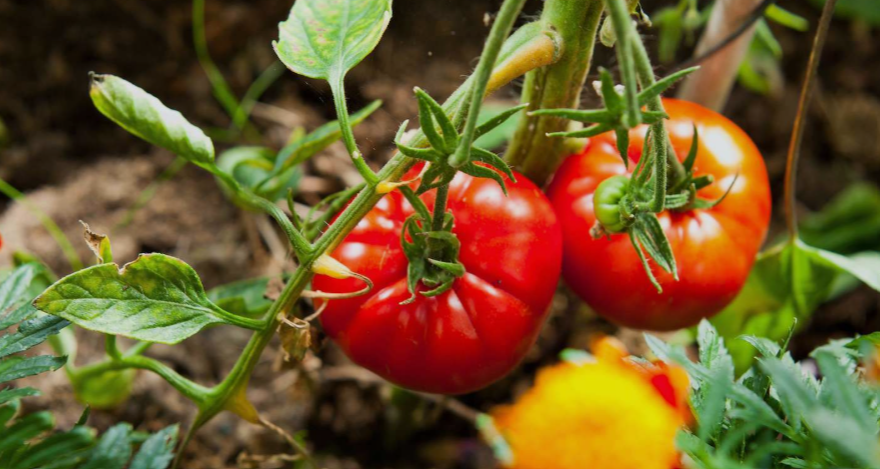
Big Beef Tomato: The Hybrid That Set the Standard for Home Gardens
Big Beef is a red beefsteak hybrid that has been a fixture in home gardens since it won an All-America Selections award in 1994. Its fruits are large, globe-shaped, and meaty, with the rich, slightly acidic flavor gardeners associate with old-fashioned tomatoes. What made it a landmark, though, was not the flavor but the combination of big fruit and a long list of disease resistances in one reliable plant.
That reliability explains why Big Beef keeps showing up on extension recommendation lists across the country, from Texas to Washington. It’s early for a beefsteak, it sets fruit under a wide range of conditions, and it carries resistance to several soil-borne and foliar diseases that can wipe out less protected plants. For a home gardener who wants slicing tomatoes without a lot of drama, it’s one of the safest choices available.
This guide covers Big Beef’s origin and breeding, how to identify it, and what its disease resistance does and doesn’t cover. It then looks at timing, weather tolerance, and practical growing advice. It closes with the plant’s weak spots and a comparison with other popular red tomatoes.
Origin and Breeding
Big Beef was bred by Colen Wyatt of Seminis Vegetable Seeds, who also developed the popular Celebrity and Husky Gold tomatoes. Bonnie Plants describes Wyatt as one of the most successful home garden vegetable plant breeders of the last half of the 20th century. All three of his tomatoes went on to win All-America Selections awards.
Big Beef earned its award in 1994, and All-America Selections later named it one of the five best plants it had recognized in its first 75 years, a group it calls the All-America Classics. According to AAS, as reported in Growing for Market, Big Beef was the first large beefsteak tomato with multiple disease resistance that insured bountiful harvests. That description captures its place in tomato history: a modern hybrid that finally delivered big, flavorful fruit without the fragility of older beefsteaks.
What Makes It Different
Large beefsteak tomatoes have long been prized for flavor but notorious for slow ripening. Many big heirlooms take 80 days or more, and Brandywine, for example, runs 80 to 100 days according to Wikipedia’s variety list. Big Beef addressed that weakness with hybrid vigor and a stack of resistance genes.
Seed companies describe it as combining old-fashioned flavor with modern disease resistance, and one seed retailer calls it the highest rated tomato overall. That’s marketing language, but extension lists back up the basic claim. The University of California Master Gardeners list it at 73 days with fruit of 10 to 12 ounces, and Washington State University’s variety list notes that it won its AAS award for good reason.
Identifying Characteristics
Big Beef produces uniform, red, globe-shaped to slightly flattened fruits with smooth skin and firm flesh. Seed sellers list the fruit at 10 to 12 ounces, while R.H. Shumway’s catalog gives a wider range of 9 ounces to 1 pound. Ohio State’s extension service, as relayed by Farm and Dairy, describes the flavor as traditional tomato flavor, good for slicing, salads, sauce, and canning.
The plant is an indeterminate vine, so it keeps growing and producing until frost. Seed catalogs disagree on how tall it gets, with one listing 3 to 5 feet, another saying up to 8 feet, and a plant retailer listing 36 to 48 inches for a nursery plant. North Carolina State’s extension leaflet puts indeterminate tomatoes at 5 to 8 feet, with a fruit cluster forming between every third leaf, so plan on a tall support and treat the smaller numbers as a nursery-plant size.
Days to Maturity
Seed companies list Big Beef at 73 days from transplant, and the University of California Master Gardeners agree. Colorado State University Extension counts anything under 69 days as early and 70 to 80 days as midseason, so Big Beef sits comfortably in the midseason range. For a beefsteak, that’s quick, since many large heirlooms take 80 days or more.
Bonnie Plants notes that, compared with other beefsteak types, Big Beef is early and sets fruit reliably even in cool, wet weather. That matters for gardeners in short-season regions, where a late variety may never ripen before frost. Seed sellers also suggest starting seeds indoors 5 to 6 weeks before the last frost date.
Disease Resistance
Disease resistance is the heart of Big Beef’s reputation. Seed companies list resistance to Verticillium wilt, Fusarium wilt races 1 and 2, root-knot nematodes, tobacco mosaic virus, Alternaria stem canker, and gray leaf spot. Some catalogs add Fusarium race 3, and the codes printed on packets vary slightly from seller to seller.
Those diseases are common soil and foliar problems in many regions. Oklahoma State University Extension notes that resistance to Fusarium wilt and nematodes is especially important because they’re common disease problems across Oklahoma, and it includes Big Beef among its 2021 tomato variety suggestions. Resistance codes cover specific diseases only, so a Big Beef plant can still suffer from late blight, early blight, or blossom-end rot.
Heat, Cool Weather, and Adaptability
Big Beef has a reputation for adapting to different climates. Texas A&M AgriLife says it can get tall but is reliable, producing when other varieties won’t. One seed retailer lists it as heat tolerant and drought tolerant, while another describes it as highly adaptable to all climates.
Heat still affects fruit set in every tomato. The University of Maryland reports that pollination and fruit formation can be disrupted when daytime temperatures exceed 90 degrees Fahrenheit and nights stay above 70, and it suggests shade cloth blocking about 30 percent of sunlight. R.H. Shumway’s catalog lists a growing range of zones 3 to 9, and Plant Addicts says it can be grown as an annual in zones 3 to 11.
Growing Big Beef
Big Beef wants full sun, rich soil, and consistent water. Seed catalogs suggest spacing plants 24 to 36 inches apart, though R.H. Shumway lists 1.5 to 2 feet. Because the vines grow long, Bonnie Plants recommends a tall cage or stake, and Park Seed says the plants require staking or caging.
Plant transplants outdoors after the danger of frost has passed, since Big Beef won’t tolerate frost. It can also be grown in a large container such as a half-barrel planter. The University of Georgia notes that staking gives extra security against wind and heavy fruit loads, and Cornell’s research describes pruning suckers as a season-long chore that keeps indeterminate vines manageable.
Pruning and Support
Suckers are the shoots that grow in the angle between the main stem and a branch. On an indeterminate tomato like Big Beef, removing them helps control growth and improves airflow, and Plant Addicts notes that suckers produce little fruit and steal energy from the plant. Arizona’s extension service adds that unchecked growth shades the fruit and reduces air circulation.
Tie vines to a sturdy stake or cage at regular intervals as they grow. Fruit of 10 to 12 ounces adds real weight to each cluster, and a flimsy support will bend or collapse. A tall cage or a trellis with a top wire works well, and South Dakota State’s extension service notes that staking reduces rot, helps decrease leaf blights, and produces cleaner fruit.
Growing Big Beef in Containers
Big Beef can be grown in a large container such as a half-barrel planter, according to Plant Addicts. Mississippi State’s extension service recommends a container at least a foot deep with drainage holes for container tomatoes, and suggests feeding with a water-soluble fertilizer about every 2 weeks. A large pot and a tall support are both needed, since Big Beef is a full-sized indeterminate vine.
Containers dry out faster than garden soil, so watering consistency matters even more. Uneven moisture is the main driver of both cracking and blossom-end rot, and potted plants swing between wet and dry more quickly than plants in the ground. A drip system or a self-watering container can help keep conditions steady.
Common Problems
Big Beef isn’t immune to the physical disorders that affect large tomatoes. Blossom-end rot, the sunken dark patch on the bottom of the fruit, results from calcium not reaching the developing tomato. University of Wisconsin Extension says the best prevention is consistent, uniform watering, along with mulch 2 to 3 inches deep and moderate nitrogen.
Cracking is the other common complaint, and the same source says it’s associated with large variations in soil moisture. Water evenly, mulch to hold moisture steady, and harvest fruit promptly once it reaches full color. Mississippi State’s extension service also notes that some varieties are more prone to cat facing, so a bumpy blossom end isn’t always a sign of a problem with your care.
Big Beef vs. Other Popular Tomatoes
Big Beef is often compared with Better Boy and Big Boy. Better Boy was introduced in 1964 by Petoseed and lists fruit of 6 to 16 ounces in about 72 days, while Big Boy was released by Burpee in 1949 with fruit of about a pound. Big Beef arrived 30 years after Better Boy, and its seed packets list more resistances than either older hybrid.
Celebrity, from the same breeder, has a long track record, though sources disagree on whether it’s determinate or semi-determinate. Texas A&M calls it the one tomato that everyone in its trial grew, and that it grew well. If you want a single reliable beefsteak on a tall vine, Big Beef is a strong choice, and if you want a more compact plant, Celebrity may fit better.
Harvesting and Using Big Beef
Pick fruit when it has developed full red color. The meaty flesh and firm texture make it a good slicing tomato, and Ohio State notes it works for salads, sauce, and canning as well. Because the fruit is large and uniform, it slices evenly for sandwiches and salads.
Big Beef is a hybrid, so seeds you save won’t produce identical plants. Buy fresh seed or plants each year if you want the same performance and disease resistance. Seed packets list about 8,000 seeds per ounce, so a small packet goes a long way.
The Bottom Line
Big Beef earned its place as a modern classic by delivering large, flavorful fruit on a plant that resists many common diseases and adapts to many climates. It’s early for a beefsteak, reliable in cool and warm weather alike, and still on university recommendation lists decades after its debut. Give it sun, a tall support, and steady water, and it will fill your kitchen with big, meaty slicers all summer.