Early Girl Tomato: The Short-Season Hybrid That Became a Dry-Farming Star
Early Girl is a medium-sized, red, globe-type hybrid tomato that has been one of America’s most dependable early tomatoes since the 1970s. It ripens in roughly 50 to 63 days from transplanting, sets fruit in cool weather, and carries resistance to two major wilt diseases. For gardeners with short summers or a hunger for the first ripe tomato of the season, it has been the default answer for half a century.
What makes Early Girl unusual is the second life it has built in California. Farmers on the Central Coast grow it without irrigation, a technique called dry farming, and the fruit has earned a cult following for its sweet, concentrated flavor. University of California and Oregon State researchers have now studied the plant closely, and their numbers explain both its appeal and its weak spots.
This guide covers Early Girl’s origin and naming, how to identify it, and how fast it really ripens. It then looks at what its disease resistance covers and at its compact sibling, Bush Early Girl. It closes with the research on dry farming and practical growing advice for home gardeners.
Origin and Naming
Early Girl is based on a short-season hybrid tomato developed in France. Wikipedia reports that the PetoSeed Company, a major agricultural seed supplier, first distributed it in the United States in the early 1970s. Tomato Dirt says PetoSeed boardmember Joe Howland had pushed for a short-season tomato, and that he nicknamed the new variety Early Girl to complement the company’s successful Better Boy.
The Burpee seed company then struck an exclusive three-year deal for the new hybrid and put it on the cover of its 1975 spring catalog. That marketing push turned a short-season hybrid into a household name. The sibling naming, Better Boy and Early Girl, was a deliberate seed-marketing choice, and it helped the new hybrid sell alongside an established favorite.
Identifying Early Girl
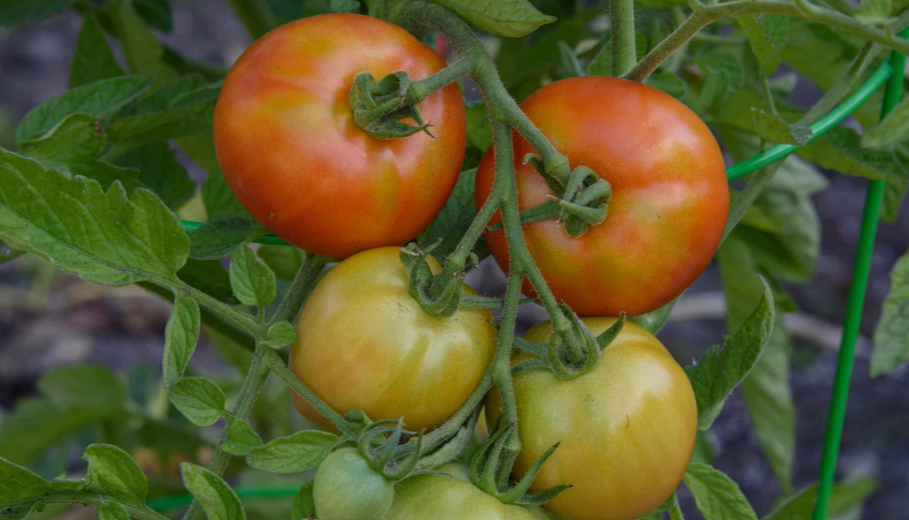
Early Girl is a medium globe-type tomato with smooth, red skin and meaty flesh. The University of California’s variety list describes smooth, red-skinned, meaty fruits of 4 to 6 ounces that are ready in about 60 days, and Ohio State lists fruit at 4 to 5 ounces with good flavor. Washington State describes large, dependable early harvests of round, red, meaty tomatoes.
The plant is an indeterminate hybrid, a vining plant that keeps growing and setting fruit all season. North Carolina State’s extension leaflet puts indeterminate tomatoes at 5 to 8 feet tall, so Early Girl needs a tall support despite its early fruit. Gardenia.net stresses that the standard Early Girl is a vigorous vine, not a compact bush, and shouldn’t be confused with Bush Early Girl.
How Early Is It?
Sources disagree on Early Girl’s exact timing, which shows how much it depends on climate and handling. Wikipedia lists maturity at 50 days, Tomato Dirt gives 57 to 59, and Cornell is quoted as placing it at roughly 57 to 63 days after transplanting. The University of California Master Gardeners list 57 to 59 days, while Burpee currently lists 59.
Colorado State University Extension counts anything under 69 days as early, so every one of those numbers puts Early Girl in the early category. Compared with a late heirloom like Brandywine at 80 to 100 days, that’s a gap of a month or more. Wikipedia adds that Early Girl can tolerate temperatures as low as 40 degrees Fahrenheit and does well in hot, dry climates.
Disease Resistance
Early Girl is available in two resistance packages. The VF version is resistant to Verticillium wilt and Fusarium wilt strain I, while the VFF version adds resistance to Fusarium wilt strain II. Tomato Dirt lists the current Burpee version as V and FF, which means Verticillium wilt and Fusarium wilt races 1 and 2.
Those codes cover specific soil-borne diseases and nothing else. Compared with Bush Early Girl’s VFFNT package, standard Early Girl covers fewer diseases, and Gardenia.net notes that resistance listings vary by source. For gardeners who want more protection, the University of California Master Gardeners describe a related hybrid, New Girl, as even more disease resistant than Early Girl and better in flavor.
Bush Early Girl
Bush Early Girl is a separate cultivar, not just a smaller version of the same plant. Tomato Dirt describes it as a determinate plant with stronger disease resistance, listed as VFFNT, and says its fruit ripens 4 to 5 days earlier than standard Early Girl on a compact plant that flourishes in containers. Gardenia.net warns against shortening Bush Early Girl to Early Girl when recording plant traits.
Determinate plants stay compact, usually 1 to 5 feet tall according to North Carolina State, and ripen most of their crop over a short period. That makes Bush Early Girl useful for patios, small beds, and gardeners who want a burst of tomatoes at once. Standard Early Girl, by contrast, keeps producing until frost and needs more room and support.
The Dry-Farming Phenomenon
Early Girl’s most surprising reputation comes from dry farming, the practice of growing tomatoes with little or no irrigation after planting. Wikipedia says dry-farmed Early Girls have a cult following and are popular at farmers’ markets in the San Francisco Bay Area, and that Chez Panisse founder Alice Waters called one of the best tomatoes she’d had a dry-farmed Early Girl. Californians have dry-farmed tomatoes since at least the 1980s, when Central Coast growers realized the cool ocean breeze sustained tomatoes through the rainless summer.
University research backs up the flavor claim. A study by UC Cooperative Extension, UC Davis, and UC Santa Cruz chose Early Girl because it had proven adaptable to water-deficit treatments. It found that marketable yield fell by only 15 to 20 percent in the driest treatments, that tasters favored fruit from stressed plots for flavor, aroma, appearance, texture, and overall quality, and that sugar concentrations were highest in the least-watered fruit and decreased as water input increased.
What Dry Farming Costs
Dry farming isn’t free of trade-offs. UC Santa Cruz researchers report that the yield per acre of dry-farmed tomatoes is about one-fifth that of conventional California tomatoes, though many Bay Area farmers find it profitable because the fruit sells at higher prices. The same report says conventional farmers use roughly a gallon of water to produce a typical 3-ounce tomato.
Blossom-end rot is a major issue. Oregon State’s dry-farming project, in a SARE-funded handout, reports that in 2019 the average farm lost 33 percent of its fruit to blossom-end rot, with rates as high as 90 percent on some farms. The same project found that Early Girl grafted onto a vigorous rootstock yielded about 4,120 pounds per acre more than ungrafted plants, though the fruit was slightly less sweet by about 0.75 degrees Brix.
Dirty Girl and Other Dry-Farm Selections
Early Girl isn’t the only tomato grown this way anymore. UC Santa Cruz reports that most dry-farmed tomatoes in California come from Dirty Girl or its close relatives, and that Dirty Girl is notable for producing more tomatoes when dry-farmed. An Organic Seed Alliance trial describes further selection under organic dry-farming conditions that produced a new population called Dark Star.
The UC Santa Cruz news office notes that growing dry-farmed Early Girl is a challenge farmers face, and that researchers are planting more than 15 varieties at Oregon State and UC Santa Cruz to find options for dry farming. The goal is to give growers alternatives as water becomes more variable. For home gardeners, it’s a reminder that Early Girl’s flavor in the garden depends partly on how you water it.
Growing Early Girl at Home
You don’t need to dry farm to enjoy Early Girl. Plant it in full sun, in rich, well-drained soil, and water it regularly after transplanting. Because it matures quickly, it’s a good choice for northern gardens, for a second planting in warm regions, and for gardeners who want ripe tomatoes by midsummer.
Even watering matters more than any other cultural practice. University of Wisconsin Extension says blossom-end rot results from wide fluctuations in soil moisture and recommends consistent, uniform watering, mulch 2 to 3 inches deep, and moderate nitrogen. The same source says cracking is also associated with large variations in soil moisture.
Support, Heat, and Pruning
Give the vine a sturdy cage or stake. The University of Georgia notes that staking gives extra security against wind and heavy fruit loads, and Cornell’s research describes removing suckers as a season-long chore for indeterminate tomatoes. Arizona’s extension service says unchecked growth shades the fruit and reduces air circulation.
Heat can interfere with fruit set. The University of Maryland reports that pollination and fruit formation can be disrupted when daytime temperatures exceed 90 degrees Fahrenheit and nights stay above 70, and shade cloth blocking about 30 percent of sunlight can help. Keeping shade cloth on hand before a heat wave arrives is a simple precaution.
Early Girl vs. Better Boy
Early Girl was named as a sibling to Better Boy, and the two make a good pair. The University of California lists Better Boy at about 72 days with fruit of 6 to 16 ounces, compared with Early Girl’s 57 to 63 days and 4 to 6 ounces. Better Boy is bigger and later, while Early Girl delivers first.
Many gardeners plant both for a staggered harvest. Early Girl provides slicers in midsummer while Better Boy ripens a few weeks later. The combination spreads the harvest across more of the season than either plant alone.
Seed Saving and Buying Plants
Early Girl is a hybrid, so seed saved from your plants won’t produce the same tomato. Buy fresh seed or transplants each year, and check the label to confirm whether you’re getting standard Early Girl, Bush Early Girl, or a newer relative. Look for the resistance codes on the tag, since the VF and VFF versions differ.
Most garden centers carry Early Girl transplants, and many seed companies sell the seed. If you’re buying for dry farming, ask for standard Early Girl rather than the bush type. Starting early and planting after frost danger has passed gives the plant a full season to produce.
The Bottom Line
Early Girl earns its reputation by doing three things well: ripening early, setting fruit in cool weather, and tasting better than its modest size suggests. University research shows that its flavor improves with water stress, though with real trade-offs in yield and blossom-end rot. Plant it for the first ripe tomato of the year, support the vine, water evenly, and it will keep delivering until frost.