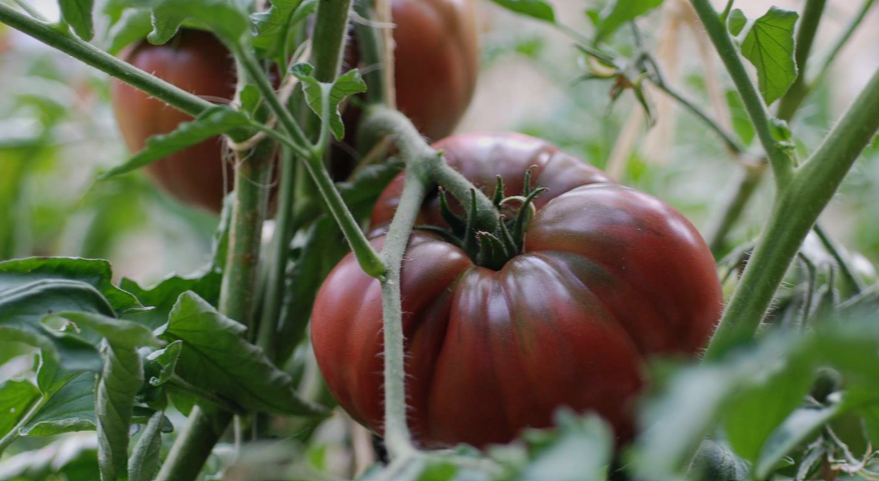
Black Krim Tomato: The Dark, Salty Heirloom From the Black Sea
Black Krim is a dark, brownish-purple heirloom beefsteak tomato that arrived in American gardens in 1990 and has been a favorite of flavor-minded growers ever since. Its fruit ripens to a deep red-brown with green shoulders, turns almost black in strong sun, and delivers a rich, slightly salty taste that sets it apart from ordinary red slicers. Gardeners love it, and they also complain about it, because the same traits that make it distinctive make it a little unpredictable.
The tomato’s story is part geography and part gardening mystery. It’s named for the Crimean region on the Black Sea, its early history is murky, and its arrival in the United States came through a Swedish seed saver in a seed-exchange yearbook. Understanding where it came from, and why its shoulders stay green, helps you grow it without panicking when it doesn’t look the way a red tomato should.
This guide covers Black Krim’s origin and naming, how to identify it, and what its flavor and yield are really like. It then looks at the green-shoulder problem, cracking, and timing. It closes with practical growing advice and tips on buying seed and using the harvest.
Origin and Naming
Black Krim comes from the Crimean Peninsula on the Black Sea. The name Krim is the local word for Crimea, and the variety is also sold as Black Crimea, Black Crimean, and Noire de Crimee. The University of California Master Gardeners trace it to the Isle of Krim in the Black Sea, while Washington State University Extension describes it as originating in Crimea.
A popular story says soldiers collected the seeds during the Crimean War of the 1850s and carried them home, but Specialty Produce presents that only as something reportedly said. The documented history is more modern. Black Krim was first offered in the Seed Savers Exchange 1990 Yearbook by Lars Olov Rosenstrom of Bromma, Sweden, and Gardenia.net notes that its North American seed history is much better documented than its earlier local history.
A Contradiction Worth Knowing
Some product descriptions claim Black Krim was developed by crossing a beefsteak with Cherokee Purple. That can’t be right for a tomato attributed to Crimea and offered in 1990, since it conflicts with the Crimean origin that most sources give. It’s a reminder that the story attached to a variety on a seed packet or produce label isn’t always reliable.
Tatiana’s TomatoBase, a variety database, records the original seed lines by their donors, including the 1990 Swedish source and later listings from gardeners in Iowa. The same database notes that one grower who bought commercial seed received crosses, typically with red fruit, or the salty strain. That detail hints at real variation between seed lots, so where you buy matters.
Identifying Black Krim
Black Krim fruit is oblate, a flattened beefsteak shape, with deep brown-red to purple-red skin and green to olive-green shoulders. Gardenia.net says the color can become nearly black in strong heat and sunlight, which matches Seed Savers Exchange’s description of violet-brown and purple-red fruit that can darken almost to black. Washington State describes the fruit as dark red-purple, turning nearly black in sunny conditions.
The plant is an indeterminate heirloom with regular-leaf foliage, which means it’s a vine that keeps growing and setting fruit all season. North Carolina State’s extension leaflet puts indeterminate tomatoes at 5 to 8 feet tall, so plan on a strong support. Tatiana’s TomatoBase describes a moderate crop of medium to large oblate brownish fruit, usually with green shoulders.
How Big Is It?
Size varies by source. The University of California Master Gardeners of Contra Costa County list Black Krim at 8 ounces, Specialty Produce says fruit average 8 to 12 ounces, and Tatiana’s TomatoBase gives 6 to 10 ounces for one listing. Johnny’s Selected Seeds, quoted by Gardenia.net, says generally 8 to 16 ounces.
Those figures place Black Krim at the smaller end of the beefsteak type, with fruit that’s large but not giant. Compare it with Brandywine Red at 16 to 24 ounces or Big Rainbow at up to 24 ounces on the same Contra Costa list. A mid-sized fruit also means a more manageable plant load, and it often ripens a little sooner than the very largest heirlooms.
Days to Maturity
Timing is broad. The Contra Costa list gives 70 to 90 days, Seed Savers Exchange says 70 to 90 days from transplant, Gardenia.net says about 80, and one catalog lists 85. Tatiana’s TomatoBase lists 80 days in one record and 75 in another.
That range puts Black Krim in the midseason to late category, depending on how you count. Gardeners in short-season regions should start seeds early and use season extenders. A tomato that needs 85 days from transplant won’t finish in a cool summer without help.
Flavor and Yield
Flavor is why people grow it. Specialty Produce describes an intense taste with a sweetness balanced by acidity and a distinct, slightly salty edge, and Seed Savers Exchange calls it an excellent, full flavor. Tasting Table says Black Krim has a more intense flavor than a classic tomato but is also less acidic, though it’s worth remembering that taste is personal.
Yield is the trade-off. Wikipedia’s list of tomato cultivars notes rather low production, and Tatiana’s TomatoBase reports a moderate crop. Texas A&M AgriLife lists Black Krim as a Master Gardener recommendation, a sign that it performs acceptably in at least some hot climates. For many gardeners, a few outstanding tomatoes are worth more than a bucketful of ordinary ones.
Why the Shoulders Stay Green
The green shoulders are Black Krim’s most recognizable trait and its most common source of worry. University of Missouri extension explains that tomato varieties that are green-shouldered when immature are more likely to show the yellow shoulder disorder than varieties with uniformly green immature fruit. The Rhode Island extension adds that in heirloom tomatoes, yellow shoulder and uneven ripening are associated with dark green shoulders in the immature fruit, and that the dark green shoulder is genetic.
Heat and potassium play a role too. The University of Missouri says yellow shoulder often follows when plant tissue potassium levels drop from the adequate 4 to 6 percent to low levels of 2 to 3 percent, especially when temperatures are high. In a University of Delaware report, researchers measured fruit temperatures between 86 and 105 degrees Fahrenheit in July and noted that lycopene, the red pigment, isn’t produced when temperatures exceed 85 to 88 degrees.
What You Can Do About It
Because the green shoulder is partly genetic, you can’t eliminate it, but you can reduce the problem. Maintain good foliage cover over the fruit so it isn’t baked by direct sun, and make sure the plants have adequate potassium, which a soil test can confirm. The URI handout recommends keeping canopy temperatures down and notes that temperatures above 90 degrees Fahrenheit in the canopy can contribute to the problem.
The University of Delaware suggests an unusual approach for severe cases: harvest tomatoes when pink color first appears and let the fruit ripen at room temperature in the dark. Because lycopene is produced as the fruit ripens, removing it from high temperatures can avoid the problem. For a variety like Black Krim, where a green top is normal, a gentle squeeze and a look at the underside color are better ripeness tests than shoulder color alone.
Cracking and Other Problems
Black Krim is also known to crack. Seed Savers Exchange reviewers describe delicious flavor but a tendency toward cracking, and one reviewer reported inconsistent ripening, with the bottom half ready while the top stayed green and hard. University of Wisconsin Extension says cracking is associated with large variations in soil moisture and recommends mulching 2 to 3 inches deep and watering regularly.
The same source says blossom-end rot results from calcium not reaching the developing fruit and recommends consistent watering and moderate nitrogen. University of Florida extension notes that heirloom tomatoes in general aren’t disease resistant, have shorter shelf lives, and are susceptible to bruising. Heirlooms like Black Krim reward careful handling and a gardener who’s willing to pick them promptly.
Growing Black Krim
Plant it in full sun, in rich, well-drained soil, and give it a tall, strong support. Water evenly, since fluctuations drive both cracking and blossom-end rot, and mulch to hold moisture steady. The University of Georgia notes that staking gives extra security against wind and heavy fruit.
Heat deserves attention. The University of Maryland reports that pollination and fruit formation can be disrupted when daytime temperatures exceed 90 degrees Fahrenheit and nights stay above 70, and shade cloth blocking about 30 percent of sunlight can help. Cornell describes pruning suckers as a season-long chore, and Arizona’s extension service says unchecked growth shades the fruit and reduces air circulation, though you want enough leaf cover to protect the shoulders from sun.
Seed Saving and Buying Plants
Black Krim is open pollinated, so seed saved from your plants should produce similar fruit if you grow one strain. Because seed lots can vary, buy from a company that names its source, such as Seed Savers Exchange or Johnny’s Selected Seeds. If your plants produce red fruit, you may have received a cross rather than the true variety.
Nursery transplants are widely available, but look for plants labeled Black Krim rather than a generic black tomato. Start seed indoors 6 to 8 weeks before your last frost, as seed sellers suggest, so plants are large enough to catch the long season. Germination typically takes 7 to 14 days.
Using the Harvest
Black Krim is a slicing tomato first. Specialty Produce says its flavor makes it great for fresh eating, salads, sandwiches, and juices, and that it can also be used for sauces. Seed Savers Exchange notes that flavor and texture suffer when tomatoes are chilled, so keep ripe fruit on the counter, and that roasting concentrates the flavor.
Because the fruit is dark, it’s easy to misjudge ripeness. Press gently and look for a slight give, and check the color on the bottom half of the fruit. Eating it with a pinch of salt and a little olive oil is the simplest way to taste what the fuss is about.
The Bottom Line
Black Krim earns its place with a dark, salty-sweet flavor and a striking look that can’t be mistaken for any other tomato. It’s moderate in yield, prone to green shoulders and cracking, and needs a long, warm season and steady care. Grow a few plants for flavor, learn to read the color, and treat the green shoulders as part of the variety’s character rather than a flaw.