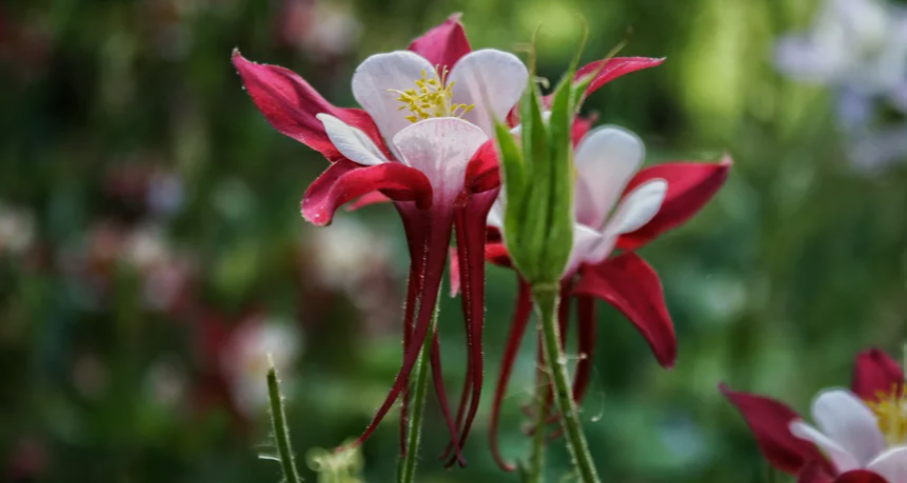
Flowers with red and white petals
Red and white flowers combine the two most dramatic colors in the garden in a single bloom, whether that means a white petal flamed with red, a red petal splashed with white, or a white flower with a bold red heart. They’re popular for holiday plantings, for patriotic color schemes, and for gardeners who want contrast without adding a third color. The 11 flowers below are all true red-and-white bloomers, from classic roses and tulips to a hardy shrub, a perennial salvia, and a tropical cigar plant.
The group is more varied than the shared palette suggests. Heights run from about 15 inches for the vinca ‘Jaio Dark Red’ to 8 to 10 feet for the ‘Red Heart’ rose of Sharon, and hardiness runs from zone 3 for the ‘Carnaval de Nice’ tulip to zone 12 for the cigar plant. Two of the entries, ‘Double Delight’ and ‘Scentimental’, are award-winning roses, while ‘Hot Lips’ and ‘Red Heart’ both hold the Royal Horticultural Society’s Award of Garden Merit.
Red-and-white coloring isn’t always fixed. The salvia ‘Hot Lips’ changes its pattern with temperature, flowering red in warm weather and bicolored in cool weather, while ‘Double Delight’ develops its red edges only as the petals take sun. Planting these flowers where they’ll get the right conditions is the surest way to see the full color contrast.
The flowers below are grouped into roses, perennials and bulbs, shrubs and camellias, and annuals. Heights, zones, and bloom times are shown as ranges where sources differ. Where a flower’s color depends on weather or sunlight, the article will guide when to expect the strongest contrast.
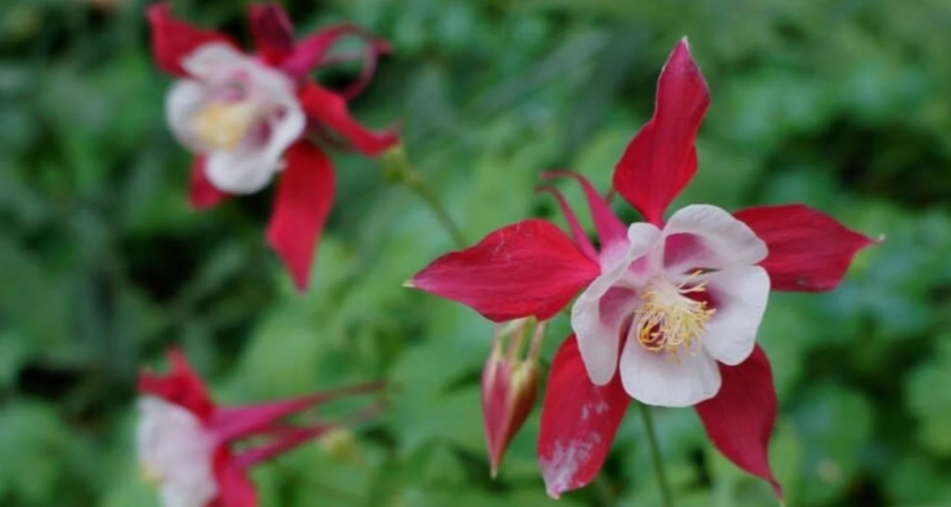
Roses
‘Double Delight’ Rose
‘Double Delight’ is a hybrid tea rose with creamy white blooms that gradually take on strawberry-red edges as sunlight reaches the outer petals. It was crowned the World’s Favorite Rose in 1977, and a member poll of the World Federation of Rose Societies gave it an American Rose Society rating of 8.6 on a scale of 10, higher than the other favorites on the same list. It forms an upright, bushy plant that reaches up to about 3.5 feet tall and 2 feet wide.
The roses are carried singly on long stems, which makes them excellent for cutting, and the fragrance is strong and spicy. Plants flower repeatedly from early summer until the first frosts in autumn. Because the red edges develop in sunlight, it’s best planted where the flowers get plenty of direct sun.
‘Scentimental’ Rose
‘Scentimental’ is a floribunda rose with burgundy-red and creamy white striped petals, and the pattern differs on the upper and under surfaces of each petal. It was bred by Tom Carruth before 1996 from the floribunda ‘Playboy’ and the grandiflora ‘Peppermint Twist’, and it was the first striped rose to win an All-America Rose award. The double flowers average about 4.75 inches across and appear in small clusters.
The plant is a compact, rounded shrub that grows 3 to 5 feet tall and 3 to 4 feet wide, depending on the source, and it’s hardy in zones 5 through 10. It blooms in flushes from spring through fall and has a spicy, damask fragrance. Disease resistance is generally good, though one rose database lists susceptibility to blackspot, so give it good airflow.
Perennials and Bulbs
‘Hot Lips’ Salvia
‘Hot Lips’ is an evergreen to semi-evergreen salvia that grows 2 to 3 feet tall and wide, with two-lipped flowers that are red and white. The upper petal is white and the lower lip is cherry red when the plant shows its classic pattern. It blooms from spring or early summer until frost and earned an Award of Garden Merit from the Royal Horticultural Society in 2015.
The color depends on temperature. In cool weather, below about 15 degrees Celsius or 59 degrees Fahrenheit, the flowers are distinctly bicolored, while warm weather deepens the red until many flowers are almost entirely crimson. Sources disagree on whether the hottest part of summer produces all-red or all-white flowers, and the pattern returns as nights cool. It’s hardy in zones 8 through 11 according to most sources, drought tolerant once established, and deer and rabbit resistant. Hummingbirds, butterflies, and bees visit the nectar-rich flowers.
‘Carnaval de Nice’ Tulip
‘Carnaval de Nice’ is a double late tulip, also called peony-flowering, introduced in 1953. Its huge, peony-shaped blooms are white, flamed and feathered with deep red, and no two flowers look exactly alike. The gray-green foliage is edged in white, which adds interest before the flowers open.
It’s one of the last tulips to bloom, flowering from mid to late spring at about 16 to 20 inches tall, and it’s hardy in zones 3 through 7 or 8 depending on the source. Like most complex double tulips, it isn’t reliably perennial and is best treated as an annual. It needs full sun and well-drained soil, since it can suffer from tulip fire and bulb rot in poorly drained ground.
Cigar Plant
Cigar plant has tubular flowers made of a calyx that’s orange to red with a thin white rim and two small purple-black petals at the tip. The effect resembles a lit cigar, which gives the plant its name. It grows 1 to 2.5 feet tall as a rounded, densely branched evergreen sub-shrub.
It blooms from late spring until frost and is hardy in zones 10 through 12, though University of Florida guidance puts its cold tolerance at about 20 degrees Fahrenheit. It does well in containers, window boxes, and borders. Hummingbirds visit the flowers.
Shrubs and Camellias
‘Red Heart’ Rose of Sharon
‘Red Heart’ is a deciduous shrub with large, single, saucer-shaped white flowers that have a deep red heart in the center. The red spreads into the petals as veins, creating a halo effect, and each flower is about 3 inches across. It has earned the Royal Horticultural Society’s Award of Garden Merit.
The Chicago Botanic Garden lists it at 8 to 10 feet tall and hardy in zones 5 through 8, while other sources give 6 to 8 feet and zones 5 through 9. It blooms from midsummer into fall, which makes it a good source of late color. It’s slow to emerge in spring, deer resistant, and visited by hummingbirds, butterflies, and bees.
‘Lipstick’ Camellia
‘Lipstick’ is an original and rare Japanese camellia that blooms from January to March. Its flowers are very unusual, red variegated with white, and the form is reminiscent of anemones. The red-and-white pattern makes each bloom look different from the next.
Japanese camellias are evergreen shrubs that grow 7 to 12 feet tall and 5 to 10 feet wide and are hardy in zones 7 through 9. University of Florida Extension notes the flowers are two to five inches across and the plants should be pruned right after flowering. They prefer part shade and moist, acidic soil and can be prone to aphids and scale.
‘Lady Vansittart’ Camellia
‘Lady Vansittart’ is a Japanese camellia known for multicolored blooms on a single plant. The flowers show a splash pattern of white, pink, and red. That variation means one shrub can produce several different looks in the same season.
Like other Japanese camellias, it performs best in zones 7 through 9, and pushing into zone 6 requires winter protection and a sheltered location. It blooms in winter and spring, when little else is in flower. Plant it in part shade with acidic, well-drained soil.
Annuals
Vinca ‘Jaio Dark Red’
‘Jaio Dark Red’ is a vinca with red flowers that have a small white center, a combination that makes the red look even deeper. The flowers are about 2 inches across. It was one of ten flowers named an All-America Selections winner for 2003.
The plant matures at about 15 inches tall with a spread of about 20 inches. That makes it a good mid-height bedding plant. Leave room for the spread when you set out plants.
Zinnia ‘Candy Stripe’
‘Candy Stripe’ is an heirloom zinnia with large double, dahlia-type flowers about 4 inches across. The blooms come in colors such as peach, orange, pink, white, and yellow, all overlaid with streaks and splotches of red. The red markings give each flower a different pattern.
Plants reach 24 to 32 inches tall and should be spaced 12 to 18 inches apart. Seeds germinate best at 70 to 80 degrees Fahrenheit, and the flowers bloom from summer into fall. It’s an annual that’s excellent for cutting and attracts bees, butterflies, and birds.
Zinnia ‘Peppermint Stick’
‘Peppermint Stick’ is a zinnia similar to ‘Candy Stripe’ but a different plant. Its flowers are about half the size of those on ‘Candy Stripe’, and the splash patterns are slightly different. The blooms are marked with red streaks over lighter colors.
The plants are a bit smaller than ‘Candy Stripe’, with less of the outward spread. Like other zinnias, it’s an annual that does best in full sun. It makes a good choice for bedding, containers, and cut flowers.
Key Takeaways
- Red and white flowers create a striking contrast and can add a bold, elegant appearance to flower beds, borders, containers, and mixed landscapes.
- These color combinations occur in many plant forms, including annuals, perennials, bulbs, vines, shrubs, and flowering houseplants.
- Red and white blooms can appear as stripes, spots, edges, patches, speckles, or separate red and white petals, giving each flower a distinctive appearance.
- Popular examples include red-and-white roses, tulips, petunias, dianthus, lilies, begonias, and bleeding heart, among many others.
- Many red and white flowers attract bees, butterflies, hummingbirds, and other pollinators, depending on the species and flower structure.
- When choosing a red and white flowering plant, consider its sunlight requirements, soil conditions, watering needs, bloom period, mature size, and local climate.