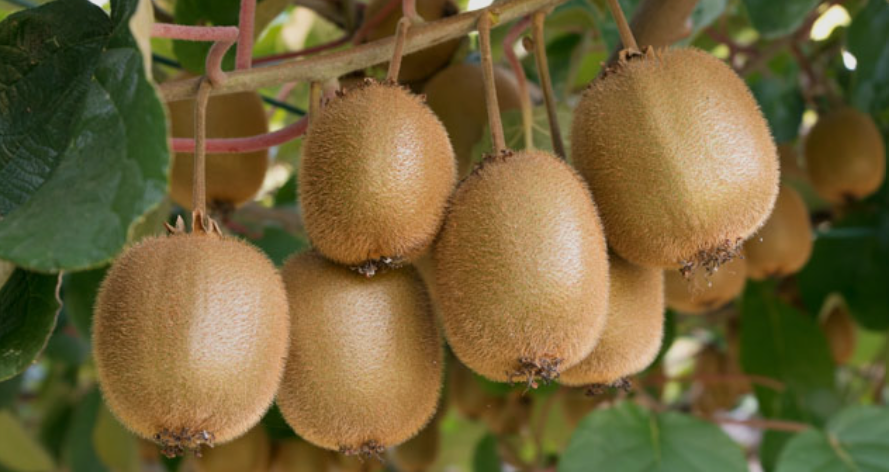
Fruits that look like kiwi share its most recognizable features, which are a small oval shape and a dull, brown, fuzzy skin. The kiwifruit itself is native to southern China, where it grows as a woody, climbing vine. It was first exported under the name Chinese gooseberry and was renamed in 1959 after New Zealand’s national bird.
New Zealand began commercial production and export in the 1950s, and California followed in the late 1960s. California now leads the United States, with a 2013 harvest of 30,100 tons from 3,700 acres. The main variety, Hayward, is grown mostly in the northern Sacramento Valley.
China has since reclaimed the lead and accounted for 55% of the world’s kiwifruit in 2023. Italy, New Zealand, Greece and Chile are the other major producers. Because the Northern and Southern Hemisphere harvests fall six months apart, fresh fruit is available year-round.
Kiwifruit vines are either male or female, so growers must plant both to get a crop. The bright green flesh owes its color to chlorophyll, which most fruits lose as they ripen. The 12 fruits below resemble the kiwi in size, shape, skin or interior, and each entry notes where the fruit is grown.
1. Kiwiberry
The kiwiberry is a miniature kiwifruit about the size of a grape. Its skin is smooth, thin and hairless, so the whole fruit is eaten without peeling. Cut in half, it shows the same green flesh and ring of tiny black seeds as its larger relative. The flavor is similar but noticeably sweeter.
The University of Minnesota notes that the kiwi group includes about 80 species native to the forests of eastern Asia. The most common kiwiberry survives winter lows of around -25°F, far colder than a fuzzy kiwifruit can take. It is grown in Oregon, Pennsylvania, New England and the upper Midwest. New vines need 4 to 5 years of training before they produce a full crop.
2. Arctic Kiwi
The arctic kiwi is an even hardier relative with fruit slightly smaller than a kiwiberry. The berries are smooth, green and oblong, with sweet flesh that is very rich in vitamin C. The vine is less vigorous and grows to only about 20 feet. Its leaves are often splashed with pink and white, which makes it popular as an ornamental.
It is native to the cold forests of northeastern Asia, including Siberia. The vine tolerates temperatures of -35°F to -40°F, which places it among the hardiest fruit plants grown. It is recommended for growers in Minnesota and similar northern climates. It is also planted in Russia, the Baltic countries and Canada.
3. Golden Kiwifruit
The golden kiwifruit is a close cousin of the green type, with smooth, bronze skin that has almost no fuzz. The flesh is bright yellow in place of green. It is sweeter and less acidic, with a tropical flavor. It also contains more vitamin C than the Hayward variety.
It was developed in New Zealand and first released commercially in 2000. A newer gold variety replaced the original after a vine disease struck orchards there in 2010. It is grown mainly in New Zealand and Italy. Smaller plantings exist in France, Japan, South Korea and California.
4. Feijoa
The feijoa is a green, egg-shaped fruit about the same size as a kiwifruit. Its skin is dull and slightly rough, with a waxy bloom. The interior resembles a kiwi’s, with a soft, jelly-like center surrounded by firmer flesh. It is usually cut in half and eaten with a spoon, in the same way.
The flavor is a blend of pineapple, guava and mint. The plant is native to southern Brazil and Uruguay. New Zealand is the largest commercial producer, and the fruit is very popular there. In the United States it is grown in California, where it is also called pineapple guava.
5. Sapodilla
The sapodilla is the closest lookalike on the outside, with a dull, brown, scurfy peel. Small, oval fruits are easily mistaken for kiwifruit at first glance. Inside, the flesh is yellow-brown to reddish-brown, soft and very sweet. The flavor is often compared to brown sugar or pear.
The University of Florida gives its origin as the Yucatán Peninsula of Mexico and Central America. In Florida the trees bear mainly from May to September. The fruit is grown widely in Mexico, India, the Philippines and the Caribbean. The tree’s milky sap was the original base of chewing gum.
6. Medlar
The medlar is a small, brown fruit with rough, russeted skin. It is 1 to 2 inches across and has an open, crown-like hollow at one end. The color and texture of the skin are much like those of a kiwifruit. It belongs to the same family as the apple and pear.
The fruit is hard and inedible when picked in late fall. It must be stored for several weeks until the flesh turns soft and brown. The ripened pulp tastes like spiced applesauce. It is grown in Britain, France, Germany and Iran, and by a few specialist growers in the United States.
7. Longan
The longan is a small, round fruit with a thin, tan to brown shell. It is about 1 inch across and grows in large clusters. The dry, slightly rough shell gives it the look of a tiny, smooth kiwifruit. Inside is translucent white flesh around a single shiny, black seed.
The flesh is juicy and sweet, with a musky flavor similar to lychee. The tree is native to southern China. It is grown on a large scale in China, Thailand and Vietnam. In the United States it is raised in south Florida and Hawaii.
8. Genipap
The genipap is an oval fruit 3 to 4 inches long with thin, leathery, gray-brown skin. Its size, shape and dull color give it a strong resemblance to a large kiwifruit. The flesh is soft and yellowish-brown when ripe. It has a sour, strongly aromatic taste.
The tree is native to tropical America, from Mexico to Brazil. The fruit is made into drinks, preserves and liqueur. Juice from the unripe fruit turns blue-black in air and has long been used as a body dye. It is grown in Brazil, Peru and the Caribbean.
9. Mamey Sapote
The mamey sapote looks like a giant kiwifruit, with rough, brown skin like sandpaper. Fruits are oval and can weigh several pounds. The flesh inside is salmon-pink to red and creamy. A single large, glossy seed sits in the center.
The University of Florida describes it as an important fruit in Miami-Dade County, Mexico, Central America and the West Indies. The tree was first introduced to southern Florida in the mid-1880s. The flavor is compared to sweet potato, pumpkin and almond. The fruit is most often blended into milkshakes and ice cream.
10. Mammee Apple
The mammee apple is a round, heavy fruit 4 to 8 inches across. Its thick, brown, slightly rough rind is similar in color to a kiwifruit’s skin. The flesh is firm and orange-yellow. It tastes something like apricot.
The tree is native to the West Indies and northern South America. The fruit is eaten fresh, stewed or made into preserves. It is grown throughout the Caribbean and in parts of Central America. It is rare in the United States and found only in the warmest parts of south Florida.
11. Velvet Apple
The velvet apple is a round fruit covered in short, reddish-brown fuzz. That velvety coat is very like the hairs on a kiwifruit. It is about the size of a flattened apple. The flesh is cream-colored, firm and mildly sweet.
The skin gives off a strong, cheese-like odor and is peeled away before eating. The tree is native to the Philippines and is related to the persimmon. It is grown in the Philippines, Indonesia and Malaysia. A few trees are found in collections in south Florida and Hawaii.
12. Baobab Fruit
The baobab fruit is an oblong pod 6 to 10 inches long with a hard, woody shell. The shell is coated in soft, greenish-brown velvet, much like an oversized kiwifruit. Inside, the pulp is dry, white and powdery. It surrounds dark, kidney-shaped seeds.
The pulp has a tart, citrus-like taste and is rich in vitamin C. It is mixed with water or milk to make drinks and porridge. The trees grow across the dry savannas of Africa, and related species are found in Madagascar and Australia. The dried pulp is exported as a powder to Europe and North America.
Key Takeaways:
- Several fruits resemble kiwifruit in appearance, including hardy kiwi, golden kiwi, gooseberries, feijoa, and certain varieties of passion fruit. They may share similar skin textures, green flesh, or small edible seeds.
- Kiwi lookalikes vary in size, shape, and skin color. Some have fuzzy brown skin like traditional kiwifruit, while others feature smooth green, yellow, or purple skin.
- Not all kiwi-like fruits belong to the same plant family. Hardy kiwi and golden kiwi are closely related to common kiwifruit, whereas gooseberries, feijoas, and passion fruits come from different plant groups.
- The flavors of kiwi lookalikes range from sweet to tangy. Some have juicy, green flesh with a refreshing acidity, while others offer tropical aromas, floral sweetness, or a more delicate taste.
- Many fruits that resemble kiwi grow in different climates. Kiwifruit and hardy kiwi grow on climbing vines, while gooseberries develop on shrubs and feijoas grow on evergreen trees or shrubs.
- Identifying kiwi lookalikes requires examining several features. Skin texture, flesh color, seed arrangement, aroma, and growth habit can help distinguish similar-looking fruits and determine their common uses.
Sources:
- University of Minnesota: Commercial kiwiberry production
- University of Florida: Sapodilla Growing in the Florida Home Landscape
- University of Florida: Mamey Sapote Growing in the Florida Home Landscape
- University of California: Kiwifruit in California
- University of California: Kiwifruit production in California
- Ohio State University: Kiwifruit and Hardy Kiwi
- University of Wisconsin: Kiwifruit
- Wikipedia: Kiwifruit