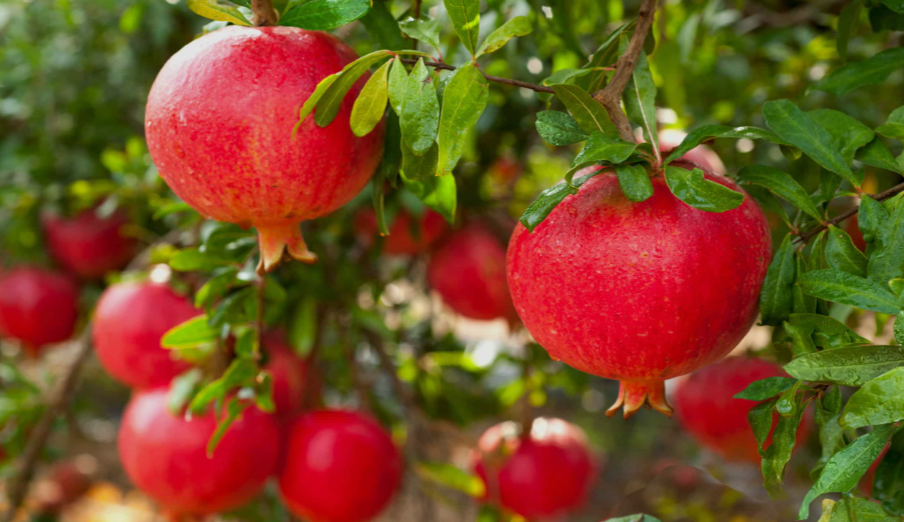
The best tasting pomegranate varieties are not always the ones sold in stores, because supermarkets favor fruit that ships and stores well over fruit that simply tastes good. The pomegranate is one of the oldest cultivated fruits, native to the region from Iran to the Himalayas. More than 500 varieties have been named, and they differ widely in sweetness, acidity, color and seed hardness.
A pomegranate is eaten for its arils, the juicy sacs that surround each seed. A single fruit holds several hundred of them, packed between bitter white membranes. The rind may be yellow, pink, red or nearly black, and it gives little indication of the flavor inside.
Growers sort pomegranates into three flavor groups according to their acid content. Sweet types have very little acid, sour types have a great deal, and sweet-tart types fall between the two. Taste panels have found that most people prefer high sweetness, low to moderate acidity and soft seeds, and that all very sour varieties score poorly.
Climate matters as much as variety. Long, hot summers build sugar, and the same tree can taste noticeably better inland than near a cool coast. The 10 varieties below are those most consistently praised in tastings, and each entry notes where the fruit is grown.
1. Parfianka
Parfianka is the variety most often named as the best tasting pomegranate in the United States. The fruit has red rind and dark red arils with very small, soft seeds. Its flavor is sweet-tart, with enough acidity to give it depth and a finish often compared to red wine. The seeds are so soft that most people eat them without noticing.
The University of Florida shares notes from the national collection that credit it with an excellent balance of flavor. It was selected in Turkmenistan from a collection of more than 1,000 varieties. It is grown in California, Florida and Georgia, mainly in home orchards and small farms. The tree is compact and begins bearing within 1 to 3 years.
2. Ariana
Ariana is another Turkmen variety that has earned top marks in California tastings. The fruit is medium to large, with bright red rind and red arils. The flavor is sweet-tart and rich, with a strong fruity character. It received the highest rating in the national collection’s tasting in 2008.
The seeds are medium-soft, which makes the fruit pleasant to eat fresh. It is grown in California’s inland valleys, where the heat brings out its sugar. Nurseries now offer it to home gardeners across the Southwest. It ripens in October and November.
3. Desertnyi
Desertnyi has pinkish-red rind and red arils with soft seeds. Its flavor is sweet with a slight tartness and distinct citrus and floral notes. Many tasters describe a hint of orange in the juice. It ranked among the favorites at a 2016 public tasting of the national collection.
It comes from Turkmenistan and is now grown in California and Florida. In Florida trials, the fruit colored well by July, which helps in humid climates. The tree is small and bears from a young age. It is best suited to home orchards, since the fruit is too delicate for long shipping.
4. Vkusnyi
Vkusnyi is a Turkmen variety whose name means tasty in Russian. The fruit is medium-sized, with red rind and red arils. The flavor is sweet-tart and intense, with more character than most soft-seeded types. One experienced taster ranked it first among 18 varieties at the 2016 tasting.
Researchers in Florida have noted that it keeps its distinctive character wherever it is grown in the state. It is planted in home orchards in California and the Southeast. The tree is productive and of moderate size. It remains uncommon in nurseries and is usually obtained as cuttings.
5. Pink Satin
Pink Satin, also sold as Sin Pepe and Pink Ice, is one of the sweetest pomegranates grown. The rind is pink and speckled, and the arils are light pink to rose. The seeds are extremely soft, and the juice is clear and does not stain. Fruit measured in the national collection had high sugar and an acid level of only 0.3%.
The flavor is sweet and mild, and it improves if the fruit is left on the tree until October. It is grown in home orchards in California and the Gulf states. It is a good choice for people who dislike sour fruit and hard seeds. Children tend to prefer it to red, tart varieties.
6. Eversweet
Eversweet is very sweet and almost free of tartness, even before it is fully ripe. The rind is pink to red, and the arils are pale pink with soft seeds. The juice is clear and does not stain. The fruit needs a shorter season to mature than most pomegranates.
The University of California describes it as the variety chosen for the Owens Valley because of that short season. It also performs well in coastal southern California, where red varieties stay sour. It is grown mainly in home gardens in California and the Southwest. The tree is small and suits a large container.
7. Angel Red
Angel Red has bright red rind and vivid red arils. Its flavor is sweet with mild tartness, and the juice is abundant. The seeds are soft enough to chew easily. In a Florida tasting, its arils were noted as large and pleasant even when the color was poor.
It ripens early, usually in September, which brings it to market ahead of the main crop. It is grown commercially in California and sold widely for home orchards. The tree stays at about 10 feet and bears heavily. It has also been planted in trial orchards in Georgia and Florida.
8. Wonderful
Wonderful is the pomegranate most Americans know, and it sets the standard for bold flavor. The fruit is large, with deep red rind and dark red arils. The taste is sweet-tart and strong, with firm acidity and intense color. In side-by-side tastings it is usually placed in the sour group.
Its flavor is at its best when the fruit ripens fully in a hot climate. It is grown mainly in California’s San Joaquin Valley and is harvested in October. It is also planted in Israel, Chile, Peru and South Africa. The seeds are harder than those of the soft-seeded types, which some people dislike.
9. Mollar de Elche
Mollar de Elche is the most prized pomegranate in Spain. The rind is cream to pink, and the arils are sweet with very soft seeds. The flavor is gentle and low in acid, quite unlike the sharp taste of Wonderful. It holds a Protected Designation of Origin, granted in 2016.
A study from the University of Palermo found that it had sweeter arils and juice than Wonderful when the two were grown together in Sicily. It is grown around Elche in the province of Alicante, in southeastern Spain. More than half of the crop is exported to other European countries. It is now also planted in Italy.
10. Bhagwa
Bhagwa is the leading pomegranate of India and one of the sweetest red varieties. The rind is glossy and saffron-red, and the arils are deep red. The flavor is sweet with very little acid, and the seeds are soft. The thick skin protects the fruit in transport.
It is grown mainly in the state of Maharashtra in western India. India is the world’s largest pomegranate producer, and Bhagwa makes up most of its exports. The fruit is shipped to the Middle East and Europe. It is also sold as ready-to-eat packaged arils.
Sources:
- University of Florida: pomegranates in the national collection
- University of California: Grow Your Own Pomegranates
- University of Palermo: Mollar de Elche and Wonderful in Sicily
- University of Florida: Pomegranates as a Dooryard and Small-Farm Enterprise
- University of Florida: Cultivar Selection Guide for Florida-Grown Pomegranates
- Fruits journal: consumer flavor preference in pomegranates
- CIHEAM: hardness and pleasantness of pomegranates
- Growing Fruit forum: pomegranate tasting at Wolfskill, 2016
- Foods and Wines from Spain: Granada Mollar de Elche