Weeds with purple flowers cause more lawn identification confusion each spring than almost any other single color group, and according to North Carolina State University’s Nash County Extension, the most common culprit suddenly appearing in yards and landscapes each spring is usually one of 2 closely related plants, purple deadnettle or henbit, both members of the mint family that share square stems, an ascending growth habit, and purple-to-pink flowers. Michigan State University Extension notes that both are winter annuals, developing a small rosette of leaves in fall that overwinters before finally flowering and setting seed each spring, then dying back completely by early summer.
A third look-alike often gets mixed into that same spring confusion. According to Penn State Extension, ground ivy is a perennial rather than a winter annual, distinguished from both henbit and purple deadnettle by its habit of rooting at stem nodes as it spreads, and correct identification matters considerably since the management approach differs for each of the 3 plants. A fourth common purple lawn weed, wild violet, rounds out what’s sometimes called the “big 4” of purple spring lawn intruders, distinguished from the others by its heart-shaped, glossy leaves rather than the square, mint-family stems shared by the other 3.
Beyond that familiar spring quartet, purple flowers show up across an enormous range of otherwise unrelated weeds, from towering prairie natives to aggressive agricultural thistles to toxic nightshade relatives. What follows covers 50 weeds with purple flowers, along with where each one grows and the data behind its bloom.
Wild Violet
Wild violet produces heart-shaped leaves and small purple or white flowers low to the ground, spreading via both seed and short underground rhizomes to form persistent lawn colonies. Beyond its visible flowers, it also produces hidden, self-pollinating flowers at the soil surface that never open, a reproductive strategy that helps it persist even in years with poor pollinator activity.
It grows throughout lawns and shaded garden beds across the eastern and central United States.
Henbit
Henbit produces scalloped, rounded leaves that clasp directly to the stem without a leaf stalk, topped with pink-to-purple, two-lipped tubular flowers marked with darker purple spots. According to Purdue University’s Botany and Plant Pathology Department, it tends to grow in disturbed soils and reduced-residue fields, and while it provides some erosion control, its spring biomass can delay soil drying ahead of planting season.
It grows throughout lawns and cultivated fields across most of the United States during the cooler months of the year.
Purple Deadnettle
Purple deadnettle produces triangular, short-stalked leaves with a distinctive purplish hue toward the growing tip that fades to green further down the stem, distinguishing it from the more rounded, stalkless leaves of henbit. According to West Virginia University Extension, it’s a winter annual with a shallow root system, making tillage one of the most effective control methods in a small home garden setting.
It grows throughout lawns and gardens across much of the United States, commonly emerging in the same cool-season window as henbit.
Ground Ivy
Ground ivy, also called creeping Charlie, spreads across lawns and shaded ground via stems that root at every leaf node they touch, distinguishing it from the non-rooting growth habit of henbit and purple deadnettle. According to the University of Illinois Extension, its small, funnel-shaped purple flowers appear in clusters at the leaf axils, and its scalloped, rough-textured leaves release a sharp minty scent when crushed.
It thrives in the moist, shaded portions of lawns throughout most of North America, often outcompeting turfgrass in exactly the spots where grass grows thinnest.
Common Vetch
Common vetch produces small, purple-pink, pea-like flowers along a climbing or sprawling vine lined with narrow, compound leaflets. As a legume, it fixes atmospheric nitrogen through its roots, occasionally planted deliberately as a cover crop despite its tendency to become a persistent volunteer weed in subsequent plantings.
It grows throughout agricultural fields and disturbed ground across much of the United States.
Hairy Vetch
Hairy vetch closely resembles common vetch, distinguished by its finely hairy stems and leaves and slightly darker purple flower clusters. Like its close relative, it’s sometimes intentionally planted as a nitrogen-fixing cover crop, complicating its reputation as either a beneficial soil-builder or a persistent weed depending entirely on the context.
It grows throughout agricultural fields and roadsides across much of the United States.
Crown Vetch
Crown vetch produces rounded clusters of pink-purple, pea-like flowers on a sprawling, mat-forming perennial originally planted for erosion control along highway embankments. Its aggressive, spreading growth habit has since made it a significant concern in natural areas adjacent to the roadsides where it was deliberately established.
It grows throughout roadsides and disturbed slopes across much of the eastern and central United States.
Chicory
Chicory produces a rosette of dandelion-like leaves and a tall, wiry flowering stem lined with distinctive sky-blue to purple-blue flowers that typically close by early afternoon each day. Its root has a long history of being roasted and ground as a coffee substitute or additive, a practice that persists in parts of the American South today.
It grows throughout roadsides and disturbed ground across most of the United States and southern Canada.
Musk Thistle
Musk thistle produces spiny, deeply lobed leaves and a large, nodding purple flower head that droops noticeably to one side once fully open, distinguishing it from the more upright blooms of bull thistle. A single plant can produce over 10,000 seeds in a season, most of which remain viable in the soil for several years after dropping.
It grows throughout pastures and roadsides across most of the United States.
Bull Thistle
Bull thistle spends its first year as a spiny rosette before sending up a heavily branched, second-year flowering stalk topped with vivid purple-pink flower heads. Its dense covering of sharp spines runs along the leaf edges, stems, and even the bracts surrounding each flower, making the entire plant genuinely uncomfortable to handle without gloves.
It grows throughout overgrazed pastures and disturbed roadsides across most of North America.
Canada Thistle
Canada thistle produces spiny-edged, deeply lobed leaves and small purple flower heads atop an extensive, far-reaching underground root system capable of sending up new shoots many feet from the original plant. A single root system can spread outward and colonize an entire field within a few growing seasons if left unmanaged.
It grows throughout pastures, fields, and roadsides across most of the northern United States and Canada, classified as a noxious weed in many states.
Scotch Thistle
Scotch thistle produces enormous, spiny, silvery-gray leaves and a towering, heavily branched flowering stalk topped with large purple flower heads, capable of reaching heights that dwarf most other thistle species. Its imposing size and dense spines make it one of the more physically intimidating weeds found in Western rangeland.
It grows throughout disturbed pastures and rangeland across much of the western United States.
Plumeless Thistle
Plumeless thistle closely resembles musk thistle, distinguished by its smaller, more upright purple flower heads and the absence of the feathery plume texture found on some related thistle species’ seed heads. It spreads aggressively through disturbed pastures, competing directly with more palatable forage plants.
It grows throughout pastures and disturbed fields across much of the eastern and central United States.
Milk Thistle
Milk thistle produces distinctive white-marbled leaves and large, spiny, purple-pink flower heads, historically valued for medicinal use even as it’s classified as a noxious weed in agricultural settings. Its bold, mottled foliage makes it one of the more visually striking thistle species found in disturbed ground.
It grows throughout roadsides and disturbed fields across much of the western and southern United States.
Spotted Knapweed
Spotted knapweed produces grayish-green, deeply divided leaves and thistle-like purple-pink flower heads ringed with distinctive black-tipped bracts that give the plant its common name. It releases an allelopathic compound from its roots that suppresses the germination and growth of neighboring plants.
It grows throughout rangeland and disturbed ground across the western and northern United States, classified as a noxious weed in numerous states.
Diffuse Knapweed
Diffuse knapweed closely resembles spotted knapweed, distinguished by its smaller white to pale purple flower heads and a distinctly branched, bushy growth habit. Mature plants break off at the base once dry and tumble across open rangeland, scattering seed as they roll.
It grows throughout dry rangeland across much of the western United States.
Russian Knapweed
Russian knapweed produces small, urn-shaped purple-pink flower heads on a deeply rhizomatous perennial capable of forming dense, persistent colonies across grazed rangeland. Its extensive underground root system makes it notably more difficult to eliminate than either spotted or diffuse knapweed.
It grows throughout rangeland and disturbed ground across much of the western United States.
Purple Loosestrife
Purple loosestrife produces tall spikes of vivid magenta-purple flowers each summer, a display so attractive that it was originally introduced to gardens before its aggressive wetland behavior became apparent. A single mature plant can produce well over a million seeds in a season, an output that has allowed it to overwhelm native wetland vegetation across large areas.
It grows throughout marshes and wetland margins across most of the United States and Canada, absent only from Florida.
Ironweed
Ironweed produces tall, sturdy stems topped with clusters of vivid magenta-purple flowers, typically reaching 4 to 6 feet tall by the time it blooms in late summer. It often flowers alongside goldenrod in the same autumn meadows, creating a dramatic mix of purple and gold.
It grows throughout the eastern and central United States, commonly found in moist meadows and along roadsides.
Joe-Pye Weed
Joe-Pye weed produces dark, hollow stems supporting whorled leaves and domed clusters of dusty pink-purple flowers in late summer, a favorite nectar source for butterflies, particularly swallowtails. Certain species can reach 5 to 7 feet tall in a single growing season.
It grows throughout the eastern United States and Canada, favoring damp, rich soils along roadsides and stream banks.
Purple-Stemmed Aster
Purple-stemmed aster produces a coarse, hairy, deep purple stem supporting pale purple, daisy-like fall flowers, its common name describing the plant’s most distinctive identification feature directly. It typically blooms alongside goldenrod and other native asters in the same late-season wetland meadows.
It grows throughout wet meadows and marshes across the eastern and central United States and Canada.
New England Aster
New England aster produces dozens of vivid purple, daisy-like flowers with a bright yellow center, blooming heavily each fall on a tall, hairy-stemmed native perennial. Its late-season nectar makes it a critical food source for migrating monarch butterflies stocking up before their journey south.
It grows throughout meadows and roadsides across much of the eastern and central United States.
Wild Bergamot
Wild bergamot produces shaggy, lavender-purple, tubular flowers atop square, mint-family stems lined with strongly scented, aromatic leaves. Its nectar-rich, firework-shaped blooms are a favorite of hummingbirds and a wide range of native pollinators throughout summer.
It grows throughout prairies and open woodland across most of North America.
Selfheal
Selfheal, also called heal-all, produces small, dense spikes of purple, two-lipped flowers on a low-growing perennial that tolerates close, repeated mowing better than most other broadleaf lawn weeds. Its historical use in folk medicine for treating minor wounds is where its common name originates.
It grows throughout lawns and disturbed ground across most of North America.
Bittersweet Nightshade
Bittersweet nightshade produces purple, star-shaped flowers with a prominent yellow center, followed by oval berries that ripen from green to bright red on a sprawling, semi-woody vine. Every part of the plant, including the strikingly colored ripe berries, is toxic if eaten, a genuine hazard given how attractive the fruit looks to children and pets alike.
It grows throughout hedgerows and disturbed woodland edges across much of the United States.
Common Milkweed
Common milkweed produces broad, opposite leaves and rounded clusters of fragrant, dusty pink-purple flowers, releasing a thick, white, mildly toxic sap whenever its stem or leaves are broken. That same toxic sap, sequestered by monarch caterpillars that feed exclusively on the plant, becomes a defense the caterpillars carry with them into adulthood.
It grows throughout fields and prairie habitats across most of the eastern and central United States.
Swamp Milkweed
Swamp milkweed produces narrow, lance-shaped leaves and clusters of fragrant pink-purple flowers, distinguished from its drier-habitat relative common milkweed by its clear preference for consistently wet soil. Like other milkweed species, it serves as an important host plant for monarch butterfly caterpillars.
It grows throughout wet meadows and marshes across most of the eastern and central United States.
Purple Milkweed
Purple milkweed produces deep reddish-purple flower clusters, among the most vividly colored of any native milkweed species, though it’s considerably less common than its widespread relatives. Its declining populations have made it a species of conservation concern in several states within its native range.
It grows in scattered populations throughout parts of the eastern and midwestern United States.
Purple Coneflower
Purple coneflower produces coarse, bristly-textured leaves and distinctive daisy-like flowers with drooping purple-pink petals surrounding a raised, spiny orange-brown cone. Its seed heads are a favorite of goldfinches in fall, making it worth leaving standing rather than cutting back too early.
It grows throughout prairies and disturbed ground across much of North America.
Blazing Star
Blazing star produces tall, dense spikes of fuzzy purple flowers that bloom from the top downward, an unusual pattern compared to most other spike-flowering plants. Its nectar-rich blooms are a significant late-summer draw for butterflies, particularly monarchs migrating through the same prairies where the plant grows.
It grows throughout prairies and open meadows across much of the central and eastern United States.
Horsenettle
Horsenettle produces spiny stems and leaves along with small, star-shaped purple to white flowers, followed by yellow, tomato-like berries that are toxic if eaten. Despite its common name, it’s unrelated to true nettle, belonging instead to the nightshade family alongside tomato and potato.
It grows throughout agricultural fields and disturbed ground across much of the eastern and central United States.
Musk Mallow
Musk mallow produces deeply divided, fern-like leaves and showy, musk-scented flowers ranging from pale pink to purple, considerably more ornamental in appearance than most other common mallow relatives. Its attractive blooms have occasionally led to confusion about whether the plant is a garden escapee or a genuine native wildflower.
It grows throughout roadsides and disturbed fields across the northeastern United States and Canada.
Common Mallow
Common mallow produces round, slightly fuzzy, lobed leaves and small pink to lavender-purple flowers, sprawling low across compacted ground rather than growing upright. Its small, round seed pods, sometimes called “cheeses” for their resemblance to a wheel of cheese, are edible.
It grows throughout lawns and disturbed, compacted soil across most of North America.
Dame’s Rocket
Dame’s rocket produces clusters of fragrant, 4-petaled purple, pink, or white flowers on a tall biennial that’s frequently mistaken for a native wildflower or garden phlox. Despite its attractive appearance, it spreads aggressively into woodland edges and has become a significant concern in several eastern states.
It grows throughout roadsides and woodland edges across much of the northeastern and midwestern United States.
Teasel
Teasel spends its first year as a spiny rosette before sending up a tall, prickly flowering stalk in its second year, topped with an egg-shaped flower head covered in small, lavender-purple flowers arranged in a distinctive banded pattern. Its dried seed heads persist through winter, historically used to raise the nap on wool fabric before modern industrial processing replaced the practice.
It grows throughout roadsides and disturbed fields across much of the eastern and central United States.
Burdock
Burdock produces enormous first-year leaves before sending up a spiny, second-year flowering stalk topped with small, thistle-like purple flower heads that mature into the familiar hooked burs. Its taproot, dug while the plant is still in its first year, is a genuine root vegetable in Japanese cuisine.
It grows throughout fences, trails, and disturbed pasture edges across most of North America.
Wild Alfalfa
Wild alfalfa, an escaped form of the cultivated forage crop, produces small clusters of purple, pea-like flowers on a deeply taprooted perennial capable of persisting for years once established outside a managed field. Its extensive root system makes it notably drought tolerant compared to many shallower-rooted weeds.
It grows throughout roadsides and disturbed fields across much of the United States.
Red Clover
Red clover produces round, dusty pink-purple flower heads atop a taller, more upright plant than its low-growing white clover relative. It’s an important nitrogen-fixing legume, valued in pastures and hayfields even as it readily persists as a volunteer weed in unwanted settings.
It grows throughout pastures, hayfields, and roadsides across most of the United States and Canada.
Blue Vervain
Blue vervain produces tall, slender spikes of small purple-blue flowers that open in rings working their way up the flower spike over several weeks. Its narrow, upright form and long bloom period make it a valuable late-season nectar source for a range of native pollinators.
It grows throughout wet meadows and disturbed ground across much of North America.
Motherwort
Motherwort produces deeply lobed leaves and small, spiny-calyxed purple-pink flowers arranged in whorls along a tall, square, mint-family stem. Its historical use in traditional herbal remedies for anxiety and heart palpitations is reflected in its common name.
It grows throughout disturbed ground and fence rows across much of the eastern United States.
Catnip
Catnip produces small, pale lavender-purple flowers on a gray-green, aromatic mint-family plant famous for the intense, often comedic reaction it triggers in domestic cats. Despite that reputation, it readily escapes cultivation and persists as a weed in disturbed ground far from any deliberate planting.
It grows throughout disturbed fields and roadsides across much of the United States.
Bugleweed
Bugleweed, an escaped form of the groundcover ajuga, produces short spikes of small blue-purple flowers atop a low, mat-forming rosette of glossy leaves. Its rapid, creeping spread has made it a persistent lawn and garden bed escapee well beyond its original ornamental plantings.
It grows throughout lawns and garden beds across much of the temperate United States.
Periwinkle
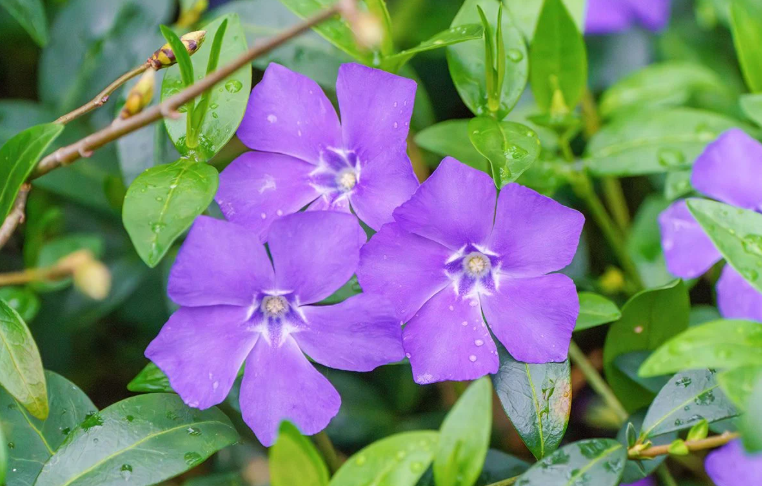
Periwinkle, an escaped groundcover, produces glossy evergreen leaves and simple, 5-petaled purple-blue flowers on a trailing vine capable of forming a dense mat that smothers native woodland groundcover. Its evergreen foliage lets it outcompete native plants even through the winter months.
It grows throughout woodland edges and disturbed ground across much of the temperate United States.
Purple Nutsedge
Purple nutsedge produces grass-like foliage from a solid, triangular stem topped with small reddish-purple flower clusters, distinguishing it from the straw-colored flowers of its yellow-flowered relative. Its underground tubers survive standard cultivation and many herbicide treatments, making it one of the most difficult agricultural weeds to eradicate anywhere in the world.
It grows throughout warm, moist regions of the southern United States.
Cornflower
Cornflower, also called bachelor’s button, produces fringed, vivid blue to purple flowers on a slender stem, an escaped garden ornamental that persists in disturbed fields and roadsides well beyond its original plantings. Its distinctive flower shape has made it a popular subject in dried flower arrangements.
It grows throughout roadsides and disturbed fields across much of the United States.
Wild Lupine
Wild lupine produces tall spikes of purple-blue, pea-like flowers atop palmately divided leaves, native to open woodland and prairie habitats where it also serves as the host plant for the endangered Karner blue butterfly. Its striking flower spikes make it easy to mistake for an intentional garden planting rather than a native wildflower.
It grows throughout sandy prairies and open woodland across parts of the northern and eastern United States.
Everlasting Pea
Everlasting pea, an escaped ornamental vine, produces clusters of pink-purple, pea-like flowers on a sprawling, climbing plant capable of persisting for years once established outside a garden setting. Unlike the edible sweet pea it resembles, its seeds are mildly toxic if consumed in quantity.
It grows throughout roadsides and disturbed fence lines across much of the United States.
Purple Toadflax
Purple toadflax, an escaped ornamental, produces tall, slender spikes of small purple, snapdragon-like flowers on a narrow-leaved perennial that readily self-seeds into disturbed ground. Its delicate, airy flower spikes have made it a popular self-seeding cottage garden plant despite its tendency to spread beyond intended beds.
It grows throughout disturbed fields and roadsides across parts of the eastern United States.
Spiderwort
Spiderwort produces grass-like leaves and distinctive 3-petaled purple-blue flowers that typically close by midafternoon regardless of when they opened that morning. Its flowers dissolve into a jelly-like liquid rather than wilting in the usual sense once they finish blooming for the day.
It grows throughout prairies and open woodland across much of the eastern and central United States.
Ivyleaf Morning Glory
Ivyleaf morning glory produces heart-shaped, lobed leaves and funnel-shaped purple-blue flowers on a fast-growing, twining annual vine that germinates fresh from seed each year. It’s a significant problem in row crop fields, where its vigorous climbing habit can wrap around and interfere with mechanical harvesting equipment.
It grows throughout agricultural fields and gardens across much of the United States.
Things to Remember
Weeds with purple flowers can look very different from one another, so flower color alone is not enough for identification. Pay attention to the shape of the leaves, stems, flowers, and overall growth habit when trying to determine which weed you have.
Some purple-flowering weeds are common in lawns and gardens, while others are more likely to occur in fields, roadsides, wetlands, or disturbed areas. Their growth patterns can also vary considerably, with some remaining low to the ground and others becoming tall or spreading rapidly.
When identifying a purple-flowering weed, compare several characteristics and use clear photographs or a reliable plant identification guide. Correct identification is especially important before removing a plant or attempting control, since similar-looking species can have very different growth habits and management needs.
Further References
- Weed Identification Photos in Maryland — University of Maryland Extension — A photo-based identification resource covering common grassy, broadleaf, and woody weeds, with individual pages for identification and management.
- Heal-all — UC Statewide IPM Program — Provides photographs and identification details for heal-all, a lawn weed with blue-violet to lavender flowers.
- Purple Cudweed — UC Statewide IPM Program — Includes photographs and detailed information about purple cudweed’s leaves, stems, flower heads, and growth characteristics.
- Purple Nutsedge — UC Statewide IPM Program — Useful for identifying purple nutsedge, including its purplish-brown flower structures, leaves, tubers, and growth habit.
- Heal-all — University of Minnesota Extension — Provides photographs and identification characteristics for heal-all, including its purple, tube-like flower clusters and creeping growth habit.