Invasive plants in Ohio have been subject to formal state regulation since 2018, when, according to Ohio State University Extension’s BYGL program, the Ohio Department of Agriculture finalized rules following nearly 2 years of stakeholder outreach, restricting the sale, growth, and distribution of 38 species determined to cause or likely cause economic or environmental harm. That initial 2018 rule wasn’t the final word, either, and Callery pear, also widely known as Bradford pear, was added to Ohio’s regulated list separately, with the ban on selling, growing, or planting it taking effect January 7, 2023.
That staggered approach to regulation reflects how invasive plant recognition tends to lag well behind actual ornamental popularity, since several of the species now banned from Ohio nurseries were, for decades, among the most commonly planted trees, shrubs, and groundcovers in the state. According to OSU Extension’s BYGL program, English ivy and wintercreeper euonymus are 2 non-native climbers Ohio homeowners have grown thoroughly accustomed to seeing in ordinary residential landscapes, which is exactly what makes their invasive behavior in nearby woodlands easy to overlook.
Existing plants generally don’t have to be removed under Ohio’s regulation, since the rules target future sale and planting rather than mandating retroactive eradication, though state agencies still encourage voluntary removal to benefit native forest ecosystems. That distinction matters for homeowners trying to understand whether a plant already established in their yard is something they’re required to deal with immediately or simply shouldn’t replace once it’s gone.
These plants span hardwood forest understories, farm fields, and residential landscapes across the state. What follows covers 21 invasive plants in Ohio, along with where each one grows and the data behind its spread.
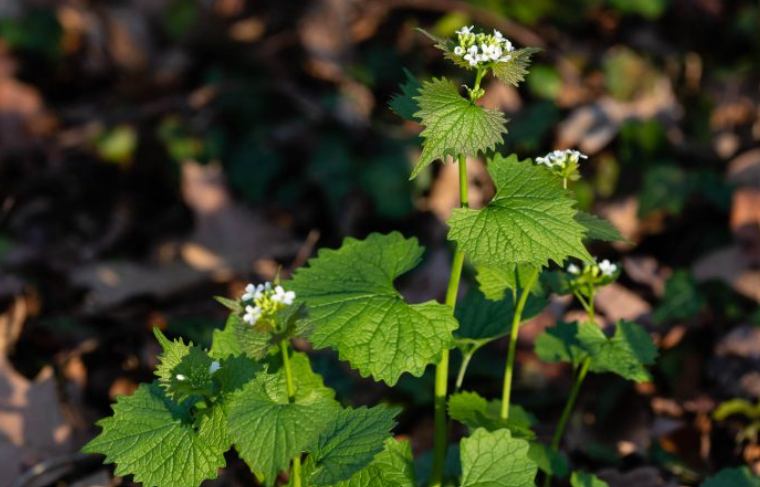
Garlic Mustard
Garlic mustard takes full advantage of its biennial life cycle to grow rapidly each spring before native wildflowers have even greened up for the season, its roots releasing chemicals into the surrounding soil that actively help it outcompete nearby native plants. A single mother plant can produce thousands of seeds that remain viable in the soil for years, making a single missed season of control enough to undo years of previous removal work.
It grows throughout wooded areas statewide, forming dense stands that threaten spring ephemerals like trilliums and trout lilies. Hand-pulling before seed set remains one of the most effective control methods available to individual landowners.
Amur Honeysuckle
Amur honeysuckle, one of several non-native bush honeysuckles found in Ohio, leafs out earlier in spring and holds its leaves later into fall than most native shrubs, giving it a considerable head start in competing for available sunlight. Its abundant red berries are readily eaten and spread by birds, allowing new infestations to establish well beyond any original planting.
It grows throughout woodland edges and disturbed areas statewide, often forming such dense understory thickets that native tree seedlings never get the light needed to establish beneath it. It’s included among the species restricted under Ohio’s 2018 invasive plant rule.
Callery Pear
Callery pear, widely sold under ornamental cultivar names including Bradford pear, and according to Ohio State University Extension’s BYGL program, it’s now illegal to sell, grow, or plant anywhere in the state, with that specific restriction taking effect January 7, 2023. Its white spring flowers carry a notably unpleasant odor, and its glossy leaves turn attractive shades of red and purple each fall, traits that made it enormously popular with landscapers despite the tree’s thorny, fast-spreading wild seedlings.
It’s found throughout much of Ohio, particularly along roadsides, fields, and meadows where its cultivars readily cross-pollinate to produce abundant, marble-sized, inedible fruit. There’s no requirement to remove existing trees, though the Ohio Department of Natural Resources’ Division of Forestry encourages voluntary removal to benefit native forest regeneration.
Common Buckthorn
Common buckthorn leafs out earlier in spring and holds its leaves later into fall than most native trees, giving it a considerable competitive advantage over the forest species it displaces. Its small, dark berries have a noticeable laxative effect on the birds and other animals that eat them, which paradoxically helps spread its seeds more widely across the landscape.
It grows extensively throughout Ohio’s woodlands and fence rows, forming dense understory thickets that shade out native tree seedlings before they have a chance to establish. It’s among the species restricted under the state’s invasive plant regulation.
Glossy Buckthorn
Glossy buckthorn closely resembles common buckthorn but favors wetter ground and lacks the thorns typically found at its close relative’s branch tips. Its berries ripen through a progression of red to purple to black on the same plant simultaneously, and like common buckthorn, they carry a similar laxative effect that helps disperse its seeds.
It grows throughout wet woodlands and swamp margins across much of Ohio, forming dense thickets in exactly the kind of soggy, poorly drained ground many native shrubs struggle to tolerate.
Autumn Olive
Autumn olive produces bright green leaves that are distinctively silver underneath, with strongly fragrant cream or yellow flowers blooming each spring. Because it fixes atmospheric nitrogen through its root system, it can alter soil chemistry in ways that favor its own continued spread over native vegetation that isn’t adapted to the resulting nutrient shift.
It grows throughout old fields, roadsides, and disturbed ground statewide, and its abundant, easily dispersed berries have made it one of the more difficult shrubs to fully eliminate once established on a property.
Multiflora Rose
Multiflora rose produces arching, thorny canes lined with clusters of small white flowers, forming dense, nearly impassable thickets wherever it’s left unmanaged. A single mature shrub can produce close to 500,000 seeds in a year, widely dispersed by birds that eat its small red hips through fall and winter.
It grows throughout pastures, fence rows, and forest edges statewide, now restricted under Ohio’s invasive plant rule despite once being recommended by conservation agencies for erosion control and living fences.
Japanese Knotweed
Japanese knotweed produces hollow, bamboo-like stems that can push through cracks in pavement and foundations as a colony expands, spreading through an extensive underground rhizome network that extends well beyond the visible canes. Its rapid growth and tolerance for a wide range of soil conditions have made it one of the most expensive invasive plants to fully remove once established.
It grows in scattered infestations throughout much of Ohio, particularly along riverbanks, roadsides, and disturbed urban lots. Even a small fragment of rhizome left in the soil after removal attempts can regenerate an entirely new colony the following season.
Purple Loosestrife
Purple loosestrife produces tall spikes of vivid magenta-purple flowers each summer, a display so attractive that it was originally introduced to gardens before its aggressive wetland behavior became apparent. A single mature plant can produce well over a million seeds in a season, an output that has allowed it to overwhelm native wetland vegetation across large areas.
It grows throughout marshes and wetland margins statewide, forming dense monocultures that crowd out the native plants waterfowl and other wildlife depend on. Biological control using host-specific beetles has become one of the more effective long-term management tools in heavily infested Ohio wetlands.
Oriental Bittersweet
Oriental bittersweet produces a woody, twining vine capable of climbing 60 feet or more into a tree canopy, eventually girdling and killing its host through a combination of constriction and accumulated weight. Its bright orange-yellow seed capsules split open in fall to reveal striking red seeds, a display that’s ironically helped spread the vine further since it remains popular for autumn wreaths despite its documented invasive behavior.
It grows throughout forest edges and disturbed woodland statewide, increasingly displacing the considerably less aggressive American bittersweet native to the same region.
Japanese Barberry
Japanese barberry produces small, oval leaves and bright red berries on a dense, spiny shrub originally valued for its ornamental foliage and deer resistance. Research has linked dense barberry thickets to higher populations of ticks carrying Lyme disease, since the humid microclimate beneath the shrub’s dense branches favors both tick survival and the small mammals that serve as their hosts.
It grows throughout woodlands and forest edges across much of Ohio, restricted under the state’s invasive plant rule, forming dense stands that few native plants can successfully compete against.
Tree of Heaven
Tree of heaven produces large, compound leaves and grows remarkably fast even by invasive tree standards, with root sprouts capable of reaching several feet in their very first year alone. Its rapid, suckering growth habit makes it notoriously difficult to eliminate through cutting alone, since removing the visible trunk typically triggers even more vigorous regrowth from the root system.
It grows throughout much of Ohio, particularly along roadsides, rail corridors, and disturbed urban lots, and it also serves as the preferred host plant for the invasive spotted lanternfly, adding a second layer of concern beyond the tree’s own aggressive spread.
Norway Maple
Norway maple, according to the Ohio Invasive Plants Council, closely resembles the native sugar maple but is broader than it is tall, with blunt leaf buds, grayish-black furrowed bark, and milky sap that oozes from a broken leaf stem, a trait sugar maple entirely lacks. It was planted extensively as a street and shade tree throughout Ohio for decades before its invasive tendencies in natural forest settings became fully understood.
It grows throughout much of the state, casting a notably dense shade that suppresses the growth of native wildflowers and tree seedlings beneath its canopy. It’s included among the species restricted under Ohio’s invasive plant regulation.
Winged Burning Bush
Winged burning bush, prized for its intensely saturated red fall foliage, produces distinctive corky, wing-like ridges along its stems that make it identifiable even without leaves. It’s now restricted from sale under Ohio’s invasive plant rule, a significant shift for a shrub that was, for decades, one of the most commonly planted foundation shrubs in the state.
It grows in scattered naturalized populations throughout Ohio’s woodlands, spreading via bird-dispersed seed into forest understories where it forms dense stands that crowd out native shrubs.
Wintercreeper
Wintercreeper, according to the Ohio Invasive Plants Council, is an evergreen, woody vine with aerial roots that let it climb into tree canopies, forming dense carpets on the forest floor that can overtop and shade out the trees it grows beneath. Its waxy leaves make it notably difficult to control even with herbicide application, since the coating limits how much spray actually penetrates the leaf surface.
It grows throughout residential landscapes and adjacent woodlands statewide, and Ohio State University Extension identifies it, alongside English ivy, as one of the non-native climbers homeowners have become thoroughly accustomed to seeing without recognizing its invasive potential.
Border Privet
Border privet produces small, oval, semi-evergreen leaves and clusters of small white flowers with a notably strong scent that many find unpleasant. Its dense, twiggy growth habit made it a popular hedging plant for decades, and its berries are readily spread by birds into adjacent natural areas.
It grows throughout residential and disturbed areas across much of Ohio, forming dense thickets in forest understories once it escapes cultivation.
Reed Canary Grass
Reed canary grass forms dense, tall stands of coarse, wide blades capable of reaching 6 feet or more, spreading aggressively through both an extensive rhizome system and abundant seed production. It’s considered one of the most difficult wetland grasses to control once established, tolerating both flooding and periods of drier soil equally well.
It grows throughout wet meadows, ditches, and streambanks across much of Ohio.
Poison Hemlock
Poison hemlock produces finely divided, fern-like leaves on a smooth, hollow stem marked with distinctive purple blotches that darken as the plant matures. Every part of the plant is highly toxic if ingested, and its population has expanded dramatically across Ohio roadsides and fields in recent years, drawing significant attention from OSU Extension educators concerned about the growing risk to livestock and unsuspecting foragers.
It grows throughout roadsides, ditches, and disturbed fields statewide, and its purple-spotted stem remains one of the most reliable features separating it from the safer carrot-family relatives it closely resembles.
Wild Parsnip
Wild parsnip produces yellow, umbrella-shaped flower clusters atop a grooved, hollow stem, its sap containing compounds that react with sunlight to cause severe burns and blistering on any exposed skin that contacts it. Because it commonly grows along the same roadsides and trails Ohioans use for recreation, it poses a genuinely practical hazard beyond its simple competitive impact on other vegetation.
It grows throughout roadsides and disturbed fields across much of Ohio.
Common Teasel
Common teasel spends its first year as a spiny rosette before sending up a tall, prickly flowering stalk in its second year, topped with an egg-shaped flower head covered in stiff bristles. A single plant can produce thousands of seeds, most of which remain viable in the soil for several years after dropping.
It grows throughout roadsides and disturbed fields across much of Ohio, classified as a noxious weed given its capacity to form dense stands that crowd out native prairie and meadow vegetation.
English Ivy
English ivy, according to Ohio State University Extension’s BYGL program, is one of the non-native climbing plants Ohio homeowners have grown thoroughly accustomed to seeing in residential landscapes, planted for decades as a low-maintenance evergreen groundcover before its invasive woodland behavior became widely recognized. Once a vine climbs high enough into full sun, its leaf shape changes from the familiar lobed form to a simpler, unlobed adult leaf, a stage that also allows it to flower and fruit.
It grows throughout much of Ohio as both a cultivated groundcover and an escaped woodland invasive, forming a dense mat capable of smothering everything from garden perennials to entire mature trees.
Things to Remember
Invasive plants in Ohio can spread quickly and compete with native plants for sunlight, water, nutrients, and growing space. Some species are particularly difficult to control once established, making early identification important for protecting gardens, woodlands, wetlands, and other natural areas.
Identification should be based on several features rather than a single characteristic. Compare the plant’s leaves, stems, flowers, fruits, growth habit, and habitat, and use reliable Ohio-specific identification resources when possible. The Ohio Department of Natural Resources maintains information and mapping resources related to the state’s natural areas and vegetation.
It is also important to remember that not every nonnative plant is invasive, and the status of a species can depend on its location and ecological effects. Before removing or treating a suspected invasive plant, confirm its identity and check current Ohio guidance so that management decisions are based on accurate information.
Further References
- Invasive Plant Species — Ohio Administrative Code — Ohio’s official regulation listing the 63 plant species designated as invasive by the state.
- List of Assessed Species — Ohio Invasive Plants Council — Provides Ohio-specific assessments of invasive plants, including their assessment scores, dates, and supporting information.
- Invasive Plants — Ohio State University Extension — Provides Ohio-focused resources for identifying and managing invasive plants, with links covering species such as tree-of-heaven, autumn olive, garlic mustard, honeysuckle, kudzu, and privet.
- Ohio — National Invasive Species Information Center — A U.S. government resource compiling Ohio invasive-species information, including invasive plant regulations, identification resources, and management programs.
- Invasive Plant Identification and Control — Ohio Department of Transportation — An Ohio-specific identification and control guide covering invasive plants such as autumn olive, bush honeysuckle, common reed, cattails, and tree-of-heaven.