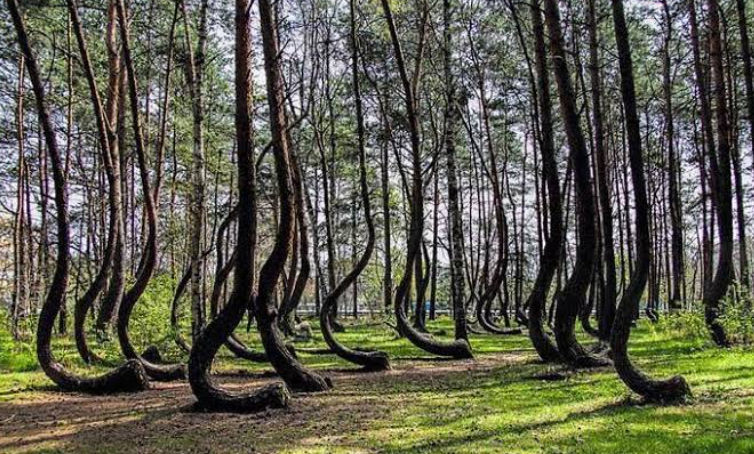
Trees that grow eerie or weird shapes tend to earn that reputation through some combination of extreme age, a genuinely strange evolutionary strategy, or growing in conditions so harsh that survival itself twists the tree into something unrecognizable. A handful owe their unsettling reputation to real, well-documented danger rather than just appearance, while others have simply accumulated centuries of folklore around a silhouette that looks unmistakably alive at dusk.
What unites this list is less a single cause than a shared outcome: each of these trees looks like it belongs in a different, stranger world than the ordinary oaks and maples growing nearby. Several are genuine botanical oddities studied specifically because their strategy for survival, whether cloning itself into a single organism spanning acres or slowly strangling another tree to death, has no close equivalent anywhere else in the plant kingdom.
These trees span deserts, tropical rainforests, ancient churchyards, and wind-blasted mountaintops across every inhabited continent. What follows covers 21 trees known for growing eerie or strange, along with where each one grows and the data behind its unsettling reputation.
Dragon’s Blood Tree
Dragon’s blood tree is native to the Yemeni island of Socotra, one of the most geographically isolated places on Earth, and its bizarre umbrella-shaped canopy, with branches all growing upward at nearly identical angles from a single point, gives it an almost alien silhouette against the island’s rocky terrain. Cutting the bark releases a thick, dark red resin, historically prized as a dye and medicine, that gives the tree its unsettling common name. A mature tree can live for several centuries and reach around 30 feet tall.
It grows only on the Socotra archipelago, isolated from mainland Africa and Arabia for millions of years, which has allowed the tree to evolve a growth form found nowhere else on the planet.
African Baobab
African baobab is native to the savannas of sub-Saharan Africa, and its massive, swollen trunk paired with a comparatively sparse, root-like crown of branches has earned it the nickname “upside-down tree,” since it genuinely looks as though it were planted roots-first. A mature trunk can exceed 30 feet in diameter, storing enormous quantities of water that allow the tree to survive months of drought. Some individual trees are estimated to be over 2,000 years old.
It grows throughout the drier savanna regions of sub-Saharan Africa, often standing alone in open grassland where its stark, swollen silhouette is visible for miles.
Avenue of the Baobabs
Avenue of the Baobabs refers to a specific stretch of Grandidier’s baobab trees in western Madagascar, standing in an unnaturally straight row along a dirt road after the surrounding forest was cleared for agriculture generations ago. Each tree can reach up to 100 feet tall with a smooth, cylindrical, gray trunk topped by a small crown of branches, creating a silhouette often described as looking like a forest of stone pillars, especially at sunset. The species is found nowhere outside Madagascar.
It grows exclusively in western Madagascar, and the avenue itself has become one of the most photographed tree formations in the world specifically because of how unnatural its perfectly aligned rows appear.
Dark Hedges
Dark Hedges refers to a specific avenue of beech trees planted in the 1770s along a road in County Antrim, Northern Ireland, whose branches have grown together over roughly 250 years to form a dense, tangled tunnel over the roadway. The gnarled, twisted branches and dense canopy block out most direct sunlight even at midday, and the site has long been associated with local ghost folklore predating its more recent fame as a filming location. A mature tree in the avenue can reach 40 to 50 feet tall.
It grows along a single road in County Antrim, and several of the original trees have died or been felled by storms over the decades, gradually thinning the once-continuous tunnel effect.
Angel Oak
Angel Oak is a single, massive live oak tree on Johns Island, South Carolina, estimated to be somewhere between 400 and 500 years old, with sprawling branches so heavy that several rest directly on the ground before curving back upward. Its canopy provides shade across an area exceeding 17,000 square feet, and thick curtains of Spanish moss draping from its limbs give it a distinctly haunted appearance, especially in fog or low light. Its trunk exceeds 9 feet in diameter.
It grows on Johns Island near Charleston, South Carolina, and its sheer scale and moss-draped limbs have made it one of the most visited individual trees in the southeastern United States.
Ghost Gum
Ghost gum is native to the arid interior of Australia, and its smooth, powdery white bark glows almost luminously under moonlight or camera flash, an effect that has made it a recurring subject in Australian art and a source of local folklore about spirits inhabiting the trees. A mature tree typically reaches 50 to 60 feet tall, thriving in rocky, sun-baked terrain where few other trees survive. Its bark sheds in patches, revealing the pale new growth beneath.
It grows throughout the arid interior of Australia, particularly in Central Australia’s rocky outcrops and gorges, where its stark white trunks stand out sharply against red desert soil.
Bristlecone Pine
Bristlecone pine is native to the high-elevation mountains of California, Nevada, and Utah, and according to University of Arizona researchers at the Laboratory of Tree-Ring Research, some living specimens exceed 5,000 years in age, making them the oldest known living trees on Earth. Harsh wind, cold, and thin soil twist the trees into stunted, gnarled shapes, with large sections of dead, bleached wood often persisting alongside a single thin strip of living bark that keeps the tree alive. A mature tree rarely exceeds 50 feet tall despite its extreme age.
It grows at high elevation in California’s White Mountains and scattered ranges in Nevada and Utah, thriving specifically in the harsh, competition-free conditions that would kill most other tree species.
Quiver Tree
Quiver tree is native to the arid regions of Namibia and South Africa, technically a giant aloe rather than a true tree, with a smooth, silvery trunk that branches into a dense crown of spiky, aloe-like leaves resembling something from an alien landscape. Its name comes from the Indigenous San people’s historical practice of hollowing out its branches to make quivers for arrows. A mature specimen can reach 30 feet tall and live for several centuries.
It grows in the arid regions of Namibia and the Northern Cape of South Africa, often photographed in dense stands against dramatic desert sunsets that emphasize its otherworldly silhouette.
Wollemi Pine
Wollemi pine is native to a single remote canyon system in Australia’s Blue Mountains, discovered alive in 1994 after being known only from fossil records dating back roughly 90 million years, earning it the nickname “dinosaur tree.” Its bizarre, bubbly bark texture, resembling bubbling chocolate, sets it apart from every other living conifer. Fewer than 100 mature individuals are known to survive in the wild.
It grows naturally only within a single protected canyon in New South Wales, Australia, with its exact wild location kept secret to protect the critically endangered population from disease and disturbance.
Manchineel Tree
Manchineel tree is native to coastal areas spanning South Florida, the Caribbean, and Central America, and according to University of Florida IFAS Extension, every part of the tree is extremely poisonous, with sap that causes burn-like blisters on contact and rainwater dripping from its leaves capable of burning exposed skin. Small, apple-like fruit hanging from its branches has earned it the nickname “beach apple,” despite being highly toxic if eaten. A mature tree can reach 50 feet tall.
It grows along the coasts of South Florida, the Caribbean, and Central America, and marked specimens are typically painted with a warning stripe given how easily its innocuous appearance disguises its danger.
Ghost Forest
Ghost forest refers to stands of dead, bleached bald cypress and other trees killed by encroaching saltwater along much of the U.S. East Coast, their bare gray trunks standing starkly amid marsh grass that has replaced the forest floor beneath them. Rising sea levels and storm surge have pushed salt water further inland in recent decades, killing trees faster than the forest can retreat. A single ghost forest can span hundreds of acres of formerly healthy woodland.
It’s found scattered along the Atlantic and Gulf coasts of the United States, particularly in North Carolina and the Chesapeake Bay region, where the phenomenon has become a widely studied visual marker of coastal climate change.
Pando
Pando, also called the Trembling Giant, is a single quaking aspen organism in Utah’s Fishlake National Forest, and according to research compiled by Utah State University, it consists of more than 47,000 genetically identical stems connected to a single underground root system, spanning 106 acres and weighing an estimated 6,500 tons. Every visible “tree” in the grove is a clone of the same original organism, making Pando a single living being disguised as an entire forest. Researchers estimate its root system may be thousands of years old.
It grows in a single location within Utah’s Fishlake National Forest, and researchers have documented the grove slowly dying back due to decades of deer and cattle browsing preventing new stems from maturing.
Sandbox Tree
Sandbox tree is native to tropical regions of the Americas, nicknamed the “dynamite tree” for its large, pumpkin-shaped seed pods that explode with a loud crack when ripe, launching seeds at speeds exceeding 150 miles per hour. Its trunk is also covered in sharp, conical spines, adding a second layer of hazard to a tree already known for its explosive fruit. A mature tree can reach 100 feet tall.
It grows throughout tropical regions of Central and South America and the Caribbean, and the sound of its seed pods detonating has reportedly startled unsuspecting visitors standing nearby.
Silk Floss Tree
Silk floss tree is native to the tropical forests of South America, easily identified by its swollen, bottle-shaped, green trunk densely covered in thick, conical thorns that give it a genuinely menacing, almost reptilian appearance. Its showy pink flowers bloom in a striking contrast against the spiked trunk each fall. A mature tree can reach 60 feet tall, with the trunk sometimes tapering dramatically toward the base.
It grows throughout subtropical and tropical regions of South America and is increasingly planted as an ornamental street tree in warm parts of the United States, where its spiked trunk regularly draws startled attention from passersby.
Rainbow Eucalyptus
Rainbow eucalyptus is native to the Philippines, Indonesia, and Papua New Guinea, and its bark peels away in strips throughout the year to reveal a shifting rainbow of green, blue, orange, and purple streaks underneath, a psychedelic effect unlike any other tree bark on Earth. The color pattern results from different layers of bark aging and oxidizing at different rates. A mature tree can reach 200 feet tall in its native tropical range.
It grows naturally in Southeast Asia and the western Pacific and has been planted as an ornamental curiosity in warm climates worldwide, including Hawaii and parts of California.
Dead Vlei Camel Thorn Trees
Dead Vlei camel thorn trees stand in a stark white clay pan surrounded by towering red sand dunes in Namibia’s Namib Desert, their blackened, skeletal trunks estimated to be around 900 years old and preserved rather than decomposed due to the pan’s bone-dry desert climate. The trees died when shifting dunes cut off the water supply that once fed the area, but the extreme aridity has prevented their wood from rotting ever since. Their charred-looking silhouettes remain standing upright despite centuries of exposure.
It’s found in a single isolated clay pan within Namibia’s Namib-Naukluft National Park, considered one of the most photographed and eerily still landscapes on the African continent.
Sausage Tree
Sausage tree is native to sub-Saharan Africa, producing enormous, gray, sausage-shaped fruit that can weigh up to 15 pounds each, dangling from long, rope-like stalks that can extend several feet from the branches. The fruit is toxic and inedible raw to humans, though it’s an important food source for hippos, elephants, and other wildlife. A mature tree can reach 65 feet tall.
It grows throughout the savannas of sub-Saharan Africa, typically along riverbanks, and falling fruit poses a genuine, if rare, injury risk to anyone standing beneath a mature tree.
Whistling Thorn Acacia
Whistling thorn acacia is native to the savannas of East Africa, and its hollow, swollen thorn bases, inhabited by colonies of biting ants in a mutually beneficial relationship, produce an eerie whistling sound when wind passes across small holes chewed into the thorns by the resident ants. The ants aggressively defend the tree from browsing animals in exchange for shelter and nectar. A mature tree typically reaches 20 feet tall.
It grows throughout the savannas of Kenya, Tanzania, and neighboring East African countries, and the whistling sound across an entire grove on a windy day has been described by visitors as sounding distinctly like human breath.
Ancient Yew
Ancient yew trees, found scattered across churchyards throughout the United Kingdom, are frequently older than the churches built beside them, with several specimens estimated at over 2,000 years old and long associated with death, mourning, and folklore predating Christianity in Britain. Their dense, dark evergreen foliage and tendency to hollow out completely while remaining alive give them a brooding, skeletal presence even in daylight. A mature yew can develop a trunk exceeding 30 feet in circumference.
It grows throughout the United Kingdom and parts of Europe, and its long association with graveyards is thought to stem partly from its extreme longevity and partly from every part of the tree being toxic if ingested.
Montezuma Cypress
Montezuma cypress, and specifically a single individual known as the Tule Tree in Oaxaca, Mexico, has the stoutest trunk of any tree on Earth, with a circumference exceeding 137 feet and a surface so deeply furrowed and burled that visitors have long reported seeing animal and human faces embedded in its bark. The tree is estimated to be over 2,000 years old. A mature specimen can reach around 116 feet tall.
It grows in a churchyard in the town of Santa María del Tule in Oaxaca, Mexico, where its sheer trunk diameter has made it a pilgrimage site for tree enthusiasts worldwide.
Strangler Fig
Strangler fig is native to tropical and subtropical regions worldwide, and according to a University of Florida IFAS Extension publication, it begins life as a seed lodged in the bark of a host tree, sending aerial roots downward that eventually fuse into a lattice-like trunk that can completely encase and kill the host, leaving only a hollow, cage-like shell where the original tree once stood. A mature strangler fig can reach 70 feet tall, with a hollow core large enough for a person to stand inside once the host has fully decomposed.
It grows throughout tropical rainforests worldwide, including South Florida, and the hollow, cathedral-like chambers left behind after a host tree rots away have become a recurring subject of both scientific study and unsettling travel photography.
Further References
- Unusual Trees of the World — Conservation International — Features unusual trees from around the world, including dragon’s blood tree, baobabs, Joshua trees, bald cypress, and other species with remarkable shapes and adaptations.
- Oddities in Plant Growth — UC Botanical Garden at Berkeley — Explains unusual plant growth such as fasciation, which can produce flattened, twisted, or otherwise distorted stems and branches.
- Selecting Landscape Plants: Uncommon Trees for Specimen Plantings — University of Missouri Extension — Covers uncommon trees selected for unusual forms, foliage, textures, flowers, and other distinctive characteristics.
- Selecting Landscape Plants: Rare and Unusual Trees — Virginia Tech — Provides information on rare and unusual trees valued for unusual forms, flowers, fruits, bark, or foliage.
- Remarkable Trees Trail — Royal Botanic Gardens, Kew — Highlights remarkable specimens, including trees with gnarled limbs, unusual growth forms, distinctive foliage, and unusual histories.