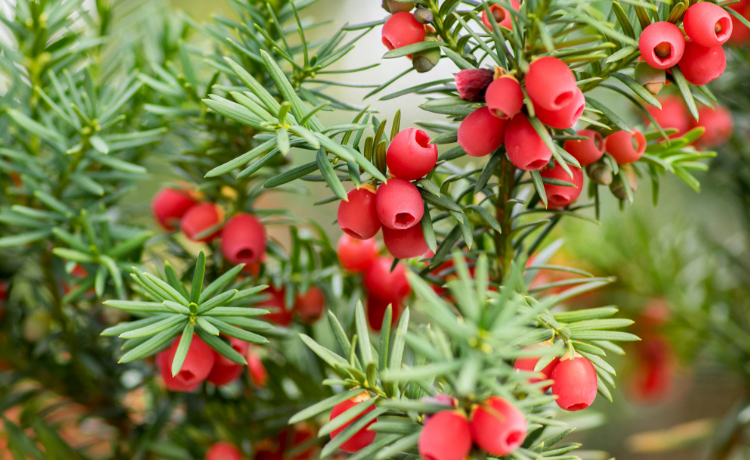
Red-berried shrubs are some of the easiest plants to notice in a garden, especially when the rest of the landscape starts losing its color. In my experience, a shrub covered with bright red fruit can completely change the look of a border or backyard during autumn and winter. The berries also tend to attract birds, adding another layer of activity to the garden.
What I like most about these shrubs is the variety. Some stay only a few feet tall and work well in small gardens, while others can grow 10 feet or more and make excellent screens or hedges. Winterberry, cranberry cotoneaster, red chokeberry, and several viburnums are particularly impressive when their berries remain on the branches after the leaves have fallen.
Below are 40 shrubs known for producing red, reddish, or red-orange berries. Their mature sizes, growing habits, and fruiting periods vary considerably, so choosing the right one depends on how much space you have and the conditions in your garden.
1. Winterberry Holly (Ilex verticillata)
Winterberry holly is one of the finest shrubs for producing a dramatic display of red berries after the leaves have disappeared. This native deciduous holly typically grows about 6 to 12 feet tall, although compact cultivars can remain much smaller. The female plants produce clusters of bright red, berry-like fruit along the stems, and these can persist well into winter. Virginia Tech lists the species at approximately 10 feet in both height and spread, while University of Maryland Extension gives a broader mature height range of 6 to 12 feet.
Winterberry is particularly effective when planted in groups, along wet areas, or near ponds and rain gardens. Its flowers are relatively inconspicuous, but the autumn and winter fruit more than compensate for the understated summer appearance. One important detail is that the species is dioecious: male and female flowers occur on separate plants, so a suitable male pollinator must be nearby for females to produce fruit. A male can often pollinate several females when appropriately matched for flowering time.
Also Read: Berry Bushes That Have Thorns
2. American Cranberrybush Viburnum (Viburnum trilobum)
American cranberrybush viburnum is a large, handsome shrub with maple-like leaves, white spring flowers, and clusters of brilliant red fruit in autumn. It commonly reaches approximately 8 to 12 feet tall, giving it enough presence to function as a screen, informal hedge, or background shrub. Iowa State Extension notes that its red fruit can persist into winter, making it particularly useful for extending seasonal interest.
The foliage adds another layer of interest because it can develop yellow, orange, or reddish autumn color before falling. The bright fruit is held in clusters that stand out particularly well after leaf drop. Birds may eventually consume the berries, so the display can change considerably as winter progresses. Its relatively large size makes it more appropriate for spacious landscapes than tiny foundation beds.
3. Red Chokeberry (Aronia arbutifolia)
Red chokeberry is a North American native shrub valued for its combination of white spring flowers, red autumn berries, and brilliant fall foliage. It generally grows around 6 to 8 feet tall and develops an upright, spreading habit. Iowa State describes the fruit as red and notes that the plant’s common name comes from the strongly astringent character of its fruit.
The berries are often produced in clusters and can remain attractive after the leaves have fallen. Red chokeberry is particularly useful when a landscape needs a native shrub that provides more than one season of interest. Its flowers support pollinators, while the fruit contributes to the autumn and winter food supply for wildlife. It can be planted in groups to create a colorful mass rather than relying on a single specimen.
4. European Cranberrybush Viburnum (Viburnum opulus)
European cranberrybush viburnum is a substantial deciduous shrub with lobed foliage, clusters of white flowers, and bright red fruit. It can reach roughly 8 to 12 feet in height depending on cultivar and growing conditions. The fruit develops after flowering and becomes especially noticeable in autumn as the foliage changes color.
The shrub’s rounded form makes it useful for informal screens, woodland edges, and mixed borders. The clusters of red fruit can remain attractive after leaf drop, giving the plant considerable winter interest. It is important, however, to distinguish ornamental viburnums from edible cranberry species; the name “cranberrybush” refers to the appearance of the fruit rather than making it a true cranberry.
5. Rockspray Cotoneaster (Cotoneaster horizontalis)
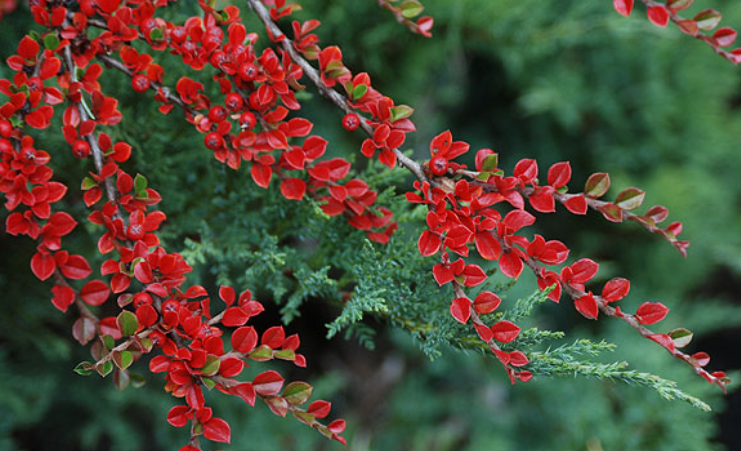
Rockspray cotoneaster is a distinctive deciduous-to-semi-evergreen shrub with strongly horizontal, layered branches. It is generally much shorter than large viburnums, making it useful for banks, walls, rock gardens, and smaller landscapes. Virginia Tech specifically lists Cotoneaster horizontalis among shrubs producing red fruit.
The small red berries appear after the spring flowers and can remain on the branches into the colder months. The unusual branching pattern is almost as attractive as the fruit itself, especially after leaves drop. It is best grown in sun to partial shade with reasonably well-drained soil. Cotoneasters are also valuable to wildlife because their flowers provide resources for pollinating insects and their berries attract birds.
6. Cranberry Cotoneaster (Cotoneaster apiculatus)
Cranberry cotoneaster is a compact shrub with arching branches, small leaves, and clusters of bright red berries. It is generally much lower-growing than many traditional shrubs and can work well along pathways, slopes, retaining walls, and mixed borders. Iowa State Extension identifies it specifically as a shrub with red winter fruit.
The berries are particularly attractive against the foliage and branches during autumn. The plant performs best in full sun to part shade and moist, well-drained soil, although established plants can tolerate somewhat drier conditions. Its compact size makes it one of the more practical red-berried choices for gardens where a 10-foot shrub would simply be too large.
7. Bearberry Cotoneaster (Cotoneaster dammeri)
Bearberry cotoneaster is a low-growing evergreen shrub that can spread horizontally across the ground. Virginia Tech lists it among evergreen shrubs with red fruit. Its spreading habit makes it particularly useful for covering slopes, suppressing weeds, and filling spaces beneath taller shrubs.
Small white flowers appear before the red fruit develops. The combination of evergreen foliage and red berries can be particularly effective in winter gardens. Like other cotoneasters, it performs best in sun to partial shade and generally prefers soils that drain reasonably well.
Also Read: Shrubs With Red Berries During Winter
8. Willowleaf Cotoneaster (Cotoneaster salicifolius)
Willowleaf cotoneaster is a larger evergreen shrub characterized by narrow leaves and arching branches. It can become a substantial landscape plant, and some cultivars reach several meters in height and width. The Royal Horticultural Society lists willowleaf cotoneaster cultivars such as ‘Avonbank’ among its larger cotoneaster selections.
Its red-orange berries appear in clusters and can remain attractive into autumn and winter. The evergreen foliage provides a strong background for the fruit, allowing the berries to stand out even after deciduous plants have lost their leaves. This makes willowleaf cotoneaster useful for screens and large borders where year-round structure is desirable.
9. Parney Cotoneaster (Cotoneaster lacteus)
Parney cotoneaster is a relatively large evergreen shrub with gracefully arching branches and clusters of bright red fruit. The University of Tennessee’s botanical garden describes it as reaching roughly 6 to 8 feet tall and wide within about 10 years under suitable conditions.
The berries develop after small pale flowers and can create an impressive display against the dark green foliage. Its upright but spreading form makes it useful as a specimen or informal screen. The species has also been noted for comparatively good resistance to some of the problems that affect other cotoneasters, although site conditions remain important.
10. Coral Beauty Cotoneaster (Cotoneaster × suecicus ‘Coral Beauty’)
Coral Beauty is a compact cotoneaster cultivar that produces masses of red-orange to coral-red berries. The RHS lists it at approximately 0.5 to 1 meter tall and 1.5 to 2.5 meters wide, giving it a distinctly spreading habit.
Its low profile makes it useful near walls, along borders, or as a ground-covering shrub. The evergreen foliage provides year-round structure, while the fruit becomes especially noticeable in autumn and winter. Small pale flowers earlier in the season also provide resources for pollinating insects.
11. Pyracantha (Pyracantha coccinea)
Pyracantha, sometimes called firethorn, is an evergreen or semi-evergreen shrub famous for its dense clusters of red, orange, or sometimes yellow berries. Virginia Tech lists Pyracantha coccinea among evergreen shrubs with red fruit. Depending on the cultivar and climate, plants can reach approximately 6 to 15 feet tall.
One of pyracantha’s defining features is its thorny branches. This makes it useful for security hedges, boundaries, and wildlife plantings, but the thorns also mean that it should be positioned carefully around paths and areas where people frequently pass. White flowers appear in spring, followed by masses of colorful fruit in autumn. Birds are often attracted to the berries, making the plant useful in wildlife-friendly landscapes.
Also Read: Shrubs With Black Berries (Berry-Like Fruit)
12. Yaupon Holly (Ilex vomitoria)
Yaupon holly is an evergreen North American shrub that can produce abundant red berries on female plants. Virginia Tech lists yaupon holly among evergreen shrubs valued for red fruit. It can vary substantially in size, with some forms remaining compact while others develop into large shrubs or even small trees.
The glossy foliage provides an attractive year-round background for the berries. As with other hollies that have separate male and female plants, fruit production depends on appropriate pollination. Yaupon holly is particularly useful in warmer climates where some other holly species may struggle.
13. Burford Holly (Ilex cornuta ‘Burfordii’)
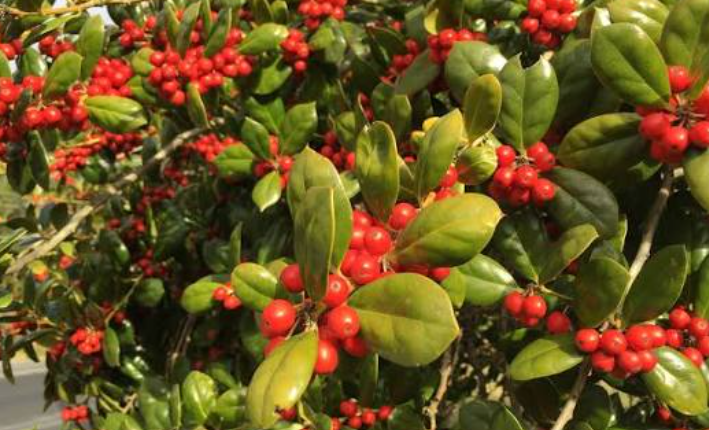
Burford holly is an evergreen Chinese holly cultivar recognized for its glossy green leaves and conspicuous red berries. Virginia Tech includes Burford holly among evergreen shrubs producing red fruit. It can become a medium-to-large shrub and is frequently used for hedges, screens, and foundation plantings.
The contrast between dark green foliage and bright red fruit is one of its strongest ornamental qualities. It can maintain visual interest throughout the year rather than relying entirely on winter fruit. Because hollies can have separate sexes depending on the species or cultivar, gardeners should check the specific plant’s pollination requirements when fruit production is the primary objective.
14. Meserve Hybrid Holly (Ilex × meserveae)
Meserve hybrid hollies are evergreen shrubs with dark green to bluish-green foliage and bright red berry-like fruit on female plants. Iowa State notes that cultivars such as ‘Blue Girl’ and ‘Blue Princess’ are hardy to around -20°F, although exact hardiness varies with cultivar and location.
These hollies are particularly attractive in winter because the foliage remains present while the red fruit provides a strong color contrast. A male plant is needed for fruit production on female plants, and the plants generally perform best in moist, well-drained, slightly acidic soils. Protection from drying winter winds can also help prevent foliage injury.
15. English Holly (Ilex aquifolium)
English holly is an evergreen shrub or small tree with glossy, often spiny leaves and bright red fruit. It is one of the classic plants associated with winter greenery and holiday landscapes. Virginia Tech lists English holly among plants producing red fruit.
In suitable climates, English holly can eventually become a substantial plant, so it should not be treated as a permanently small shrub. Female plants produce the familiar red berries when pollinated. The combination of evergreen foliage and red fruit makes it especially valuable where year-round structure is desired.
16. American Holly (Ilex opaca)
American holly is a native evergreen species that can develop into a large shrub or small tree. Its stiff, glossy foliage and bright red berries give it an unmistakable appearance. Virginia Tech lists American holly among evergreen plants producing red fruit.
In a sufficiently spacious landscape, it can become an important structural plant rather than merely a decorative shrub. Female plants produce the red fruit after successful pollination. The berries provide seasonal food for birds, while the dense evergreen foliage offers cover and nesting opportunities.
17. Possumhaw Holly (Ilex decidua)
Possumhaw holly is a deciduous holly that produces brilliant red berries on bare branches after the foliage drops. Virginia Tech includes Ilex decidua among deciduous shrubs with red fruit. This leafless winter appearance makes the berries especially conspicuous.
The shrub can grow into a medium-sized landscape plant and works well in naturalized settings, woodland edges, and wildlife gardens. As with winterberry, male and female plants are separate, so fruit production requires suitable pollination. Its ability to carry bright berries after leaf drop gives it considerable cold-season ornamental value.
18. American Beautyberry — Red-Fruited Forms (Callicarpa americana)
American beautyberry is usually famous for purple berries, but selections and related beautyberries can produce red, pinkish, or unusual fruit colors. The shrub is generally deciduous and develops arching branches. Where red-fruited forms are available, they can provide an unusual alternative to the more familiar purple-fruited beautyberry.
The berries form in conspicuous clusters around the stems. Beautyberries are particularly valuable for wildlife gardens because birds readily use the fruit. Gardeners should verify the exact cultivar before purchasing because standard American beautyberry is normally recognized for its vivid purple fruit rather than true red fruit.
Also Read: Perennial Shrubs With Purple Flowers
19. Coralberry (Symphoricarpos orbiculatus)
Coralberry is a deciduous North American shrub that produces clusters of pinkish-red to purplish-red fruit. Iowa State lists coralberry among shrubs with colorful fruit that can persist into winter. The shrub generally forms a dense, spreading colony through suckering stems.
Its small berries stand out particularly well after the foliage falls. Coralberry can be useful for naturalized plantings, wildlife gardens, and erosion-control situations where a spreading shrub is appropriate. It is less suited to formal beds where uncontrolled suckering would be undesirable.
20. Red Fruited Rose (Rosa rugosa)
Rugosa rose is better known for its fragrant flowers and heavily textured foliage, but it also produces attractive red to orange-red rose hips after flowering. Virginia Tech lists Rosa rugosa among deciduous shrubs with red fruit. Plants commonly reach about 4 to 6 feet tall and can spread through suckering.
The large rose hips can persist well into autumn and provide strong seasonal color after the flowers have disappeared. The shrub also has dense, thorny growth, making it useful as a barrier or informal hedge. Its flowers are attractive to pollinators, while the hips contribute additional wildlife value.
21. Linden Viburnum (Viburnum dilatatum)
Linden viburnum is a medium-to-large deciduous shrub with attractive white flower clusters followed by bright red fruit. Nebraska Extension describes it as growing approximately 8 to 10 feet tall.
The fruit becomes especially visible after the leaves fall, creating clusters that can resemble small red raisins as they age. It works well as a background shrub or informal screen. Its combination of spring flowers, summer foliage, autumn color, and red fruit gives it several distinct periods of ornamental interest.
22. Doublefile Viburnum (Viburnum plicatum)
Doublefile viburnum is primarily celebrated for its horizontal branches and spectacular spring flowers, but some forms also produce red fruit that later darkens. The shrub can reach approximately 8 to 10 feet tall and wide, although dwarf cultivars are available.
The layered branch structure makes this shrub especially attractive even before fruit develops. Red berries provide an additional seasonal feature, particularly when the foliage begins changing color. It is an excellent specimen for a mixed border where flowers, form, foliage, and fruit are all desirable.
23. Wayfaring Tree Viburnum (Viburnum lantana)
Wayfaring tree is a large deciduous shrub with dense foliage, creamy-white flowers, and clusters of fruit that develop through shades of red before becoming darker. It can reach approximately 10 to 15 feet tall and wide under favorable conditions.
Its size makes it particularly useful as a screen or background plant. The fruit display is most attractive during the transition from summer to autumn, when clusters may contain berries at different stages of ripening. The dense growth also provides useful cover for wildlife.
24. Nannyberry (Viburnum lentago)
Nannyberry is a large native viburnum that can grow as a shrub or small tree. It often reaches 8 to 15 feet in height and produces clusters of fruit that pass through red before becoming dark blue-black at maturity.
The plant is particularly useful in naturalized landscapes because it combines spring flowers, attractive foliage, autumn color, and wildlife-supporting fruit. Its adaptable nature makes it suitable for woodland margins and larger shrub borders. The changing fruit colors also add interest rather than providing only one short period of red.
Also Read: Shrubs With Pink Flowers
25. Hobblebush (Viburnum lantanoides)
Hobblebush is a broad, arching native shrub associated with woodland environments. It usually remains around 3 to 6 feet tall but can spread considerably wider. Its fruit changes color as it matures, often moving through reddish shades before becoming darker.
The unusual branching habit makes it useful for woodland gardens where a loose, natural appearance is preferred. Large leaves provide a substantial summer presence, while autumn fruit contributes color. It generally prefers moist, organic woodland soils and partial shade.
26. Mapleleaf Viburnum (Viburnum acerifolium)
Mapleleaf viburnum is a smaller native viburnum named for its maple-like foliage. It generally grows around 4 to 6 feet tall, making it more suitable for smaller landscapes than many larger viburnums. Its fruit can appear red before becoming dark blue-black as it matures.
The shrub is especially valuable for naturalistic plantings beneath taller trees or along woodland edges. Fall foliage can become attractive shades of red and purple, allowing the plant to offer color from both its leaves and fruit. Its compact habit also makes it useful where a large screen is unnecessary.
27. Tea Viburnum (Viburnum setigerum)
Tea viburnum is a medium-sized deciduous shrub known for its clusters of bright red fruit. It can reach approximately 6 to 10 feet tall and develops an upright to spreading form.
The red fruit appears after white flowers and can remain conspicuous into autumn. Its foliage adds additional seasonal interest before dropping. Tea viburnum is especially useful in mixed shrub borders where a medium-sized plant with attractive fruit is needed.
28. European Fly Honeysuckle (Lonicera xylosteum)
European fly honeysuckle is a deciduous shrub that produces pairs of red berries after its small flowers fade. It generally grows around 5 to 10 feet tall and has an upright, branching habit.
The paired berries are one of its most distinctive features, appearing almost like small red beads attached to the branches. It is mainly grown as an ornamental and wildlife plant rather than as a fruit crop. Because honeysuckles vary greatly in invasiveness by region and species, gardeners should check local recommendations before planting this species.
29. Tatarian Honeysuckle (Lonicera tatarica)
Tatarian honeysuckle is a large deciduous shrub that can reach approximately 8 to 12 feet tall. It produces attractive tubular flowers followed by red berries. The fruit gives the shrub considerable late-season interest after its spring flowering period.
Although historically planted widely as an ornamental, this species has become invasive in parts of North America. For that reason, it is important to check regional invasive-plant guidance before planting it. Where it is considered appropriate, its red fruit and dense growth can provide wildlife value, but native alternatives may be preferable.
30. Red Chokecherry-Type Shrubs (Prunus spp.)
Several shrubby Prunus species produce small red fruits before the fruit darkens with maturity. These plants can vary from compact shrubs to small trees depending on species. Their spring flowers are often an important feature, followed by fruit that attracts wildlife.
The main attraction is therefore the combination of flowers and fruit rather than a long-lasting red berry display alone. When selecting a species, gardeners should confirm mature size, disease resistance, and whether the particular plant is better classified as a shrub or small tree.
31. Cotoneaster ‘Cornubia’
Cotoneaster ‘Cornubia’ is a large, vigorous cotoneaster capable of developing into a substantial shrub or small tree. The RHS lists it at approximately 4 to 8 meters in both height and width.
Its large size makes it unsuitable for tiny gardens but excellent where a tall evergreen or semi-evergreen screen is required. Clusters of red-orange berries develop after the flowers and can remain attractive into winter. The branches can also be cut for decorative arrangements, providing another use for the fruiting stems.
32. Franchet’s Cotoneaster (Cotoneaster franchetii)
Franchet’s cotoneaster is a medium-to-large evergreen or semi-evergreen shrub with arching branches and narrow foliage. The RHS gives mature dimensions of roughly 2.5 to 4 meters in both height and width for its standard form.
Clusters of red-orange berries develop in autumn and provide strong contrast against the foliage. It works well as a hedge, screen, or specimen shrub where sufficient room is available. Like other cotoneasters, it is useful to wildlife because its flowers attract pollinating insects and its fruit is consumed by birds.
33. Tibetan Cotoneaster (Cotoneaster conspicuus)
Tibetan cotoneaster is a relatively compact shrub, with the RHS listing cultivars such as ‘Decorus’ at approximately 1 to 1.5 meters tall and 1.5 to 2.5 meters wide. Its relatively modest size makes it useful for borders and smaller gardens.
The shrub produces pale flowers followed by bright berries, often red or red-orange depending on the plant. Evergreen foliage can provide winter structure while the fruit adds seasonal color. Its spreading form works particularly well when allowed to grow naturally rather than being tightly clipped.
34. Creeping Cotoneaster (Cotoneaster procumbens)
Creeping cotoneaster is among the lowest-growing shrubs in this group. The RHS lists ‘Queen of Carpets’ at only around 0.1 to 0.5 meters tall while spreading approximately 1.5 to 2.5 meters wide.
This makes it particularly useful for slopes, rock gardens, low walls, and ground-cover situations. Red berries develop among the low foliage, producing small but attractive spots of color. It can be an excellent solution when the goal is to have red-fruited shrubs without sacrificing valuable vertical space.
35. Rockspray Cotoneaster ‘Variegatus’
Variegated forms of rockspray cotoneaster combine patterned foliage with red fruit. The leaves provide interest even before the berries develop, while the red fruit becomes increasingly noticeable as autumn approaches.
Its relatively compact, spreading form works particularly well in borders and rock gardens. The horizontal branches create a layered appearance, and the fruit can remain after much of the surrounding garden has begun to fade. As with other cotoneasters, full sun generally encourages better flowering and fruiting.
36. Winterberry ‘Red Sprite’ (Ilex verticillata ‘Red Sprite’)
‘Red Sprite’ is a compact female winterberry cultivar that is particularly useful when the standard species is too large. The University of Vermont notes that ‘Red Sprite’ grows to roughly 3 feet tall and wide, compared with some winterberries that can reach 12 feet.
Despite its small stature, it produces large, vivid red berries that can create an impressive display. It still requires a compatible male pollinator to produce fruit. The compact size makes it especially useful for smaller gardens, foundation beds, and areas where a traditional 10-foot winterberry would overwhelm neighboring plants.
37. Winterberry ‘Winter Red’ (Ilex verticillata ‘Winter Red’)
‘Winter Red’ is another female winterberry cultivar selected for its abundant, vivid red fruit. North Carolina State Extension lists it at approximately 6 to 8 feet tall and wide and notes that it is a heavy fruit producer when an appropriate male pollinator is nearby.
The shrub is particularly impressive after its leaves fall because the red berries are left exposed along the stems. It prefers moist to wet, organic-rich acidic soils but can tolerate clay and low-lying areas. It is especially well suited to rain gardens, pond edges, naturalized plantings, and winter-focused landscapes.
Also Read: Shrubs With Deep Blue Flowers
38. Winterberry ‘Sparkleberry’ (Ilex verticillata ‘Sparkleberry’)
‘Sparkleberry’ is a female winterberry selection valued for its heavy fruiting. Like other female winterberries, it develops clusters of red berries after pollination. The berries become especially noticeable after the shrub loses its foliage.
It can be used in mass plantings, wildlife gardens, and informal borders. Pairing female cultivars with a compatible male winterberry helps ensure reliable fruit production. Because flowering time varies among cultivars, choosing a male with overlapping bloom periods is important.
39. American Cranberrybush ‘Hahs’ (Viburnum trilobum ‘Hahs’)
‘Hahs’ is a more compact selection of American cranberrybush viburnum. Iowa State notes that it grows approximately 6 to 8 feet tall and produces large, attractive fruit. This makes it useful where the species’ standard 8- to 12-foot dimensions would be somewhat excessive.
The large red fruit clusters are particularly attractive in autumn and can persist into winter. Maple-like foliage provides additional interest before falling. The combination of compact size, large fruit, and seasonal color makes ‘Hahs’ a strong choice for mixed shrub borders.
40. American Cranberrybush ‘Redwing’ (Viburnum trilobum ‘Redwing’)
‘Redwing’ is another selection of American cranberrybush valued for its fruit display. Iowa State reports that it can grow approximately 8 to 10 feet tall and produces large clusters of glossy red fruit.
Its combination of spring flowers, attractive foliage, autumn color, and glossy red fruit makes it a genuinely multi-season shrub. It works particularly well as an informal hedge or screen where there is enough room for its mature size. In a wildlife-friendly garden, the fruit also contributes seasonal food resources for birds.
Further References
- University of Vermont Extension — Colorful Winter Shrubs With Red Berries. Useful information on winterberry, cultivar sizes, growing conditions, red berry production, and pollination requirements.
- Iowa State University Extension — Trees and Shrubs With Colorful Fruit in Fall and Winter. Useful information on red chokeberry, cranberry cotoneaster, winterberry, Meserve hollies, American cranberrybush viburnum, fruit color, mature sizes, and growing conditions.
- Virginia Tech — Recommended Native Shrubs for Virginia Landscapes. Useful information on red chokeberry, viburnums and other landscape shrubs, including mature size, hardiness zones, fruit characteristics, and site requirements.
- University of Illinois Extension — Winterberry. Useful information on winterberry’s mature size, hardiness, bright red fruit, cultivars, and the need for male and female plants for fruit production.
- Iowa State University Extension — Color in the Winter Landscape. Useful information on shrubs with colorful winter fruit, including red chokeberry, American cranberrybush viburnum, Japanese barberry, and Meserve hybrid hollies, along with their fruiting characteristics and sizes.