Animals that walk on 2 legs represent a surprisingly diverse group, spanning birds that rely on bipedal movement for their entire lives, mammals that shift between two and four legs depending on the situation, and even a handful of lizards capable of sprinting upright when speed becomes essential. True bipedalism, where an animal walks on two legs as its primary or exclusive mode of movement, is relatively rare across the animal kingdom and appears in less than 1 percent of vertebrate species when birds are excluded from the count.
Birds, on the other hand, represent the largest and most consistent group of two-legged walkers, with more than 10,000 known species relying on this movement style for daily life. Beyond birds, bipedal movement in mammals and reptiles tends to be either a permanent adaptation shaped by specific evolutionary pressures or a temporary behavior used for reaching food, scanning for predators, or achieving bursts of speed. This list explores 30 animals whose relationship with two-legged walking ranges from constant and essential to occasional and situational.
Human
The human is the most well-known example of a fully bipedal mammal, having evolved this walking style over roughly 4 million years according to fossil evidence tracing early hominin footprints. Walking upright freed the hands for tool use and carrying objects, a shift researchers believe played a major role in human cognitive and technological development over time. The human body shows extensive skeletal adaptations for two-legged walking, including a curved spine, a wide pelvis, and an arched foot structure that together allow for efficient, sustained upright movement. Unlike most other bipedal animals, humans rely on two legs exclusively for both slow walking and fast running, with no regular use of four-limbed movement in typical daily activity.
Ostrich
The ostrich is the largest living bird and one of the most powerful two-legged walkers on Earth, capable of reaching running speeds up to 45 miles per hour on its long, muscular legs. Each stride can cover up to 16 feet at full speed, and the ostrich’s legs make up a significant portion of its overall height, which can reach 9 feet in males. This bird has only two toes on each foot, an adaptation believed to reduce weight and improve running efficiency compared to the three or four toes found in most other birds. Because ostriches cannot fly, their two legs serve as the primary tool for both escaping predators and covering the long distances needed to find food across open grassland habitat.
Emu
The emu, native to Australia, walks and runs exclusively on two legs, reaching speeds of up to 30 miles per hour when startled or pursued. This flightless bird can stand up to 6.2 feet tall, and its powerful legs account for much of that height, built for covering long distances efficiently while foraging across arid and semi-arid landscapes. Emus are capable of maintaining a steady walking pace for extended periods, sometimes traveling several hundred miles during seasonal movements in search of food and water. Their legs also serve a defensive purpose, delivering a powerful forward kick that can be strong enough to injure a potential predator.
Cassowary
The cassowary walks on two powerful legs equipped with sharp claws, including an especially large, dagger-like claw on the inner toe that can measure up to 5 inches long. This bird is considered one of the most dangerous in the world due to its ability to deliver forceful kicks with these claws, a defense made possible by the strength and structure of its two-legged stance. Cassowaries are capable of running through dense rainforest at speeds up to 31 miles per hour, using their legs to navigate thick vegetation that would be far more difficult to move through on four limbs. Despite their bulk, which can reach up to 130 pounds, cassowaries are also strong jumpers, using their legs to leap several feet into the air when necessary.
Rhea
The rhea, a large flightless bird native to South America, relies entirely on its two long legs for movement, reaching speeds of up to 40 miles per hour when running from predators. This bird’s legs are notably long relative to its body, allowing for an efficient stride that helps it cover the open grasslands and scrublands where it typically lives. Rheas often run in a zigzag pattern to evade predators, using quick directional changes powered by strong leg muscles rather than relying on straight-line speed alone. Unlike the ostrich, the rhea has three toes on each foot, an adaptation that provides additional stability while running across uneven terrain.
Chicken
The chicken walks on two legs as its default and near-constant mode of movement, using short, quick steps to forage across open ground for seeds, insects, and other small food items. Despite being capable of limited flight, chickens rely on their legs for the vast majority of daily activity, including scratching at soil to expose buried food, a behavior that requires strong leg muscles and coordinated balance. A chicken’s legs are also used for establishing social hierarchy within a flock, with dominant birds often displaying more assertive, upright walking postures. This bird’s two-legged stance allows it to react quickly to threats, transitioning rapidly from walking to short bursts of running when startled.
Turkey
The turkey walks confidently on two legs, typically moving at a slow, deliberate pace while foraging but capable of running at speeds up to 25 miles per hour when needed. Wild turkeys spend the vast majority of their time on the ground, using their legs to search through leaf litter and open fields for nuts, seeds, and insects. Male turkeys often use an upright, two-legged strutting display during breeding season, fanning their tail feathers while walking in a slow, deliberate manner to attract mates. This bird’s strong legs also allow it to launch into short bursts of flight when escaping danger, though walking remains its primary form of daily movement.
Peacock
The peacock, or male peafowl, walks on two legs with a notably upright, deliberate gait, especially when displaying its elaborate tail feathers during courtship. This bird’s legs must support considerable additional weight and balance demands when the tail is fanned, which can account for around 60 percent of the bird’s total body length. Peacocks spend most of their time walking across open ground while foraging for seeds, insects, and small reptiles, reserving flight mainly for escaping predators or reaching roosting sites. The peacock’s slow, confident walking style during displays is thought to help showcase the tail’s coloration and pattern more effectively to potential mates.
Flamingo
The flamingo walks on two long, thin legs that can account for a significant portion of its total height, allowing it to wade through shallow water while foraging for algae, small crustaceans, and other food. This bird is also known for standing on a single leg for extended periods, a behavior researchers believe helps conserve body heat by reducing the surface area exposed to water and air. Flamingo legs contain a specialized joint structure that allows the bird to lock its leg in place while resting, reducing the muscular effort needed to remain balanced on one leg for hours at a time. When walking through mud or shallow water, the flamingo’s legs and wide, webbed feet work together to prevent sinking into soft surfaces.
Emperor Penguin
The emperor penguin walks upright on two legs, using a distinctive waddling gait that conserves energy while moving across ice and snow in extremely cold conditions. This bird can stand up to 4 feet tall, and its short legs are set far back on the body, an adaptation that improves swimming efficiency but results in the characteristic side-to-side walking motion seen on land. Emperor penguins sometimes switch to tobogganing, sliding on their bellies while pushing with their legs, a faster and more energy-efficient method of covering long distances across ice compared to walking alone. During breeding season, male emperor penguins may walk or shuffle for extended periods while balancing a single egg on their feet to keep it off the freezing ground.
Secretary Bird
The secretary bird, native to the grasslands of sub-Saharan Africa, walks on unusually long legs that can cover significant distances each day while hunting for snakes, insects, and small mammals. This bird can travel up to 20 miles in a single day on foot, using its height and long stride to spot prey moving through tall grass. Its legs are also a primary weapon, delivering forceful, rapid stomping kicks capable of striking prey with a force several times the bird’s own body weight. Despite being a capable flyer, the secretary bird spends the vast majority of its active hours walking across open terrain rather than hunting from the air.
Kiwi
The kiwi, a small flightless bird native to New Zealand, relies entirely on its two legs for movement, using strong, stocky limbs that make up a notably large proportion of its body mass compared to other birds. This nocturnal bird forages by walking slowly across the forest floor, using an excellent sense of smell, unusual among birds, to locate insects and worms hidden beneath leaf litter and soil. A kiwi’s legs are proportionally larger and more muscular than those of most bird species, reflecting the bird’s complete reliance on walking rather than flight for daily survival. Despite its small size, typically under 4 pounds, the kiwi can move with surprising speed and agility through dense underbrush when startled.
Sandhill Crane
The sandhill crane walks on tall, slender legs well suited to wading through shallow wetlands and foraging across open fields for seeds, insects, and small animals. This bird can stand around 4 feet tall, with legs that make up a substantial portion of its overall height, allowing it to survey its surroundings easily while walking through tall grasses. Sandhill cranes are known for elaborate courtship dances that include bowing, leaping, and coordinated walking movements between paired birds. During migration, sandhill cranes may walk long distances at stopover sites to forage and rebuild energy reserves before continuing their journey, which can span thousands of miles.
Marabou Stork
The marabou stork walks on long, thin legs across African wetlands, savannas, and even urban areas, often scavenging for carrion in addition to hunting small live prey. This large bird can stand up to 5 feet tall, and its legs are frequently covered in a whitish coating caused by the bird defecating on them, a behavior believed to help regulate body temperature through evaporative cooling. Marabou storks are capable of walking for extended periods while searching for food, often following larger predators to scavenge remains once a kill has been made. Despite an imposing wingspan that can exceed 10 feet, this bird spends much of its foraging time walking on the ground rather than in flight.
Kangaroo
The kangaroo moves almost exclusively by hopping on its two powerful hind legs, a specialized form of bipedal movement that allows it to reach speeds of up to 35 miles per hour while conserving significant energy. A kangaroo’s oversized hind legs and thick tail work together as a counterbalance system, with the tail acting almost like a third leg during slower movement across the ground. This animal’s tendons store and release elastic energy with each hop, a mechanism so efficient that kangaroos can travel long distances using barely more energy than they would while standing still. When moving slowly, such as while grazing, kangaroos use a five-point gait involving both front paws and the tail, but faster movement relies entirely on the powerful two-legged hop.
Kangaroo Rat
The kangaroo rat, despite its small size, moves primarily by hopping on its two hind legs, a bipedal adaptation that allows it to travel quickly across open desert terrain while avoiding predators. This rodent can leap distances of up to 9 feet in a single bound, using powerful hind leg muscles that make up a disproportionately large share of its total body mass. Kangaroo rats rely on this rapid, unpredictable hopping pattern specifically to evade snakes and owls, changing direction mid-leap to make their movement harder to track. Their long tails provide balance during these rapid hops, functioning similarly to the tail of a much larger kangaroo despite the enormous difference in body size.
Springhare
The springhare, native to parts of Africa, moves by hopping on its two long hind legs, resembling a small kangaroo despite being more closely related to rodents than marsupials. This nocturnal animal can leap distances of up to 6 feet in a single bound, using its powerful legs to escape predators quickly across open, sandy terrain. Springhares spend daylight hours resting in burrows, emerging at night to forage, and their bipedal hopping style allows for rapid, energy-efficient travel between feeding areas. Their long tails, which can be nearly as long as their body, help maintain balance during fast hopping movement, much like the tail mechanics seen in kangaroos and kangaroo rats.
Jerboa
The jerboa, a small desert rodent found across parts of Asia and North Africa, moves by hopping on two greatly elongated hind legs that can be up to four times longer than its front legs. This animal is capable of leaping distances of up to 10 feet in a single jump, an impressive feat for a rodent that typically weighs less than a few ounces. Jerboas rely on this rapid, bipedal hopping style almost exclusively for movement, rarely using their small front legs for anything beyond feeding and grooming. Their long tails, often tipped with a distinctive tuft of fur, provide crucial balance and steering during high-speed hops across loose desert sand.
Pangolin
The pangolin is capable of walking on its two hind legs for short distances, holding its front legs and long claws off the ground while balancing with its thick, muscular tail. This unusual bipedal walking style is thought to help protect the pangolin’s sharp digging claws from unnecessary wear when the animal is not actively foraging or excavating a burrow. Pangolins typically alternate between this two-legged stance and a more standard four-legged walk depending on the terrain and the specific task at hand. When threatened, a pangolin usually curls into a tight ball rather than relying on speed, but its occasional bipedal walking remains a distinctive and unusual trait among mammals.
Meerkat
The meerkat frequently stands and moves short distances on its two hind legs, using this upright posture primarily to scan the surrounding landscape for predators such as birds of prey. This small mammal relies heavily on group vigilance, with individual meerkats taking turns standing bipedally on guard duty while the rest of the group forages for food. A meerkat’s tail helps provide balance during this upright stance, functioning as a stabilizing counterweight similar to the mechanism seen in kangaroos, though on a much smaller scale. While meerkats do not walk long distances on two legs, their frequent bipedal standing and short shuffling movements make this posture a defining part of their daily behavior.
Gibbon
The gibbon is capable of walking upright on two legs while moving along tree branches, a behavior known as bipedal brachiation support that helps maintain balance in the forest canopy. This primate spends most of its time swinging through trees using its long arms, but when it does move along the ground, it typically walks upright on two legs with its arms raised for balance. Gibbons are considered among the most naturally bipedal of all non-human primates when on the ground, walking with a more upright posture than chimpanzees or gorillas typically display. This bipedal ground movement is relatively rare, however, since gibbons overwhelmingly prefer to travel through the trees rather than descend to the forest floor.
Chimpanzee
The chimpanzee is capable of walking on two legs for short distances, particularly when carrying food, tools, or infants that require the use of its hands. Despite this ability, chimpanzees primarily move using a four-limbed style called knuckle-walking, reserving bipedal movement for specific situations where upright posture offers a clear advantage. Researchers have observed that chimpanzees walking bipedally use roughly the same amount of energy as they do while knuckle-walking, a finding that has informed theories about why early human ancestors may have shifted toward full-time bipedalism. Chimpanzees also stand upright on two legs to get a better view over tall grass or to display dominance during social interactions.
Bonobo
The bonobo, closely related to the chimpanzee, walks on two legs somewhat more frequently than its relative, particularly during social displays, food carrying, and wading through shallow water. This primate’s slightly more upright natural posture, even during four-limbed movement, is thought by some researchers to make the transition to bipedal walking less physically demanding compared to other great apes. Bonobos have been observed walking upright for longer stretches than chimpanzees in certain contexts, especially when moving through swampy forest terrain where staying more upright can help keep the body drier. This behavior has made the bonobo a frequent subject of study among researchers investigating the evolutionary origins of human bipedalism.
Gorilla
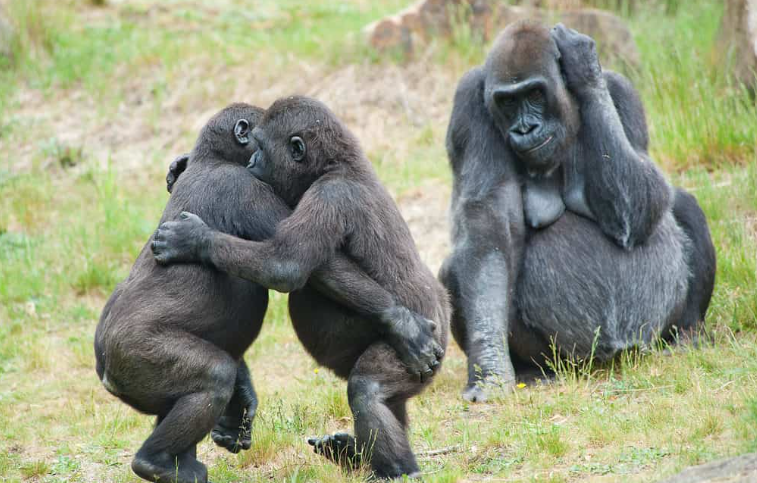
The gorilla is capable of standing and walking briefly on two legs, most commonly during chest-beating displays meant to establish dominance or ward off perceived threats. Despite this ability, gorillas primarily move using knuckle-walking, a four-limbed style that better supports their substantial body weight, which can exceed 400 pounds in large adult males. When gorillas do walk bipedally, it is typically for only a few steps at a time, since sustained two-legged movement is considerably less energy efficient for an animal of this size and skeletal structure. Young gorillas are sometimes observed standing upright longer than adults, using the posture as part of play behavior rather than for defensive or territorial displays.
Orangutan
The orangutan is capable of walking upright on two legs, particularly while moving along wide tree branches where balance benefits from raised arms and a more vertical posture. This primate spends the vast majority of its life in trees, and its bipedal movement on branches is thought to be an adaptation that helps it navigate the flexible, uneven canopy structure of its rainforest habitat. When orangutans do descend to the ground, they typically move quadrupedally, but short bipedal walking bouts have been documented, especially when the animal is carrying food. Some researchers have pointed to the orangutan’s occasional bipedal branch-walking as an important clue in understanding how early bipedal movement may have first developed among primate ancestors.
Sifaka Lemur
The sifaka lemur, native to Madagascar, is well known for a distinctive sideways bipedal hopping motion used to cross open ground between trees. This primate’s legs are significantly longer and more powerful than its arms, an adaptation suited primarily for vertical clinging and leaping through the forest canopy rather than efficient four-limbed walking. When a sifaka needs to cross open terrain, it hops sideways on its two hind legs with its arms raised for balance, a movement pattern that has made this lemur particularly popular in wildlife videos. This unusual hopping gait allows the sifaka to cover ground quickly despite a body structure that is otherwise poorly suited to walking on all four limbs.
Prairie Dog
The prairie dog frequently stands upright on its two hind legs, using this bipedal posture primarily as a lookout position to scan the surrounding grassland for approaching predators. This small burrowing rodent lives in large colonies, and coordinated upright standing allows individuals to watch for threats while other colony members continue foraging nearby. A prairie dog’s upright stance is often accompanied by a distinctive warning call, alerting the rest of the colony to potential danger detected from this elevated vantage point. While prairie dogs do not travel long distances on two legs, their frequent and consistent use of this posture makes bipedal standing an essential part of their group survival strategy.
Basilisk Lizard
The basilisk lizard is capable of running on its two hind legs at high speed, a behavior most famously used to sprint briefly across the surface of water to escape predators. This reptile can reach speeds of up to 7 miles per hour while running bipedally across water, aided by specialized fringed scales on its feet that increase surface area and reduce sinking. The basilisk’s long tail helps maintain balance during this rapid two-legged movement, both on water and on land, where it can also run bipedally for short bursts. This unique ability has earned the basilisk lizard the popular nickname of the Jesus lizard, referencing its remarkable water-walking behavior.
Collared Lizard
The collared lizard is capable of running on its two hind legs at considerable speed, reaching up to 16 miles per hour during short bursts when escaping predators or chasing prey. This reptile lifts its front legs off the ground during high-speed pursuit, shifting its weight backward and relying on powerful hind leg muscles for propulsion. Collared lizards typically use this bipedal running technique only during fast movement, reverting to a standard four-legged stance when moving slowly or at rest. Their long tails play an important role in balance during bipedal sprinting, helping to counteract the forward momentum generated by the powerful hind legs.
Frilled Lizard
The frilled lizard, native to Australia and New Guinea, is capable of running on its two hind legs, often doing so immediately after displaying its large, distinctive neck frill to startle a potential predator. This reptile can reach speeds of several miles per hour during a bipedal sprint, using the sudden shift to two-legged running as an effective way to quickly put distance between itself and a threat. The frilled lizard’s tail provides essential balance during this rapid movement, functioning similarly to the tail mechanics seen in other bipedal-running lizard species. This combination of a dramatic frill display followed by fast two-legged flight makes the frilled lizard one of the more distinctive bipedal reptiles in the animal kingdom.