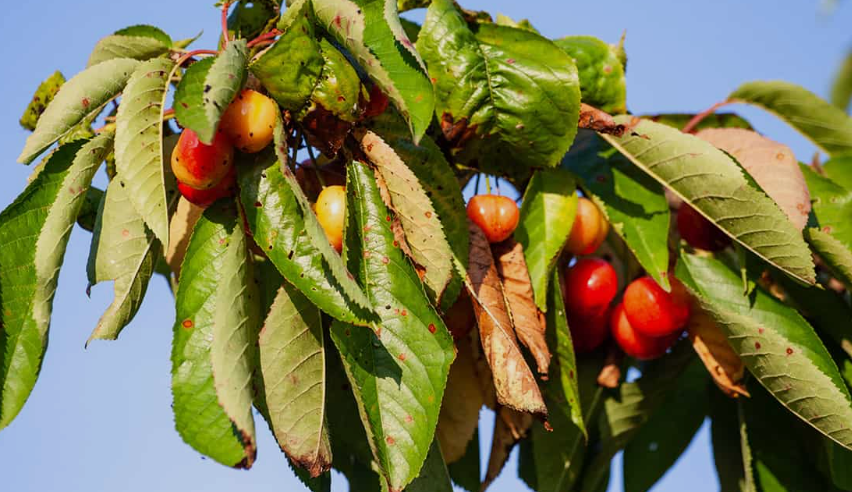
A healthy cherry tree can produce fruit for 15 to 20 years, but very few cherry trees make it through a full growing season without encountering at least one pest or disease along the way. Extension services tracking backyard and orchard cherry trees consistently report that fungal diseases and fruit-feeding insects account for the large majority of crop loss each year, with cherry fruit fly alone capable of infesting up to 100 percent of unprotected fruit in some regions if left uncontrolled. Because cherry trees flower early and leaf out fast, they’re exposed to a long window of pest and disease pressure that starts before the blossoms even open and continues through fruit set, ripening, and into the following winter. Knowing what to look for, and catching problems within the first week or two of symptoms appearing, is usually the difference between a minor nuisance and a season of lost fruit.
Below are 18 of the most common pests and diseases affecting cherry trees, along with the control methods that actually work for each one. Some are cosmetic issues that barely affect fruit production, while others can kill a mature tree within a few seasons if ignored, so it’s worth reading through the full list even if you’re only dealing with one visible problem right now.
1. Black Cherry Aphid
Black cherry aphids are small, shiny black insects that cluster on the undersides of young leaves and along new shoot tips in early spring, feeding on sap and causing leaves to curl, yellow, and distort. A single untreated colony can produce several overlapping generations in one season, since aphids reproduce asexually and a female can generate dozens of offspring within days. Heavy infestations coat leaves and fruit in sticky honeydew, which then attracts sooty mold. Control usually starts with a strong jet of water to knock colonies off the tree, followed by insecticidal soap or horticultural oil applied directly to the undersides of affected leaves; encouraging ladybugs and lacewings, both natural aphid predators, also helps keep populations in check season over season.
2. Cherry Fruit Fly
Cherry fruit fly is widely considered the single most damaging insect pest of cherries, since its larvae develop directly inside the fruit, making infested cherries unsellable and often invisible to the eye until the fruit is cut open. Adult flies emerge from the soil in late spring and lay eggs just under the skin of developing cherries, and a single female can lay well over 100 eggs across a two- to three-week egg-laying period. Yellow sticky traps hung in the canopy in mid-spring help growers time insecticide applications to when adult flies are actually active, and covering smaller trees with fine insect netting before fruit begins to color is one of the most reliable non-chemical controls available.
3. Plum Curculio
Plum curculio is a small, grayish-brown weevil that damages cherries by feeding on and laying eggs inside young fruit, leaving a distinctive crescent-shaped scar that causes the fruit to become deformed or drop early. Damage is heaviest in the two to three weeks immediately following petal fall, making that window the most important period for monitoring and treatment. Because adult curculios often play dead and drop to the ground when disturbed, laying a light-colored tarp under the tree and shaking the branches in early morning is a simple way to confirm their presence before deciding whether insecticide treatment is warranted.
4. Eastern Tent Caterpillar
Eastern tent caterpillars build easily recognizable silken tents in the forks of branches in early spring, and the caterpillars emerge from these tents to feed on nearby leaves, sometimes stripping entire branches bare during a heavy infestation. A single egg mass, which overwinters as a hardened band wrapped around a twig, can contain 150 to 400 eggs that all hatch within the same one- to two-week period in spring. Small tents can simply be removed by hand or pruned out and destroyed before the caterpillars disperse; for larger infestations, Bacillus thuringiensis, a naturally occurring bacterial insecticide, provides effective control without harming beneficial insects.
5. Pear Sawfly (Cherry Slug)
Despite the name, pear sawfly larvae, commonly called cherry slugs, are frequent pests of cherry trees, appearing as small, slimy, olive-green to black larvae that skeletonize leaves by feeding on the upper surface tissue and leaving the leaf veins intact. Two generations typically occur per year, with the second generation in late summer usually causing more visible damage than the first. Light infestations rarely threaten tree health and can be controlled with a strong spray of water or insecticidal soap, while heavier infestations affecting a large portion of the canopy may warrant a targeted insecticide application.
6. Japanese Beetle
Japanese beetles feed in groups on cherry leaves during mid to late summer, chewing out the tissue between leaf veins and leaving a distinctive lace-like skeleton behind. A single beetle does limited damage, but populations can build quickly, and heavily infested trees can lose a significant portion of their leaf surface within a few weeks during peak beetle activity in July. Hand-picking beetles into a bucket of soapy water in the early morning, when they’re most sluggish, remains one of the most effective controls for small trees, while pheromone traps are generally discouraged since they tend to attract more beetles to the area than they actually catch.
7. Spider Mites
Spider mites are tiny arachnids, barely visible without magnification, that feed on the undersides of cherry leaves and cause a fine stippling or bronzing across the leaf surface, often accompanied by delicate webbing during heavy infestations. Populations explode fastest during hot, dry weather, with a full generation completing in as little as five to seven days under warm conditions, which is why mite problems often appear to worsen overnight. Regular water sprays that dislodge mites from leaf undersides, combined with horticultural oil for more established infestations, provide reliable control without disrupting the predatory mites that naturally keep populations in check.
8. Scale Insects
Scale insects attach themselves to the bark of branches and twigs, appearing as small, immobile bumps that can be easily mistaken for part of the tree itself. They feed by piercing the bark and drawing out sap, and heavy infestations can cause branch dieback, reduced vigor, and yellowing foliage over time. Dormant oil applied in late winter before buds break is the most effective single treatment, since it smothers overwintering scale before the growing season begins; established infestations on active growth may require a follow-up treatment with a systemic insecticide.
9. Peachtree Borer
Peachtree borer larvae tunnel into the trunk and major roots of cherry trees at or just below the soil line, and their feeding damage can girdle and kill young trees within one to two seasons if left unaddressed. A telltale sign of infestation is gummy sap mixed with reddish-brown frass pushed out of small holes near the base of the trunk. Because larvae feed inside the wood, topical insecticides have limited effect once tunneling has begun, so prevention through trunk treatments applied in late summer, when adult moths are laying eggs, is far more effective than trying to treat an active infestation.
10. Leafhoppers
Leafhoppers are small, wedge-shaped insects that feed on the underside of cherry leaves, causing a stippled or bleached appearance and, in some cases, transmitting plant pathogens between trees as they move from host to host. Populations tend to peak in early to mid-summer and can produce multiple generations in warmer climates. Most infestations are cosmetic and don’t require treatment, but insecticidal soap applied directly to the undersides of leaves is effective for the rare cases where populations are dense enough to stress a young or already-weakened tree.
11. Brown Rot
Brown rot is a fungal disease that affects blossoms, twigs, and fruit, causing flowers to wilt and turn brown shortly after bloom and, later in the season, causing ripening fruit to develop soft brown spots that quickly spread across the entire cherry. In favorable wet, humid weather, infected fruit can go from a small spot to fully rotted within just a few days. Removing and destroying infected fruit and blighted twigs promptly, improving air circulation through pruning, and applying a fungicide at bloom time are the three most effective control measures, since brown rot spores overwinter on infected plant material left on or near the tree.
12. Black Knot
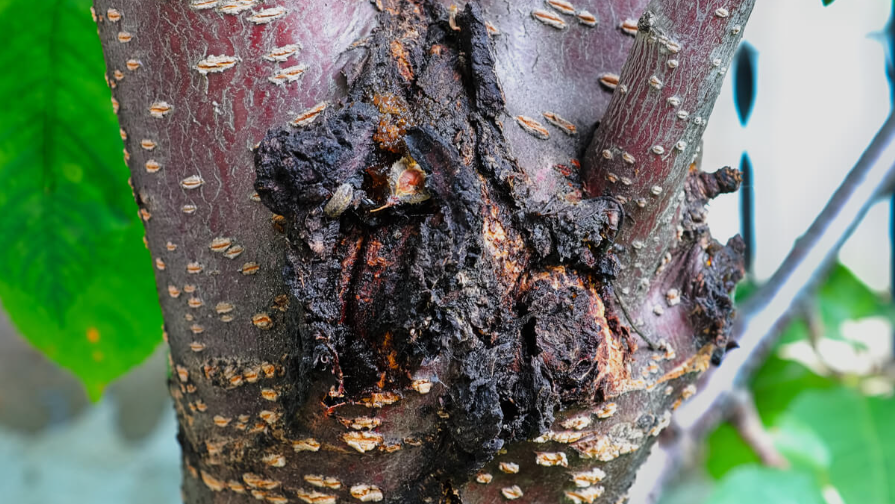
Black knot produces hard, black, tumor-like swellings on branches and twigs that can girdle and kill the affected limb over one to two years if not removed. The disease spreads through airborne spores released during wet weather in spring, and a single untreated knot can serve as a spore source for years, gradually infecting more of the tree and nearby trees. The only reliable control is aggressive pruning, cutting affected branches at least 6 to 8 inches below any visible swelling during the dormant season, followed by destroying the removed wood rather than composting it, since the fungus can continue producing spores even after the branch is cut.
13. Cherry Leaf Spot
Cherry leaf spot appears as small purple to reddish-brown spots scattered across the upper leaf surface, and in heavy infections the centers of these spots eventually fall out, leaving a distinctive shot-hole appearance. Severely infected leaves often turn yellow and drop weeks ahead of normal fall leaf drop, and a tree that loses a large share of its leaves early in the season two years in a row can suffer measurable declines in cold hardiness and fruit production. Fungicide applications timed to shortly after petal fall, combined with raking and destroying fallen leaves in autumn to reduce overwintering spores, form the backbone of effective control.
14. Powdery Mildew
Powdery mildew coats leaves, shoots, and sometimes fruit in a fine white to gray powdery growth, most commonly affecting new, tender growth during warm days followed by cool, humid nights. While rarely fatal on its own, heavy infections can stunt shoot growth and reduce fruit quality, and repeated infections over several seasons can weaken a tree’s overall vigor. Improving air circulation through proper pruning and spacing, avoiding excessive nitrogen fertilization that promotes overly soft new growth, and applying a fungicide labeled for powdery mildew at the first sign of infection all help keep this disease from becoming a recurring problem.
15. Bacterial Canker
Bacterial canker causes sunken, discolored lesions on branches and trunks that often ooze gummy sap, along with small, angular, water-soaked spots on leaves that can merge and cause significant leaf drop. The disease is particularly dangerous to young trees, and infections at or near the trunk can girdle and kill an entire tree within a single season under the right conditions. Because the bacteria enter through wounds, pruning cuts, and natural openings, timing pruning for late summer rather than winter, when bacterial populations and infection risk are lower, is one of the most effective preventive strategies available.
16. Silver Leaf Disease
Silver leaf disease causes a distinctive silvery sheen across the leaf surface, caused by a fungus that grows inside the wood and produces toxins that separate the leaf’s layers, creating the characteristic reflective appearance. Cutting into an affected branch typically reveals a dark stain running through the wood, which distinguishes silver leaf from other causes of leaf discoloration. Infected branches should be pruned out well below any visible staining and destroyed, and because the fungus enters through fresh wounds, pruning during dry summer weather rather than during damp winter and spring conditions significantly reduces infection risk.
17. Armillaria Root Rot
Armillaria root rot, sometimes called honey fungus, attacks the root system and lower trunk of cherry trees, often going unnoticed until a tree shows sudden wilting, branch dieback, or dies outright, since most of the damage happens underground. A telltale sign is a white, fan-shaped fungal growth found just under the bark at the base of the trunk, along with honey-colored mushroom clusters that can appear at the base of infected trees in fall. There is no effective chemical cure once a tree is infected, so management focuses on removing and destroying infected root material, avoiding replanting susceptible species in the same location, and improving soil drainage, since the fungus thrives in consistently wet soil.
18. X-Disease (Phytoplasma)
X-disease is caused by a phytoplasma, a bacteria-like organism spread primarily by leafhoppers, and it causes cherry fruit to become small, pointed, and poorly colored while leaves develop a reddish or yellowish discoloration and may curl upward along the edges. Infected trees typically decline steadily over two to four years, with fruit quality worsening each season until the tree is no longer productive. Because there is no cure once a tree is infected, control focuses on removing and destroying infected trees promptly to eliminate the phytoplasma source, along with managing leafhopper populations and removing nearby chokecherry trees, which commonly serve as a reservoir for the disease.
Building a Season-Long Control Strategy
Most cherry tree problems fall into predictable seasonal windows, which makes a proactive schedule far more effective than reacting to damage after it appears. Dormant oil applied in late winter addresses overwintering scale and mite eggs before they become active. A fungicide application at bloom time targets brown rot during the tree’s most vulnerable flowering period, and a follow-up application shortly after petal fall helps control both brown rot and cherry leaf spot. Monitoring for cherry fruit fly with sticky traps should begin as fruit starts to develop, and regular inspection of trunks and major limbs throughout the growing season catches borers, canker, and black knot early enough to act before serious damage sets in. Sanitation, meaning the prompt removal of infected fruit, fallen leaves, and pruned wood, does more to reduce disease pressure year over year than almost any single spray application.
Frequently Asked Questions
What is eating holes in my cherry tree leaves? Holes and chewed leaf tissue are most commonly caused by Japanese beetles, pear sawfly larvae, or eastern tent caterpillars, while a shot-hole appearance with the centers of spots falling out is a classic sign of cherry leaf spot rather than insect feeding. Checking the timing of damage and looking closely at the leaf margins versus scattered holes helps narrow down the cause.
Why are the cherries on my tree falling off before they ripen? Early fruit drop is frequently caused by plum curculio feeding and egg-laying damage shortly after petal fall, though brown rot infection and inconsistent watering during fruit development can also cause cherries to drop prematurely.
Is it safe to eat cherries from a tree with fruit fly damage? Fruit visibly infested with cherry fruit fly larvae should not be eaten. Infested cherries often show a small puncture mark from egg-laying and may contain larvae inside, so any fruit showing these signs should be removed from the tree and disposed of rather than composted nearby.
How do I know if my cherry tree has a fungal disease versus a bacterial one? Fungal diseases like brown rot, black knot, and cherry leaf spot typically produce visible growths, spots, or powdery coatings on plant tissue, while bacterial diseases like bacterial canker more often cause oozing, sunken lesions and water-soaked spots that lack the fuzzy or powdery texture associated with fungal infections.
Can I prevent most cherry tree pests and diseases without spraying chemicals? Sanitation practices such as removing fallen fruit and leaves, pruning out infected wood promptly, spacing trees for good air circulation, and avoiding overhead watering late in the day significantly reduce pest and disease pressure, though some problems, particularly cherry fruit fly and brown rot, are difficult to manage in high-pressure years without at least some targeted treatment.