Apple trees can be remarkably productive, but a healthy-looking tree does not necessarily mean an easy crop. Apples are affected by insects, fungal and bacterial diseases, physiological disorders, weather damage, and problems associated with roots and soil. The good news is that an apple tree does not need to experience all of these problems. Susceptibility varies considerably among cultivars, growing conditions, and local climates.
One reason apple problems can be frustrating is that different causes often produce similar symptoms. Yellow leaves might result from disease, root stress, drought, or normal aging. Holes in fruit may indicate codling moth, apple maggot, sawfly, or another pest. Brown spots can be caused by several different diseases.
For that reason, the most effective approach is not to spray first and identify later. It is to look at where the damage occurs, when it appears, what the symptom actually looks like, and whether the problem is spreading.
Apple pest and disease management is generally most successful when it combines monitoring, sanitation, pruning, appropriate growing conditions, resistant cultivars where available, and carefully targeted treatments when they are genuinely necessary. This is the basis of integrated pest management (IPM).
1. Apple Scab
Apple scab is one of the most familiar diseases of apple trees. It is a fungal disease that can affect both foliage and fruit.
What Apple Scab Looks Like
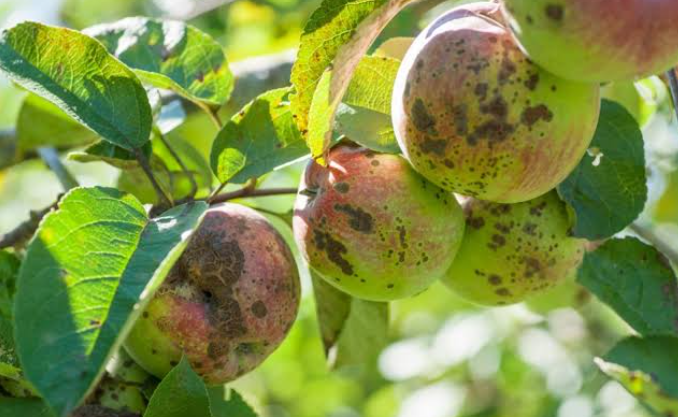
Early symptoms may appear as olive-green to dark spots on leaves. As the disease develops, spots can become darker and more noticeable, while severely affected leaves may yellow and fall prematurely.
On apples, scab produces rough, dark, corky lesions. Cracks can sometimes develop in badly affected fruit.
The RHS identifies apple scab as a common apple problem affecting both leaves and fruit.
How to Control Apple Scab
Start with sanitation.
Remove fallen leaves and affected fruit rather than allowing them to remain beneath the tree. Pruning to improve air movement can also help foliage dry more quickly.
When planting new trees, consider cultivars with good scab resistance where those varieties are suitable for your area.
For established trees with recurring disease, fungicide programs may be necessary in some climates. Timing is important, so use only products registered for apples in your location and follow the label carefully.
2. Fire Blight
Fire blight is a bacterial disease that can attack blossoms, shoots, branches, and sometimes larger portions of an apple tree.
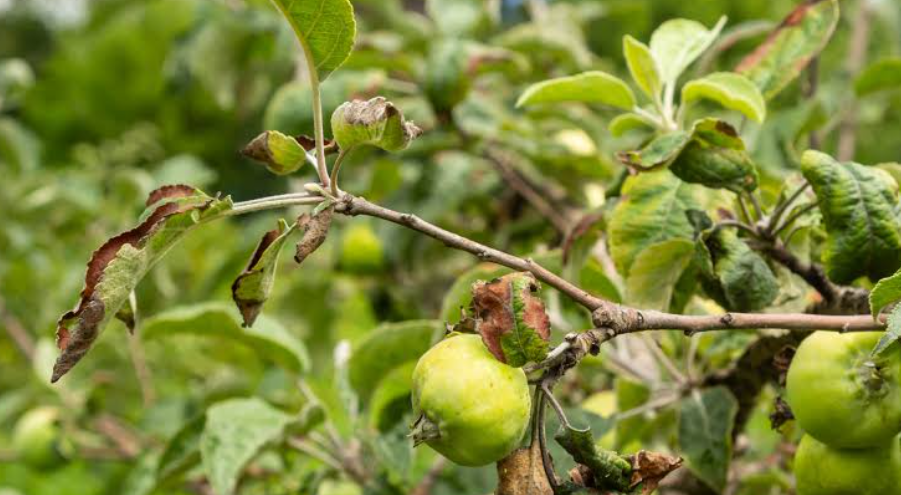
It can be particularly alarming because affected shoots may appear as though they have suddenly been scorched.
Symptoms
Look for:
- Wilted flowers
- Blackened or brown shoots
- Rapid shoot dieback
- Curved or hooked young shoots
- Darkened areas spreading down branches
The RHS notes that fire blight can cause shoot dieback after flowering and may progress farther down a shoot than blossom wilt.
How to Control Fire Blight
Monitor new growth carefully during periods favorable to disease.
Remove infected portions where appropriate, cutting well below visibly affected tissue and disinfecting pruning tools between cuts.
Avoid excessive nitrogen fertilization because very vigorous, soft new growth can be more vulnerable to fire blight.
Where fire blight is a recurring concern, selecting resistant or less susceptible cultivars can be an important long-term strategy.
Because fire blight can affect valuable trees and spread between susceptible plants, serious or uncertain cases are worth having diagnosed by a local extension service or plant-health professional.
3. Codling Moth
Codling moth is one of the most important apple fruit pests. Its larvae enter developing apples and feed inside the fruit.
This is the classic cause of what gardeners often call “maggoty apples.”
Iowa State University Extension describes codling moth as one of the most destructive apple pests, with larvae boring into developing fruit and leaving tunnels and frass around entry points.
Symptoms
You may notice:
- Small holes in apples
- Brown material around entry points
- Tunnels inside the fruit
- Larvae or caterpillar-like insects
- Prematurely damaged or unusable fruit
How to Control Codling Moth
Monitoring is an important first step.
Pheromone traps can help determine when adult moths are active and can be useful for timing management decisions. The RHS recommends using pheromone traps to monitor codling moth activity.
Remove damaged or infested fruit rather than leaving it on the tree or ground.
For significant infestations, control measures need to be timed according to local pest activity rather than applied randomly throughout the season.
4. Apple Maggot
Apple maggot is another fruit-infesting pest. The larvae tunnel through developing apples, leaving brown trails and damaged flesh.
Iowa State University Extension identifies apple maggot as an important pest that can distort fruit and make the flesh unusable.
How to Control Apple Maggot
Monitor for adult flies and inspect fruit regularly.
Remove affected apples from the tree and ground.
Good garden sanitation is particularly useful because leaving damaged fruit beneath the tree can allow the pest to continue its life cycle.
In areas where apple maggot is a recurring problem, appropriately timed traps or other locally recommended controls can be incorporated into an IPM program.
5. Apple Sawfly
Apple sawfly can damage young fruitlets soon after flowering.
The larvae feed beneath the skin of developing apples, sometimes leaving characteristic scars.
The RHS notes that apple sawfly damage can cause fruitlets to fall in early summer, while surviving fruit may develop a long ribbon-like scar.
Control
Inspect young fruit after flowering.
Remove badly damaged fruitlets where practical.
Maintaining orchard hygiene and monitoring the pest’s activity can help prevent a small problem from becoming a larger one.
6. Aphids
Several aphid species can feed on apple trees.
Some primarily affect young shoots and leaves, while others can distort fruitlets.
Symptoms
Aphid infestations may cause:
- Curled leaves
- Distorted young shoots
- Sticky foliage
- Stunted growth
- Distorted fruitlets
The sticky material is honeydew, which aphids produce while feeding. It can encourage sooty mold growth on leaves.
How to Control Aphids
Not every aphid infestation requires treatment.
Healthy established apple trees can often tolerate modest aphid populations, and natural predators can help keep them under control.
Monitor young growth and look for ladybirds, lacewings, and other beneficial organisms.
If populations become large enough to cause significant distortion or stress, use an appropriate control method registered for apples in your area.
7. Woolly Apple Aphid
Woolly apple aphids are distinctive because they produce a white, cotton-like or woolly covering.
They can occur on shoots, branches, and around wounds.
The RHS notes that the insect itself can appear as a brown-black aphid beneath its protective white wax.
Symptoms
Look for:
- White woolly patches
- Lumpy areas around branches
- Weak or distorted growth
- Insects beneath the white material
How to Control Them
Inspect trees regularly, particularly around pruning wounds and older branches.
Small infestations can sometimes be removed manually or washed away where practical.
Encouraging beneficial insects and avoiding unnecessary insecticide applications can preserve natural predators.
Persistent or severe infestations may require a locally approved treatment.
8. Mites
Several types of mites can affect apple foliage.
Because they are extremely small, the damage may be easier to see than the pest itself.
Symptoms
Possible signs include:
- Fine speckling
- Yellowing or bronzing
- Dull foliage
- Reduced vigor
- Fine webbing in some severe infestations
Iowa State Extension includes aphids and mites among insects that can affect apple trees, while noting that many such infestations have limited impact unless populations become significant.
Control
Inspect leaves closely, especially during hot, dry weather.
Avoid unnecessary broad-spectrum insecticides because they can eliminate predatory organisms that naturally help suppress mites.
Keep trees adequately watered during drought and maintain good overall vigor.
9. Caterpillars and Leaf-Eating Moths
Several moth caterpillars feed on apple leaves.
Winter moth caterpillars can be particularly troublesome because they may attack buds, blossoms, and young fruitlets in addition to leaves. Tortrix moth caterpillars may tie leaves together with silk while feeding.
Control
Inspect foliage during spring and early summer.
Small numbers can often be removed by hand.
Encourage birds and beneficial insects that prey on caterpillars.
If an outbreak is severe, identify the caterpillar before choosing a treatment. Different pests may require different management approaches.
10. Apple Canker
Apple canker is a fungal disease that affects the bark and woody portions of apple trees.
The RHS describes it as producing sunken areas of dead bark on branches and sometimes larger stems. Infections often begin around wounds or buds.
Symptoms
Look for:
- Sunken bark
- Cracked areas
- Dead patches on branches
- Branch dieback
- Expanding lesions
How to Control Apple Canker
Prune out affected branches where possible.
Make pruning cuts into healthy wood rather than leaving obviously infected tissue behind.
Avoid unnecessary injury to the bark and branches.
Maintain good tree vigor and avoid planting apples in locations with persistent waterlogging.
Remove heavily infected prunings from the growing area.
11. Brown Rot
Brown rot is a fungal disease that affects apples and several other fruit crops.
It can begin as a small brown area on the fruit and then spread rapidly.
Symptoms
Affected apples may develop:
- Brown circular spots
- Softening and decay
- Enlarging rotten areas
- Pale brown fungal pustules
- Mummified fruit remaining on the tree
The RHS recommends removing damaged fruit promptly because brown rot can spread to nearby apples.
Control
Remove rotten fruit as soon as you notice it.
Do not leave mummified apples hanging on the tree over winter.
Avoid unnecessary fruit injuries because damaged skin provides opportunities for infection.
Prune to improve airflow and maintain a canopy that dries reasonably quickly after rain.
12. Powdery Mildew
Powdery mildew produces a characteristic white, dusty coating.
It can occur on young leaves and shoots and may become more obvious as new growth develops.
Symptoms
You may notice:
- White powder on leaves
- Distorted young foliage
- Stunted shoots
- Reduced vigor
The RHS notes that heavy powdery mildew infection can reduce tree vigor.
Control
Prune crowded growth to improve air circulation.
Avoid creating excessive lush growth through overfertilization.
Remove severely affected shoots where appropriate.
When planting new trees, consider cultivars with useful disease resistance.
13. Cedar-Apple Rust
Cedar-apple rust is a fungal disease that requires compatible hosts to complete its life cycle.
Iowa State Extension lists cedar-apple rust among important apple diseases.
Symptoms
Apple foliage can develop yellowish or orange-colored spots, sometimes followed by more distinctive structures on the underside of leaves.
Fruit can also be affected.
Control
Choose resistant cultivars where possible.
Remove heavily infected leaves and fruit when practical.
Because the disease involves another host plant, managing nearby susceptible host plants can sometimes reduce disease pressure, although the usefulness of this depends on local conditions and the distance involved.
14. Black Rot
Black rot is another fungal disease associated with apple trees.
It can affect leaves, branches, and fruit.
Symptoms
Watch for:
- Leaf spots
- Dead areas on branches
- Dark lesions
- Rotting fruit
- Fruit that becomes black and shriveled
Iowa State Extension includes black rot among the major diseases encountered in apple production.
Control
Remove infected fruit and dead wood.
Prune out diseased branches where practical.
Avoid leaving dead fruit attached to the tree.
Good sanitation is particularly important because dead plant material can serve as a source of disease.
15. Sooty Blotch and Flyspeck
These are primarily surface blemish diseases rather than problems that destroy the interior of the apple.
They produce dark marks on the fruit skin.
The RHS identifies sooty blotch and flyspeck as fungal blemish diseases that can produce black marks on apples.
How to Reduce Them
Good airflow and an open canopy can help foliage and fruit dry more quickly.
Pruning also improves light penetration and air circulation.
In regions where these diseases are common, growers may use preventative fungicide programs, but product choice and timing should follow local recommendations.
16. Honey Fungus
Honey fungus is a serious root disease that can attack many woody plants, including apples.
The RHS identifies honey fungus and Phytophthora root rot as two important causes of root decay in apple trees.
Symptoms
A tree may show:
- Poor growth
- Yellowing foliage
- Branch dieback
- General decline
- Root decay
- Problems around the base of the trunk
Control
Honey fungus is difficult to manage once established.
Avoid planting susceptible replacement trees in heavily affected ground without obtaining local advice.
Remove infected plant material where practical and improve growing conditions for remaining plants.
If a mature apple tree is declining for no obvious reason, examining the roots and base of the trunk can sometimes reveal that the problem begins below ground rather than in the leaves.
17. Phytophthora Root Rot
Phytophthora root rot is associated with poorly drained or waterlogged conditions.
The RHS specifically notes that Phytophthora root rot is favored by waterlogging.
Symptoms
Possible signs include:
- Yellowing leaves
- Weak growth
- Premature leaf drop
- Branch dieback
- Wilting despite wet soil
- Dark or deteriorating roots
Control
Improve drainage where possible.
Avoid excessive irrigation.
Do not automatically assume that a wilting tree needs more water. If the soil is already saturated, additional water can make the underlying problem worse.
When planting new apple trees, choose a well-drained location and a rootstock suited to the site.
Apple Tree Problems That Are Not Actually Pests or Diseases
This is where diagnosis becomes particularly important.
Bitter Pit
Bitter pit produces dark spots within or near the flesh of apples and is associated with calcium imbalance in developing fruit.
It is a physiological disorder, not an insect infestation.
The RHS identifies low calcium levels in developing fruit as the cause of bitter pit.
Management focuses on maintaining consistent growing conditions and addressing the underlying nutritional and watering situation rather than simply treating the fruit as though it had a fungal infection.
June Drop
Seeing many tiny apples fall in early summer can be alarming.
But this is often completely normal.
Apple trees naturally shed some immature fruitlets in a process commonly called June drop. The RHS explains that this allows the remaining fruit to receive adequate resources as they develop.
Therefore, not every fallen apple is evidence of a pest or disease.
Frost Damage
Late frost can damage blossoms and young fruitlets.
This can result in poor fruit set, distorted fruit, or rings of russeting.
If flowers were healthy one day and suddenly turn brown following freezing temperatures, environmental damage may be a better explanation than disease.
How to Prevent Apple Pests and Diseases
The best apple pest-management program starts long before the first insect appears.
Choose Disease-Resistant Cultivars
Some apple cultivars are much more susceptible to particular diseases than others.
When planting a new tree, investigate disease resistance as well as flavor, fruiting season, size, and climate suitability.
This can save years of frustration.
Inspect the Tree Regularly
Walk around the tree rather than only looking at it from a distance.
Check:
- New shoots
- Leaf undersides
- Flowers
- Young fruit
- Mature fruit
- Branch unions
- Trunk
- Soil around the root zone
Early detection gives you more options.
Keep Fallen Fruit and Leaves Under Control
Sanitation is one of the simplest ways to reduce disease pressure.
Remove rotten apples, heavily diseased fruit, and other infected plant debris.
This is particularly important for diseases that can persist in fallen leaves or mummified fruit.
Prune for Airflow
An overly dense canopy creates a humid environment in which some fungal diseases can thrive.
Pruning should not mean removing large amounts of the tree indiscriminately. The goal is to develop a balanced canopy with adequate air movement and light penetration.
Avoid Water Stress
Both drought and excessive moisture can weaken apple trees.
Water deeply when needed, but make sure the soil drains appropriately.
A tree growing in constantly saturated ground can experience root problems even though it appears to have plenty of water.
Don’t Overfertilize
Excessive fertilizer, especially nitrogen, can encourage very soft, vigorous growth.
That is not always desirable when disease pressure is high.
Fertilize according to the tree’s actual needs rather than assuming more fertilizer means more apples.
Protect Beneficial Insects
Not every insect on an apple tree is an enemy.
Ladybirds, lacewings, predatory bugs, parasitoid wasps, and other beneficial organisms can help suppress pest populations.
Integrated pest management specifically emphasizes monitoring and combining cultural, biological, and targeted control methods rather than relying automatically on pesticides.
A Quick Apple Pest and Disease Identification Chart
| What you see | Possible problem |
|---|---|
| Olive-green or dark scabby leaf spots | Apple scab |
| Scabby lesions on fruit | Apple scab |
| White powder on leaves | Powdery mildew |
| Brown rotten fruit with fungal growth | Brown rot |
| Black marks on fruit skin | Sooty blotch/flyspeck |
| Orange or yellow leaf spots | Cedar-apple rust or another leaf disease |
| Sunken dead areas on branches | Apple canker |
| Blackened shoots after flowering | Fire blight or blossom-related disease |
| Curled, sticky young leaves | Aphids |
| White woolly patches on branches | Woolly apple aphid |
| Holes and tunnels inside apples | Codling moth or apple maggot |
| Ribbon-like scars on young fruit | Apple sawfly |
| Leaf damage from caterpillars | Moth caterpillars |
| Brown roots and declining tree | Root disease or waterlogging |
| Brown spots inside fruit with bitter taste | Bitter pit |
| Many small fruitlets falling in early summer | Often natural June drop |
This chart is useful for narrowing down the possibilities, but symptoms can overlap. When a tree is seriously declining, an accurate diagnosis is more valuable than treating several possible causes at once.
The Most Effective Way to Manage Apple Tree Problems
Apple trees respond best to a preventive, observation-based approach.
Instead of waiting until half the fruit is damaged, inspect the tree while it is flowering. Instead of treating every yellow leaf, look at the pattern of yellowing and examine the roots and soil. Instead of spraying whenever an insect appears, determine whether the insect is actually causing economically important damage.
A practical yearly routine might look like this:
Winter: prune appropriately, remove diseased wood and old fruit, and inspect the trunk and branches.
Early spring: watch buds and developing leaves for aphids, caterpillars, and early disease symptoms.
Flowering: monitor blossoms and avoid unnecessary pesticide applications that could harm pollinating insects.
After fruit set: inspect young apples for sawfly, aphids, scab, and other problems.
Summer: monitor codling moth and other fruit pests, maintain appropriate soil moisture, and remove damaged fruit.
Late season: remove rotten or mummified fruit and inspect the tree for disease before winter.
After leaf fall: clear significant diseased leaf and fruit debris and assess the tree’s overall health.
This kind of seasonal monitoring is consistent with the IPM approach recommended by extension specialists, which uses scouting and the tree’s growth stage to guide management decisions.
Final Takeaway: Learn to Read the Apple Tree
The biggest mistake in managing apple trees is assuming that every symptom has one obvious cause.
A curled leaf might be an aphid. A brown leaf might be disease—or drought. A fallen apple might contain a pest—or it might simply be part of the tree’s natural fruit-thinning process. A declining branch might have canker, root problems, fire blight, or simply be dead wood that needs pruning.
That is why the most valuable skill is learning to read the pattern of the damage.
Look at the location. Look at the timing. Look underneath the leaves. Examine the fruit. Check the soil. Consider the weather. Then decide what action, if any, is actually necessary.
Once you approach apple-tree problems this way, pest and disease control becomes much more manageable. You stop treating symptoms blindly and start responding to the specific problem in front of you. That results in healthier trees, fewer unnecessary treatments, and a much better chance of harvesting good-quality apples.