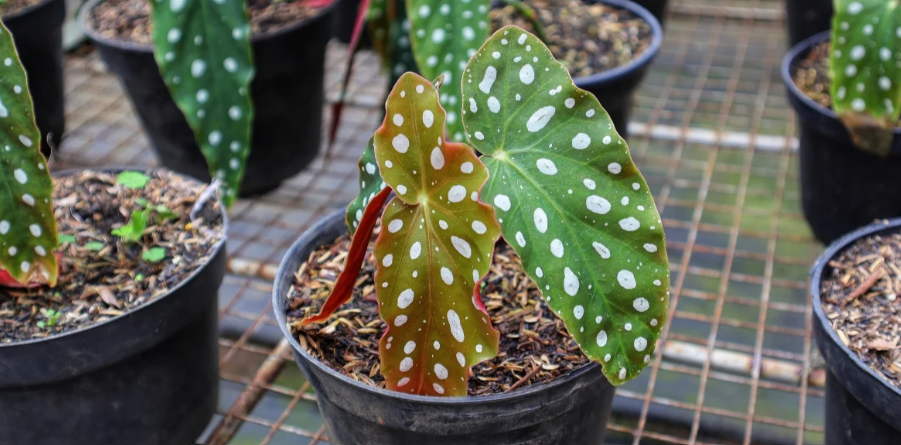
Angel wing begonia is one of the most distinctive members of the begonia family. Its large, wing-shaped leaves, upright cane-like stems, and clusters of delicate flowers give it an appearance that is quite different from compact bedding begonias. Depending on the variety, the foliage may be green, silver-spotted, olive, bronze, or marked with contrasting veins, while the flowers commonly appear in shades of pink, red, orange, or white.
The name angel wing begonia is commonly used for cane-type begonias with elongated, asymmetrical leaves that resemble the shape of an angel’s wing. Many of the plants sold under this name are hybrids derived from species such as Begonia aconitifolia and Begonia coccinea. They are popular both as houseplants and outdoor ornamental plants in warm climates.
Unlike some begonias that remain close to the ground, angel wing begonias develop upright stems that can become tall and somewhat woody with age. This gives them a shrub-like appearance and makes them useful when a gardener wants to add height to a collection of tropical or subtropical plants.
Botanical Classification of Angel Wing Begonia
Angel wing begonias belong to the following botanical classification:
- Kingdom: Plantae
- Clade: Angiosperms
- Clade: Eudicots
- Order: Cucurbitales
- Family: Begoniaceae
- Genus: Begonia
- Horticultural group: Cane-type begonias
The term “angel wing begonia” does not describe one single botanical species. Instead, it generally refers to a group of cane begonias and their hybrids that have characteristic wing-shaped leaves.
Many cultivated angel wing begonias have a complex horticultural history because breeders have crossed different begonia species to combine desirable traits such as attractive foliage, upright growth, vigorous flowering, and improved adaptability.
This is why two plants sold as angel wing begonias can look noticeably different while still belonging to the same general horticultural group.
History of Angel Wing Begonias
The history of angel wing begonias is closely connected with the development of cane begonias as ornamental plants.
Begonias originated primarily in tropical and subtropical regions of the Americas, Africa, and Asia. As botanical exploration expanded, numerous species were collected and introduced into horticulture.
The angel wing forms became particularly popular after breeders began crossing different cane-type species. Among the most important parent plants were Begonia aconitifolia and Begonia coccinea. Their hybridization produced plants combining attractive foliage with upright, cane-like growth and abundant flowering.
The famous ‘Lucerna’ begonia is one of the historically important cane-type hybrids associated with the development of modern angel wing begonias. Later breeding produced numerous cultivars with different leaf patterns, plant sizes, and flower colors.
Today, angel wing begonias are grown in homes, conservatories, patios, shaded gardens, containers, and tropical landscapes.
Also Read: Other Types of Begonia
Identifying Characteristics of Angel Wing Begonias
Several features make angel wing begonias relatively easy to recognize.
Wing-Shaped Leaves
The most obvious feature is the foliage.
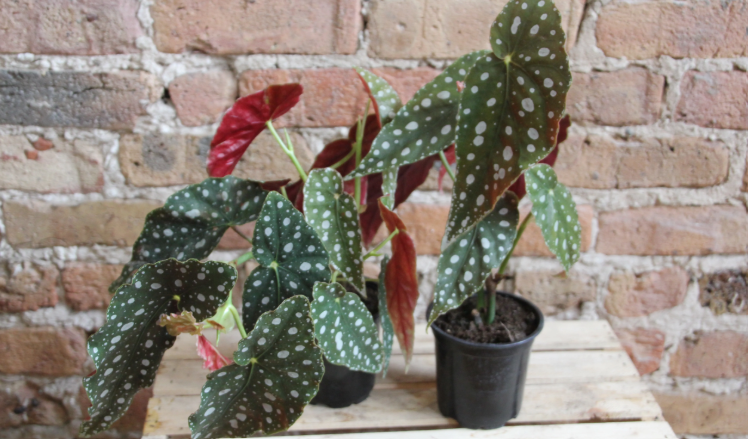
The leaves are typically elongated and asymmetrical, with a shape that can resemble an angel’s wing. This distinctive appearance is responsible for the common name.
Leaves can vary considerably in size depending on the cultivar. Some are relatively narrow, while others are broad and dramatic.
Silver or White Spots
Many angel wing begonias have silver, white, or pale spots scattered across the upper surface of the leaves.
The spots can be small and numerous or larger and more pronounced. Some varieties have rows of spots that create an almost painted appearance.
Not every angel wing begonia has strongly spotted foliage, so leaf shape and growth habit are more reliable identification characteristics than spotting alone.
Cane-Like Stems
Angel wing begonias are cane begonias, meaning they produce upright stems that resemble canes.
The stems can become increasingly substantial as the plant ages. Older stems may develop a somewhat woody appearance near the base while remaining softer toward the newer growth.
This upright structure distinguishes angel wing begonias from creeping or rhizomatous begonia types.
Hanging Flower Clusters
Angel wing begonias can produce clusters of flowers that hang from the stems, creating an attractive contrast with the upright foliage.
Flower colors include:
- Pink
- Red
- Coral
- Orange
- White
Some cultivars flower particularly heavily when given suitable conditions, while others are grown primarily for their foliage.
Asymmetrical Foliage
Like many begonias, angel wing begonias have asymmetrical leaves. One side of the leaf is often noticeably different from the other.
The combination of asymmetry, wing-like shape, spotting, and cane growth provides a useful collection of clues when identifying the plant.
How to Grow Angel Wing Begonia
Angel wing begonias are relatively forgiving when their basic needs are understood. Their greatest enemies are usually extremes: intense direct sunlight, prolonged dryness, constantly wet soil, cold temperatures, or severe fluctuations in growing conditions.
Rather than treating them like ordinary bedding plants, it helps to think of angel wing begonias as warm-climate woodland plants. They appreciate bright but filtered light, steady moisture, warmth, and an airy growing environment.
Choose the Right Light
Light is one of the most important factors affecting angel wing begonias.
They generally perform best in bright, indirect light or filtered sunlight. A location near a bright window indoors can work well, provided the leaves are protected from harsh direct afternoon sun.
Outdoors, morning sun followed by afternoon shade can be an excellent arrangement.
Too little light can result in weak, stretched growth and fewer flowers. On the other hand, intense direct sunlight, especially through glass or during hot afternoons, can scorch the leaves.
A useful approach is to judge the plant by its response. Strong, compact growth with healthy-looking foliage generally indicates that the light level is suitable. Long gaps between leaves and weak stems may indicate insufficient light.
Give the Roots Airy Soil
Angel wing begonias appreciate moisture, but their roots should not remain surrounded by stagnant, waterlogged soil.
Use a loose, well-draining growing medium containing components that allow both water movement and air around the roots. A quality indoor potting mix amended with materials that improve drainage can work well.
The objective is not to make the soil extremely dry. Instead, aim for a medium that becomes moist after watering but gradually dries as the plant uses the available water.
Containers must have drainage holes. Decorative pots without drainage can trap excess water around the roots.
Water According to the Plant, Not the Calendar
One of the most useful ways to care for angel wing begonias is to stop thinking of watering as a fixed weekly routine.
The plant’s water requirement changes according to temperature, light, pot size, humidity, and season.
Check the growing medium before watering. If the upper layer has begun to dry while the lower root zone remains appropriately moist, the plant may not need immediate watering.
When watering is necessary, apply enough water to moisten the root zone thoroughly and allow excess water to escape through the drainage holes.
Avoid allowing the plant to sit in a saucer of standing water for extended periods.
At the same time, do not allow an angel wing begonia to remain severely dry for long periods. Repeated cycles of extreme dryness followed by heavy watering can cause unnecessary stress.
Maintain Moderate Humidity
Angel wing begonias generally appreciate moderate to high humidity, particularly when grown indoors in dry environments.
However, increasing humidity does not necessarily mean constantly misting the leaves.
A better approach can be grouping plants together, using a suitable humidifying method, or positioning the plant in a naturally more humid part of the home while maintaining good air circulation.
Avoid creating a stagnant, constantly damp environment around the foliage. High humidity combined with poor airflow can encourage fungal and bacterial problems.
Keep the Plant Warm
Angel wing begonias are warm-growing plants and do not tolerate frost.
Indoor plants should be protected from cold drafts, particularly during winter. Outdoor plants in cool climates should be brought indoors or otherwise protected before temperatures become damaging.
Sudden temperature changes can also cause stress. A stable environment is generally preferable to repeatedly moving the plant between very different conditions.
Also Read: How To Grow And Care For Begonia
Fertilize During Active Growth
Angel wing begonias can benefit from regular nutrition while actively producing leaves and stems.
A balanced, water-soluble fertilizer applied according to its label directions can support healthy growth. During periods of active growth, modest but consistent feeding is generally more useful than occasional heavy applications.
If the plant is already growing vigorously in fertile potting mix, excessive fertilizer is unnecessary.
Watch the foliage and overall growth rather than assuming that more fertilizer will automatically produce more flowers.
Pruning for a Fuller Angel Wing Begonia
Pruning is one of the most useful techniques for maintaining an attractive angel wing begonia.
Without occasional pruning, the plant can become tall and sparse, particularly when grown indoors under moderate light.
When a stem becomes too long, cut it just above a healthy node. New shoots can develop from nodes below the cut, encouraging branching.
Instead of cutting the plant back severely all at once, it is often better to shape it gradually. Remove weak, damaged, or excessively long stems while preserving healthy growth.
This approach can produce a fuller plant without creating unnecessary stress.
Pinching Young Growth
Pinching the tips of young shoots can also encourage branching.
When the growing tip is removed, the plant may redirect growth toward lateral buds farther down the stem. Repeated selectively during active growth, this can help produce a bushier specimen.
However, avoid excessive pinching if the main goal is to encourage flowering on existing mature stems.
A good balance is to allow some stems to develop naturally while shaping others to maintain the plant’s overall form.
How to Encourage Flowers
A healthy angel wing begonia can produce impressive clusters of flowers, but flowering depends on several factors.
Adequate light is particularly important. A plant growing in very low light may produce attractive leaves while flowering poorly.
Consistent nutrition and appropriate watering also support flowering.
Allow the plant enough time to mature rather than continually cutting back every new stem. Mature cane growth is often where flowering becomes most impressive.
If a plant is healthy but produces abundant foliage and few flowers, examine the light level first.
Propagating Angel Wing Begonia
Angel wing begonias are relatively easy to propagate from stem cuttings.
Select a healthy stem with several nodes and make a clean cut. Remove lower leaves if necessary and place the cutting in an appropriate rooting medium or water, depending on the method being used.
Once roots develop sufficiently, the new plant can be transferred into a suitable growing medium.
Stem propagation is particularly useful because the resulting plant can retain many of the characteristics of the parent cultivar.
It is also an easy way to rejuvenate an older plant that has become too tall or sparse.
Repotting Angel Wing Begonia
Angel wing begonias do not necessarily need to be moved into a much larger pot every year.
Repot when the existing container has become crowded with roots, the growing medium has deteriorated, or the plant’s growth has clearly outgrown its container.
Move the plant into a pot only moderately larger than the previous one. An excessively large container can retain moisture for longer than the roots can use it, increasing the risk of overly wet soil.
Repotting is also an opportunity to inspect the roots and replace compacted growing medium.
Common Problems With Angel Wing Begonia
Yellow Leaves
Yellowing can have several causes. Older leaves may naturally yellow and fall, but widespread yellowing can indicate excessive moisture, poor drainage, insufficient light, or another environmental problem.
Check the soil before changing the watering routine.
Brown Leaf Edges
Brown edges may occur when the plant experiences dry conditions, low humidity, excessive fertilizer, or environmental stress.
Rather than treating brown edges as a single problem, examine the plant’s overall growing conditions.
Leaf Drop
Sudden leaf drop can occur after major changes in temperature, watering, light, or location.
Avoid repeatedly moving the plant between dramatically different environments. Give it stable conditions and allow it time to adjust.
Leggy Growth
Long stems with large spaces between leaves often indicate insufficient light.
Move the plant gradually toward a brighter location while avoiding sudden exposure to intense direct sunlight.
Pruning can then be used to encourage new branching.
Root Rot
Constantly wet soil is one of the most serious problems for potted angel wing begonias.
If the growing medium remains wet for an unusually long time, improve drainage, reassess the container, and adjust watering frequency.
Pests That Can Affect Angel Wing Begonias
Angel wing begonias can occasionally attract common houseplant pests such as aphids, mealybugs, spider mites, and whiteflies.
Inspect new growth, leaf undersides, and areas around stem joints regularly.
Early detection is much easier to manage than a large infestation. Isolating an affected houseplant from other plants can also reduce the possibility of pests spreading.
Growing Angel Wing Begonia Outdoors
In warm, frost-free climates, angel wing begonias can become impressive outdoor landscape plants.
They can be grown in containers, shaded patios, protected borders, and tropical-style gardens.
Choose a location with bright filtered light and protection from severe afternoon heat. Outdoor plants may grow substantially larger than indoor specimens when they receive favorable conditions.
In climates where temperatures regularly become too cold, containers provide the advantage of allowing the plant to be moved to a protected location.
Growing Angel Wing Begonia Indoors
Angel wing begonias can make excellent indoor specimens when given enough light and room to develop.
Place the plant near a bright window where it receives plenty of indirect light. If natural light is inadequate, supplemental plant lighting can help maintain compact growth.
Because cane begonias can become tall, allow sufficient vertical space. Regular pruning is often more useful than trying to keep an inherently upright plant extremely small.
What You’ll Eventually Learn From Growing Angel Wing Begonia
Growing an angel wing begonia teaches an important gardening lesson: a plant’s appearance often tells you more than a fixed care schedule does.
Over time, you will learn to read the relationship between the plant’s leaves, stems, watering, light, and growth. You may notice that new leaves become smaller when light is inadequate, that stems stretch when the plant is searching for more illumination, or that the soil stays wet longer during cooler periods.
You will also discover the value of pruning. An older angel wing begonia does not necessarily need to be replaced simply because it has become tall or sparse. A well-timed cut can encourage new branches and transform an awkward plant into a fuller specimen.
Another lesson is that consistency matters more than perfection. Angel wing begonias do not require a complicated collection of treatments. They respond best when their basic conditions remain reasonably stable: suitable light, well-drained soil, appropriate moisture, warmth, nutrition, and airflow.
As you grow the plant, you will also begin to recognize the enormous diversity hidden within the begonia genus. The spotted leaves and hanging flower clusters of an angel wing begonia are only one expression of a botanical group that includes plants with radically different shapes, colors, and growth habits.
Perhaps the most rewarding lesson is learning to work with the plant’s natural character rather than constantly trying to control it. Angel wing begonias naturally want to grow upward, produce branching canes, develop dramatic foliage, and eventually flower from mature growth. Once you understand that pattern, pruning, watering, feeding, and positioning become much easier decisions.
In the end, growing an angel wing begonia is not simply about keeping a houseplant alive. It is an opportunity to learn how light, water, temperature, nutrition, pruning, and plant maturity interact to shape the appearance of a living plant.