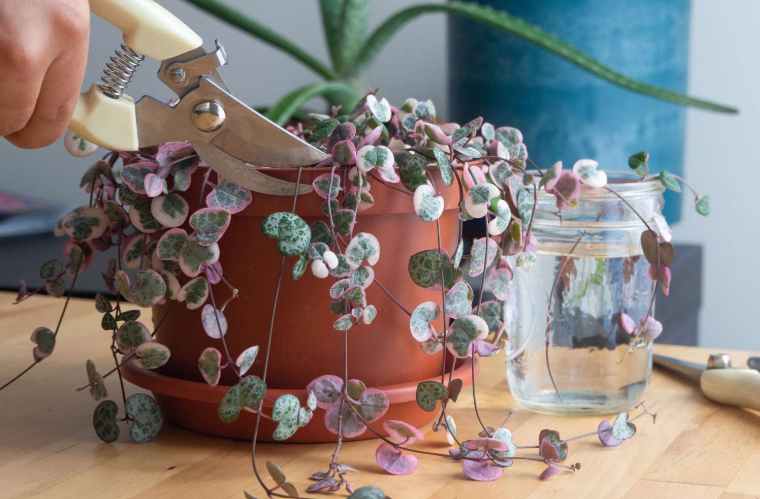
String of Hearts is one of the most charming and widely loved trailing houseplants in the world, producing long, wire-like purple stems strung with pairs of small, heart-shaped leaves that dangle elegantly from hanging baskets and shelf edges. Native to the rocky hillsides and scrubby woodland margins of South Africa, Zimbabwe, and Eswatini, it grows naturally as a semi-succulent trailing vine that scrambles over rocks and through low shrubs in warm, seasonally dry environments. Its extraordinary combination of delicate appearance and genuine drought tolerance has made it one of the most popular houseplants of the past decade.
The leaves are one of its most distinctive features, typically measuring half an inch to one inch across and displaying beautiful silver-green marbling on the upper surface and rich purple-pink on the undersides, with coloring most vivid in bright light. The trailing stems can reach an impressive 3 to 9 feet in length on well-established plants given adequate space to cascade freely. Several cultivated varieties exist including a highly sought-after variegated form with cream, pink, and green leaves that commands prices ten to twenty times higher than the standard green variety in the collector houseplant market.
String of Hearts produces small, tubular, pink to pale purple flowers with a distinctive dark purple, lantern-like base that appear intermittently along the stems during the warmer months. More horticulturally interesting are the small, round tubers called aerial corms that develop at the nodes along the stems and can be used for propagation by simply pressing them onto moist soil where they root readily. These aerial corms are a unique and fascinating feature that makes this plant exceptionally easy and rewarding to propagate compared to most other trailing houseplants.
The plant has built an enormous following across social media plant communities worldwide, regularly appearing among the most shared and saved plant images on Instagram and Pinterest globally. Demand for String of Hearts has increased dramatically over the past five years, and it is now widely stocked in mainstream garden centers, supermarket plant sections, and online nurseries across North America, Europe, Australia, and East Asia. The variegated form in particular has become one of the most discussed and coveted plants in the modern houseplant hobby.
String of Hearts belongs to the milkweed family and is classified as a semi-succulent rather than a true succulent, meaning it stores some water in its fleshy leaves and stems but requires more frequent watering than a true cactus. It prefers temperatures between 60°F and 80°F (16°C to 27°C) and is not frost-hardy, making it suitable for outdoor growing only in USDA zones 10 to 12. In all cooler zones it is grown exclusively as a houseplant or brought indoors before the first autumn frost.
String of Hearts is considered mildly toxic to dogs and cats if ingested in significant quantities, so careful placement in pet-owning households is advisable. It is a long-lived plant that becomes increasingly spectacular over time as the trailing stems lengthen and multiply into a genuinely breathtaking cascading display. For plant enthusiasts wanting a beautiful, relatively low-maintenance, visually distinctive trailing plant, String of Hearts is one of the very finest choices available in the entire houseplant world.
Also Read: How To Grow And Care For String of Hearts
How To Propagate String of Hearts
1. Understand the main propagation methods available.
String of Hearts can be propagated by four main methods — stem cuttings in water, stem cuttings in soil, aerial corm propagation, and the butterfly method — and all four are reliably successful when carried out correctly during the active growing season from spring through early summer. Each method has its own advantages in terms of speed, ease, and the number of new plants that can be produced from a single parent plant at one time. Understanding the differences between the methods before starting allows you to choose the approach best suited to your available materials, time, and propagation goals.
2. Propagate from stem cuttings in water.
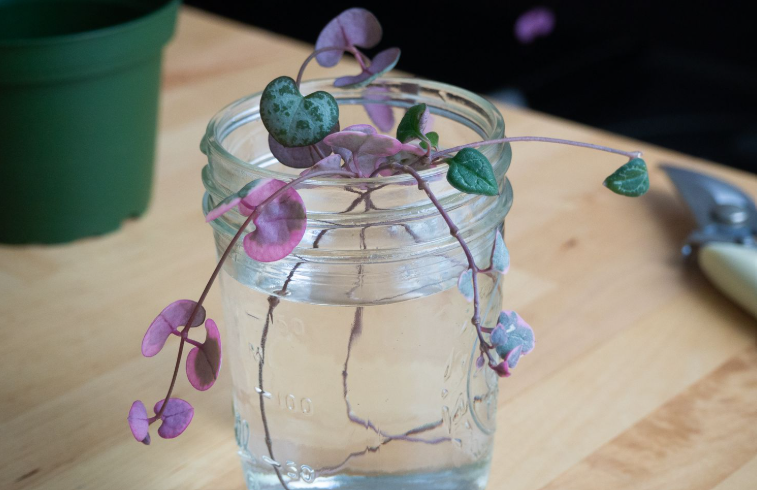
Water propagation is one of the simplest and most popular methods for String of Hearts, allowing you to watch root development in real time which is both practically useful and enormously satisfying. Take cuttings of 3 to 4 inches in length from healthy, actively growing stems, remove the bottom one or two pairs of leaves to expose a bare node, and place the cut end in a small glass or jar of room-temperature water ensuring the node is submerged but the leaves remain above the waterline. Place in a bright, warm position out of direct sun, change the water every three to four days to prevent bacterial buildup, and roots typically appear within two to four weeks before the rooted cutting is potted into fast-draining soil.
3. Propagate from stem cuttings directly in soil.
Soil propagation produces plants that transition immediately to their permanent growing medium without the adjustment period sometimes needed when moving water-rooted cuttings into soil. Take cuttings of 3 to 4 inches, remove the lower leaves to expose a node, allow the cut end to callous over for one to two hours in open air, then press the node end into moist, well-draining potting mix — ideally a cactus and succulent blend with added perlite — and position the cutting so the node is in contact with or just below the soil surface. Keep the soil very lightly moist and place in a warm, bright spot, and roots typically establish within three to five weeks.
4. Use the butterfly method for maximum efficiency.
The butterfly method is a particularly efficient propagation technique that produces the greatest number of new plants from the least amount of stem material and is ideal when propagating from a small or precious plant. Lay a long stem flat on a surface and cut it into individual sections, each containing one pair of leaves and the node between them — these individual sections resemble small butterflies when the pair of leaves is spread out, giving the method its name. Press each section flat onto the surface of moist potting mix with the node in contact with the soil, pin it gently in place with a bent wire or hairpin if needed, and keep the soil lightly moist in a warm, bright position until roots develop from the node and new growth emerges.
5. Propagate from aerial corms.
The aerial corms — small, round, pea to marble-sized tubers that form naturally at the nodes along the trailing stems — are one of the most unique and easiest propagation tools available for this plant. Remove a corm carefully from the stem, place it on the surface of moist, well-draining potting mix without burying it, and maintain the soil surface consistently but lightly moist in a warm, bright location. New shoots typically emerge from the corm within two to four weeks, and this method produces particularly vigorous new plants because the corm contains a significant energy reserve that fuels rapid early growth far beyond what a simple stem cutting can achieve.
Also Read: Houseplants That Like High Humidity
6. Leave corms attached to the stem for the easiest method of all.
An even simpler variation of corm propagation involves leaving the corm attached to its parent stem rather than removing it. Place a small pot of moist, fast-draining potting mix directly below a section of the parent plant’s trailing stem that carries a corm, press the corm gently onto the surface of the soil in the secondary pot while leaving it attached to the parent stem, and pin it in place if necessary. Once the corm has rooted into the new pot and produced visible new growth — typically within three to six weeks — the connecting stem can be cut to separate the new plant from its parent, producing a well-rooted young plant with minimal stress or risk.
7. Take propagation cuttings at the right time of year.
The most successful propagation results are consistently achieved during the active growing season of spring and early summer when the plant’s natural growth energy is highest and rooting hormones within the stem tissue are most active and concentrated. Propagation attempted during autumn and winter when the plant is largely dormant is significantly less reliable and much slower, often with lower success rates and longer waiting times for root development. If propagation outside the optimal season is necessary, providing additional warmth with a heat mat set to around 70°F to 75°F beneath the propagation container can meaningfully improve success rates.
8. Maintain the right conditions for rooting success.
Regardless of which propagation method is used, maintaining the right environmental conditions around the cuttings or corms during the rooting period dramatically improves success rates. The ideal rooting environment is warm — between 65°F and 75°F — bright with indirect light, and slightly humid around the cutting without being excessively wet at the root zone. Placing a clear plastic bag loosely over soil-rooted cuttings or a propagator lid over the tray creates a mini greenhouse effect that maintains gentle humidity and warmth around the cuttings, accelerating root development noticeably compared to leaving cuttings uncovered in typical room conditions.
9. Pot rooted cuttings correctly for healthy establishment.
Once cuttings or corms have developed visible roots of at least half an inch to one inch in length, they are ready to be potted into their first permanent container. Use a small pot — no larger than 2 to 3 inches in diameter for a single cutting — filled with fast-draining cactus and succulent mix or standard potting mix amended with perlite and horticultural grit. Pot multiple rooted cuttings into the same container together to create a fuller, more attractive young plant from the outset, as a single cutting in a small pot can look sparse and underwhelming for several months before it begins to trail meaningfully.
10. Plant multiple cuttings together for the best display.
The single most effective way to produce a full, lush, impressive String of Hearts display quickly from propagated material is to plant as many rooted cuttings as possible into the same hanging basket or pot simultaneously rather than growing individual cuttings in separate containers. A hanging basket planted with ten to fifteen rooted cuttings from the same parent plant will begin trailing attractively within one growing season, whereas a single cutting may take two or more years to achieve the same visual impact. Taking a large batch of cuttings at the start of the growing season, rooting them all together, and planting the entire batch into a single display container is the fastest and most rewarding approach to building a spectacular String of Hearts display from scratch.