Aralia plants are a diverse and visually striking group of ornamental trees, shrubs, and houseplants that have been prized in gardens and interiors around the world for centuries. Belonging to the broader family that also includes ginseng and ivy, aralias are native to a wide range of regions including Asia, the Pacific Islands, the Americas, and parts of Africa, with different species adapted to habitats ranging from tropical rainforests to temperate woodlands. With over 70 recognized species and a large number of cultivated varieties and hybrids, the aralia group offers an extraordinary range of forms — from bold, tropical specimen trees reaching 30 feet or more in their native habitat to compact, finely textured houseplants that stay under 18 inches indoors.
What makes aralias particularly appealing to gardeners and interior plant enthusiasts is the remarkable diversity of their foliage. Leaves range from enormous, deeply lobed, tropical paddles to delicate, finely divided, lacy fronds that more closely resemble a fern than a traditional broadleaf plant. Many varieties display rich combinations of green, gold, cream, white, and deep purple, and the texture of the foliage — whether glossy, matte, ruffled, or finely serrated — adds further visual complexity. Mature aralias frequently produce clusters of small white or greenish flowers followed by dark berries, though in cultivation they are grown almost exclusively for the spectacular ornamental quality of their foliage.
Aralias have been widely used in both landscape and interior design for decades. In tropical and subtropical outdoor gardens they serve as bold specimen trees, privacy hedges, and dramatic accent plantings, with some species capable of reaching 10 to 25 feet in outdoor cultivation. As houseplants, the most commonly grown varieties are valued for their tolerance of low light, their striking foliage textures, and their ability to grow into impressive indoor trees over time. The global ornamental plant trade includes several aralia varieties among the most popular large-scale foliage plants used in commercial interior landscaping.
Aralias prefer warm temperatures between 60°F and 85°F (16°C to 30°C) and do best in bright to moderate indirect light, well-draining potting mix, and moderate watering with good drainage to prevent root rot. Most species are sensitive to cold drafts and sudden temperature drops, which can trigger significant leaf drop even on otherwise healthy plants. Several parts of the aralia plant — particularly the roots, bark, and berries of certain species — contain compounds that are mildly toxic if ingested, so placement out of reach of children and pets is advisable. When given appropriate conditions, aralias are long-lived, architecturally impressive plants that reward patient growers with some of the most spectacular foliage displays available in the entire world of ornamental horticulture.
Types of Aralia Plants
1. Balfour Aralia
The Balfour Aralia is one of the most popular and widely grown aralia houseplants, producing round, scallop-edged, glossy, dark green leaves arranged in whorls along upright, cane-like stems that give the plant a clean, layered, architectural appearance. It typically grows to 4 to 6 feet indoors as a potted specimen, making it an excellent medium to large floor plant for living rooms, offices, and hotel lobbies. A variegated form with cream and green marbled leaves is also widely available and equally popular in the indoor plant trade.
2. Variegated Balfour Aralia
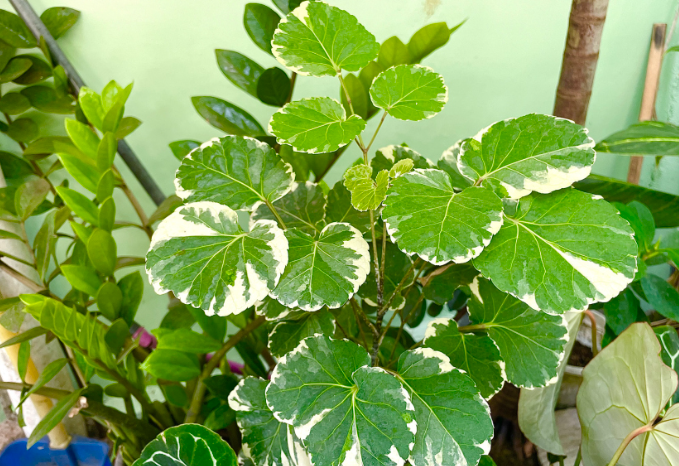
The Variegated Balfour Aralia carries the same round, scallop-edged leaves as the standard green form but with striking irregular patches and marbling of cream, white, and pale green against the darker green background, creating a brighter and more colorful effect. It grows to 3 to 5 feet indoors and the variegated foliage is most vivid in bright indirect light, sometimes reverting toward more green in very low light conditions. It is one of the most elegant and widely sold variegated foliage plants in the large-scale indoor plant category.
3. Ming Aralia
The Ming Aralia is one of the most refined and delicate-looking of all aralia types, producing tiny, finely divided, feathery, dark green to bright green leaflets on gracefully twisted, gnarled stems that give mature plants an appearance closely resembling a miniature bonsai tree. Indoors it typically grows to 4 to 6 feet in height, though very old specimens can reach 8 feet, and the intricate, lacy texture of the foliage makes it one of the most visually complex houseplants available. It is widely used by interior designers as a statement plant for upscale residential and commercial spaces.
4. Dwarf Ming Aralia
The Dwarf Ming Aralia is a compact, slower-growing form of the standard Ming that stays considerably smaller, typically reaching only 18 to 36 inches in height indoors, making it suitable for tabletop display, shelves, and smaller spaces where the full-sized Ming would quickly outgrow its position. Despite its smaller stature it produces the same finely divided, feathery foliage and characteristically gnarled stems that make the Ming group so distinctive. It is popular as a bonsai subject and as a refined desktop accent plant in office and home environments.
5. Elegantissima Aralia
The Elegantissima, sometimes called the False Aralia or Threadleaf Aralia, is a strikingly unusual houseplant with very narrow, deeply serrated, copper-toned to dark bronze-green leaves on upright, slender stems that give the plant a dramatic, almost Gothic appearance quite unlike any other commonly grown indoor plant. It typically grows to 4 to 6 feet indoors and the dark, coppery tones of the juvenile foliage are among the most unusual and striking color combinations in the houseplant world. As the plant matures the leaves broaden and green somewhat, but the deeply serrated, dark-toned foliage remains highly ornamental.
6. Geisha Girl Aralia
The Geisha Girl is a cultivar of the Balfour aralia group with particularly round, deep green, wavy-edged leaves that have a more pronounced scalloping around the leaf margin than the standard Balfour form, giving the foliage a more ruffled, decorative quality. It grows to 3 to 5 feet indoors and maintains a well-branched, symmetrical habit that gives mature plants a full, lush appearance. It is a popular choice for indoor display in contemporary and tropical-themed interiors.
7. Japanese Aralia
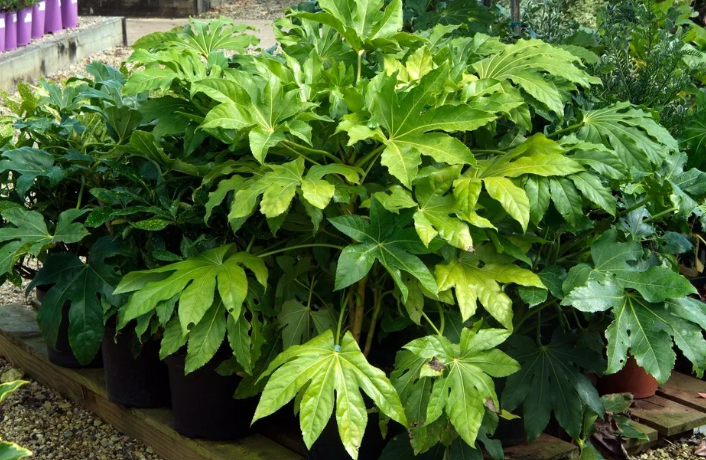
The Japanese Aralia is a bold, large-leafed species producing enormous, deeply lobed, hand-shaped leaves that can reach 12 to 16 inches across on a plant that grows to 6 to 10 feet outdoors and 4 to 6 feet indoors. The leaves are thick, deeply glossy, and a rich, saturated dark green that gives the plant a dramatic, tropical presence entirely out of proportion to the relatively temperate climate it tolerates. It is one of the most cold-hardy aralia species, surviving outdoors in USDA zones 8 to 11, and is widely planted as an architectural garden specimen in mild-climate regions.
8. Variegated Japanese Aralia
The Variegated Japanese Aralia produces the same enormous, deeply lobed, hand-shaped leaves as the standard form but with bold cream to white margins running around the outer edge of each leaf, creating a dramatic two-tone effect on already impressively large foliage. Grown outdoors it can reach 6 to 10 feet in mild climates, while indoor specimens typically stay at 4 to 6 feet. The combination of very large leaf size and strong white marginal variegation makes it one of the most visually impactful variegated foliage plants available for large indoor or sheltered outdoor spaces.
9. Chicken Gizzard Aralia
The Chicken Gizzard Aralia is an unusually textured variety with thick, deeply puckered, irregularly shaped, dark green leaves that have a crinkled, almost topographic surface quality that distinguishes it immediately from the smooth or finely divided foliage of most other aralia types. It grows to 3 to 5 feet indoors and the heavily textured leaves create an interesting tactile and visual contrast when displayed alongside smoother-leafed plants. It is found primarily in specialist tropical plant nurseries and collector circles.
10. Gold Splash Aralia
Gold Splash is a bright, colorful cultivar producing leaves heavily splashed and mottled with vivid golden-yellow against a rich green background, creating one of the most vivid and eye-catching foliage displays in the aralia group. It grows to 3 to 5 feet indoors and the golden splashing is most intense and saturated in bright indirect light, making placement near a well-lit window highly desirable for maximum color impact. It is a popular choice in contemporary interior plant design where a bold, colorful foliage accent is required.
11. Snowflake Aralia
The Snowflake Aralia is a charming, compact cultivar with small, rounded, scallop-edged leaves in deep green irregularly edged and speckled with white, giving the foliage a light, snowy appearance that inspired its evocative name. It typically stays compact at 2 to 4 feet indoors, making it a versatile plant for shelves, tabletops, and smaller spaces where larger aralia varieties would be impractical. The white speckling and edging is most vivid and well-defined in bright indirect light.
12. Fabian Aralia
The Fabian Aralia is a dramatic, upright-growing variety with large, round, deep burgundy-purple to dark green leaves arranged in distinct tiers along sturdy, upright stems, creating a bold, layered, sculptural silhouette that has made it one of the most popular large aralia houseplants in the contemporary market. It grows to 4 to 6 feet indoors and the deep, moody coloring of the foliage — particularly vivid on younger leaves — suits modern, minimalist, and dark-toned interior design aesthetics exceptionally well. It is widely available and has become a staple in upscale plant retail over the past decade.
13. Dizzy Aralia
Dizzy is a highly variegated cultivar with large, deeply lobed leaves boldly patterned in a complex mix of green, cream, yellow, and pink tones that shift and blend across the leaf surface in an irregular, swirling pattern that earns the plant its dizzy name. It grows to 3 to 5 feet indoors and is one of the most colorful and visually complex aralia cultivars available, delivering multi-color foliage interest without requiring flowers or fruit. The pink tones are most vivid in bright indirect light and may fade toward cream in lower light.
14. Dinner Plate Aralia
The Dinner Plate Aralia is aptly named for its exceptionally large, round, flat, glossy, dark green leaves that can reach 8 to 12 inches across individually, giving the plant a bold, generous, tropical presence. It grows to 4 to 6 feet indoors as an upright, well-branched specimen and the sheer size and clean, circular form of the individual leaves creates a visually satisfying, organized display. It is a popular choice for large lobbies, open-plan offices, and spacious living rooms where a statement floor plant is required.
15. White Aralia
The White Aralia is a variegated form with round to slightly lobed, green leaves generously edged and marked with white to cream, creating a bright, clean, high-contrast foliage display that lightens and brightens any indoor space. It grows to 3 to 5 feet indoors and maintains a relatively compact, well-branched habit that makes it practical for a range of indoor positions. The white markings are clean, consistent, and evenly distributed across most leaves, giving the plant a more uniform appearance than the irregular splashing of some other variegated types.
16. Celery Leaf Aralia
The Celery Leaf Aralia produces deeply divided, finely cut, bright to mid-green leaves that genuinely resemble the flat-leaf variety of celery or a flat-leafed parsley in overall form, giving the plant a fresh, herbal quality quite unlike the rounder or more tropical-looking aralia types. It grows to 3 to 5 feet indoors and the finely divided foliage creates a soft, airy texture that contrasts effectively with bolder, broader-leafed houseplants in mixed indoor displays. It is a refreshing and underused aralia type that deserves wider cultivation.
17. Stump Aralia
The Stump Aralia, also called the Wild Coffee or Coffee Aralia in some regions, is a slow-growing species that develops a distinctive, thick, gnarled trunk or base over time, giving old specimens a naturally bonsai-like, tree-form appearance that takes decades to develop but is extraordinarily impressive in mature plants. It grows to 3 to 6 feet indoors over many years and the rugged, sculptural trunk character combined with fine, divided foliage makes it one of the most architecturally interesting long-term aralia houseplants. It is particularly popular among enthusiasts of bonsai-style indoor trees.
18. Threadleaf Aralia
The Threadleaf Aralia produces extremely narrow, elongated, deeply serrated, almost strap-like leaflets in rich, dark bronze-green to near-black tones on an upright, sparsely branched plant that typically grows to 4 to 6 feet indoors. The thread-like quality of the very narrow leaflets gives the plant an almost architectural, graphic quality quite unlike the broader-leafed varieties, and the very dark, near-black coloring of the foliage makes it one of the most dramatically dark-toned aralia types. It is often used as a vertical accent plant in contemporary interior plant arrangements.
19. Aralia Sun King
Sun King is a large, bold cultivar with enormous, deeply lobed, hand-shaped leaves in a warm, golden-yellow to chartreuse tone that gives the whole plant a vivid, luminous quality unlike most other large-leafed aralia types. Outdoors in mild climates it reaches 4 to 6 feet in height with a similar spread, while indoor specimens typically stay at 3 to 5 feet. The bold, warm yellow foliage is most vivid in bright indirect to partial outdoor light and makes it one of the most striking golden-leaved large-foliage plants available in the ornamental plant trade.
20. Black Aralia
The Black Aralia is a dramatic, upright variety with deeply lobed, hand-shaped leaves in an exceptionally deep, rich, near-black to very dark burgundy-green tone that is among the darkest foliage colors of any commonly cultivated ornamental plant. It grows to 4 to 6 feet indoors and the moody, intense coloring of the foliage creates a powerful visual impact in contemporary, industrial, and dark-palette interior design schemes. The near-black leaves are most deeply colored on newer growth and develop slight green undertones as they fully mature.
21. Aralia Quinquefolia
This species produces distinctive, palm-like compound leaves divided into five separate, elongated, lance-shaped leaflets that radiate from a central point like the fingers of an open hand, creating a clean, graphic leaf structure quite different from the lobed or rounded forms of most aralia types. It grows to 3 to 5 feet indoors with an open, airy branching habit and the five-fingered leaf form gives it a naturalistic, woodland quality. It is found primarily in specialist botanical collections and herb-focused plant nurseries.
22. Aralia Laciniata
Aralia Laciniata is a deeply cut, finely divided cultivar with lacy, intricately lobed leaves that are significantly more finely divided than those of most standard aralia varieties, creating a foliage texture closer to a large, bold fern than a typical broadleaf plant. It grows to 3 to 5 feet indoors and the finely cut, lacy leaf form creates an extraordinary soft-textured foliage display that contrasts dramatically with broader-leafed plants in mixed arrangements. It is an underappreciated cultivar of considerable ornamental merit.
23. Aralia Guilfoylei
Aralia Guilfoylei is a species producing large, boldly compound leaves divided into broad, oval to lance-shaped leaflets with strongly serrated margins on a plant that grows to 6 to 15 feet in tropical outdoor cultivation and 4 to 6 feet indoors. Several variegated and colored-margin forms have been developed including varieties with white-edged, yellow-edged, and cream-margined leaflets that are widely grown as ornamental shrubs across tropical and subtropical regions. It is one of the more commonly grown outdoor aralia species in tropical garden landscapes.
24. Aralia Spinosa
The Devil’s Walking Stick is a native North American aralia species that produces enormous, doubly compound leaves that can reach 3 to 4 feet in length — among the largest leaves of any temperate-climate plant in North America — on a large, upright, tree-like shrub that grows to 10 to 20 feet outdoors. The stems are covered in sharp spines that give the plant its common name and make it an imposing, impenetrable screening or specimen plant for large outdoor gardens. In late summer it produces massive clusters of small white flowers followed by dark purple berries that are highly attractive to birds.
25. Aralia Elata
The Japanese Angelica Tree is a large, deciduous, tree-like species native to northeastern Asia that produces enormous, doubly compound leaves reaching 2 to 4 feet in length that create an exceptionally bold, tropical-looking foliage display on a plant that is surprisingly cold-hardy, surviving in USDA zones 3 to 9. It grows to 15 to 30 feet outdoors but is also grown in large containers and as a bold landscape specimen where its extraordinary leaf size creates maximum visual impact. Variegated forms with cream or yellow leaf margins are among the most spectacular of all hardy variegated trees.
26. Aralia Cordata
Aralia Cordata, sometimes called the Udo, is a large, herbaceous perennial species from Japan and China that dies back to the ground each winter and re-emerges each spring with enormous, boldly compound leaves on thick, succulent stems reaching 4 to 8 feet in height during the growing season. The young shoots are a traditional edible vegetable in Japan, where blanched shoots are eaten as a spring delicacy, and the plant is grown both as an ornamental and as a food crop. A golden-leafed form called Sun King produces vivid chartreuse-yellow foliage and is widely grown as an ornamental garden perennial.
27. Aralia Nudicaulis
Wild Sarsaparilla is a low-growing, native North American woodland aralia species that spreads by underground rhizomes to form colonies of compound, three-part leaves on slender stems that rise to only 12 to 20 inches in height. It grows in shaded woodland environments and produces small clusters of greenish-white flowers followed by dark purple berries, and the roots have a traditional history of use as a flavoring agent and herbal remedy across indigenous North American cultures. It is primarily a botanical and ecological species of interest rather than a mainstream ornamental plant.
28. Aralia Racemosa
American Spikenard is a large, bold, herbaceous perennial aralia native to eastern North America with enormous, compound, tropical-looking leaves on arching stems reaching 3 to 6 feet in height. It produces long, branching flower spikes followed by clusters of dark red to near-black berries that are highly ornamental in late summer and autumn, and the aromatic roots have a long history of use in traditional North American herbal medicine. It is an increasingly popular choice for naturalistic garden plantings and shade gardens where its dramatic leaf size creates an impressive tropical effect.
29. Aralia Stipulata
Aralia Stipulata is an Asian aralia species that produces large, bold compound leaves with broad, oval leaflets on a tree-like shrub that grows to 6 to 15 feet in its native habitat of mountain forests in China and the Himalayas. It produces large clusters of white flowers in summer followed by ornamental dark berries and is grown as a bold garden specimen in mild-temperate to subtropical climates. It is primarily found in specialist botanical garden collections in temperate regions outside its native range.
30. Aralia Californica
Elk Clover is a large, bold, native Californian aralia species found naturally in shaded, moist forest environments along the Pacific Coast, producing enormous compound leaves on thick, succulent stems reaching 4 to 8 feet in height during the growing season before dying back in winter. The large, tropical-looking foliage and the ability to grow in deep shade make it one of the most impressive large native perennials for shaded West Coast gardens, where it creates a lush, jungle-like understory effect. It produces clusters of small white flowers followed by dark berries and is of significant ecological value to native wildlife.