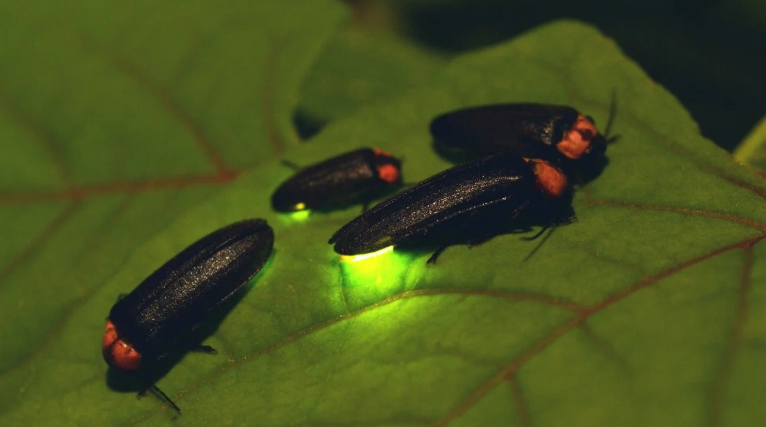
Among the approximately 400,000 known species of beetles, a small but extraordinary group has evolved the ability to produce bioluminescent light — making them among the most fascinating insects on Earth. Glowing beetles are found across three distinct families: Lampyridae (fireflies and glow-worms), Phengodidae (railroad worms and glowworm beetles), and Elateridae (click beetles of the tribe Pyrophorini). Scientists estimate there are roughly 2,200 species of luminescent beetles worldwide, with the greatest diversity found in tropical regions of the Americas, Southeast Asia, and the Indo-Pacific.
The bioluminescent reaction in glowing beetles is a masterpiece of biochemical engineering. Light is produced when an enzyme called luciferase catalyzes the oxidation of a compound called luciferin in the presence of oxygen and ATP, releasing energy almost entirely as visible light with virtually no heat — an efficiency of close to 100% that no human-made light source has ever matched. The color of beetle bioluminescence ranges from deep red through orange and yellow to blue-green, and in some species different parts of the body simultaneously glow in different colors — a multi-channel light display produced by subtle variations in the chemical environment of the light organs.
Glowing beetles face serious and accelerating threats globally, with studies indicating population declines of 30–50% or more in many species over the past two decades. Light pollution is now identified as the primary driver of firefly decline, as artificial light at night masks the flash signals beetles use to find mates, effectively silencing their entire communication system. Habitat loss, pesticide use, and climate change compound these pressures, and the International Union for Conservation of Nature now lists several firefly species as vulnerable or endangered — a sobering reminder that even insects capable of lighting up the night can be quietly extinguished by human activity.
Beetles That Glow at Night
1. Common Eastern Firefly (Photinus pyralis)
The common eastern firefly is the most familiar and abundant glowing beetle in North America, lighting up gardens, meadows, and woodland edges across the eastern United States and Canada on warm summer evenings from June through August. Males fly in characteristic J-shaped arcs, producing a half-second yellow-green flash approximately every six seconds, while females perched in vegetation respond with a precisely timed answering flash to guide males toward them. The luciferase enzyme extracted from this species was the first to be cloned and expressed in another organism in 1986, launching an entire field of genetic reporter technology that has since become indispensable in medical research, drug development, and cancer diagnostics worldwide.
2. Synchronous Firefly (Photinus carolinus)
The synchronous firefly is one of only a handful of firefly species in the world capable of synchronizing their flashes across large populations, and the only species in North America to do so with consistent, large-scale precision. On peak nights in late May and early June in the Great Smoky Mountains, thousands of males flash simultaneously in rhythmic bursts of five to eight pulses, then pause together in darkness before the next synchronized wave — a display so extraordinary that a lottery system was introduced to manage the crowds of visitors seeking to witness it. The mechanism of synchronization involves each male adjusting its internal flash oscillator in response to neighboring males, a process mathematically similar to the synchronization of coupled pendulums.
3. Blue Ghost Firefly (Phausis reticulata)
The blue ghost firefly of the southern Appalachian Mountains is among the most ethereally beautiful of all glowing beetles, with males producing a continuous, unwavering glow of pale blue-white light as they drift slowly and silently just above the forest floor on warm late spring nights. Unlike the flashing species, the blue ghost’s steady light means that on a good night the forest floor appears to be drifting with dozens of floating blue embers moving in slow, dreamlike arcs among the trees. Females are entirely wingless and glow from the leaf litter below, making the dark forest floor appear simultaneously lit from above by drifting males and below by stationary females.
4. Big Dipper Firefly (Photinus pyralis)
The name “big dipper” is applied to Photinus pyralis to describe the distinctive downward dipping arc of the male’s flight path as it delivers its flash — a motion that traces a shape resembling the Big Dipper constellation against the summer darkness. This species was central to the pioneering bioluminescence research of American biochemist William McElroy in the 1940s and 1950s, who first characterized the luciferin-luciferase reaction by collecting thousands of firefly lanterns by hand and grinding them for biochemical analysis. Today the same reaction, reconstructed in laboratory conditions, is used in everything from food safety testing to detecting bacterial contamination in hospital environments.
5. Pennsylvania Firefly (Photuris pennsylvanica)
The Pennsylvania firefly is a large, long-legged North American glowing beetle and one of the most behaviorally sophisticated — females are predatory mimics that imitate the flash responses of smaller Photinus firefly females to lure their males, then catch and eat them rather than mate. By consuming Photinus males, the females acquire lucibufagins — toxic steroidal compounds that Photinus beetles produce as chemical defenses — and incorporate them into their own body tissues, gaining chemical protection against spider predators that they cannot manufacture themselves. This extraordinary chain of chemical theft, from plant to Photinus to Photuris, is one of the most complex examples of predatory chemical ecology known in any insect group.
6. European Glow-worm (Lampyris noctiluca)
The European glow-worm is a firefly beetle native to Europe and temperate Asia in which it is the wingless, slug-like female that glows — producing a steady, bright green light from the underside of the tip of her abdomen as she perches on grass stems and low plants on warm summer nights to attract flying males. The male, by contrast, is a typical-looking winged beetle with large eyes adapted for detecting the female’s glow from the air, but produces no light of his own. UK populations have declined by an estimated 75% over the past 25 years, with surveys by the UK Glow Worm Survey recording consistent year-on-year losses attributed to light pollution, rough grassland loss, and the decline of snail populations on which the carnivorous larvae feed.
7. Lesser Glow-worm (Phosphaenus hemipterus)
The lesser glow-worm is a small and relatively little-known European firefly beetle in which both males and females are flightless — an unusual situation among fireflies where it is typically only females that lack wings. Males produce a faint glow and use pheromone signals rather than light to locate females at night, while females glow weakly from sheltered positions on the ground among leaf litter and low vegetation. Because it relies more on chemical than light communication, the lesser glow-worm is considered less vulnerable to light pollution than species that depend entirely on flash signaling, though habitat loss remains a significant threat.
8. Headlight Elater (Pyrophorus noctilucus)
The headlight elater is a large click beetle of tropical Central and South America that produces a continuous green bioluminescent glow from two prominent oval light organs set into the pronotum — the shield behind the head — giving the beetle the appearance of a miniature vehicle approaching in darkness. A third, brighter light organ located on the underside of the abdomen activates only during flight, functioning as a signal visible from below as the beetle flies. Historical accounts from the colonial Caribbean describe Indigenous people and colonists collecting these beetles in small perforated gourds or cages and using their combined glow as natural lanterns to light paths and workspaces at night.
9. Firefly Click Beetle (Ignelater luminosus)
Ignelater luminosus is a bioluminescent click beetle of the Caribbean — found in Puerto Rico, Cuba, Hispaniola, and neighboring islands — that glows continuously from paired pronotal light organs and produces a bright flash of green light from an abdominal organ during flight. It inhabits humid tropical forest and is most active on dark, overcast nights when males fly slowly through the understory searching for the stationary, glowing females. Unlike fireflies, the light organs of Pyrophorini click beetles like Ignelater are thought to serve multiple functions simultaneously — mate attraction, predator deterrence, and possibly species recognition — though the relative importance of each function remains an active area of research.
10. Railroad Worm Beetle (Phrixothrix hirtus)
The railroad worm is the wingless adult female of a South American glowworm beetle in the family Phengodidae, and it produces one of the most spectacular bioluminescent displays of any insect on Earth — glowing simultaneously in two different colors, with paired green light organs along each body segment and a single red light organ on the head. The two-color display, seen on the forest floor of South American rainforests, creates the impression of an illuminated train moving through the darkness — the source of the species’ memorable common name. Red bioluminescence is extraordinarily rare in nature, and the biochemical mechanism producing the red headlight of the railroad worm — involving a modified luciferase enzyme — has been the subject of intense scientific interest for its potential applications in deep-tissue medical imaging.
11. Glowworm Beetle (Phengodes plumosa)
Phengodes plumosa is a North American glowworm beetle in the family Phengodidae whose wingless, larviform females glow from multiple paired light organs along the sides of their segmented bodies, producing a soft greenish bioluminescence visible on the forest floor on warm nights. Males are winged, short-lived, and far less conspicuous, with feathery, comb-like antennae used to detect the pheromones released by females — an unusually large role for chemical signaling compared to the light-dominant communication of fireflies. The predatory larvae of Phengodes are specialized hunters of millipedes and are themselves faintly bioluminescent, making this the only beetle genus in which multiple life stages glow.
12. Windowpane Firefly (Pyractomena borealis)
The windowpane firefly is an early-season North American species, one of the first fireflies to emerge each spring — sometimes appearing as early as April in the southern United States — when temperatures are still cool and other firefly species have not yet emerged. Males produce a distinctive amber-orange flash while flying high in the tree canopy, earning the species an alternative name of “spring firefly” and making it visually distinctive from the lower-flying, yellow-green species that dominate summer displays. Its early emergence and canopy-level flashing behavior mean it is easily overlooked by observers focused on the more familiar summer species flashing at eye level.
13. Snappy Firefly (Photinus scintillans)
The snappy firefly is a small North American species recognized by the rapid, repeated double-flash that males produce in quick succession as they fly at dusk just above ground level in open fields, meadows, and forest edges. The double flash is precisely timed and species-specific, allowing females to distinguish males of their own species from the dozens of other firefly species that may be flying simultaneously in the same habitat on summer evenings. Like most Photinus species, adults do not feed during their brief adult lives of one to three weeks, surviving entirely on fat reserves accumulated during the larval stage.
14. Trilobite Beetle (Duliticola hoiseni)
The female trilobite beetle of Southeast Asian rainforests is a mysterious and rarely encountered insect that retains a flattened, heavily armored, larva-like appearance as an adult — a form of neoteny — and produces a faint bioluminescent glow from its segmented body on the rainforest floor. So different are the males and females that they were described as entirely separate species when first discovered in the 19th century, and the full life cycle of the species remains incompletely documented even today. The function of the female’s glow is presumed to be mate attraction, but the cryptic habits, extreme rarity of observations, and dense rainforest habitat of this species make behavioral studies exceptionally difficult.
15. Winter Firefly (Ellychnia corrusca)
The winter firefly is a fascinating exception among North American glowing beetles — adults are entirely non-luminescent, communicating through pheromones rather than light, yet they belong to the firefly family Lampyridae and their larvae glow faintly in the soil. Adults emerge in late autumn and are active through winter and early spring, sometimes visible crawling on snow-dusted tree bark on mild days — making them one of the very few insects active as adults in freezing temperatures. Their existence challenges the popular perception of fireflies as exclusively warm-weather, light-flashing insects and points to the remarkable diversity of life history strategies that have evolved within this single beetle family.
16. Cliff Firefly (Pteroptyx tener)
The cliff firefly is a small Southeast Asian firefly beetle renowned for the spectacular mass-synchronizing flash displays produced by thousands of males gathering in mangrove and riverside trees along rivers in Malaysia, Thailand, Indonesia, and Borneo on clear nights throughout the year. Entire trees pulsate with perfectly synchronized green flashes, the rhythm maintained without any single individual leading — an emergent property of thousands of beetles each adjusting their flash timing in response to their immediate neighbors. The riverside trees that serve as traditional display sites are highly specific and faithfully returned to night after night and year after year, making riverbank habitat conservation critical to the survival of this iconic species.
17. Japanese Firefly (Aquatica lateralis)
The Japanese firefly is the most culturally significant glowing beetle in Asia, celebrated in Japanese poetry, painting, and seasonal tradition for over a thousand years as an emblem of summer, longing, and the fleeting beauty of life. Its larvae are aquatic predators of freshwater snails in clean, cool, unpolluted streams, and the presence or absence of this species is used as a direct biological indicator of river water quality in Japan. Mass emergence events each June draw participants to traditional firefly-viewing parties — hotaru-gari — in rural Japan, and civic restoration of clean waterways specifically to restore local firefly populations has become a cultural and environmental priority in many Japanese communities.
18. Luminous Click Beetle (Pyrophorus divergens)
Pyrophorus divergens is a tropical American luminescent click beetle closely related to the headlight elater, found across the humid lowland forests of South America where males fly on warm nights producing a bright, steady green glow from their paired pronotal light organs. Like other members of the Pyrophorini tribe, this species maintains its glow continuously rather than flashing, and the light is bright enough to be clearly visible from several meters away in total darkness. The biochemistry of Pyrophorini click beetle bioluminescence differs subtly from that of fireflies — despite using the same luciferin-luciferase system — and these differences have been exploited by researchers developing improved bioluminescent reporter systems for biomedical imaging.
19. Seashore Firefly (Lamprohiza splendidula)
The European shining firefly Lamprohiza splendidula is a glow-worm relative found across central and eastern Europe in which both the wingless female and — unusually — the winged male produce bioluminescent light, though of different intensities. Males emit a weak, continuous glow during flight from a light organ beneath their transparent elytra, while females produce a brighter steady glow from abdominal segments to guide males toward them on the ground. This species favors damp meadows, woodland clearings, and riverbanks, and has declined significantly across much of its European range due to the drainage of wet grassland habitats and increasing suburban light pollution.
21. Pteroptyx Firefly (Pteroptyx malaccae)
Pteroptyx malaccae is a Malaysian synchronizing firefly species closely related to the famous cliff firefly, found along forested tidal rivers and mangrove creeks of peninsular Malaysia and Sumatra where males gather in display trees to produce coordinated, rhythmic green flashes throughout the night. This species is the focus of significant conservation concern due to the widespread clearance of mangrove forest along Malaysian and Sumatran coastlines for aquaculture, agriculture, and coastal development — removing not only the beetles’ display trees but the entire riverine mangrove ecosystem on which their life cycle depends. Ecotourism operations centered on this and related synchronizing firefly species have become important economic incentives for mangrove conservation along several Malaysian rivers, directly linking the survival of glowing beetles to the livelihoods of local communities.