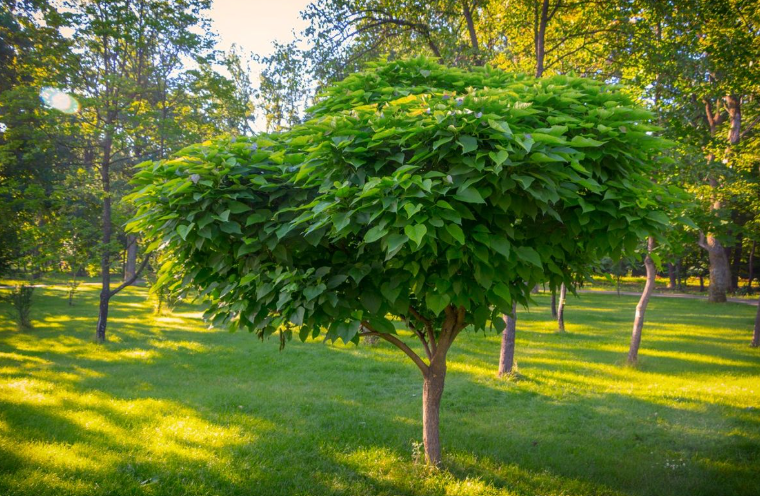
The catalpa tree is a group of deciduous flowering trees known for huge heart-shaped leaves, showy trumpet-like flowers, and long bean-like seed pods. Botanical authorities such as Kew accept 8 species, spread across 3 regions: the central and eastern United States, the Caribbean, and China. Only 2 species are native to North America, and each has a surprisingly small native range.
A mature northern catalpa typically stands 40 to 60 feet tall, according to Iowa State University, and grows about 15 feet in 7 to 8 years. Its bell-shaped flowers are about 2 inches long, and its seed pods can reach 12 to 22 inches in length, according to the Missouri Botanical Garden. The northern species is hardy in USDA zones 4 to 8, and in Nebraska’s drier climate it can live up to 150 years.
Catalpas also vary in how fast they mature. Most begin flowering after roughly 3 years and fruit after about 5 years, but Haitian catalpa can flower after just 6 months from seed and produce seed after 18 months. The genus is ancient too, and a fossil species preserved in Dominican amber shows that catalpas had reached the Caribbean by the Miocene.
This guide covers 16 types of catalpa trees, including the accepted species, the main hybrids, and the best-documented cultivars. Cornell University’s Woody Plants Database and Utah State University’s TreeBrowser both list ‘Aurea’, ‘Koehnei’, ‘Nana’, ‘Pulverulenta’, ‘Purpurea’, and ‘Variegata’ as cultivars, and Cornell adds that both the species and its cultivars are rare in the trade.
Northern Catalpa
Northern catalpa, also called hardy catalpa, western catalpa, and cigar tree, is native to a small area around the confluence of the Mississippi and Ohio Rivers, according to the University of Minnesota, but it has since spread from Maine to Texas. It is generally considered the hardier and finer of the two North American species, and settlers learned of its extra cold tolerance after the exceptionally hard winters of 1855 and 1856.
The Missouri Botanical Garden describes white flowers with purple and yellow spotting that open in late May to early June in St. Louis, followed by abundant pods every 2 to 3 years. The leaves of this species do not give off the unpleasant smell that southern catalpa’s bruised leaves do, which is one of the easiest ways to tell them apart.
Southern Catalpa
Southern catalpa, also called common catalpa and Indian bean tree, is native to a small area of the Southeast that includes central Mississippi, Alabama, and south Georgia through Florida. It is squatter than its northern cousin, with bark that flakes off in scales and more flowers that are slightly smaller and open a few weeks later.
Its bruised leaves give off an unpleasant smell, and Yale’s Nature Walk notes that it is susceptible to verticillium wilt, leaf spots, mildew, dieback, and blight. The International Dendrology Society’s Trees and Shrubs Online adds that the two American species may be the ends of a continuum, with “possibly only one biological species,” although in practice they are universally recognized as two.
Chinese Catalpa
Chinese catalpa, also called yellow catalpa, is native to China and is planted outside its natural range as an ornamental for its pale yellow flowers. It is one of the parents of the hybrid catalpas described below, and it is generally described as blooming later, with smaller blossoms, than the native American species.
Its main importance in gardens is as a parent, since crossing it with southern catalpa produced a hybrid that has become a cultivated ornamental in its own right. The species is known to cross with southern catalpa, so seedlings from trees growing near each other may not come true to type.
Manchurian Catalpa
Manchurian catalpa is native to China and is cultivated there both as an ornamental and for its wood. It is a much smaller tree than the American species, and one wholesale nursery lists it at 24 to 30 feet tall and about 10 feet wide, hardy in zone 6, with fragrant white flowers.
A 2017 taxonomic revision of the genus merged several Chinese names into this species, including the Chinese bean tree and a former Tibetan species. That is why nurseries sometimes sell what is essentially the same tree under different names.
Chinese Bean Tree
Chinese bean tree is native to China and produces pink blossoms in spring, and it is described as thriving in full or part sun and in poor or fertile soil. Some authorities, including Kew, treat it as part of Manchurian catalpa, so it may be sold under either name.
The Cambridge University Botanic Garden grows it in its collection. If you are shopping for pink-flowered catalpa, it is worth asking the seller which name and origin the tree is sold under, since the naming is inconsistent.
Haitian Catalpa
Haitian catalpa is one of 4 tropical Caribbean species in the genus, and it is remarkable for how fast it matures. It can flower after 6 months of growth from seed and produce seed after 18 months, compared with about 3 and 5 years for most catalpas.
As a tropical species, it would be expected to need a frost-free climate, so it is mostly a curiosity for gardeners in cold regions. Beyond its fast flowering, little has been written about it for home gardeners.
Cuban and Hispaniolan Dry-Forest Catalpa
This small tree has no widely used common name, and it is native to Cuba, the Dominican Republic, and Haiti. In Cuba it grows in the hilly Baire area north of the Sierra Maestra and on the coastal Cabo Cruz, in the Dominican Republic in Azua Province, and in Haiti in the Massif de la Hotte.
It grows in dry, limestone-soil forests and has been listed as vulnerable by the International Union for Conservation of Nature. That assessment dates from 1998, so its current status may differ, but it is a reminder that some catalpas are rare, localized trees and not the roadside giants familiar in North America.
Other Caribbean Catalpas
Two further tropical Caribbean species complete the group of 4 in the genus’s tropical section. They are among the least documented catalpas, and neither has a widely used common name in English.
A 2017 taxonomic revision of the genus by Olsen and Kirkbride is the main modern reference for them. There is little sign that either species is sold commercially, so they are best thought of as botanical rarities.
Hispaniolan Amber Catalpa
This is an extinct catalpa, known only from a fossil preserved in Dominican amber. It shows that the genus had reached the Caribbean by the Miocene, a period that ended more than 5 million years ago.
The genus is thought to have originated in North America, so the amber fossil is evidence that catalpas spread widely long before people planted them. It hints that the catalpas of the Caribbean have a long history on the islands.
Hybrid Catalpa
Hybrid catalpa is a cross between southern catalpa from the United States and Chinese catalpa from China. It is a medium-sized tree that reaches at most about 20 meters, or 65 feet, and it has become a cultivated ornamental in its own right.
Two of its best-known selections, ‘J.C. Teas’ and the purple-leaved ‘Purpurea,’ are described below. It is worth considering as an alternative to the pure American species when you want something a little different.
J.C. Teas Hybrid Catalpa
‘J.C. Teas’ is one of the best-known hybrid catalpas, and it is named for J.C. Teas of Bayville, Indiana, who grew the tree. Teas thought it was probably a northern catalpa, but a botanist named Dode used his plant as the type for a new hybrid name in 1907. An 1900 nursery catalog listed it as ‘Teas’ Japan Hybrid.’
It can become a very large tree, and the UK champion at Chilham Castle in Kent has a trunk 1.5 meters thick. It is a good example of how an American nursery selection ended up as a landmark tree in Britain.
Purple Hybrid Catalpa
‘Purpurea’ is the purple-leaved form of hybrid catalpa, with young leaves that are purple or chocolate colored and turn green as they mature. It is also sold as the red-leaved Indian bean tree and has won the Royal Horticultural Society’s Award of Garden Merit.
It is sometimes pollarded, or cut hard back each year, to produce larger, more colorful foliage, as in the tropical garden at Chatsworth House in Derbyshire. Some sellers list a similar burgundy-leaved hybrid as ‘Purpurescens,’ with spring leaves that fade to green in the summer heat.
Golden Catalpa
‘Aurea’ is the golden-leaved form of southern catalpa, with rich yellow or golden-green leaves that turn light yellow-green in summer. Trees and Shrubs Online describes it as a spreading, medium-sized tree to about 15 meters, smaller in all characters than the typical species.
In the United States it was first sold as ‘Aurea Variegata’ in an 1886 nursery catalog, and the name is now better treated as a group of similar trees with multiple origins. Its leaves lose their brightest color as summer heat builds, so it is at its best in spring.
Dwarf and Umbrella Catalpa
‘Nana’ is an old dwarf selection of southern catalpa that dates from around 1850 and originated in France. Grown on its own roots, it forms a dense, rounded tree 10 to 20 feet tall, with rich green summer leaves that turn butter yellow in fall, and it is hardy in zones 5 to 9.
It is also sold as an umbrella catalpa, grafted on a tall stem to give a distinctive umbrella shape, typically 10 to 15 feet tall. Garden centers note that the grafted form rarely if ever blooms, so it is worth asking which version a nursery is selling.
Speckled Catalpa
‘Pulverulenta’ is listed by Cornell and Utah State among the cultivars of northern catalpa, and botanical records also list it as a form of southern catalpa. The name means powdery, and on other trees the same name has been used for leaves streaked with white and yellow.
Little detail is published on how it performs in gardens. Cornell notes that both the species and its cultivars are rare in the trade and calls the genus one that deserves greater use and selection.
Colorful Manchurian Catalpa
This variegated form of Manchurian catalpa has irregular, variegated leaf margins. It was discovered in 2011 by Huaming Wang as a branch sport, meaning a spontaneous mutation on a single branch, on a roadside tree in Long’an District, Anyang City, Henan Province, China.
It is one of the newest documented catalpa selections, and it is a reminder that new forms are still turning up. Like other variegated forms, it is rare, and it is worth looking for from specialist nurseries.
Why Catalpa Trees Are a Landscaping Gem
Catalpa trees combine a bold appearance with practical value. Their exceptionally large, heart-shaped leaves create a lush, tropical-looking canopy, while clusters of white or pale flowers add seasonal interest in late spring or early summer. The long, slender seed pods that follow the flowers give the tree another distinctive feature, making catalpas easy to recognize in a landscape.
Catalpa trees can provide useful shade and a strong vertical presence in larger yards, parks, and open landscapes. Their broad canopy can create a comfortable shaded area during hot weather, while their adaptability to a range of growing conditions makes them useful in different settings. With enough space to accommodate their mature size, a catalpa can become a striking focal tree that changes noticeably through the seasons.
Growing Catalpa Trees: Essential Tips
Plant catalpa trees in early spring or fall in full sun (6+ hours daily) with well-drained, moist, slightly acidic to neutral soil (pH 5.5–7.5). Dig a hole twice the root ball’s width, planting at nursery depth, and water deeply (2–3 gallons weekly) for the first year, reducing as trees establish drought tolerance. Fertilize in spring with a balanced 10-10-10 formula to promote growth, avoiding excess nitrogen to prevent weak wood. Prune in late winter to remove dead, damaged, or crossing branches, shaping young trees for a strong structure.
Monitor for pests like catalpa worms (beneficial for fishing bait) or diseases like verticillium wilt, treating with insecticidal soap or fungicides as needed. Space trees 20–40 feet apart, depending on variety, and plant 30–40 feet from buildings or pipes to avoid root damage. In invasive-prone areas, choose compact cultivars like Nana or Catalpa bungei to minimize spread, and remove pods to limit seed dispersal. Rake leaf and pod litter regularly to maintain tidy landscapes.
Design Ideas for Catalpa Landscapes
Catalpa trees transform landscapes with their bold presence. Plant Northern Catalpa or Catalpa x galleana as shade trees in large parks, spacing 30–40 feet apart, underplanted with shade-tolerant hostas for texture. Use Aurea or Variegata as focal points in mixed borders, paired with purple salvia for color contrast. Create a formal avenue with Southern Catalpa or J.C.
Teas along driveways, spacing 25–35 feet apart, accented by low-growing junipers. Plant Nana or Catalpa bungei in small courtyards or urban patios, spacing 10–15 feet apart, with colorful annuals like petunias for vibrancy. Grow Catalpa fargesii near water features with ferns for an exotic, lush aesthetic. These designs attract pollinators like bees and hummingbirds, boosting biodiversity, but avoid planting near paved areas or foundations to prevent root or litter issues.
Health and Environmental Benefits
Catalpa trees offer ecological and aesthetic advantages. Their large canopies sequester carbon and provide shade, reducing urban heat by up to 5°C in summer. Their nectar-rich flowers attract bees, hummingbirds, and butterflies, supporting pollinator populations, while their seed pods feed birds like cardinals. Catalpas tolerate urban pollution and clay soils, aiding land restoration in degraded areas. Their lightweight wood is used for furniture, fence posts, or carvings, offering renewable resources.
Historically, Native Americans used catalpa roots for medicinal teas, though modern use is rare due to toxicity risks. Their dramatic foliage and pods enhance mental well-being, creating serene landscapes. However, fallen pods and leaves create litter, and catalpa worms may defoliate trees, though they’re harmless and attract fish. Catalpa seeds and pods are mildly toxic if ingested, so keep away from pets and children.
Challenges and Conservation
Catalpa trees face challenges like verticillium wilt, powdery mildew, and pests such as catalpa worms or scale, requiring regular monitoring and organic treatments like neem oil. Their brittle wood is prone to storm damage, so prune weak branches and avoid windy sites. Heavy pod and leaf litter can clutter lawns, necessitating cleanup, especially for varieties like Northern Catalpa. In regions like Australia, Southern Catalpa is considered invasive, outcompeting native plants, so choose non-seeding cultivars like Nana in sensitive areas.
Conservation efforts focus on preserving native catalpas, such as Catalpa speciosa in the U.S., through habitat protection and sustainable cultivation. Source trees from reputable nurseries like Arbor Day Foundation, Cold Stream Farm, or FastGrowingTrees.com to ensure healthy, disease-free stock. Check local regulations, as some areas restrict catalpa planting due to invasiveness, and avoid planting in ecologically sensitive zones.