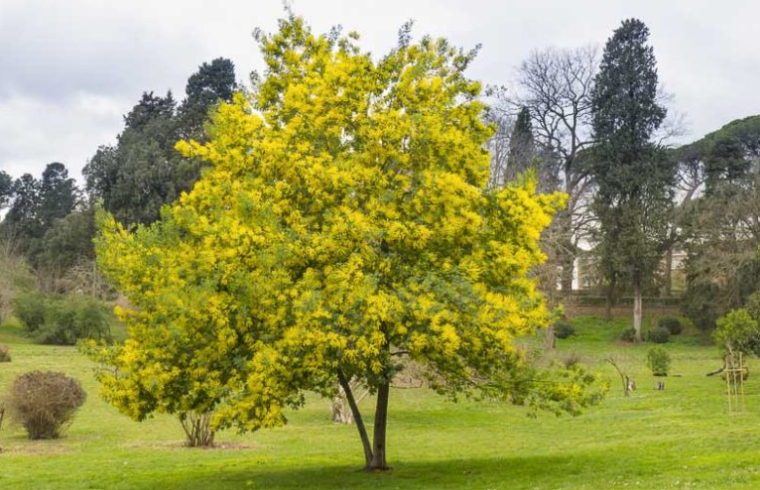
Wattle is the common name for Acacia, a genus so large and so central to the Australian landscape that it has become a national symbol in its own right. According to the CSIRO, more than 1,000 wattle species grow across the continent, ranging from towering 30-meter forest trees to tiny groundcovers easy to miss until they burst into flower, and somewhere in Australia a wattle is blooming on almost any given day of the year.
The golden wattle has been Australia’s official national floral emblem since 1988, and wattle forest covers roughly 9.8 million hectares of the country, making it the second most common forest type after eucalypt forest. Few plant groups anywhere carry this much cultural, ecological, and even scientific-political weight all at once, since the genus has also been at the center of one of the more heated naming disputes in modern botany.
This guide covers the wattle’s classification, its history and cultural significance, the 2005 controversy over who gets to call their plants Acacia, how to identify one, where wattles grow, their role in fire ecology, their practical uses, and what it takes to grow one.
Botanical Classification
Wattle belongs to the genus Acacia within the pea and legume family, and it’s the largest genus of native flowering plants in Australia. Estimates vary depending on how species are counted and when the count was last updated, but botanists have described more than 1,000 wattle species, with one count putting the figure at over 1,070 as of 2022, and all but about 17 of them native to Australia.
That makes wattle Australia’s largest plant genus by a wide margin, ahead of even eucalypts. Species range enormously in size and form, and individual flower clusters can hold as few as a dozen or as many as 130 or more tiny flowers packed into a single round or elongated head.
Brief History
The common name “wattle” has a genuinely practical origin. Early European settlers in Australia used the flexible young branches of certain acacias in a traditional building technique called wattle and daub, weaving branches into a lattice and packing it with mud or clay to form a wall. The plant took on the name of the building method rather than the other way around.
Wattle held deep cultural significance for Aboriginal peoples long before European settlement, and its symbolic role continued into the colonial and federation eras. The golden wattle was informally embraced as a national symbol around the time of Australian Federation in 1901, and it appeared on the Commonwealth Coat of Arms from 1912. The first organized National Wattle Day celebrations took place in Sydney, Melbourne, and Adelaide on September 1, 1910, and a Wattle Day League formed in 1909 and was formalized in 1913 to coordinate the annual event, though momentum stalled after the outbreak of World War I.
Official recognition took decades longer than popular affection. The golden wattle wasn’t formally proclaimed Australia’s national floral emblem until September 1, 1988, timed to the bicentenary of the First Fleet’s arrival in Sydney, and even the date of Wattle Day itself wasn’t formally settled until 1992, after regional confusion over differing bloom times between August and September. The Wattle Day Association now coordinates events and educational resources around the annual celebration.
The Great Acacia Name Debate
Few plant groups have triggered a scientific controversy as public as the one that engulfed Acacia in the mid-2000s. Because the genus as traditionally defined included species from Australia, Africa, and the Americas, and because genetic research showed it wasn’t a single natural group, botanists proposed splitting it into several separate genera.
The complication was that the original type species used to define Acacia scientifically was an African plant, meaning that, under normal botanical rules, Africa would keep the name Acacia and nearly a thousand Australian species would have to be renamed, most controversially to the awkward-sounding Racosperma. Australian botanists petitioned instead to designate an Australian species as the new type, which would let the vast majority of wattles keep the name Acacia while African and American relatives were reclassified into other genera.
The proposal went to a vote at the International Botanical Congress in Vienna in 2005, where it passed by a narrow margin, and the decision was confirmed again at a follow-up congress in 2011. As a result, most Australian wattles kept the name Acacia, while most African acacias were reclassified into 2 new genera, Vachellia and Senegalia, a decision that remains a sore point for many African botanists who felt the normal rules of taxonomic priority had been overturned for essentially political reasons.
Identifying Characteristics
One of the more unusual things about many wattle species is that they don’t actually have true leaves for most of their lives. Wattle seedlings typically start out with normal, feathery, compound leaves, but as the plant matures, many species replace those leaves with phyllodes, flattened, leaf-like stems that do the same job of photosynthesis without being true leaves at all. A wattle with phyllodes, like the golden wattle, is often mistaken for having simple, undivided leaves when what’s actually growing is a modified stem.
Flowers are typically small and packed densely into either a rounded, puffball-like head or an elongated, bottlebrush-style spike, and while most wattles bloom in shades of cream, yellow, or gold, a handful of species break the mold entirely, including at least one with a striking red-flowered form and another with genuinely pink and purple blossoms. After flowering, wattles produce pea-like seed pods, a clear giveaway of the genus’s membership in the broader legume family.
Native Range and Habitat
Wattles grow in nearly every environment Australia has to offer, from the poorly drained, swampy soils of Tasmania to the skeletal soils of mallee scrub and the arid heart of the continent’s deserts. Western Australia alone is home to an estimated 450 to 500 wattle species, most concentrated in the state’s biodiverse southwest.
That ecological range is part of why wattle forest, at nearly 9.8 million hectares according to Bush Heritage Australia, ranks as Australia’s second most common forest type, found in every state and territory. Some wattle species grow as towering forest trees reaching 30 meters, while others stay low and prostrate, spreading along the ground and easy to overlook outside their brief flowering window.
Fire Ecology and Seed Survival
Fire is a defining force in the Australian landscape, and wattle seeds are remarkably well adapted to it. Many species produce seeds with tough, hard coats capable of surviving intense heat, lying dormant in the soil for years, sometimes decades, until a fire cracks the seed coat and the following rain triggers germination.
That strategy means a wattle population can be entirely destroyed above ground by a bushfire and still return in force once conditions are right, often as one of the first plants to reappear on a burned landscape. It’s a genuinely elegant survival mechanism, and it’s part of why wattle is often among the first green to reappear after a fire moves through.
Practical and Cultural Uses
The Australian National Botanic Gardens notes that wattle bark has long been a commercial source of tannin, the compound used to cure and preserve leather, with silver wattle, black wattle, and golden wattle all historically harvested for the purpose. Some species are valued for timber instead, most notably blackwood, whose wood is prized for fine furniture making.
Aboriginal peoples have used various wattle species for food, medicine, tools, and cultural purposes for tens of thousands of years, a relationship that long predates and runs far deeper than the plant’s more recent adoption as a national emblem. Today wattle also holds a simpler, everyday role as one of the most widely grown ornamental native plants in Australian gardens, valued for fast growth, reliable flowering, and genuine, easy beauty.
Invasive Species Concerns
The same traits that make wattle so successful in Australia, fast growth, prolific seed production, and hardy, fire-resistant seeds, have made several species significant invasive weeds elsewhere in the world. Silver wattle, for example, is classified as a Category 1 weed requiring eradication in South Africa’s Western Cape, and a Category 2 weed requiring control outside plantation areas elsewhere in the country, and it has also naturalized in parts of Europe, Asia, the Americas, and even the Black Sea coast of Russia.
Black wattle, grown commercially overseas for its tannin-rich bark, has become an aggressive invader in parts of South Africa as well. Even within Australia, golden wattle itself has become locally invasive outside its natural range, spreading in parts of the Perth district in Western Australia where it isn’t native. It’s a useful reminder that a plant perfectly at home in its native ecosystem can become a genuine problem once removed from the natural checks that kept it in balance there.
Growing Considerations
Wattle is generally easy to grow, fast-growing, and tolerant of poor soil, which is exactly why it spreads so readily both at home and abroad. Most species want full sun and well-drained soil, and because many are adapted to nutrient-poor Australian soils, they typically resent excessive fertilizer, especially high-phosphorus formulations that can damage or kill many native Australian plants outright.
Many wattle species are also relatively short-lived compared to other trees, with some living only a couple of decades, though a handful of longer-lived species can persist for well over a century.
Pruning lightly after flowering helps many wattles stay dense and encourages a stronger flush of blooms the following season, and deadheading spent flower heads can tidy up a shrub that’s finished for the year. Because so many species are adapted to fire-prone environments, most wattles also handle a hard prune far better than a typical garden shrub would, resprouting readily from cut stems. Given how many hundreds of species exist, from tiny groundcovers to substantial trees, choosing the right wattle for a specific garden comes down mostly to matching the species to the available space and the local climate, since a plant bred for arid inland conditions won’t necessarily thrive in a humid coastal garden, and vice versa.
The Bottom Line
Wattle is Australia’s floral heavyweight, a genus so large, so ecologically important, and so culturally embedded that it has become a national emblem, a building-technique namesake, and the subject of an international taxonomic showdown all at once. Whether grown as a fast, cheerful garden shrub or admired as an entire golden forest after a good rain, wattle remains one of the most distinctly Australian plants there is.