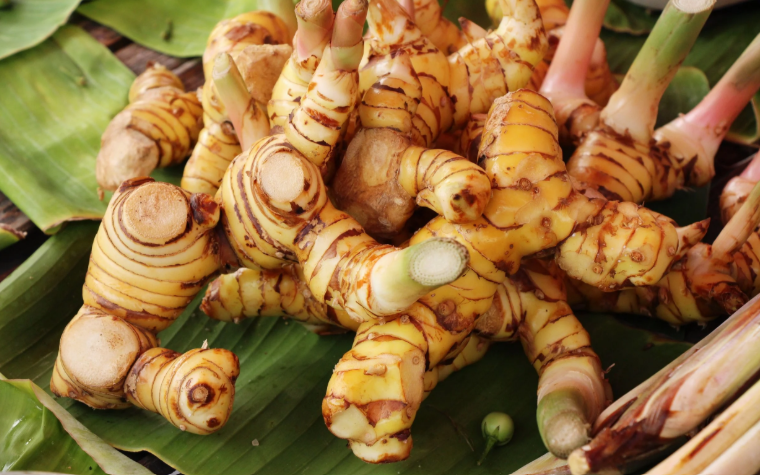
Galangal is a group of aromatic rhizome plants belonging to the ginger family, native to Southeast Asia and southern China and cultivated across the tropical and subtropical regions of Asia for over 1,000 years as both an indispensable culinary spice and an important traditional medicine ingredient. Often called Thai ginger or blue ginger in Western markets, galangal is one of the three foundational flavor ingredients of Thai cuisine alongside lemongrass and kaffir lime leaves, and it is equally fundamental to Indonesian, Malaysian, Cambodian, Vietnamese, and Lao cooking traditions. Despite being closely related to common ginger and resembling it physically, galangal has a distinctly different flavor — sharper, more piney, more citrusy, and slightly medicinal — that cannot be effectively substituted by common ginger in authentic Southeast Asian recipes.
Galangal plants grow from thick, horizontal, cream to pale pink-skinned rhizomes that spread underground to form slowly expanding clumps, producing tall, upright, cane-like stems with lance-shaped leaves reaching 4 to 6 feet in height for Greater Galangal and 3 to 4 feet for Lesser Galangal. The rhizomes are harvested year-round in tropical growing regions, with Greater Galangal producing the largest and most widely traded commercial rhizomes typically reaching 3 to 6 inches in diameter in mature plants. Galangal is grown primarily across Indonesia, Thailand, Malaysia, China, India, and Vietnam, with Indonesia and Thailand being the dominant producers and exporters of both fresh and dried galangal for domestic and international markets.
The pungent, complex flavor of galangal comes primarily from volatile aromatic compounds including galangol, galangin, and various terpenoids that give it the characteristic sharp, piney, eucalyptus-like, slightly citrusy flavor profile. Galangal has been extensively studied in pharmacological research, with documented antimicrobial, anti-inflammatory, antioxidant, and anticancer properties attributed to its bioactive compounds — particularly galangin and alpinetin flavonoids. In traditional Ayurvedic, Chinese, and Southeast Asian medicine systems, galangal has been used for centuries to treat digestive complaints, respiratory conditions, and as a general tonic, and the global medicinal herb and functional food ingredient markets increasingly value galangal extracts for their documented biological activities.
Galangal is consumed in numerous culinary forms across its native regions — fresh rhizome sliced or ground into curry pastes, dried and powdered as a spice, pickled in vinegar, and brewed into herbal teas and medicinal decoctions. In Western markets it is most widely available dried and ground as galangal powder, as dried sliced pieces for reconstituting in cooking, and increasingly as fresh rhizomes in Asian specialty grocery stores serving Southeast Asian cooking communities. The global galangal market is growing steadily as Thai, Indonesian, and broader Southeast Asian cuisine continues to gain international popularity and as health food consumers seek out the documented bioactive properties of galangal extracts and powders. It grows as a perennial in USDA zones 8 to 11 and can be grown as a container plant in cooler climates.
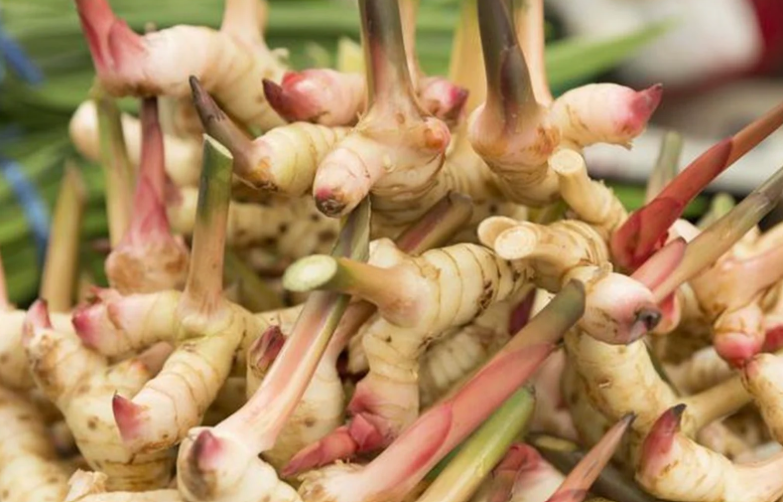
Types of Galangal
1. Greater Galangal
Greater Galangal is the most widely grown, most commercially important, and most culinarily significant galangal species, the rhizome most commonly sold as galangal in Asian grocery stores and the species used in the vast majority of Southeast Asian cooking recipes that call for galangal. It produces large, pale cream to pinkish-cream skinned rhizomes with white, firm, fibrous flesh and a sharp, piney, citrusy, slightly medicinal flavor that is fundamental to Thai green and red curry pastes, tom kha gai coconut soup, Indonesian rendang, and countless other Southeast Asian preparations. It grows to 4 to 6 feet in USDA zones 8 to 11 and is the primary galangal of Thai and Indonesian culinary tradition.
2. Lesser Galangal
Lesser Galangal is a smaller, more pungent, and more intensely flavored galangal species producing smaller, reddish-brown-skinned rhizomes with harder, more fibrous flesh and a significantly more pungent, sharp, peppery, camphor-like flavor than the milder Greater Galangal. It is widely used in traditional Chinese medicine and in the historic medieval European spice trade where it was one of the most prized and expensive imported spices — known as galingale — used in medieval European cooking and medicine before falling out of use as Asian trade routes changed. It grows to 3 to 4 feet in USDA zones 8 to 11 and is available from specialist herb and Asian plant nurseries.
3. Kencur (Sand Ginger)
Kencur, sometimes called sand ginger or resurrection lily, is a distinct galangal relative producing very small, dark-skinned, aromatic rhizomes with an unusually strong, camphor-like, numbing, intensely aromatic flavor quite unlike any other member of the galangal group. It is an essential and irreplaceable ingredient in Javanese and Balinese Indonesian cooking — particularly in the cold rice salad preparation called nasi timbel and in the traditional Javanese herb drink jamu — and cannot be substituted by Greater or Lesser Galangal in these specific traditional preparations. It grows to only 6 to 12 inches as a low-growing, seasonal plant in USDA zones 9 to 12.
4. Chinese Galangal
Chinese Galangal refers to the galangal varieties grown in southern China — particularly in Guangdong, Guangxi, and Hainan provinces — that are used extensively in Cantonese and southern Chinese cooking as both a culinary flavoring and an important Traditional Chinese Medicine ingredient. Chinese galangal varieties tend to produce smaller, more fibrous rhizomes with a slightly different, somewhat more delicate flavor profile than the large, bold Greater Galangal of Thai cooking, suited to the more subtle, refined flavor balance of Cantonese cooking traditions. China is one of the world’s most important galangal producers for both domestic consumption and export to Chinese diaspora markets worldwide.
5. Thai Galangal (Kha)
Thai Galangal, known as kha in Thai, refers specifically to the Greater Galangal varieties selected and cultivated in Thailand for the particular flavor qualities most suited to Thai cooking — the sharp, piney, citrusy, moderately pungent character that is essential to the authentic flavor of Thai cuisine. Thai-grown galangal is considered by Thai chefs to be the finest quality galangal for Thai cooking and is preferred over Indonesian or Chinese galangal for its optimal balance of flavor compounds. It is the galangal most widely exported fresh to international Thai restaurant supply chains and specialist Asian food retailers serving Thai cooking communities.
6. Indonesian Galangal (Laos)
Indonesian Galangal, called laos in Indonesian cooking, refers to the Greater Galangal varieties cultivated across Java, Sumatra, and other Indonesian islands where galangal is an essential and irreplaceable ingredient in the culinary tradition. Indonesian galangal tends to be slightly larger and somewhat milder than Thai kha, with a flavor nuance that Indonesian cooks consider optimally suited to Indonesian cooking styles including rendang, soto, and the complex spice pastes called bumbu that form the flavor foundation of countless Indonesian dishes. Indonesia is one of the world’s most important galangal producers and exporters.
7. Malaysian Galangal
Malaysian Galangal refers to the galangal varieties grown in peninsular Malaysia and the Malaysian states of Sabah and Sarawak on Borneo, used extensively in Malay, Chinese Malaysian, and Nyonya (Peranakan) cooking traditions where it is a fundamental ingredient in laksa paste, curry preparations, and numerous other essential Malaysian dishes. Malaysian galangal cultivation is concentrated in the warm, humid conditions of the Malaysian lowlands and foothills where the combination of tropical heat and high rainfall produces galangal rhizomes of good flavor quality for both domestic use and export to Singaporean and international Malaysian food markets.
8. Vietnamese Galangal (Riềng)
Vietnamese Galangal, called riềng in Vietnamese, is used across North and South Vietnamese cooking traditions with somewhat different applications in each regional tradition — more commonly used in northern Vietnamese cooking as a key ingredient in the traditional pork preparation thịt chó (dog meat dishes) and in various broths and soups, and used alongside lemongrass and other aromatics in southern Vietnamese preparations. Vietnamese cooks distinguish between young, fresh galangal with a brighter, more citrusy character preferred for certain applications and older, more fibrous galangal with a more concentrated, piney flavor suited to braised and slow-cooked preparations.
9. Cambodian Galangal (Romdeng)
Cambodian Galangal, called romdeng in Khmer, is an essential ingredient in traditional Cambodian cooking where it appears in the national spice paste called kroeung — the foundational flavor paste of Cambodian cuisine made from galangal, lemongrass, kaffir lime leaf, turmeric, garlic, and shallots — that forms the aromatic base of numerous traditional Cambodian dishes including amok fish curry and samlor korko soup. Cambodian culinary tradition places considerable importance on the precise flavor balance of kroeung and the specific quality and freshness of the galangal used is considered critical to achieving the authentic flavor of traditional Cambodian cooking.
10. Lao Galangal (Kha)
Lao Galangal, sharing the same kha name as Thai galangal, is a fundamental ingredient in traditional Lao cooking where it appears in numerous soups, stews, and the traditional pounded Lao salad known as tam mak hoong (papaya salad) preparations, contributing the sharp, piney, citrusy character that is as essential to Lao cooking as it is to Thai cuisine. Lao cooking shares many ingredient and flavor foundations with northern Thai cooking, reflecting the close cultural and historical connections between the two traditions, and galangal plays an equally central role in both culinary traditions as a non-negotiable aromatic base ingredient.
11. Indian Galangal (Kulanjan)
Indian Galangal, known in traditional Indian medicine as kulanjan, is used extensively in Ayurvedic medicine as a digestive tonic, respiratory treatment, and general medicinal herb, representing the Greater Galangal species adapted to Indian cultivation conditions and consumed primarily in medicinal rather than culinary contexts in most Indian regional traditions. India grows galangal primarily in the states of Kerala, Karnataka, and the northeastern hill states where the tropical and subtropical growing conditions are suitable, and Indian galangal production serves primarily the domestic traditional medicine market and the growing Ayurvedic health product export industry.
12. Dried Galangal (Laos Powder)
Dried Galangal, sold as laos powder in European and North American specialty food markets, is produced by slicing fresh Greater Galangal rhizomes thinly and drying them — either whole slices or ground into powder — creating a shelf-stable spice product with a more concentrated, somewhat different, woodier, less citrusy flavor than fresh galangal due to the changes in volatile compound profiles that occur during the drying process. Dried galangal is the form most widely available in Western supermarkets and specialty food stores where fresh galangal may not be readily accessible, and while inferior to fresh for most Southeast Asian cooking applications, it provides a reasonable substitute for soups, braises, and spice blends where the galangal flavor is one component among many.
13. Galangal in Traditional Chinese Medicine (TCM)
TCM Galangal refers specifically to the dried Lesser Galangal rhizome as used in Traditional Chinese Medicine formulations, where it has been prescribed for over 1,000 years as a warming digestive tonic used to treat stomach coldness, digestive pain, vomiting, and hiccups according to TCM diagnostic principles. The TCM applications of galangal are distinct from its culinary uses and the specific TCM preparation uses the dried Lesser Galangal in precisely calibrated doses in herbal formulas combined with other TCM herbs. China is the primary producer of Lesser Galangal for the global TCM export market, which has grown substantially alongside increasing international interest in traditional Chinese medicine.
14. Fingerroot (Krachai)
Fingerroot, called krachai in Thai and temu kunci in Indonesian, is a distinctive galangal relative producing clusters of finger-like, projecting yellowish-brown rhizomes arranged in a pattern resembling a bunch of keys — which gives it the alternative name Chinese keys. It has a sharp, peppery, slightly bitter, distinctively aromatic flavor used in specific Thai dishes including fish curry and the traditional Miang Kham preparation, and it cannot be effectively substituted by Greater Galangal or any other galangal relative in the dishes where it is the traditional ingredient. It grows to 18 to 36 inches in USDA zones 9 to 12.
15. Japanese Galangal (Myoga)
Japanese Galangal, or Myoga Ginger, represents the Japanese equivalent in the galangal-ginger flavor family, producing distinctively mild, delicately flavored, pale pink flower buds and young shoots used as a garnish and flavoring in Japanese cooking with a gentle, fresh, slightly pungent, aromatic character that is considerably milder and more refined than any of the Southeast Asian galangal species. While botanically more closely related to ginger than to true galangal, myoga occupies a similar culinary niche in Japanese cooking to galangal in Southeast Asian cuisines — providing an essential, irreplaceable aromatic element that defines the character of the dishes in which it appears. It grows to 2 to 3 feet in USDA zones 7 to 10.