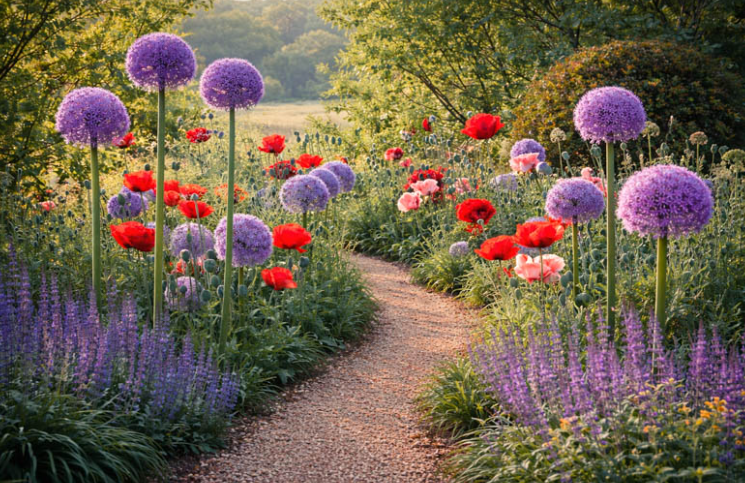
Allium, commonly known as ornamental onion, is a genus of perennial bulbous plants prized for their striking globe-shaped flower heads and strong vertical presence in the garden. The genus is enormous, containing more than 700 recognized species, ranging from towering ornamental types to the culinary alliums grown in kitchen gardens worldwide, including garlic, chives, shallots, and onions. Most ornamental varieties reach 1 to 4 feet in height, with the tallest giant types capable of producing flower globes up to 8 inches across atop sturdy, leafless stems.
Alliums are prized for their resilience as much as their appearance, tolerating drought well once established and generally requiring only full sun and well-drained soil to thrive. Their strong onion or garlic scent, released when the foliage is bruised or crushed, makes them naturally resistant to deer and rabbits, a trait that has made them increasingly popular in gardens plagued by browsing wildlife. Most ornamental alliums are hardy across USDA zones 3 through 9, though individual cultivars vary, with a handful of more tender types limited to zones 6 and warmer.
Bloom timing for alliums helps bridge the gap between the spring bulb season and full summer bloom, with most varieties flowering from mid-to-late spring into early summer, right as tulips and daffodils are fading and before peonies and irises reach their peak. A smaller number of varieties bloom later, extending color into midsummer and even August in some cultivars. Each individual flower head is actually made up of dozens, and in some giant varieties hundreds, of small star-shaped florets clustered tightly together, creating the recognizable spherical or starburst silhouette associated with the genus.
Alliums also offer strong value as pollinator plants, with their nectar-rich blooms attracting bees and butterflies throughout the flowering season, and their dried seed heads often left standing through fall and winter for continued architectural interest in the garden. Many varieties naturalize readily, multiplying from bulb offsets to form larger clumps over just a few years, while a select few well-behaved cultivars have been specifically bred to produce little to no viable seed, reducing the risk of unwanted spreading. Below are 35 different types of allium, each known for its own size, color, or bloom timing.
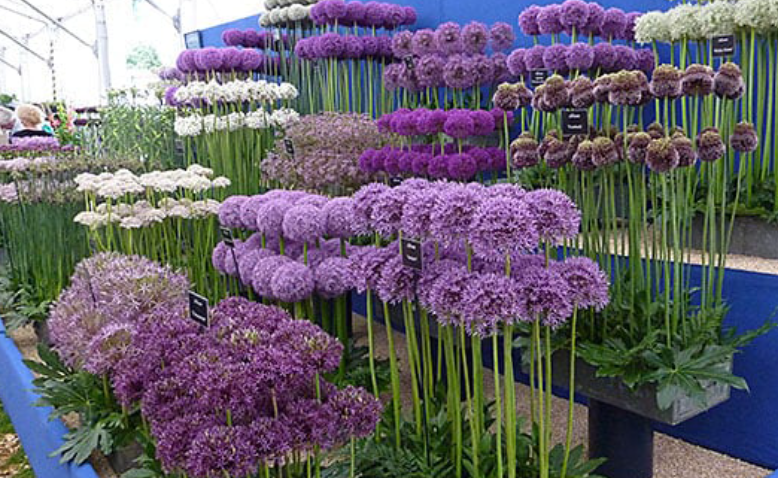
Types of Allium Flowers
Purple Sensation
Purple Sensation is one of the most widely planted ornamental alliums, producing rich violet-purple globes about 4 inches across atop stems reaching 24 inches tall. This variety is typically among the earliest alliums to bloom, opening in mid-to-late May in many temperate gardens. Purple Sensation is hardy in USDA zones 3 through 9 and performs best when planted at a density of about 4 bulbs per square foot.
Millenium
Millenium is considered one of the best flowering allium varieties for mixed borders, producing rounded rose-purple blooms on a compact, well-branched plant that stays notably shorter than many giant types. This cultivar is highly resistant to disease and rarely bothered by pests or browsing wildlife. Millenium blooms in summer, typically around August, extending the allium flowering season well beyond the spring giants, and is hardy in USDA zones 4 through 8.
Gladiator
Gladiator produces large, rounded purple flower heads on tall stems, typically blooming in late May to early June alongside irises and peonies. This variety is valued for its dramatic height and dense, uniform flower globes. Gladiator is hardy in USDA zones 4 through 8 and works well as a mid-border accent plant.
Globemaster
Globemaster is a hybrid variety producing some of the largest violet flower heads in general cultivation, with glossy foliage that complements its bold blooms. This variety typically flowers in late May to early June, around the same time as Gladiator and other giant types. Globemaster is hardy in USDA zones 5 through 8 and remains one of the most popular choices for dramatic garden focal points.
Mount Everest
Mount Everest produces large, pure white flower globes that offer a striking contrast to the purple and violet tones common among many other giant allium types. This variety typically blooms in late spring, reaching heights similar to other giant cultivars. Mount Everest is hardy in USDA zones 4 through 8 and pairs particularly well with darker-colored companion plants.
Summer Beauty
Summer Beauty produces smaller, soft lilac-pink flower clusters later in the season than most giant alliums, helping extend allium interest into midsummer. This variety stays more compact than the larger spring-blooming types, making it well suited to border fronts. Summer Beauty is hardy in USDA zones 4 through 8 and is valued for its extended bloom period compared to earlier-flowering cultivars.
Blue Eddy
Blue Eddy is a compact allium variety producing soft lavender-blue blooms on a notably smaller plant than most ornamental types. This cultivar’s reduced size makes it well suited for rock gardens and xeriscaping projects where taller alliums would be impractical. Blue Eddy is hardy in USDA zones 4 through 8 and offers a more delicate alternative to the bold giant types.
Serendipity
Serendipity produces soft, powder-blue to lavender flower clusters on a compact plant well suited to dry, well-draining garden conditions. This variety thrives in rock gardens and xeriscaped beds alongside other drought-tolerant perennials. Serendipity is hardy in USDA zones 4 through 8.
Silver Spring
Silver Spring is noted for its high ornamental value, featuring a distinctive bicolor bloom combining white petals with a contrasting darker center, giving it one of the more dramatic appearances among allium cultivars. This variety stands out in mixed borders thanks to its unusual color pattern. Silver Spring is hardy in USDA zones 4 through 8.
White Giant
White Giant produces large, pure white flower globes on tall stems, with dried flower heads that retain strong ornamental appeal well after the blooms have faded. This variety is easy to grow and provides season-long structural interest even once flowering has finished. White Giant is hardy in USDA zones 5 through 8.
Jeannine
Jeannine, sometimes called golden onion, produces star-shaped golden-yellow flowers arranged in a circular floret atop stems reaching only about a foot tall. This variety features soft, strap-like blue-green leaves that pair attractively with its yellow blooms. Jeannine is hardy in USDA zones 3 through 9 and multiplies readily, rewarding gardeners who plant at least a dozen bulbs together for a fuller display.
Giant Onion
Giant Onion lives up to its descriptive name, producing large, bold, lollipop-like purple flower heads on tall stems that emerge in late spring. This variety is one of the tallest commonly grown ornamental alliums, creating a dramatic vertical accent in the garden. Giant Onion is hardy in USDA zones 5 through 9.
Turkestan Onion
Turkestan Onion is a short, squat variety standing only about a foot tall, with thick, showy gray-green leaves mottled with purple and a reddish edge. This variety produces a long-blooming, pale silver-lavender flower that dries attractively and holds its shape well after fading. Turkestan Onion is hardy in USDA zones 5 through 9 and is best planted in groups of 3 or 5 for maximum visual impact.
Tumbleweed Onion
Tumbleweed Onion is a handsome variety that has been cultivated since Victorian times, valued for its long garden history as much as its ornamental appeal. This type produces rounded flower heads typical of the genus on sturdy stems. Tumbleweed Onion is hardy in USDA zones 4 through 9.
Graceful Beauty
Graceful Beauty is a compact native variety reaching only about 12 inches tall, making it a strong choice for container gardens and ground cover plantings. This variety produces elegant white-pink flower heads rising above grassy foliage each summer. Graceful Beauty is hardy in USDA zones 3 through 9 and shows strong resistance to disease.
Nodding Onion
Nodding Onion is named for its distinctive drooping flower heads, which curve downward rather than standing upright like most other allium types. This variety produces clusters of small, bell-shaped pink to lavender flowers on slender stems. Nodding Onion is hardy in USDA zones 4 through 8 and is one of the few alliums native to North America.
Star of Persia
Star of Persia produces large, spherical flower heads made up of dozens of star-shaped, silvery-lilac florets, creating a striking metallic sheen in the right light. This variety typically reaches about 20 inches tall and holds its dried seed heads well into the following season. Star of Persia is hardy in USDA zones 4 through 9.
Blue Globe Onion
Blue Globe Onion is one of the few true blue-flowered alliums available, producing small, densely packed spherical flower heads in a rich cornflower blue. This variety adds a rare cool tone to a genus otherwise dominated by purple, pink, and white flowers. Blue Globe Onion is hardy in USDA zones 4 through 8.
Golden Garlic
Golden Garlic produces loose clusters of bright yellow, star-shaped flowers on low-growing stems, offering a more relaxed, informal look compared to the tightly packed globes of larger allium types. This variety spreads readily in favorable conditions, making it well suited for naturalized plantings. Golden Garlic is hardy in USDA zones 3 through 9.
Naples Onion
Naples Onion produces loose, airy clusters of white, star-shaped flowers with a light fragrance, blooming earlier in spring than many other ornamental allium types. This variety is slightly less cold-hardy than some of its relatives, favoring milder climates. Naples Onion is hardy in USDA zones 6 through 9.
Ostrowsky Onion
Ostrowsky Onion is a low-growing variety producing large, soft pink, star-shaped flowers relative to its compact overall size. This variety stays close to the ground, making it a good fit for rock gardens and border fronts. Ostrowsky Onion is hardy in USDA zones 5 through 9.
Drumstick Allium
Drumstick Allium produces small, egg-shaped flower heads in deep wine-red to maroon, held on slender stems that give the plant a distinctive, elongated silhouette compared to the rounder globes of other allium types. This variety blooms later than many spring types, typically in early to midsummer. Drumstick Allium is hardy in USDA zones 4 through 8.
Wild Leek
Wild Leek, also known as ramps, is a woodland-native allium type valued as much for its edible foliage as for its ornamental white flower clusters. This variety prefers shaded, moist woodland conditions rather than the full sun favored by most other ornamental alliums. Wild Leek is hardy in USDA zones 3 through 7.
Wild Garlic
Wild Garlic produces small clusters of pink to white flowers on slender stems, often found growing informally in meadows and disturbed areas across its native range. This variety spreads readily and can naturalize aggressively in favorable conditions. Wild Garlic is hardy in USDA zones 4 through 8.
Lavender Bubbles
Lavender Bubbles produces soft, rounded lavender-purple flower heads on a mid-sized plant, offering a gentler color option compared to the deeper violet tones of varieties like Purple Sensation. This cultivar performs well in mixed borders alongside both pastel and boldly colored companion plants. Lavender Bubbles is hardy in USDA zones 4 through 8.
Red Mohican
Red Mohican is a novelty cultivar producing white, egg-shaped flower heads topped with a distinctive tuft of green foliage, resembling a small mohawk hairstyle. This unusual, textural bloom sets it apart from the smoother, rounder flower heads typical of the genus. Red Mohican is hardy in USDA zones 4 through 8.
Hair Allium
Hair Allium is grown specifically for its unusual, thread-like green appendages that emerge from the center of each flower head, creating a shaggy, textured appearance unlike any other allium type. This novelty variety is often included in dried flower arrangements for its unique structure. Hair Allium is hardy in USDA zones 4 through 8.
Pink Jewel
Pink Jewel produces soft pink, star-shaped flowers arranged in a loose, rounded cluster, offering a gentler pastel option within the broader allium color range. This variety performs well in mixed cottage-style plantings. Pink Jewel is hardy in USDA zones 4 through 8.
Schubert’s Allium
Schubert’s Allium produces one of the most dramatic and unusual flower forms in the entire genus, with individual florets held on wildly varying stem lengths that create a firework-like, explosive silhouette. This variety typically reaches only 12 to 18 inches tall despite its dramatic bloom size, which can span up to 10 inches across. Schubert’s Allium is hardy in USDA zones 5 through 8.
Sicilian Honey Garlic
Sicilian Honey Garlic produces nodding, bell-shaped flowers in a soft blend of cream, pink, and green, giving each cluster a soft, multi-toned appearance quite different from the rounded globes of most other allium types. This variety releases a light honey-like fragrance, contributing to its common name. Sicilian Honey Garlic is hardy in USDA zones 5 through 9.
Chinese Chives
Chinese Chives, also grown as a culinary herb, produce clusters of small white, star-shaped flowers atop flat, grass-like foliage. This variety is valued both for its ornamental flowers and its edible leaves, which carry a mild garlic flavor. Chinese Chives are hardy in USDA zones 4 through 9.
Blue Allium
Blue Allium describes a small group of alliums bred or selected specifically for cooler blue-toned blooms, a relatively uncommon color within the broader genus. These varieties typically produce smaller, more delicate flower heads compared to the large purple giants. Blue Allium types are generally hardy in USDA zones 4 through 8.
Egyptian Walking Onion
Egyptian Walking Onion is a novelty variety that produces small bulbils at the top of its flowering stem instead of a typical seed head, which eventually weigh the stem down and allow the plant to root and “walk” to a new spot in the garden. This unusual reproductive habit makes it a popular curiosity among heirloom gardeners. Egyptian Walking Onion is hardy in USDA zones 3 through 9.
Chives
Chives are among the most widely grown alliums for culinary use, producing small, round, lavender-pink flower puffs above thin, hollow, edible leaves. This variety is a popular dual-purpose choice for both kitchen gardens and ornamental borders. Chives are hardy in USDA zones 3 through 9.
Keeled Garlic
Keeled Garlic produces loose, nodding clusters of pink to purple bell-shaped flowers on slender stems, offering a softer, more relaxed bloom form than the tightly packed globes of larger allium types. This variety tends to spread readily once established, making it useful for naturalized plantings. Keeled Garlic is hardy in USDA zones 4 through 8.