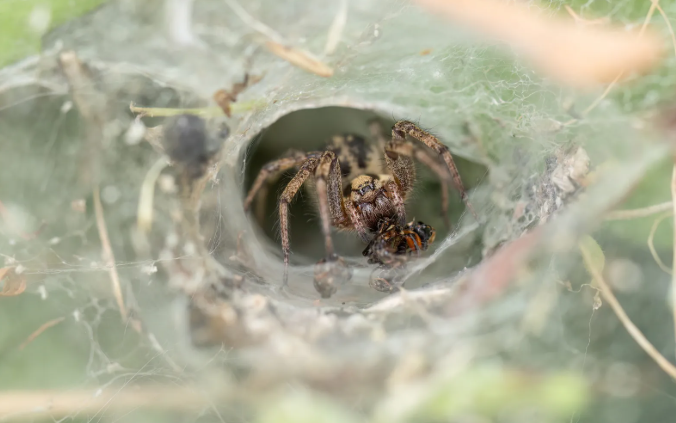
Funnel-web spiders are a group of spiders that construct distinctive funnel-shaped webs, used both as a retreat and a trap for prey, with species ranging from highly venomous Australian spiders to harmless North American funnel weavers.
Spiders that make funnel webs fall into two groups 2 groups that share almost nothing beyond a similarly shaped web and an unfortunate overlap in common name. According to Ohio State University’s Ohioline Extension, a funnel weaver is most easily identified by its web, constructed as a flat sheet that narrows into a funnel or tube shape at the back, typically tucked into a shrub, dense grass, or a crevice in a structure. The vast majority of spiders that build this exact style of web belong to the family Agelenidae and are harmless to humans, capable of nothing worse than a minor, insect-scaled bite.
The other group, confusingly sharing the common name “funnel-web spider,” belongs to an entirely separate and unrelated family found only in Australia, and includes some of the most medically significant venomous spiders on Earth. The 2 groups aren’t even in the same spider suborder, meaning the resemblance in web shape is a case of convergent engineering rather than any shared ancestry, and mixing them up in casual conversation is exactly how a harmless backyard grass spider ends up with an undeserved reputation for danger.
These spiders span lawns and basements across North America and Europe, the rainforest floor of equatorial Africa, and the eucalyptus forests and burrows of eastern Australia. What follows covers 24 spiders that make funnel webs, along with where each one is found and the data that separates the harmless majority from the genuinely dangerous few.
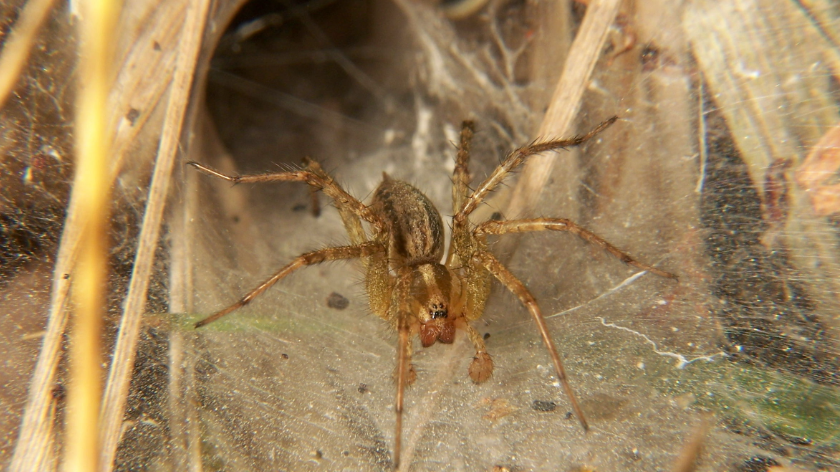
American Grass Spider (Agelenopsis spp.)
American grass spider, genus Agelenopsis, is found throughout most of North America, and according to Penn State Extension, its webs are large, somewhat concave, mostly horizontal, and sheetlike with a funnel or tunnel located off to one side. A mature female typically reaches close to an inch in body length, larger than the male.
It’s found throughout Pennsylvania and most of the United States, commonly seen on grass, weeds, and groundcovers like ivy and periwinkle, and dewy mornings frequently reveal dozens of its webs scattered across a single lawn.
Pennsylvania Grass Spider (Agelenopsis pennsylvanica)
Pennsylvania grass spider, Agelenopsis pennsylvanica, is found across at least 21 U.S. states, one of the most common grass spider species encountered in the eastern United States. According to Ohio State University’s Ohioline Extension, it’s tan with 2 dark brown stripes on the cephalothorax that break into mottling or spots on the abdomen, maturing in late summer and mating in autumn.
It’s found throughout much of the eastern United States, commonly building its webs in lawns, shrubs, and hedges.
Desert Grass Spider (Agelenopsis aperta)
Desert grass spider, Agelenopsis aperta, is found throughout the arid southwestern United States, building its characteristic funnel web in desert scrub and disturbed ground. A mature female typically reaches a similar size to other Agelenopsis species.
It’s found throughout Arizona, New Mexico, and neighboring desert states, notable among arachnologists for extensive behavioral research on its territorial and foraging habits.
Agelenopsis Naevia (Agelenopsis naevia)
Agelenopsis naevia is another widespread grass spider species found across much of the eastern and central United States, building the same sheet-and-funnel web typical of the genus. A mature female is broadly similar in size and appearance to its close relatives.
It’s found throughout much of the eastern and central United States, often overlapping in range and habitat with other Agelenopsis species.
Barn Funnel Weaver (Tegenaria domestica)
Barn funnel weaver, Tegenaria domestica, is found throughout much of the world, and its webs are commonly found in basements, barns, sheds, and other structures. A mature spider is medium to large, light brown to tan, with 2 dark lines running down its back beginning at the eyes.
It’s found throughout North America and Europe, thriving specifically in the dark, undisturbed corners of human structures.
Giant House Spider (Eratigena atrica)
Giant house spider, Eratigena atrica, is found throughout Europe and has become established in parts of the Pacific Northwest, among the largest funnel-weaving spiders commonly encountered indoors. A mature female’s leg span can exceed 3 inches.
It’s found throughout the United Kingdom, continental Europe, and the northwestern United States, often startling homeowners with its size despite posing no real danger.
Hobo Spider (Eratigena agrestis)
Hobo spider, Eratigena agrestis, is found throughout the Pacific Northwest and parts of the Rocky Mountain states, and according to the Utah Plant Pest Diagnostic Lab, no significant scientific evidence suggests hobo spiders have a necrotic, flesh-eating bite, and the CDC does not list them among venomous spider species toxic to humans. A mature spider builds a funnel web similar to other Agelenidae species.
It’s found throughout Utah and the broader Pacific Northwest, historically the subject of considerable, largely unsubstantiated concern about its bite.
Labyrinth Spider (Agelena labyrinthica)
Labyrinth spider, Agelena labyrinthica, is found throughout Europe, building an elaborate funnel web often woven through dense vegetation with a maze-like structure leading to its retreat. A mature female is typically larger than the male.
It’s found throughout the United Kingdom and continental Europe, commonly seen in meadows and hedgerows during summer.
Coras (Coras spp.)
Coras is a genus of funnel weaver native to North America, typically found in leaf litter and damp, wooded habitats rather than open grass. A mature spider builds a funnel web tucked beneath logs, rocks, or dense ground cover.
It’s found throughout much of the eastern United States, generally less conspicuous than Agelenopsis species due to its preference for hidden, sheltered locations.
Hololena (Hololena spp.)
Hololena is a genus of funnel weaver native to western North America, building funnel webs in similar grassy and shrubby habitats to Agelenopsis. A mature spider is broadly similar in size and habits to other Agelenidae genera.
It’s found throughout the western United States, particularly common in California.
Wadotes (Wadotes spp.)
Wadotes is a genus of funnel weaver native to eastern North America, typically found in wooded and leaf-litter habitats rather than open lawns. A mature spider builds a funnel-shaped retreat similar to its relatives.
It’s found throughout the eastern United States, generally overlooked due to its secretive, ground-dwelling habits.
Textrix Denticulata (Textrix denticulata)
Textrix denticulata is a small funnel weaver found throughout parts of Europe, typically building its web low to the ground among rocks and short vegetation. A mature spider is considerably smaller than many other funnel weaver species.
It’s found throughout the United Kingdom and continental Europe, often overlooked due to its small size and low-growing web placement.
Social Funnel-Web Spider (Agelena consociata)
Social funnel-web spider, Agelena consociata, is found in the rainforests of Gabon in equatorial Africa, notable among funnel weavers for its genuinely social behavior, with dozens to hundreds of individuals cooperating within a single interconnected web system. A mature colony can span a substantial area of forest understory.
It’s found in the tropical rainforests of Gabon, one of relatively few spider species anywhere in the world documented to live and cooperate in large social colonies.
Cicurina (Cicurina spp.)
Cicurina is a genus of small funnel weaver found throughout North America, including several rare species restricted to cave systems in Texas. A mature spider is typically quite small compared to other funnel weaver genera.
It’s found throughout much of North America, with several cave-dwelling Texas species listed as federally endangered due to their extremely limited habitat range.
Cambridgea (Cambridgea spp.)
Cambridgea is a genus of funnel weaver endemic to New Zealand, building large sheet-and-funnel webs in forest understories and among rocks. A mature spider can be among the larger funnel weavers found in New Zealand ecosystems.
It’s found throughout New Zealand, occupying a similar ecological niche to Agelenopsis species in North America.
Black House Spider (Badumna insignis)
Black house spider, Badumna insignis, is found throughout Australia, building a distinctive funnel-shaped retreat within a lacy, irregular web typically placed in window frames, wall crevices, and tree bark. A mature female’s body can reach close to an inch in length.
It’s found throughout Australia and has been introduced to New Zealand and Japan, and while its bite can cause localized pain and minor illness, it’s not considered medically dangerous.
Grey House Spider (Badumna longinqua)
Grey house spider, Badumna longinqua, closely resembles the black house spider in web structure and general appearance, found throughout Australia and introduced to parts of North America and New Zealand. A mature female is similar in size to its darker relative.
It’s found throughout Australia, California, and New Zealand, commonly encountered around building exteriors.
Sydney Funnel-Web Spider (Atrax robustus)
Sydney funnel-web spider, Atrax robustus, is found within roughly a 100-mile radius of Sydney, Australia, and according to the University of Melbourne’s Australian Venom Research Unit, the male is Australia’s most dangerous spider, capable of causing death in as little as 15 minutes, and colonies of more than 100 spiders may be found together. An effective antivenom introduced in 1980 has prevented any confirmed fatalities since its release, following at least 14 deaths before that point.
It’s found in burrows and rock crevices around the greater Sydney region, and males in particular tend to wander into homes during summer, especially after rain.
Northern Tree Funnel-Web Spider (Hadronyche formidabilis)
Northern tree funnel-web spider, Hadronyche formidabilis, is found in the forests of northeastern New South Wales and southeastern Queensland, one of the largest and most dangerous of the tree-dwelling Australian funnel-web species. A mature female’s body can exceed 2 inches in length.
It’s found throughout coastal forests of northeastern Australia, typically nesting in tree hollows and under loose bark rather than in ground burrows.
Southern Tree Funnel-Web Spider (Hadronyche cerberea)
Southern tree funnel-web spider, Hadronyche cerberea, is found along the coast of New South Wales, one of only 2 tree-dwelling funnel-web species documented to cause the most severe human envenomation among the group. A mature spider builds its retreat in tree hollows and dense bark crevices.
It’s found throughout coastal forests of New South Wales, and medical treatment protocols for its bite mirror those developed for the Sydney funnel-web spider.
Blue Mountains Funnel-Web Spider (Hadronyche versuta)
Blue Mountains funnel-web spider, Hadronyche versuta, is found in the Blue Mountains region west of Sydney, building ground burrows in moist forest soil similar to its close relative Atrax robustus. A mature spider is broadly similar in size and danger profile to the Sydney funnel-web spider.
It’s found throughout the Blue Mountains and surrounding areas of New South Wales, generally treated with the same medical urgency as a Sydney funnel-web spider bite.
Toowoomba Funnel-Web Spider (Hadronyche infensa)
Toowoomba funnel-web spider, Hadronyche infensa, is found around Toowoomba and the Fraser Coast region of southeastern Queensland, building ground burrows in forest and garden soil. A mature spider is considered medically significant, though less extensively studied than the Sydney funnel-web spider.
It’s found throughout southeastern Queensland, occupying a similar ecological role to other ground-dwelling Hadronyche species.
Darling Downs Funnel-Web Spider (Hadronyche valida)
Darling Downs funnel-web spider, Hadronyche valida, is found in the Darling Downs region of southeastern Queensland, building silk-lined burrows in moist soil. A mature spider closely resembles other Hadronyche species in general appearance.
It’s found throughout the Darling Downs region of Queensland, considered part of the broader group of medically significant Australian funnel-web spiders.
Atrax Montanus (Atrax montanus)
Atrax montanus is a lesser-known relative of the Sydney funnel-web spider, found in mountainous regions of eastern Australia. A mature spider builds a silk-lined burrow similar to its more famous relative.
It’s found in scattered upland habitats of eastern Australia, and its full medical significance remains less thoroughly documented than that of Atrax robustus.
Key Takeaways
Funnel webs take the shape of a flat sheet leading into a narrow tunnel. This design is both a home and a trap, giving them a safe retreat while still functioning as a hunting tool. The layout allows them to stay hidden while monitoring the world outside.
The funnel shape is not accidental; it serves a purpose. The flat portion of the web acts like a stage, where unsuspecting insects wander across, while the tunnel provides cover for the predator. From inside, the resident can feel the vibrations of prey and dash out with incredible speed to seize it.
These webs are made of dense, non-sticky silk. Instead of capturing insects by glue-like threads, they rely on strength and quick reflexes. When a creature steps on the sheet, the builder senses it immediately, rushes out from the tunnel, and drags it back into the retreat for feeding.
Different species make their funnels in different environments. Some prefer tall grass and shrubs, weaving their sheets close to the ground, while others build them in cracks, tree bark, or corners of human dwellings. Each choice of location provides shelter and an advantage in hunting.
Further References
- Spider Webs — Natural History Museum — Excellent UK reference covering funnel webs made by Agelenidae, including labyrinth spiders (Agelena) and house spiders (Tegenaria and Eratigena).
- Spiders — UC Statewide Integrated Pest Management Program — Useful North American reference covering funnel weavers/grass spiders (Agelenidae), their horizontal sheet webs, funnel-shaped retreats, and North American diversity.
- Common Spiders Found Around Homes and Buildings — University of Kentucky — Describes North American funnel-web or grass spiders, including their horizontal sheet-like webs and funnel-shaped retreats.
- British Spider Families — British Arachnological Society — A useful UK identification reference for Agelenidae, including their sheet webs, tubular retreats, and distinctive spinnerets.
- Australian Funnel-web Spiders — Australian Museum — Covers the Australian funnel-web group, including Atrax, Hadronyche, and Illawarra, and explains their distribution and web/retreat structures.