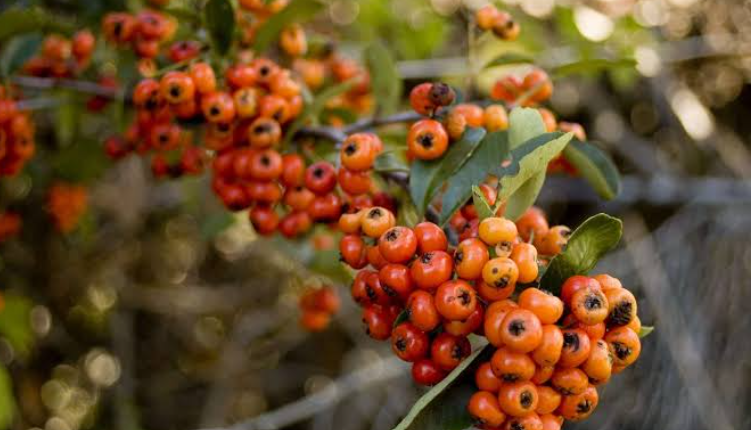
Shrubs with orange berries occupy a striking middle ground in the landscape, warmer and more attention-grabbing than yellow fruit but softer than the classic red display most fall gardens lean on. That orange hue often signals something specific happening at a chemical level, since many of these fruits carry high concentrations of carotenoid pigments, the same compounds responsible for the color of carrots and pumpkins, layered over or instead of the red anthocyanins found in most berry-producing shrubs.
The shrubs on this list come from an unusually wide set of native habitats, ranging from the swamps and thickets of the eastern United States to the mountain forests of eastern Asia and the arid scrublands of coastal California. Several are native species valued specifically for supporting local wildlife, while others are naturalized or invasive plants that spread aggressively precisely because their orange-red fruit is so appealing to birds. Knowing which category a given shrub falls into matters just as much as knowing how to grow it, since a few entries here are better avoided or actively controlled rather than planted.
Hardiness across this list spans from USDA zone 3, where a handful of tough native shrubs shrug off brutal winters, up to zone 11, where only genuinely tropical species can survive outdoors year-round. Mature size varies just as widely, from low, spreading groundcovers under 2 feet tall to vigorous, multi-stemmed shrubs and small trees capable of reaching 30 feet or more.
What follows covers 21 shrubs recognized for their orange or orange-red fruit, along with where each one grows natively, its typical size and hardiness, and the data that distinguishes it from its red- and yellow-berried relatives.
Orange-Fruited Firethorn
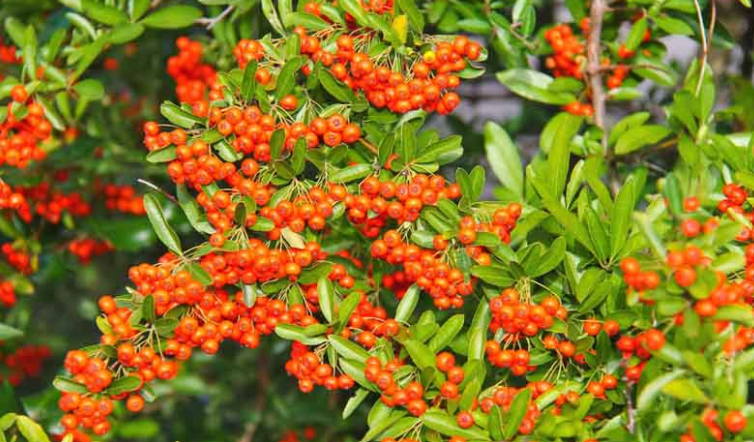
Firethorn is native to a broad stretch of southern Europe, the Caucasus, and China, where it grows as a dense, thorny shrub across rocky hillsides and open scrub. Its most classic and widely planted forms produce dense clusters of bright orange to orange-red berries each fall, covering the evergreen foliage so thoroughly that individual leaves can become hard to see. A mature plant typically reaches 6 to 10 feet tall and wide, with thorns exceeding an inch in length on older wood.
It tolerates USDA zones 6 through 9 and requires full sun for the heaviest berry production, generally needing at least 6 hours of direct light daily. Its berries persist well into winter in most climates, since birds often bypass firethorn in favor of softer-fleshed fruit until other food sources run low.
Orange-Fruited Winterberry Holly
Winterberry holly is native to wetlands, swamps, and damp thickets across the eastern United States, and while most wild plants produce red fruit, a long-cultivated orange-fruited selection has been available in the nursery trade for decades. It grows as a rounded, deciduous shrub reaching 6 to 10 feet tall and wide, with quarter-inch berries that stand out sharply against bare branches once the leaves drop each fall. Because it’s dioecious, a male plant is needed within roughly 50 feet of female shrubs to ensure a heavy fruit set.
It tolerates USDA zones 3 through 9 and, unlike most hollies, thrives in consistently wet or poorly drained soil, making it a strong choice for low-lying areas and rain gardens where other shrubs often fail.
American Cranberrybush Viburnum
American cranberrybush viburnum is native across the northern United States and much of Canada, typically found along stream banks, forest edges, and the margins of wetlands in cooler climates. Its maple-like leaves turn shades of red and purple in fall, appearing alongside dense clusters of translucent orange-red berries that can persist on the branch well into winter. A mature shrub reaches 8 to 12 feet tall and wide, with flat clusters of white spring flowers that precede the fruit by several months.
It tolerates USDA zones 2 through 7, making it considerably more cold-hardy than many other viburnums, and prefers full sun to partial shade with consistently moist soil.
European Cranberrybush Viburnum
European cranberrybush viburnum is native across Europe, North Africa, and temperate Asia, growing in similar wetland and woodland-edge habitats to its American counterpart. Most standard, non-cultivated forms produce translucent red to orange-red berries in dense, drooping clusters that ripen in early fall and often persist through most of the winter. It reaches 8 to 12 feet tall with a rounded, spreading form and maple-like foliage that colors well in autumn.
It tolerates USDA zones 3 through 8 and adapts to a wide range of soil types, though it performs best with consistent moisture and at least partial sun exposure.
Mountain Ash
Mountain ash, also called rowan, is native across a huge swath of Europe and northern Asia, growing wild in mountain forests, rocky slopes, and cool upland habitats at elevations most other flowering shrubs and small trees can’t tolerate. Its dense, flat-topped clusters of small orange to orange-red berries ripen in late summer and are among the most sought-after fruit sources for migratory birds each fall. A mature specimen typically reaches 20 to 40 feet, technically classifying it as a small tree in most contexts, though younger and multi-stemmed forms are often grown and pruned as large shrubs.
It tolerates USDA zones 3 through 6 and struggles noticeably in hot, humid summer climates, performing best in cooler regions with well-drained, slightly acidic soil.
Orange-Fruited Cotoneaster
Cotoneaster is native to a wide range across temperate Asia, particularly China and the Himalayan foothills, where dozens of wild species grow across rocky slopes and forest margins at varying elevations. Most cultivated forms produce abundant orange-red berries each fall, following small white spring flowers that draw in a wide range of pollinators. A mature upright shrub typically reaches 8 to 12 feet, with arching branches that become heavily laden with fruit by early autumn.
It tolerates USDA zones 5 through 8 and adapts to a range of soil types, showing good resistance to both drought and urban pollution once established.
Rock Cotoneaster
Rock cotoneaster is native to western China, where it grows as a low, spreading shrub along rocky slopes and cliff faces rather than the more upright form typical of other cotoneaster species. Its distinctive herringbone branching pattern stays low to the ground, typically reaching just 2 to 3 feet tall while spreading 5 to 8 feet wide, making it a popular groundcover or bank-stabilizing plant. Small orange-red berries appear along the branches in fall, following pink-tinged white spring flowers.
It tolerates USDA zones 5 through 8 and thrives in full sun with well-drained soil, tolerating drought and poor soil conditions considerably better than most other groundcover shrubs.
European Spindle Tree
European spindle tree is native across most of Europe and parts of western Asia, growing wild in woodland understories, hedgerows, and forest edges. Its unusual fruit consists of bright pink to red four-lobed capsules that split open in fall to reveal seeds coated in a vivid orange covering, creating a striking two-color display against the plant’s green to burgundy fall foliage. A mature shrub reaches 12 to 20 feet, though it’s often kept smaller through regular pruning in garden settings.
It tolerates USDA zones 4 through 7 and adapts to a range of soil types, including chalky or alkaline conditions that many other flowering shrubs struggle with.
Strawberry Bush
Strawberry bush, also called hearts-a-bustin, is native to the eastern and central United States, typically found in the understory of deciduous woodlands and along forest edges from New York south into Florida and west to Texas. Like its European relative, it produces warty, pinkish-red seed capsules that split open to reveal bright orange-coated seeds, a combination that has made it a popular native alternative to non-native spindle trees. It grows as a loosely branched, multi-stemmed shrub reaching 4 to 6 feet tall and wide.
It tolerates USDA zones 6 through 9 and prefers partial shade with rich, well-drained soil, reflecting its natural habitat as an understory plant beneath larger deciduous trees.
Bittersweet Nightshade
Bittersweet nightshade is native to Europe and Asia but has become widely naturalized across most of North America, commonly found scrambling through wetlands, streambanks, thickets, and disturbed ground. As documented by Utah State University Extension’s integrated pest management program, its round berries change color as they mature, passing through green, yellow, and orange stages before ripening to a deep red, meaning a single cluster often displays several colors at once. It grows as a semi-woody, climbing or trailing vine reaching up to 10 feet in length, with distinctive purple, star-shaped flowers and bright yellow centers blooming alongside developing fruit.
It tolerates a wide range of USDA zones, generally 4 through 8, and its aggressive, weedy growth habit has led several states to classify it as invasive; all parts of the plant, including the unripe orange berries, are toxic if ingested.
Rugosa Rose
Rugosa rose is native to coastal areas of eastern Asia, including Japan, Korea, and northeastern China, where it grows in sandy, salt-exposed dune habitats along the shoreline. Rather than the small, dry hips typical of most roses, rugosa rose produces unusually large, round, orange-red hips that can exceed an inch in diameter, ripening in late summer and often persisting into winter. A mature shrub reaches 4 to 6 feet tall and wide, with dense, prickly canes and crinkled, deeply veined leaves.
It tolerates USDA zones 2 through 7 and handles salt spray, sandy soil, and coastal wind exceptionally well, a trait tied directly to its native dune habitat.
Orange Jessamine
Orange jessamine is native to a broad region spanning South and Southeast Asia, including India, southern China, and parts of Australia, where it grows as a dense, evergreen shrub along forest edges in warm, humid climates. It produces small, intensely fragrant white flowers throughout much of the year in frost-free climates, followed by clusters of small, egg-shaped berries that ripen from green to a bright orange-red. A mature shrub typically reaches 6 to 12 feet tall, with dense, glossy, dark green foliage that makes it a popular hedging plant in warm regions.
It tolerates USDA zones 9 through 11 and cannot survive any meaningful frost, making it a container or indoor plant across most of the continental United States outside the warmest coastal and southern regions.
Toyon
Toyon is native almost exclusively to California, where it grows throughout the chaparral-covered hills and coastal sage scrub habitats that gave the Hollywood neighborhood of Los Angeles its name, according to widely repeated local folklore documented by the University of California’s Master Gardener Program. Its dense clusters of small, holly-like berries ripen from green to a vivid orange-red by December, providing one of the most reliable winter food sources for birds across its native range. A mature specimen typically reaches 8 to 12 feet tall and 4 to 6 feet wide, though older, well-established plants can exceed 20 feet under ideal conditions.
It tolerates USDA zones 8 through 10 and handles drought, poor soil, and even fire exposure remarkably well, reflecting its deep adaptation to California’s chaparral fire ecology.
Possumhaw Holly
Possumhaw holly is native to the south-central United States, commonly found in bottomlands, stream margins, and moist woodland edges from Virginia west to Texas and Kansas. Unlike most hollies, it’s fully deciduous, dropping its leaves each fall to reveal branches densely covered in small, bright orange to red berries that persist through most of the winter. A mature shrub or small tree typically reaches 12 to 20 feet, with an upright, somewhat irregular branching habit.
It tolerates USDA zones 5 through 9 and adapts to both wet and moderately dry soils, though it produces its heaviest berry crop with consistent moisture and at least several hours of direct sun.
Washington Hawthorn
Washington hawthorn is native to a range spanning Virginia south to Alabama and west to Missouri and Arkansas, and it was reportedly first grown commercially near Washington, D.C. in the late 1700s, which is how it acquired its common name. According to a University of Florida IFAS Extension fact sheet on the species, its abundant small white spring flowers give way to showy orange to red fruit that persists into winter if birds don’t strip it first. It typically grows 20 to 35 feet tall in a wide pyramidal shape, technically a small tree, though it’s frequently used and pruned as a large multi-stemmed shrub in home landscapes.
It tolerates USDA zones 4 through 8 and adapts to a wide range of soil types, showing good drought tolerance once established, though its thorns, which can reach up to 3 inches long, require some caution during placement and pruning.
Amur Honeysuckle
Amur honeysuckle is native to northeastern Asia, including Manchuria and Korea, where it grows in forest understories and along woodland edges within its natural range. According to the University of Illinois Extension’s invasive species program, it was introduced to North America as an ornamental plant in 1898 and has since become one of the most aggressive invasive shrubs across the Midwest and eastern United States, spreading rapidly thanks to birds distributing its abundant orange-red berries. A mature shrub commonly reaches 15 feet tall and equally wide within 10 to 15 years, forming dense, arching thickets that shade out native understory plants.
It tolerates USDA zones 4 through 8 and grows vigorously in both full sun and significant shade, a flexibility that has contributed heavily to its success as an invasive species; removal rather than cultivation is recommended across most of its introduced range.
Oriental Bittersweet
Oriental bittersweet is native to eastern Asia, including China, Japan, and Korea, where it grows as a woody, twining vine along forest edges and disturbed ground. Introduced to North America in the 1860s as an ornamental plant, it has since become a serious invasive species across the eastern United States, producing round yellow-orange capsules that split open in fall to reveal bright red-orange seed coverings, a combination that made it popular for autumn wreaths before its invasive nature became widely recognized. It grows aggressively, with vines capable of reaching 60 feet or more as they climb into tree canopies.
It tolerates USDA zones 4 through 8 and outcompetes the native American bittersweet vine through both faster growth and more prolific fruit production, contributing to a steep decline in the native species across much of its former range.
Jerusalem Cherry
Jerusalem cherry is native to South America, particularly Peru and Ecuador, though it has become naturalized in warm regions worldwide and is most commonly grown as a decorative potted plant rather than a landscape shrub. Its rounded, cherry-tomato-like berries ripen from green to a bright orange to red, held upright above glossy, dark green foliage in a display that makes it a popular holiday houseplant. A mature plant typically stays compact, reaching just 1 to 2 feet tall in cultivation.
It tolerates USDA zones 9 through 11 outdoors and is more commonly grown as an annual or indoor container plant elsewhere; every part of the plant, including its attractive berries, is toxic if ingested.
Staghorn Sumac
Staghorn sumac is native to eastern North America, growing widely across forest edges, roadsides, and disturbed open ground from the Canadian Maritimes south into the Appalachian region. Rather than true berries, it produces dense, upright clusters of small, fuzzy, deep red to rust-orange fruit that persist through winter, providing an important late-season food source once softer fruits have already been consumed by wildlife. A mature shrub or small tree reaches 15 to 25 feet, spreading readily by root suckers to form large colonies over time.
It tolerates USDA zones 3 through 8 and thrives in poor, dry, rocky soil where many other shrubs struggle, making it a popular choice for erosion control on difficult sites.
Surinam Cherry
Surinam cherry is native to a tropical region spanning Suriname, Brazil, and neighboring parts of South America, where it grows as a dense, multi-stemmed shrub in warm, humid lowland habitats. Its distinctively ribbed, lantern-shaped fruit ripens from green through orange to a deep red, and the orange stage is often harvested specifically for its tangy, slightly resinous flavor before the fruit fully matures. A mature shrub typically reaches 10 to 15 feet, with small, glossy evergreen leaves that make it a popular hedging plant in tropical and subtropical regions.
It tolerates USDA zones 9 through 11 and requires warm, frost-free conditions year-round, generally grown as a container plant that’s brought indoors during winter in cooler climates.
Goji Berry
Goji berry, also called wolfberry, is native to a wide region spanning northern China, Mongolia, and the Himalayan foothills, where it grows as a sprawling, thorny shrub along riverbanks and rocky slopes in cold, arid climates. Its familiar elongated fruit ripens to a bright orange-red, hanging in small clusters along arching, willowy stems that benefit from support or regular pruning. A mature plant typically reaches 3 to 6 feet tall, spreading somewhat wider if left untrained.
It tolerates USDA zones 5 through 9 and handles poor, alkaline, and saline soils with relative ease, reflecting its adaptation to the harsh growing conditions of Central Asia; a single established plant can produce several pounds of fruit annually once mature.
Further References
- University of Minnesota Extension — Shrubs and Vines — Useful information on identifying, selecting, and growing berry-producing shrubs in home landscapes.
- Missouri Botanical Garden — Plant Finder — Provides botanical information, mature size, growing requirements, and fruit characteristics for many ornamental shrubs.
- North Carolina Extension Gardener Plant Toolbox — Offers detailed profiles for shrubs, including berries, habitat, identification features, and landscape uses.
- University of Wisconsin–Madison Extension — Woody Ornamentals — Covers the identification and landscape characteristics of numerous woody shrubs and ornamental plants.
- U.S. Forest Service — Fire Effects Information System — A useful botanical reference for native shrubs, including information on fruit, habitat, distribution, and ecological characteristics.