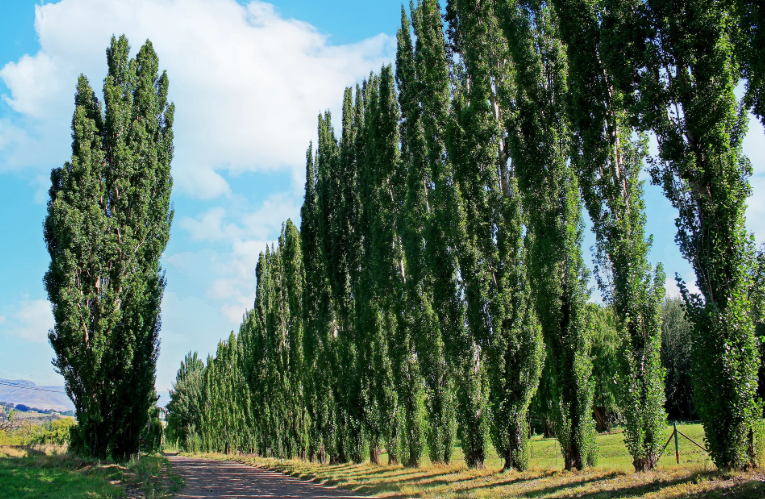
The Lombardy poplar tree is one of the most instantly recognizable trees in the landscaping world, known for its narrow, column-like shape that shoots skyward like a green exclamation point. Widely planted across North America and Europe as a fast-growing privacy screen and windbreak, this tall, slender tree has a striking silhouette unlike almost any other deciduous species.
This article covers everything to know about the Lombardy poplar, from its origins to its care requirements and its quirks as a short-lived but visually dramatic landscape tree.
Botanical Classification
The Lombardy poplar belongs to the willow family, placing it alongside willows, aspens, and cottonwoods in one of the largest plant families found in temperate climates. Within that family, it sits in the poplar genus, a group that includes roughly 25 to 35 recognized species across the Northern Hemisphere. The Lombardy poplar is technically classified as a cultivated variety of the black poplar, distinguished by its unusual fastigiate growth habit, meaning its branches grow nearly parallel to the trunk rather than spreading outward.
Because it originated as a single mutation rather than through natural seed propagation, nearly every Lombardy poplar in cultivation today is a male clone, propagated exclusively through cuttings. This means the species produces no seeds and spreads only through human planting, a detail that sets it apart from many of its more aggressively self-seeding poplar relatives.
Brief History
The Lombardy poplar traces its origin to the Lombardy region of northern Italy, where it was first documented in the 17th century as a naturally occurring mutation of the black poplar. Its dramatic columnar form quickly caught the attention of European landscapers and estate owners, and by the 1700s it had spread throughout France, England, and the rest of Europe as an ornamental and boundary tree.
The tree arrived in North America in the late 1700s, with some records crediting its introduction to colonial-era plant collectors who recognized its potential as a fast-growing screen. Founding-era estates, including plantings associated with early American landscape design, helped popularize the species, and by the 1800s it had become a common sight lining driveways, property boundaries, and rural roads across the eastern United States.
The Lombardy poplar’s popularity peaked in the early 20th century, when it was widely planted as a quick windbreak across the Great Plains during agricultural expansion, with some reports noting that a single Lombardy poplar can grow over 6 feet in a single year under ideal conditions. That same rapid growth, paired with a average lifespan of only 15 to 30 years, has made it a tree that is planted heavily in cycles, with older specimens frequently dying back and being replaced by new plantings within a few decades.
Identifying Characteristics
The defining feature of the Lombardy poplar is unquestionably its shape. Rather than forming the broad, rounded crown typical of most poplars, it grows in a tight, upright column, often reaching heights of 40 to 60 feet while spreading only 10 to 15 feet at its widest point. This narrow profile makes it easy to distinguish from a distance, even before examining its leaves or bark.
The leaves are triangular to diamond-shaped, typically 2 to 4 inches long, with finely serrated edges and a glossy green color on top. In autumn, the foliage transitions to a golden yellow, adding seasonal interest before the leaves drop. Bark on young trees is smooth and greenish-gray, gradually developing deep vertical furrows and a darker gray-brown color as the tree matures.
Because nearly all cultivated specimens are male, Lombardy poplars produce only male catkins in early spring, reddish-brown structures roughly 2 to 3 inches long that release pollen but never develop into the cottony seed capsules associated with female poplar trees. This absence of seed-fluff production is often cited as one of the tree’s more practical advantages over other poplar species.
The root system, while shallow like most poplars, tends to be less aggressively suckering than the white poplar or its relatives, though it still frequently causes problems with sidewalks, driveways, and underground utilities when planted too close to hardscaping.
Habitat and Distribution
Lombardy poplars are not typically found growing wild in the way native species are, since the clonal, all-male nature of the tree prevents natural seed dispersal. Nearly every specimen across its current range exists because it was deliberately planted, whether as an ornamental screen, a windbreak, or a boundary marker.
Within the United States, the tree is documented in nearly all 48 contiguous states, with particularly dense historical plantings across the Midwest and Great Plains, where it was used extensively for agricultural windbreaks throughout the early and mid-1900s. Significant populations also persist in New England and parts of the Pacific Northwest, where the tree’s fast growth made it popular for quick privacy screening around new developments.
The species tolerates a wide range of soil conditions but performs best in moist, well-drained soils with consistent access to water. It shows relatively poor drought tolerance compared to other poplar species, and trees planted in dry or poor soils frequently show earlier decline, sometimes dying back within 10 to 15 years rather than reaching their typical 20 to 30 year lifespan.
USDA Hardiness Zone and Growing Needs
The Lombardy poplar grows well across USDA hardiness zones 2 through 9, giving it one of the broadest climate ranges of any ornamental tree and explaining its historical popularity from the cold prairies of the northern Great Plains down through warmer temperate regions.
For those planting or maintaining the species today, several growing factors are worth understanding.
Full sun exposure is essential for healthy, vigorous growth, with the tree showing significantly reduced vigor and a more open form when planted in partial shade. Soil moisture needs are relatively high, and the species performs best with consistent watering, particularly during the first several years of establishment.
Spacing should account for the tree’s narrow but tall form, with most landscapers recommending 6 to 10 feet between trees when planting a screen or windbreak row, close enough to create a dense visual barrier without excessive competition. Pruning is generally minimal given the tree’s natural columnar habit, though removing dead or damaged branches in late winter helps reduce disease entry points.
Disease susceptibility is a significant consideration, since the species is notably vulnerable to poplar canker and bacterial wetwood, conditions that are largely responsible for the tree’s shortened average lifespan. Wind tolerance is moderate, though the tall, narrow form and shallow root system make mature specimens susceptible to toppling or snapping during severe storms, particularly once internal decay has set in.
Fertilization needs are minimal in average soils, as the species is considered a light to moderate feeder. Lifespan expectations should factor heavily into planting decisions, since most Lombardy poplars begin showing significant decline within 20 years, with die-back, canker damage, and structural weakness becoming increasingly common after that point.
Replacement planning is often recommended by arborists managing windbreak rows, since staggered plantings can help maintain a continuous screen as older trees decline. Root system awareness matters near hardscaping, since even though suckering is less aggressive than in some poplar relatives, root damage to sidewalks and foundations remains a documented issue in older plantings.
Fun Facts and Additional Notes
Nearly every Lombardy poplar growing today is genetically identical to the original tree discovered in Italy centuries ago, since the species has been propagated exclusively through cuttings rather than seeds, making it one of the most extensive single-clone plantings of any tree species in the world.
Some estimates suggest that Lombardy poplars were planted along more than 10,000 miles of windbreak rows across the Great Plains during the agricultural expansion of the early 1900s, part of a broader effort to reduce wind erosion following the region’s dust storms.
The tree’s dramatic, narrow silhouette has made it a favorite subject in landscape painting for centuries, with its column-like form frequently appearing in European countryside artwork dating back to the 1700s and 1800s.
Because the species is male-only and seedless, it has never developed the invasive reputation associated with other poplar relatives, despite its widespread and deliberate planting across multiple continents.
The Lombardy poplar remains a tree defined by contrast: dramatic and fast-growing in its youth, but short-lived and prone to structural decline as it ages. For anyone considering the species, its striking vertical form is best appreciated with a clear understanding of its relatively brief lifespan and the eventual need for replacement or removal.