Kangaroo Paw: The Australian Native Plant
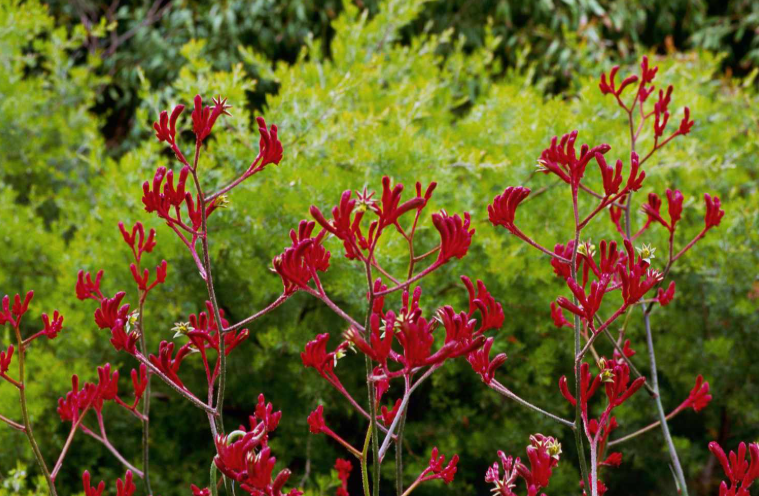
Kangaroo paw is one of the most instantly recognizable wildflowers in Australia, its tubular, velvet-coated blooms splitting open into curved claw-like fingers that genuinely resemble a small marsupial’s paw reaching up from the stem. Few flowers anywhere commit so completely to their common name, and fewer still manage to look this strange and this striking at the same time.
The plant belongs almost entirely to a single genus, Anigozanthos, which contains 11 described species, every one of them found nowhere else on Earth but the southwestern corner of Western Australia. A twelfth, closely related species, the black kangaroo paw, is distinctive enough to sit in a genus entirely of its own, Macropidia, sharing the same general flower form and common name while remaining botanically separate from its 11 cousins.
This guide covers the plant’s classification and discovery, how to identify it, its native range, its status as a state emblem, its unusual relationship with nectar-feeding birds, its cultural significance to Aboriginal Australians, and what it takes to grow one successfully.
Botanical Classification
Kangaroo paw belongs to the family Haemodoraceae, and the genus Anigozanthos comprises 11 recognized species along with numerous subspecies, all endemic to the southwest of Western Australia. The closely related black kangaroo paw, Macropidia fuliginosa, shares the same general flower structure and common name but is distinct enough botanically to warrant its own separate, single-species genus.
Common names within the group shift depending on the specific species’ size and flower shape: larger, more upright species are generally called kangaroo paw, while smaller species with more rounded flower clusters are called wallaby paw, a name that itself replaced the older term catspaw. Every species in both genera, with just one exception, carries a distinctive velvety texture across its flowers and flower stem, a fine covering of hairs that gives the blooms their genuinely fur-like appearance and feel.
Brief History
Kangaroo paw was first formally described in 1792 by Jacques-Julien Houtou de La Billardière, a French naturalist and botanist traveling with an exploratory expedition to the region. His work documenting the plant was part of a broader scientific record from that voyage, which also included detailed accounts of the lands and Aboriginal peoples the expedition encountered along the way.
The plant’s considerable visual distinctiveness made it an early favorite for description and collection among European naturalists working in the region, and it has remained one of the signature wildflowers associated with Western Australia ever since that first formal scientific account.
Breeding and cultivation interest picked up considerably over the following 2 centuries, particularly as florists and home gardeners outside Australia discovered the plant’s unusual form and long vase life. That interest eventually led to the development of numerous hybrid cultivars, many of them created specifically to combine the best ornamental traits of different wild species while improving on the disease resistance and garden performance of the straight species.
Identifying Characteristics
Kangaroo paw flowers grow in fan-like clusters attached to long, often branching stems rising well above the plant’s strappy, grass-like foliage. Each individual bloom is tubular at the base before splitting into curved, finger-like lobes at the tip, a shape that gives the plant its instantly recognizable, paw-like silhouette.
Size varies dramatically across the genus: in the largest species, leaves can grow up to a meter long and 5 centimeters wide, while the smallest species have leaves as short as 10 centimeters and barely a centimeter across, and flower stems in some species rarely exceed 20 centimeters in height, a scale difference considerable enough that the smallest and largest species in the genus can look almost unrelated at first glance. Flower color spans a considerable range too, including red, green, yellow, orange, and rare pink and burgundy tones, and the plant forms an underground rhizome, a modified stem, that allows some species to die back entirely to ground level each summer before resprouting the following autumn. That rhizome also lets an established clump survive periods when conditions above ground become too harsh for the leaves and flower stems to persist, storing the energy needed to regrow once favorable weather returns.
Native Range and Habitat
All 11 Anigozanthos species, along with the related black kangaroo paw, occur naturally only in the southwestern corner of Western Australia, a region recognized as a global biodiversity hotspot for exactly this kind of concentrated, highly localized plant diversity. Within that region, individual species occupy a range of specific habitats, from sandy coastal plains to drier inland woodland.
That narrow endemic range means the entire genus is found growing wild nowhere else on the planet, a genuinely significant botanical distinction shared by a considerable number of Western Australia’s other iconic native wildflowers.
A State Emblem
The red and green kangaroo paw, Anigozanthos manglesii, was formally proclaimed the floral emblem of Western Australia in October 1960, in a declaration made by the state’s premier at the time. That species was later incorporated directly into the state’s official Coat of Arms, a mark of genuine civic recognition extended to few other Australian native plants.
Today the flower appears widely across Western Australian branding and symbolism, including on postage stamps, and its distinctive red-and-green coloring makes it one of the most immediately recognizable state emblems anywhere in the country. Few other Australian wildflowers carry quite that same combination of formal government recognition and everyday public familiarity.
Pollination and the Search for Blue
Kangaroo paws rely almost entirely on nectar-feeding birds for pollination rather than insects, and species like honeyeaters and wattlebirds are the primary visitors responsible for carrying pollen between plants. Researchers studying the plant have found that pollination success drops sharply without reliable bird activity, underscoring just how specifically the flower’s shape and nectar reward have evolved around its avian pollinators rather than bees or other insects.
That bird-pollination strategy has also made true blue flower color a genuine rarity across the entire group, since blue pigmentation is notably uncommon among bird-pollinated flowers generally, a pattern seen across many unrelated plant families worldwide and not something unique to kangaroo paw alone. Researchers at Western Australia’s Kings Park Botanic Garden have spent years running a dedicated cross-pollination breeding program specifically aimed at developing a stable blue-flowered kangaroo paw, work that eventually produced a cultivar released under the name ‘Masquerade,’ a genuine breeding achievement given how rare true blue coloring is within this particular flower group.
Aboriginal Significance
Kangaroo paw holds real cultural significance for the Noongar people, the Aboriginal custodians of the southwestern Western Australian region where the plant grows wild. It’s known by several Noongar names, including Nollamara, Kurulbrang, and Yonga Marra, and it has traditionally been used in preparing medicine, reflecting a relationship with the plant that predates its European scientific description by many thousands of years.
That cultural connection runs considerably deeper than the plant’s more recent adoption as a state emblem or ornamental garden subject, and it reflects a continuous, living tradition of Noongar knowledge about the local landscape and its native flora passed down across many generations.
Landscape Uses
Kangaroo paw has become a popular garden plant well beyond its native range, valued for its striking, unusual flowers and its considerable appeal to nectar-feeding birds, a genuine way to encourage native bird activity in a home garden. It’s also widely used in both fresh and dried floral arrangements, since its sturdy, long-lasting blooms hold their color and shape well after cutting.
Many of the most successful garden cultivars are hybrids bred using Anigozanthos flavidus, the tall kangaroo paw, as one parent, since that species is notably adaptable to a wide range of soil and climate conditions and shows some natural resistance to the fungal disease that affects the genus more broadly. Patented cultivars like ‘Bush Ranger,’ a cross between dwarf and tall kangaroo paw parent species, and ‘Bush Emerald,’ a cross between green and red-and-green kangaroo paw species, have been specifically bred for improved disease resistance compared to their parent species.
Growing Considerations
Kangaroo paw performs best with a northern aspect and full sun, since plants that spend part of the day in shade bloom less prolifically and become considerably more prone to disease. The plants are not particularly demanding feeders, and a balanced fertilizer formulated for Australian native plants provides adequate nutrition without encouraging the kind of soft, disease-prone growth that heavier feeding can cause.
Mulching is generally discouraged around kangaroo paws, since traditional mulch materials tend to predispose the plants to the fungal disease that represents their single biggest cultivation challenge. Although kangaroo paws are technically perennial, most growers should expect to divide or replace plants every 3 to 5 years as older clumps decline, and the rare exception to the plant’s velvety texture, Anigozanthos viridis, lacks that characteristic hairy covering found across every other species in the genus.
Pests and Diseases
Ink disease, caused by the fungus Alternaria alternata, is the single most significant threat to cultivated kangaroo paws, producing black discoloration on the leaf tips that progressively spreads into the plant’s rhizome and eventually kills it outright. Plants growing in cool, moist climates are considerably more susceptible, and the disease is notoriously difficult to treat once it takes hold, which is why prevention through good drainage, strong air circulation, and avoiding excess moisture matters more than any treatment applied after symptoms appear.
Root and stem rot caused by Pythium and Phytophthora pathogens represent a further disease risk, and snails are drawn to the foliage as well, making regular inspection of new growth a worthwhile habit for anyone growing the plant seriously. In 2007, Kings Park Botanic Garden launched a dedicated breeding program specifically aimed at developing kangaroo paw varieties with stronger disease resistance and better resilience to a changing climate, reflecting just how seriously disease pressure is taken within the plant’s own native growing region. The disease has also spread well beyond Australia, with an outbreak documented on cultivated kangaroo paw plants in Okinawa, Japan, in 1990.
The Bottom Line
Kangaroo paw earns its place among Australia’s most beloved native wildflowers through genuine visual drama, a flower shape found nowhere else in the plant world, a deep cultural history with the Noongar people that predates European settlement by millennia, and an entire evolutionary strategy built around the birds that pollinate it rather than the insects most garden flowers depend on. Give it full sun, sharp drainage, and a watchful eye for ink disease, and this unmistakably Australian flower will reward you with a bloom unlike anything else in the garden.